Reflections by Dr. Gregory Klages on non-fiction books dealing primarily with politics, history, and religion. Significant attention to Canadian content. Mail me/comment if you read anything. I love to hear feedback!
Monday, 13 February 2012
Max and Monique Nemni, "Trudeau Transformed: The Shaping of a Statesman 1944-1965" (2011)
The second-volume of this Trudeau biography series came as a bit of a surprise to me. I read the first volume (Young Trudeau, 1919-1944: Son of Quebec, Father of Canada (2006) - sheesh, what a title!), but frankly, have forgotten it almost completely. The approach in this second volume, however, strikes me as a departure from the previous one. It is, in many respects, an intellectual history; a record of the development of Trudeau's philosophy, arrived at through close analysis of his published, and some unpublished, writing. The Nemni's make a good attempt to place the material within the context of the political events within (and beyond) Quebec, as well as showing how Trudeau's ideas fit within or contrasted with philosophic trends, once again, particularly within Quebec.
The first few chapters are rather surprising. They offer a very close analysis of Trudeau's notes and letters from the late 1940s, when he was studying at Harvard, Paris' "Sciences Po", and the London School of Economics. What might be quite boring offers intriguing insights into the evolution of Trudeau's thinking has he is exposed to a variety of challenging thinkers and texts. The Nemnis suggest that popular characterizations of Trudeau's influences during this period (such as Keynes and Schumpeter) are inaccurate. While their explanations of each thinkers' ideas is a little off-putting, it is more or less required to help tie the concepts advanced by the thinkers to Trudeau's responses to them.
The most significant weakness of the book is that in an attempt to trace the development of Trudeau's changing (or consistent) position on issues such as Quebec nationalism, justice, and democracy, the authors have opted (and in a sense are required) to jump from period to period, from event to event, from article to article, and then, to jump back and forth again to trace development of some other idea. In a following chapter, they'll return to an event discussed previously, to touch on another aspect of Trudeau's thinking, or refer back to it to clarify how it relates to some other event from the period that they didn't discuss. This form of historical hopscotch is a little frustrating.
Additionally, the authors will engage in a few unnecessary asides that seem more suitable to an undergraduate essay rather than an opus on one of our most contentious Prime Ministers. These quips are not particularly stinging, however, and rare enough that they can be forgiven.
In conclusion, this volume is a particularly useful record of the development of Trudeau's thoughts. It places many of the essays in long-available compilation volumes such as Federalism and the French Canadians (1968) in their philosophic and political context, and is an enjoyable read. While the structure is awkward, this is an admirable effort.
Labels:
biography,
book reviews,
Canadian history,
Canadian politics,
philosophy
Monday, 6 February 2012
Andrew Hussey, "The game of war: the life and death of Guy Debord" (2001)
I'm torn about this book. While reading it I was distracted by Hussey's interjection of personal anecdotes regarding his drinking interviews with Debord associates. These smacked of insecurity, as if Hussey was desperate to assure us that he was 'cool' enough to wander Paris' Left Bank, to share cognac with Alice Becker-Ho, and to mix comfortably and confidently with these notoriously catty theoreticians and revolutionaries.
On the other hand, his explication of Debord's theories at times was rather simplistic. For the common reader, this would be helpful, though I can't help but wonder how many 'common' readers were likely to pick such a book up?
In short, Game of War was akin to an extended Rolling Stone biography. Pithy, loaded with personal insights, and light on philosophical and political insights. I can say, however, that I had never known that Debord once opened a bar in Paris, and designed advertising for the bar before he became involved as a co-manager.
As an addendum, particularly given the title of this book I was disappointed to find that Hussey did not offer a translation (or really even a mention) of Debord's 1987 text that outlined the rules for the kriegspiel he invented (the only version of the text that I have found was the translation in Len Bracken's Guy Debord: Revolutionary, and frankly, the editing quality of that volume was so bad that I can't help but regard anything in the book as being a bit dodgy). As Hussey discusses Debord and Becker-Ho wiling away many days playing this game, and suggests the game was a metaphor in some ways for Debord's later thinking about politics and revolution, this oversight feels significant.
Labels:
art history,
biography,
book reviews,
European history,
French history,
philosophy
Thursday, 29 December 2011
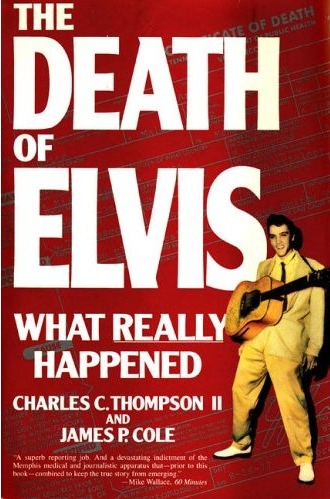
James P. Cole, "The Death of Elvis: What Really Happened?" (1991)
Ever since the early 1990s, when I was researching an article on Elvis' death for my university newspaper, I have found the death of the 'king of rock'n'roll' pretty fascinating. At the time, my interest was spurred by the conclusions of the rather inflated sounding Elvis Presley Commission. This book seems to be generally regarded as one of the less biased, and better researched texts on the topic.
While the book generally presents a fairly convincing case, it is written in the kind of 'crime thriller' rhetoric that intends to make the process of research (conducting interviews and archival digging) more exciting. I have to admit that the process was exciting, in that much of the research was conducted as part of a respected American investigative news program, and/or as part of a legal proceedings growing out of the program's work. Attempts by the authors to occasionally describe their participant's behaviour, or characterizations of what these persons were thinking sometimes rang as amateurish.
In short, the book provides a nice introduction to some of the issues around Presley's death, and given the descriptions of expert testimonies in legal proceedings, helps to build a strong case for the proposal that Presley died of a drug overdose or, at the very least, drug-related causes.
Labels:
book reviews,
rock music history,
U.S.A. history
Frances Widdowson & Albert Howard, "Disrobing the Aboriginal Industry" (2008)
The subtitle for this book is "The Deception Behind Indigenous Cultural Preservation."
This book is tough to read. Widdowson and Howard are not gentle in their criticism of aboriginal activists, government negotiators, academics, and the sundry hangers-on that speak in favour of a mythical 'golden' state of nature for aboriginals, and economic, social, and political solutions for contemporary Canadian problems based on that 'golden' myth.
More to follow.
Labels:
book reviews,
Canadian history,
Canadian politics,
racism
Thursday, 22 December 2011
Alexandra Highcrest, "At Home On The Stroll" (1997)
The subtitle of this book clarifies what it is really about: "My Twenty Years As A Prostitute In Canada."
In short, the story of a northern Ontario boy who moves to Toronto, begins working as a prostitute, finds the life not particularly objectionable (especially the money), makes some friends, conflicts with family, deals with some bad tricks, begins to experiment with living as a woman, leaves the trade, becomes an advocate. An intriguing story that doesn't wallow in polemicizing about the evils of prostitution, or preaching the virtues of liberal live-and-let-live economics. It is one person's story, one person's analysis, and a very humane one at that.
Belinda Beaton has written a very good review of this book in Books in Canada.
Labels:
book reviews,
Canadian politics,
prostitution
Vincent Bugliosi, "Reclaiming History: The Assassination of President John F. Kennedy" (2007)
I worked on Bugliosi's epic (more than 1,500 pages, as well as a full CD of notes and sources) on and off from 2008 through to the end of 2011 (more off than on, I'll admit). It is compelling, if at times annoying, reading. It is to be expected that anyone who treads into such a storied and controversial subject will anger many, and 'speak truth' to others. Bugliosi gives short shrift to the abundant conspiracy theorists. He denies, flat out and without any apology, the prospect of any conspiracy being involved in JFK's death. He attacks, sometimes in quite vitriolic terms, the arguments and even sometimes the reputations of many conspiracy theorists.
Bugliosi has an impressive history as an American prosecutor. He successfully tried, for instance, Charles Manson. In the 1980s, he was hired by a British media firm to engage in a mock trial of Lee Harvey Oswald. The budget for the project was fairly large, and resulted in something close to 15 hours of television. Bugliosi's preparation for the case likely forms the foundation for this book.
Part of what makes Reclaiming History so compelling is simply the weight... or should I say, the volume... of the text itself. It's hard to argue with a book that offers such a comprehensive, overwhelming amount of text, and that appears to be based on an exhaustive search of primary and secondary documents related to the case. Bugliosi also, like a good prosecutor would, not only provides an overview of what he understands the events related to the case to be, but devotes chapters to demolishing a multitude of positions related to conspiracy proposals, including questions regarding Oswald's ownership of the gun used for the assassination, sightings of other shooters, irregularities of the autopsy, etc. For this, the book's encyclopedic coverage is tremendously useful.
Bugliosi's writing style is - to be kind - indulgent. The text often wades into annoying rhetorical questions, petty name-calling, and unnecessary speculation about other authors' motivations. The worst chapter for such indulgence is the second-last, which explores Oliver Stone's film, JFK, in depth. With much of the rhetoric and excess excised (something a good editor could and should have done, if they could have gotten through the whole of the text in less than a year) the book would have run to perhaps a far more manageable 1,000 pages.
The length of the text is its central shortcoming for casual readers. The book is not for the faint of heart, nor for the weak of arm. For those with a deep interest in the Kennedy assassination, you will get what you most need in the first ten chapters or so. Some may also find it useful to read the chapter devoted to the film JFK.
Bryan Burrough wrote a very good review of Reclaiming History for the 20 May 2007 New York Times:
http://www.nytimes.com/2007/05/20/books/review/Burrough-t.html
You can watch or read the FORA.tv transcript of a 2007 talk by Bugliosi on the book:
http://fora.tv/2007/05/15/Vincent_Bugliosi_Reclaiming_History
Saturday, 3 December 2011
Joseph E. Stiglitz & Linda J. Bilmes, "The Three Trillion Dollar War" (2008)
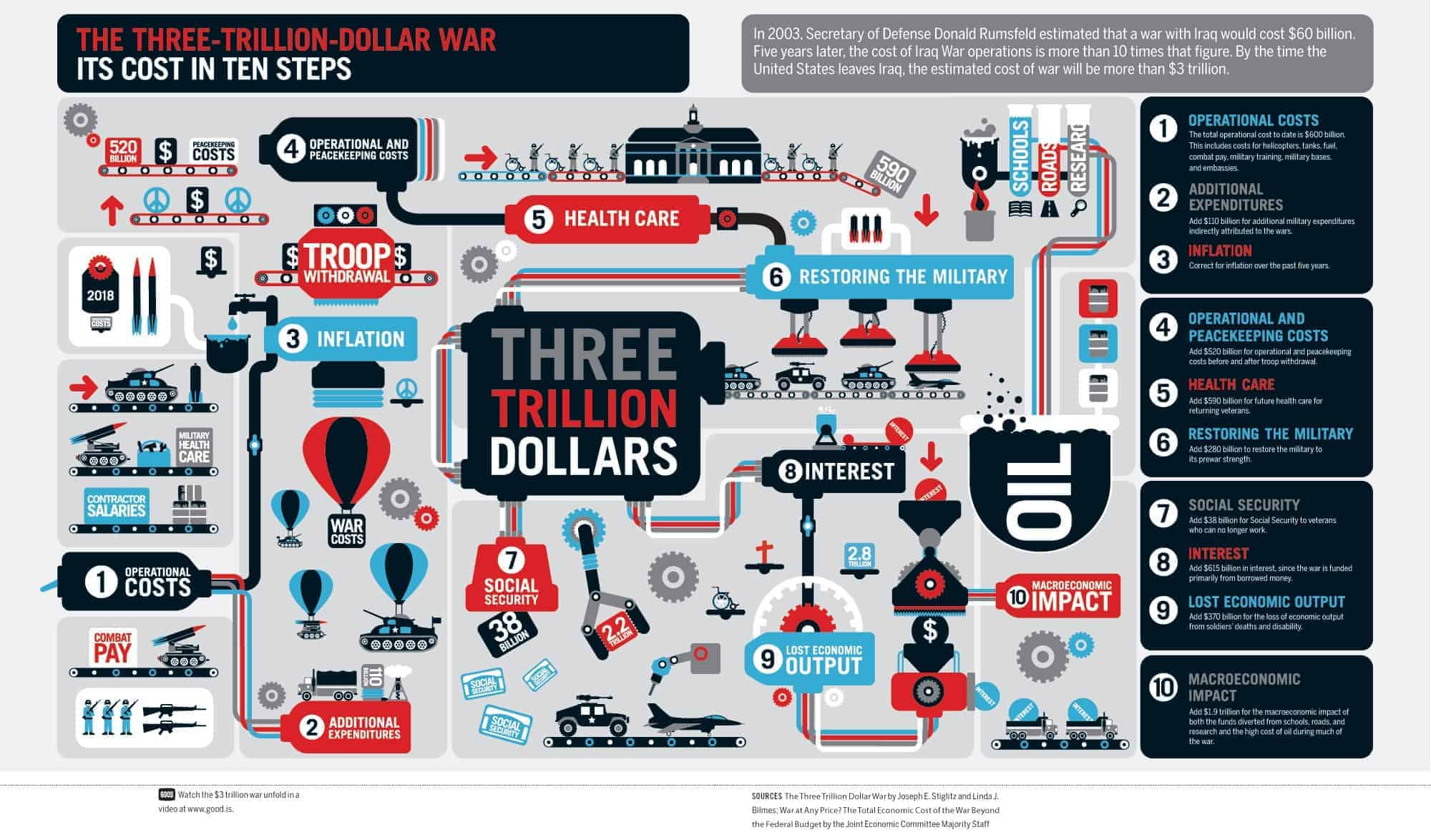
The full title of Stiglitz and Bilmes' much talked about book is The Three Trillion Dollar War: The True Cost of the Iraq Conflict. The central idea they propose in the book is that the way the costs of the war were discussed, by the great unwashed masses, the US government, and the US military, is wildly misleading, either by intention or error. They propose, through using a form of what I will call forensic auditing - for lack of a term I know that will be more correct - to identify heretofore hidden costs of the war, costs of the war that have not been discussed or built into short and long-term US national budgeting, and incidental or related costs of the war that do not go reported in calculations claiming to capture the cost of the war.
A decent, though cursory, outline of the types of costs the book analyses are laid out here:
http://dailyinfographic.com/wp-content/uploads/2011/01/threetrilliondollarwar.jpeg
Excerpts from the book can be read at:
National Public Radio, USA (NPR) - http://www.npr.org/templates/story/story.php?storyId=87855957
Vanity Fair, Apr. 2008 - http://www.vanityfair.com/politics/features/2008/04/stiglitz200804
Labels:
economics,
Middle East,
military,
U.S.A. history
Subscribe to:
Posts (Atom)