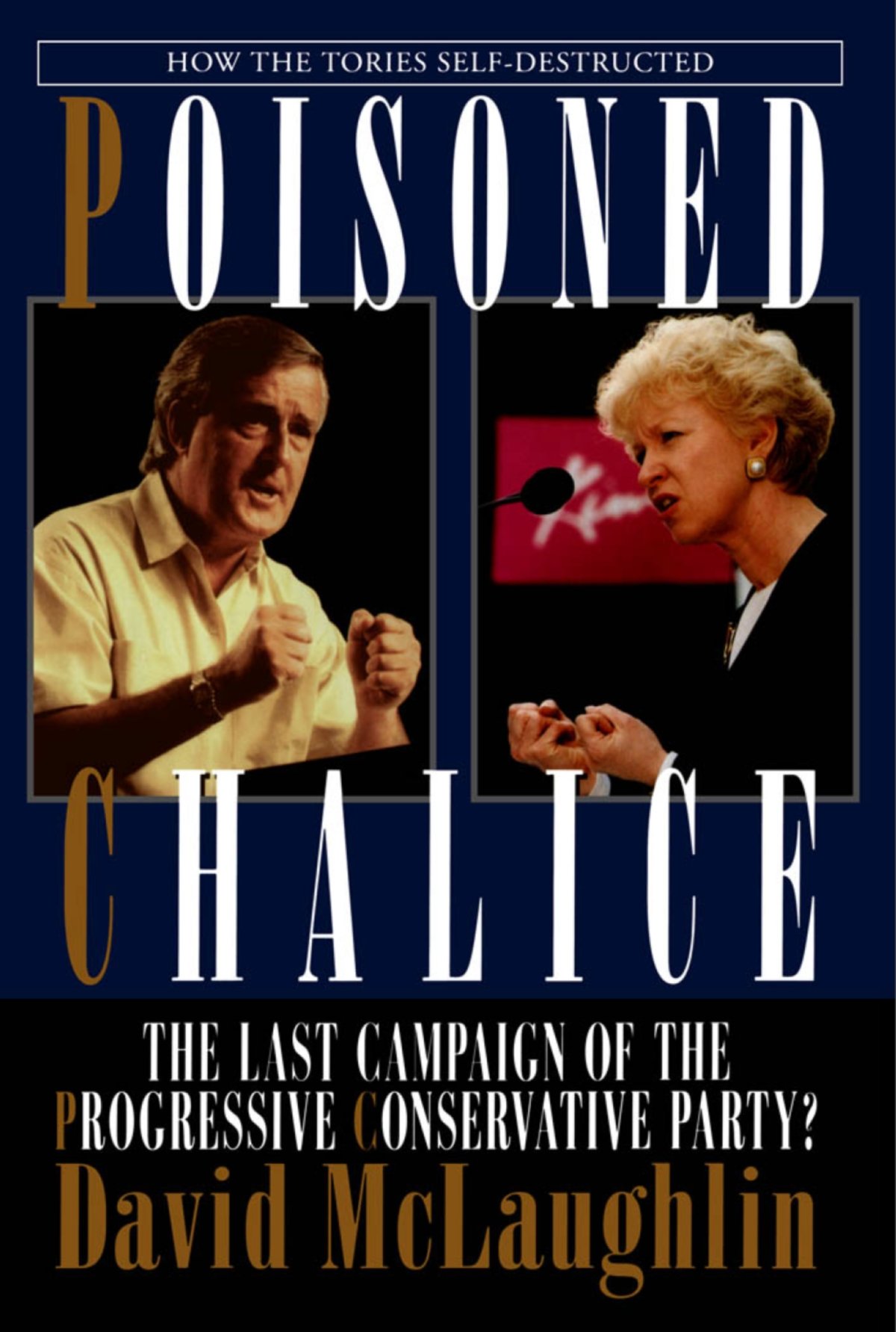
Subtitle: "The Last Campaign of the Progressive Conservative Party?"
McLaughlin wrote a fascinating insider's tale of how the federal Progressive Conservative Party of Canada firstly decided on Kim Campbell as the replacement for outgoing, highly controversial Prime Minister Brian Mulroney, making Campbell Canada's first female Prime Minister, and secondly, how the CPC and Campbell's soon-to-follow election campaign resulted in the utter and complete decimation of the party in the polls.
As most Canadians know, the rhetorical question used as the sub-title for McLaughlin's book was soon answered. Within a decade the Progressive Conservative Party had been essentially colonized and folded into it's former challenger, the Reform/Alliance party, and renamed as the Conservative Party of Canada. By the mid-2000s, the CPC would govern Canada for at least a decade. How things change.
As an insider to the events he narrates, McLaughlin includes fascinating snippets of the day-to-day strangeness out of which the Campbell leadership and election campaigns were built upon. Some of his stories smack of honesty that many of his peers might not have wanted aired publicly, particularly when the PCPC might still have harboured hope to survive into the late 1990s.
Along with providing insights into Campbell's personality, the book also provides useful insights into how federal politics operates in Canada (and how it a federal party can operate poorly). For those interested in Canadian politics, Poisoned Chalice also provides a useful set of crib notes on the emerging lights in Canada's then-'conservative' political community, from Hugh Segal to Jean Charest… figures who would in the 2000s be critical points of reference for Canada's political observers.
Reflections by Dr. Gregory Klages on non-fiction books dealing primarily with politics, history, and religion. Significant attention to Canadian content. Mail me/comment if you read anything. I love to hear feedback!
Showing posts with label Canadian history. Show all posts
Friday, 25 September 2015
Saturday, 18 July 2015
Kevin Lippert, "War Plan Red" (2015)
Subtitle: "The United States' Secret Plan to Invade Canada and Canada's Secret Plan to Invade the United States."
More notes to follow soon.
Lippert's book is disappointingly brief for such a provocative concern. Essentially, he provides a fairly basic outline of Canadian-American relations since the early 1800s, highlighting armed conflicts ranging from all-out wars (War of 1812), to silly skirmishes over concerns such as ownership of a pig.
Much of Lippert's focus is on a rather fanciful Canadian plan for how it might invade the United States if circumstances ever compelled it. This feint - which hardly lives up to the promise of the book's title - was primarily intended as a delaying tactic by which Canada might dampen US enthusiasm for invasion, and destabilize US plans to assault Canada if Canada was ever able to safely and reasonably conclude it was about to be invaded by the United States. That Canada would attempt a pre-emptive invasion of the United States is a stretch of imagination, which is likely one of the reasons Lippert's book takes a rather light-hearted approach to the idea of war between the two countries.
His assessment of US plans to invade Canada are unnecessarily similarly light. Given the traditional dynamics between the two countries, that the US had plans to occupy Canada - from Manifest Destiny onwards - and that it had the capacity to do so (as if physical invasion was even really necessary after NAFTA) would seem reason to approach the idea with more circumspection.
More notes to follow soon.
Lippert's book is disappointingly brief for such a provocative concern. Essentially, he provides a fairly basic outline of Canadian-American relations since the early 1800s, highlighting armed conflicts ranging from all-out wars (War of 1812), to silly skirmishes over concerns such as ownership of a pig.
Much of Lippert's focus is on a rather fanciful Canadian plan for how it might invade the United States if circumstances ever compelled it. This feint - which hardly lives up to the promise of the book's title - was primarily intended as a delaying tactic by which Canada might dampen US enthusiasm for invasion, and destabilize US plans to assault Canada if Canada was ever able to safely and reasonably conclude it was about to be invaded by the United States. That Canada would attempt a pre-emptive invasion of the United States is a stretch of imagination, which is likely one of the reasons Lippert's book takes a rather light-hearted approach to the idea of war between the two countries.
His assessment of US plans to invade Canada are unnecessarily similarly light. Given the traditional dynamics between the two countries, that the US had plans to occupy Canada - from Manifest Destiny onwards - and that it had the capacity to do so (as if physical invasion was even really necessary after NAFTA) would seem reason to approach the idea with more circumspection.
Friday, 3 July 2015
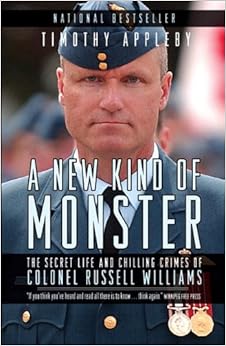
Timothy Appleby, "A New Kind of Monster" (2011)
Subtitle: "The Secret Life and Chilling Crimes of Colonel Russell Williams."
This 'true crime' book documents the many crimes committed by a well-respected, high-ranking member of Canada's military. It is a relatively easy, although certainly disturbing, read. Appleby refrains from wading into 'pop psychology' to explain Williams' behaviour, concentrating instead on narration.
Here's a link to the publisher's webpages for the book.
This 'true crime' book documents the many crimes committed by a well-respected, high-ranking member of Canada's military. It is a relatively easy, although certainly disturbing, read. Appleby refrains from wading into 'pop psychology' to explain Williams' behaviour, concentrating instead on narration.
Here's a link to the publisher's webpages for the book.
Labels:
biography,
book reviews,
Canadian history,
law,
mental health,
military,
true crime
Wednesday, 1 July 2015
Stephen Williams, "Karla: A Pact with the Devil" (2003)
It's hard to offer any new insights on the sordid and tragic tale of sexual assaults and murders conducted by Paul Bernardo and Karla Homolka. In 2003, when this book was written, Williams was able to provide some new insights into the case, as well as Karla's state of mind in prison. Although he is evasive in the book, Williams apparently opened a mail conversation with her, while also seeking out interviews with a multitude of other people involved in the case.
The book plots out the legal prosecution of Karla Homolka, and explains the development of the plea bargain that would result in her serving much shorter jail time than she might otherwise face in exchange for testifying against her husband. Williams seems to want to tell the valid, but hard to integrate story of bureaucratic bungling in prosecuting Homolka (and Bernardo), along with a sympathetic telling of Homolka's suffering at the hands of a penal and justice system that approached her in a harsher fashion than other inmates guilty of similar crimes. In short, Williams seems to want to tell us that Karla is a criminal that deserved a worse sentence, but having reached a plea bargain, deserved to relish the terms she had been given by the state.
Williams lives in the region from which I grew up, and I wanted to enjoy this book, despite the story it tells. The tale he tells has all the hallmarks of a great work: internationally noteworthy crime, nationally much-discussed and controversial plea bargain, and suggestions of investigative and prosecutorial shortcomings. I found myself distracted by Williams rather awkward story-telling, and the poor editing of the book. Williams seems to fancy himself a cross between Truman Capote and Hunter S. Thomson. He blends comments on his own adventures, the food he's dining on and the company he keeps, with specious psychological analysis of the people he writes about. He makes an unfortunately showy love of vocabulary that I suspect serves to distance most readers, rather than impress them. I can only explain his strategy as a product of fearing his topic pandered to the stereotypical 'true crime' reader, and so sought to elevate his authorial persona with language he felt might better reflect his elevated intelligence. I found it more pompous and off-putting than appealing.
Quotations, and Gregory Klages' notes:
Chapter 7 - Cancer
"...post-traumatic stress disorder and its symptoms were fully extrapolated in a book by Arthur Kardiner, first published in 1941, called The Neuroses of War."
Chapter 9 - The Wedding Planner
"…[Karla] had seen a television program about how Italian men frequently live with their mothers until they are in their fifties. That might have explained it — Paul Bernardo was of Italian descent — but in the television program all the men really loved their mothers and Paul hated his and he wasn’t just saying it either and Karla could understand why."
NOTE: This sort of run-on sentence helps to establish a certain 'voice' for Karla. If it reflects her actual voice in the letters, wouldn't it have been more useful to actually use her words? I suppose this is part of the challenge of writing a textual conversation: if the author doesn't intervene, they become irrelevant. With too much intervention, the text becomes more about them than it does about the topic.
Chapter 22 - Deciphering Code
"Not to mention the anti-psychiatry, such as the idea that Karla was a malingering, histrionic hybristophiliac, developed for Bernardo’s defense team by Dr. Graham Clancy."
NOTE: If the average reader needs to check a dictionary more than once in a sentence, particularly when reading a pulp 'true crime' story, it should be a sign for concern.
Chapter 23 - The Man with Whom the Buck Stops
"And as Murray Segal said in this February 1995 letter to George Walker, they would continue to do exactly."
NOTE: End of sentence?… where are you?
Chapter 26 - A Propensity to Lie
"He was arraigned the next day, and held without bail for months even though Inspector Bevan’s charges on the murder charges had been thrown out."
NOTE: Editor? Did you disappear with the end of the sentence above?
Chapter 27 - The Fine Art of Adjudication
"What is now abundantly clear is that Michael Code’s ultimate decision not to charge Karla with respect to the repeated heinous attacks on Jane Doe, and the subsequent grant of blanket immunity, whereby, theoretically, he reinforced her “credibility” as an “accomplice witness,” has done nothing to maintain the public confidence in the administration of Justice — quite the opposite — but that consideration was clearly not the most important on Michael Code’s list. Although there are many facts and arguments to the contrary, which I tried to press on him time and again, he stubbornly asseverated that any prosecution of Karla Homolka would have put the successful prosecution of Paul Bernardo for first-degree murder at great risk. To him, Karla was by far the lesser of two evils, and was not then and is not now a danger to society."
NOTE: The quotation above is a fine example of all of the primary problems with this book.
"We did, however, agree on two other things. Karla should have been released on her statutory date, and that the prison officials far exceeded their mandate and their role when they detained her."
Chapter 30 - Macabre Cynicism
"On the surface, it seems lucid and logical but its observations and remarks are repetitive and pleonastic, as though they were uncomfortable with their subject matter, their decision and the basis on which it was made."
Chapter 31 - Back to the Future
"...doing time does something to one’s sense of time. You pass through it as though it is a vast mucilaginous bubble, emerging three months later none the wiser, feeling as though only three or four days have gone by."
NOTE: Hmmmm… is this Williams speculating, speaking from experience, or sharing Homolka's confidences? We'll never know.
"Understandably, this pecuniary redemption would ameliorate behavior and provide relief from stress and deliver some good old-fashioned middle-class stability."
The book plots out the legal prosecution of Karla Homolka, and explains the development of the plea bargain that would result in her serving much shorter jail time than she might otherwise face in exchange for testifying against her husband. Williams seems to want to tell the valid, but hard to integrate story of bureaucratic bungling in prosecuting Homolka (and Bernardo), along with a sympathetic telling of Homolka's suffering at the hands of a penal and justice system that approached her in a harsher fashion than other inmates guilty of similar crimes. In short, Williams seems to want to tell us that Karla is a criminal that deserved a worse sentence, but having reached a plea bargain, deserved to relish the terms she had been given by the state.
Williams lives in the region from which I grew up, and I wanted to enjoy this book, despite the story it tells. The tale he tells has all the hallmarks of a great work: internationally noteworthy crime, nationally much-discussed and controversial plea bargain, and suggestions of investigative and prosecutorial shortcomings. I found myself distracted by Williams rather awkward story-telling, and the poor editing of the book. Williams seems to fancy himself a cross between Truman Capote and Hunter S. Thomson. He blends comments on his own adventures, the food he's dining on and the company he keeps, with specious psychological analysis of the people he writes about. He makes an unfortunately showy love of vocabulary that I suspect serves to distance most readers, rather than impress them. I can only explain his strategy as a product of fearing his topic pandered to the stereotypical 'true crime' reader, and so sought to elevate his authorial persona with language he felt might better reflect his elevated intelligence. I found it more pompous and off-putting than appealing.
Quotations, and Gregory Klages' notes:
Chapter 7 - Cancer
"...post-traumatic stress disorder and its symptoms were fully extrapolated in a book by Arthur Kardiner, first published in 1941, called The Neuroses of War."
Chapter 9 - The Wedding Planner
"…[Karla] had seen a television program about how Italian men frequently live with their mothers until they are in their fifties. That might have explained it — Paul Bernardo was of Italian descent — but in the television program all the men really loved their mothers and Paul hated his and he wasn’t just saying it either and Karla could understand why."
NOTE: This sort of run-on sentence helps to establish a certain 'voice' for Karla. If it reflects her actual voice in the letters, wouldn't it have been more useful to actually use her words? I suppose this is part of the challenge of writing a textual conversation: if the author doesn't intervene, they become irrelevant. With too much intervention, the text becomes more about them than it does about the topic.
Chapter 22 - Deciphering Code
"Not to mention the anti-psychiatry, such as the idea that Karla was a malingering, histrionic hybristophiliac, developed for Bernardo’s defense team by Dr. Graham Clancy."
NOTE: If the average reader needs to check a dictionary more than once in a sentence, particularly when reading a pulp 'true crime' story, it should be a sign for concern.
Chapter 23 - The Man with Whom the Buck Stops
"And as Murray Segal said in this February 1995 letter to George Walker, they would continue to do exactly."
NOTE: End of sentence?… where are you?
Chapter 26 - A Propensity to Lie
"He was arraigned the next day, and held without bail for months even though Inspector Bevan’s charges on the murder charges had been thrown out."
NOTE: Editor? Did you disappear with the end of the sentence above?
Chapter 27 - The Fine Art of Adjudication
"What is now abundantly clear is that Michael Code’s ultimate decision not to charge Karla with respect to the repeated heinous attacks on Jane Doe, and the subsequent grant of blanket immunity, whereby, theoretically, he reinforced her “credibility” as an “accomplice witness,” has done nothing to maintain the public confidence in the administration of Justice — quite the opposite — but that consideration was clearly not the most important on Michael Code’s list. Although there are many facts and arguments to the contrary, which I tried to press on him time and again, he stubbornly asseverated that any prosecution of Karla Homolka would have put the successful prosecution of Paul Bernardo for first-degree murder at great risk. To him, Karla was by far the lesser of two evils, and was not then and is not now a danger to society."
NOTE: The quotation above is a fine example of all of the primary problems with this book.
"We did, however, agree on two other things. Karla should have been released on her statutory date, and that the prison officials far exceeded their mandate and their role when they detained her."
Chapter 30 - Macabre Cynicism
"On the surface, it seems lucid and logical but its observations and remarks are repetitive and pleonastic, as though they were uncomfortable with their subject matter, their decision and the basis on which it was made."
Chapter 31 - Back to the Future
"...doing time does something to one’s sense of time. You pass through it as though it is a vast mucilaginous bubble, emerging three months later none the wiser, feeling as though only three or four days have gone by."
NOTE: Hmmmm… is this Williams speculating, speaking from experience, or sharing Homolka's confidences? We'll never know.
"Understandably, this pecuniary redemption would ameliorate behavior and provide relief from stress and deliver some good old-fashioned middle-class stability."
Tuesday, 30 December 2014
Justin Trudeau, "Common Ground" (2014)
Notes will follow, eventually.
Pg. 119 - "...the blogger, who had been telling his readers I was destined for failure, gave me a respectful nod on his website for taking the time to answer his questions. This was a small thing... but it reinforced my belief that today's activists and supporters expect and deserve direct engagement through the digital media."
Pg. 152 - With regard to progress on issues related to Canada's relationship to First Nations' peoples: "With the notable exception of Paul Martin, who through the Kelowna Accord created a framework and principles to tackle so many of these problems... significant progress has eluded most of our prime ministers."
Pg. 185 - A "First Nations prayer" that Justin Trudeau read at his brother's funeral:
O Great Spirit whose voice I hear in the winds, and whose breath gives life to all the world, hear me.
I stand before you: one of your many children,
I am small and weak; I need your strength and wisdom.
Let me walk in beauty, and make my eyes ever behold the red and purple sunset.
Make my hands respect the things you have made, my ears sharp to hear your voice.
Make me wise so that I may understand the things you have taught my people.
Let me learn the lessons you have hidden in every leaf and rock.
I seek strength, not to be greater than my brothers, but to fight my greatest enemy, myself.
Make me always ready to come to you with clean hands and straight eyes,
So when life fades, as the fading sunset, my spirit may come to you without shame.
For those interested in this book, you might also read my comments on related titles:
- Peter Newman, When the Gods Changed: The Death of Liberal Canada
- Michael Ignatieff, Fire and Ashes: Success and Failure in Politics
- Lawrence Martin, Harperland
- Brian Topp, How We Almost Gave the Tories the Boot
Tuesday, 9 December 2014
Wayne Larsen, "Tom Thomson: Artist of the North" (2011)
Larsen's book is a brief, easy-to-read summary of many popular stories regarding the life of Canadian landscape painter Tom Thomson, who died in Ontario's Algonquin Park during the summer of 1917, under what has become described as 'mysterious circumstances'.
The book, as part of the Dundurn Press Quest Biography series, was conceived to appeal primarily to high school/junior undergraduate readers. This is important to note in evaluating Larsen's work. It is a basic form of biographical summary, written in clear and accessible language. He has not waded deeply into archival resources, and seems to have likely derived most - if not all - of the book from secondary sources.
The book is a fine introduction to Thomson's life, and certainly better than some biographies. That being said, it is not particularly demanding on the reader, and doesn't serve to challenge or question much of the hagiographic treatments of Thomson traditionally offered.
You can listen to a 2011 interview with Larsen here.
The book, as part of the Dundurn Press Quest Biography series, was conceived to appeal primarily to high school/junior undergraduate readers. This is important to note in evaluating Larsen's work. It is a basic form of biographical summary, written in clear and accessible language. He has not waded deeply into archival resources, and seems to have likely derived most - if not all - of the book from secondary sources.
The book is a fine introduction to Thomson's life, and certainly better than some biographies. That being said, it is not particularly demanding on the reader, and doesn't serve to challenge or question much of the hagiographic treatments of Thomson traditionally offered.
You can listen to a 2011 interview with Larsen here.
Tuesday, 14 October 2014
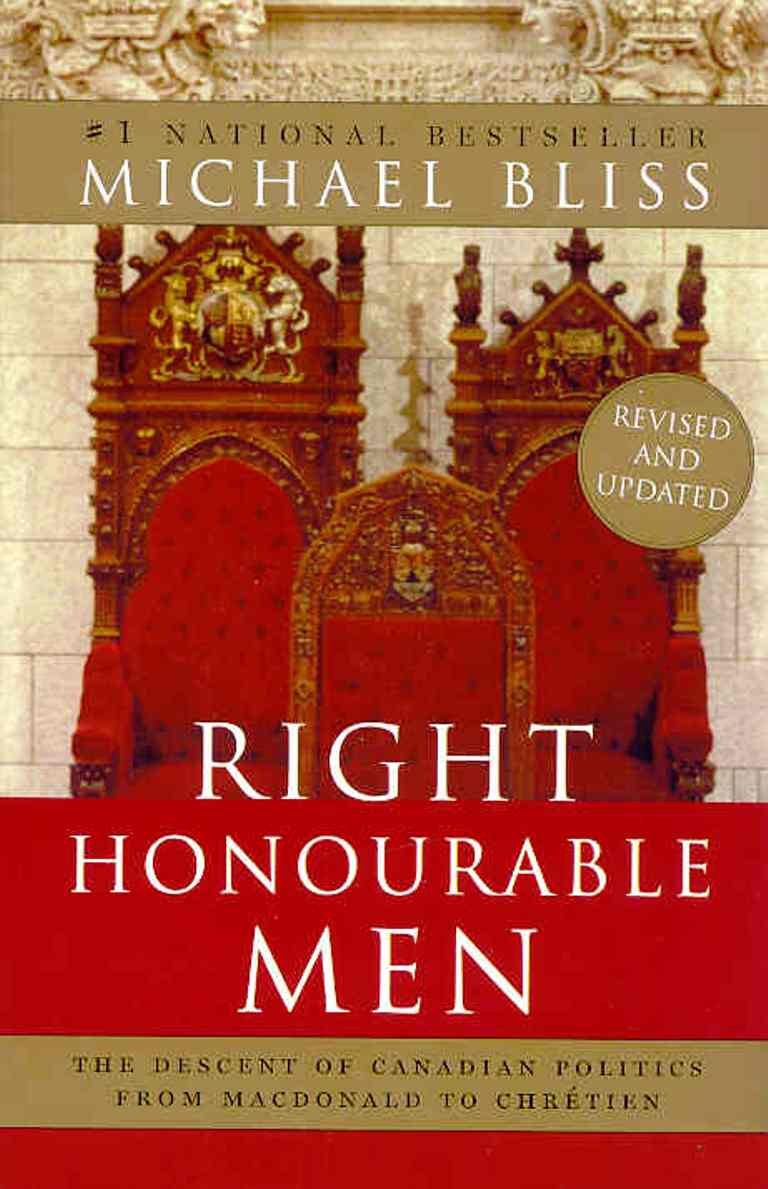
Michael Bliss, "Right Honourable Men" (1996, rev. 2004)
Subtitle: "The Descent of Canadian Politics from Macdonald to Chrétien".
Bliss presents a selective history of the men he regards as the most noteworthy Canadian Prime Ministers. His commentaries primarily reflect on these men's time as political leaders, exploring their campaigns, the decisions they made, and evaluating their successes and failures.
There are few surprises in the book, if you already have a decent grasp of Canada's political history. If not, Bliss writes an eminently readable book. It is more substantive than the average 'curiosity' reader probably wants, and perhaps a bit light for the academic reader. It would be ideal for a junior undergraduate course text.
Read a sample here.
You might also compare my comments on Bliss' book with those I've offered on Bruce Hutchison's Mr. Prime Minister: 1867-1964, a similar book written in 1965.
Bliss presents a selective history of the men he regards as the most noteworthy Canadian Prime Ministers. His commentaries primarily reflect on these men's time as political leaders, exploring their campaigns, the decisions they made, and evaluating their successes and failures.
There are few surprises in the book, if you already have a decent grasp of Canada's political history. If not, Bliss writes an eminently readable book. It is more substantive than the average 'curiosity' reader probably wants, and perhaps a bit light for the academic reader. It would be ideal for a junior undergraduate course text.
Read a sample here.
You might also compare my comments on Bliss' book with those I've offered on Bruce Hutchison's Mr. Prime Minister: 1867-1964, a similar book written in 1965.
Labels:
biography,
book reviews,
Canadian history,
Canadian politics,
Quebec
Monday, 22 September 2014
Sam Sutherland, "Perfect Youth" (2012)
Subtitle: "The Birth of Canadian Punk."
Sutherland weaves a nice series of anecdotal tales culled from the memories of the Canadian punks who were "there" during the emergence of Canada's punk scene in the mid-to-late 1970s. His dogged determination in tracking down people who have left behind their punk roots (some to enter the sanctified realm of boardrooms, some to continue to struggle along in the music biz, and other who have simply moved to struggling...) is admirable and produces real insights into an era that is hard to source.
Sutherland's love of the subject, and of researching his subject, comes across in his writing. It is neither hagiography or shock journalism. It is simple and compassionate story-telling at its best. He conveys the spirit of the people, as well as of the music these people made, which is difficult to find. In this regard, Sutherland does a real service in providing something akin to a shopping list for those who want to find out more about Canadian punk, lends impetus to the effort to preserve these works and extend access to them, and increase awareness of the strong and important influence these bands had within their respective hometowns and (much to my surprise) internationally.
The book was received quite positively by critics, as can be seen in this National Post review, or one in Maclean's, this NOW magazine interview with Sutherland, or a similar author interview in Vice magazine.
Sutherland weaves a nice series of anecdotal tales culled from the memories of the Canadian punks who were "there" during the emergence of Canada's punk scene in the mid-to-late 1970s. His dogged determination in tracking down people who have left behind their punk roots (some to enter the sanctified realm of boardrooms, some to continue to struggle along in the music biz, and other who have simply moved to struggling...) is admirable and produces real insights into an era that is hard to source.
Sutherland's love of the subject, and of researching his subject, comes across in his writing. It is neither hagiography or shock journalism. It is simple and compassionate story-telling at its best. He conveys the spirit of the people, as well as of the music these people made, which is difficult to find. In this regard, Sutherland does a real service in providing something akin to a shopping list for those who want to find out more about Canadian punk, lends impetus to the effort to preserve these works and extend access to them, and increase awareness of the strong and important influence these bands had within their respective hometowns and (much to my surprise) internationally.
The book was received quite positively by critics, as can be seen in this National Post review, or one in Maclean's, this NOW magazine interview with Sutherland, or a similar author interview in Vice magazine.
Friday, 19 September 2014
Rory Leishmann, "Against Judicial Activism" (2006)
Subtitle: "The Decline of Freedom and Democracy in Canada."
This fair assessment is offered in the Osgoode Hall Law Journal.
You can also read the introduction to the book here.
Gregory Klages -
Quotations from, and comments on: Against Judicial Activism: The Decline of Freedom and Democracy in Canada
"there is not now, and never has been, any mention of sexual orientation in the Canadian Charter of Rights and Freedom.
"in Egan v. Canada, 1995 SCC, the Court read sexual orientation into the equality rights provisions of section 15 of the Charter...
"In M v. H., 1999 SCC, the Supreme Court of Canada followed up on Egan and Vriend by decreeing that the denial of spousal benefits to same-sex couples under the Ontario Family Law Act was inconsistent with the allegedly implicit equality rights of homosexuals in section 15 of the Charter to an extent that could not be demonstrably justified in a free and democratic society.
"In an attempt to limit the adverse impact of M. v. H. on marriage and the natural family, the Canadian Alliance proposed a resolution in the House of Commons on 8 June 1999 declaring: “It is necessary, in light of public debate around recent court decisions, to state that mar- riage is and should remain the union of one man and one woman to the exclusion of all others, and that Parliament will take all necessary steps within the jurisdiction of the Parliament of Canada to preserve this definition of marriage in Canada.” Prime Minister Jean Chrétien supported this Opposition resolution.
"With the backing of most Liberal and Progressive Conservative members of Parliament, this Canadian Alliance resolution upholding the historic definition of marriage in the common law of Canada was adopted by the overwhelming margin of 216 to 55.
"In reaction to these illegitimate rulings, Parliament could have invoked its power under the notwithstanding clause of the Constitution to enact a bill reaffirming the traditional definition of marriage. Chrétien rejected this option. He abandoned the formal commitment that he and his Liberal Cabinet colleagues had made just two years earlier
"...on 9 June 2005 when the Court handed down one of its rare right-wing decisions in Chaoulli v. Quebec (Attorney General), 2005 SCC 35, which struck down the prohibition on private health insurance in the health and hospital insurance acts of Quebec.
"Under the venerable rules of the common law, freedom of association was so firmly guaranteed that an organization like Rape Relief had an unimpeachable right in law to accept or reject anyone – homosexual, heterosexual, bisexual, or transsexual – as a voluntary rape crisis counsellor.
"Sensible precedents like Canada v. Owen mean nothing to activist judges and human rights adjudicators. They prefer to read their own ideological preferences into the law by subjecting the plain words of the text to large, liberal, progressive, and idiosyncratic interpretations.
"...the Supreme Court of Canada has twisted the original meaning of the Charter out of all recognition. Take, for example, the purported guarantee of freedom of con- science and religion in section 2(a) of the Charter. Under the guise of upholding this guarantee, the Supreme Court of Canada contrived in R. v. Big M Drug Mart, 1985 SCC, to strike down the longstanding Sunday-closing provisions in the federal Lord’s Day Act.
"In an aptly entitled book, The New Anti-Liberals, Borovoy notes: “The terms of the government’s proposed injunction were so broad that they could arguably have prohibited even silent, peaceful, information picketing within easy view of the abortion clinics. A restriction against physical obstruction is one thing; a ban on informational picketing is another thing entirely.” When Boyd obtained the picketing injunction on behalf of Rae’s NDP government, Charles Harnick, speaking for the Official Opposition, denounced the measure as an attack on freedom of speech. Yet after taking over from Boyd as attorney general of Ontario in Premier Mike Harris’s Progressive Conservative government, Harnick did nothing to get the injunction withdrawn. The infamous court order still remains in effect under the Liberal government of Premier Dalton McGuinty.
"...Gibbons once had an abortion. She is eager to protect vulnerable young women from making the same grievous error. To this end, she has insisted upon maintaining a peaceful, prayerful, and nonobstructive prolife witness immediately outside Toronto’s Scott Street abortion clinic in Toronto in violation of Boyd’s freedom-stifling court order. Time and again, Gibbons has been arrested, charged, convicted, and incarcerated. As punishment for her “silent, peaceful, information picketing,” she has spent close to four years in an Ontario jail as a prolife prisoner of conscience.
"The rule that judges of the common law must follow precedents is the doctrine of stare decisis...
"In conformity with this understanding of the proper role of the judiciary, judges who uphold the rule of law and respect the constitutional separation of legislative and judicial powers do not, in essence, make the law: They only interpret and apply the law to the specific case before the court as the law is found in precedents, statutes, and the Constitution. Blackstone emphasized that in the case of statutes, the guiding rule for interpretation must not be the will of the judge but the will of the legislator
"...the principle affirmed by the Supreme Court of Canada in A.G. Can. v. Hallet & Carey, 1952 SCC: “Statutes which encroach on the rights of the subject, whether as regards person or property, are subject to a ‘strict’ construction.” This phrase “strict construction” is a technical term denoting the doctrine of the common law that requires a court to construe statutes as con- forming with civil liberties unless the wording of the law contains clear and definite language constricting a fundamental freedom or human right.
"There is no reference to sexual orientation in section 15 or any other section of the Charter. The omission was deliberate. During clause-by-clause consideration of the Charter by the Special Joint Committee of the Senate and the House of Commons on the Constitution of Canada on 29 January 1981, New Democratic Party (NDP) Member of Parliament Svend Robinson proposed an amendment to include a ban on discrimination on the basis of sexual orientation in section 15. The committee decisively repudiated Robinson’s motion by a vote of twenty-two to two.
"Black’s Law Dictionary defines obiter dictum as “Words of an opinion entirely unnecessary for the decision of the case.”
"...human rights tribunals have carried on as usual, ordering mayors from one end of the country to another to issue gay pride proclamations regardless of the preferences of ordinary citizens.
"...the Oakes test represents a power grab by the Supreme Court of Canada that has no warrant in the language or history of the Charter. Nonetheless, Finlayson conceded: “I must apply the Oakes test.” Finlayson had no choice. In the Charter era, he and all other judges on the provincial courts of appeal are no less bound than ordinary citizens to obey the decrees of the Supreme Court of Canada.
"In the opinion of Brockie’s counsel, facilitating the provision of “a non-life-essential service” to one or other of the groups singled out for special treatment in the Ontario Human Rights Code cannot justify a gross violation of the fundamental right to freedom of religion.
"...the hitherto universal and constant teaching of the Christian church that sodomy is no less sinful and wrong than fornication and adultery. In support of this viewpoint, these Christians cite authoritative texts of the Bible such as the explicit reference to the sinfulness of homosexual acts by the Apostle Paul in Romans 1…
GK NOTE: The use of 'authoritative' here is an intriguing bit of rhetoric. The New Testament of the Bible (which includes Romans) is authoritative to Christians only. Why Leishmann chose this piece of Christian scripture, instead of something from the Old Testament or Pentateuch is intriguing, as that would seem to engage a far wider selection of belief communities.
"Given all the heartache and morbidity caused by promiscuous homosexual behaviour, one might reasonably expect that educators, religious leaders, and public officials would do whatever they can to warn young people about the perils of taking up a gay or lesbian lifestyle. At the least, the merits of homosexual practices should be a legitimate subject for public debate…
GK NOTE: Clearly, Leishmann has a bee-in-his-bonnet over homosexuality. Would be admit - given the predominance of heterosexuals - that young people should be even more aware of the perils of taking up a heterosexual lifestyle, given all the heartache and morbidity that such a lifestyle causes?
"Whatcott has first-hand knowledge of the seamier side of the gay lifestyle. He was a homosexual prostitute and drug abuser before converting to Christianity at age eighteen.
"the gay rights agenda
GK NOTE: I find this sort of reductionist titling of political interests troubling, similar to the misnomer of the 'pro-life' agenda. If someone is pursuing the practice of human rights, or even of - gasp - libertarianism, is that equal to being a consumer/advocate of a 'gay rights agenda'?
"Prior to enactment of the Canadian Charter of Rights and Freedoms, it would have been inconceivable for the courts to change the law and the Constitution so that someone like Scott Brockie, Bill Whatcott, or Mayor Dianne Haskett could end up in jail for expressing their views on the lifestyles of sexually active homosexuals.
"Morgentaler, 1988, was a legally unprincipled ruling in which a majority of the judges decided for a variety of conflicting reasons that the minimal restrictions on abortion that Parliament had enacted at Trudeau’s behest in 1969 violated the guarantee of life, liberty, and security of the person in section 7 of the Charter to an extent that could not be justified.
"In the judgment of the Court, the BC government’s failure to provide this translation service in publicly funded hospitals violated equality rights for the deaf as guaranteed in the Charter to an extent that is not reasonably justifiable in a free and democratic society.
"On 28 September 1981 the Supreme Court of Canada handed down its judgment in the Patriation Reference. The ruling was a legal shambles. On the key issue of the legality of Parliament acting without provincial consent to obtain a constitutional amendment affecting provincial powers, the Court was clear: Seven of the judges who took part in the case, including Laskin and Dickson, held that there is nothing “that casts any doubt in law as to the undiminished authority of the Parliament of the United Kingdom over the British North America Act.” This same majority also concluded that “the law knows nothing of any requirement of provincial consent, either to a resolution of the federal Houses or as a condition of the exercise of United Kingdom legislative power.”
"In a joint dissent in the Patriation Reference, they pointed out that: “The degree of provincial participation in constitutional amendments has been a subject of lasting controversy in Canadian political life for generations. It cannot be asserted, in our opinion, that any view on this subject has become so clear and so broadly accepted as to constitute a constitutional convention.”
"...the Chrétien government tried to clarify the issues surrounding Quebec separatism by referring the following questions to the Supreme Court of Canada: “1. Under the Constitution of Canada, can the National Assembly, legislature or government of Quebec effect the secession of Quebec from Canada unilaterally? 2. Does international law give the National Assembly, leg- islature or government of Quebec the right to effect the secession of Quebec from Canada unilaterally?”
"Theologically orthodox Christians and Jews hold that God is the supreme moral authority. Saunders gives precedence to the Supreme Court of Canada.
GK NOTE: Or… more accurately, the secular authority of the SCC's interpretation of the Charter. I'm not sure why Leishmann leaves out Muslim's belief in Allah. I wonder if there might be a implicit prioritization of what beliefs are correct for Canadians.
"Saunders explained that in her view: “Freedom of religion includes freedom from religion.” In support of this doctrine, she recalled that in striking down the federal Lord’s Day Act in R. v. Big M Drug Mart Ltd., 1985 SCC, Chief Justice Dickson stated: “Religious belief and practice are historically prototypical and, in many ways, paradigmatic of conscientiously-held [sic] beliefs and manifestations and are therefore protected by the Charter. Equally protected, are expressions of non-belief and refusals to participate in religious practice.” Therefore, Saunders concluded that the guarantee of freedom of religion in the Charter sanctions a law that imposes freedom from religion in the public schools.
"...the activist judges on Canada’s top court distorted the law to conform to their own ideological preferences in favour of having grade-school children indoctrinated in the acceptability of families headed by same-sex parents...
GK NOTE: "Indoctrinated." This phrasing suggests that without the intervention of the state/public education system, students would believe in something contrary to the acceptability of same-sex parenting. My convenience sample suggests that little children don't particularly care if another kid has two moms, two dads, or a dad and a mom, or for that matter, two dads and two moms. My sample suggests that kids care a lot more whether the kids around them are fun and interesting and willing to play nice. Perhaps those who are worried about the unacceptability of same-sex parents have been indoctrinated with that belief, and might benefit from exposure to contrary beliefs.
"Within Canada theologically orthodox Christians are in a minority, as are gay-rights activists. When the clashing viewpoints of these two minorities collide, McLachlin maintains that the gay-rights ideology must prevail. “This,” she insists, “is fair to both groups.” Faithful Catholics and Evangelical Christians might beg to differ. From their perspective, there is nothing at all fair about the judgment of the Supreme Court of Canada in Surrey. It constitutes an unprecedented attack on the democratic rights of all parents who uphold the traditional teaching of the Christian Church on the sinfulness of homosexual behaviour.
"In line with the reasoning in Trinity Western, the Supreme Court of Canada is all too likely to rule that a teacher has no right under the Charter to refer a young student to any counselling service that might help him or her to avoid taking up a potentially lethal homosexual lifestyle…
GK NOTE: If our goal was to establish this right, then we should require the same for referring students considering a potentially lethal heterosexual lifestyle, joining the military, driving a car, smoking, or not wearing sunscreen. The critical problem becomes what proof of 'lethality' is required to justify the reference?
"To justify flouting the original understanding of the drafters of the Constitution, Sankey contended: “The British North America Act planted in Canada a living tree capable of growth and expansion within its natural limits.”
"What, however, has the Supreme Court of Canada done since the Canadian Charter of Rights and Freedoms came into effect in 1982? It has assumed the right to change the law and dictate national policies on abortion and euthanasia, on lesbian and gay rights, on Aboriginal land claims and fishing rights, on the admission of refugees and immigrants to Canada – the list gets ever longer. Our judges-cum-politicians on the Supreme Court of Canada have laid down new rules governing the hot pursuit of murderers by the police. They have changed the rules on eligibility for spousal benefits under the Old Age Security Act. They have mandated translation services in the nation’s hospitals and imposed two-tiered medicine on the Province of Quebec. In Operation Dismantle v. The Queen, 1985 SCC, the Supreme Court of Canada even presumed to pass judgment on a key issue of national security. At issue was the decision by the federal Cabinet to permit the United States to test cruise missiles in Canada...
"...abetted by the Chrétien Cabinet, the Court broke the law and violated the Constitution by reading sexual orientation into section 15 of the Charter.
"On 14 January 2001 Bourassa and Varnell generated headlines across Canada by pledging their troth to each other in a simulacrum of a marriage ceremony at the Metropolitan Community Church in Toronto.
GK NOTE: The use of simulacrum here is pure rhetoric. If the ceremony was legally recognized, then how could it NOT be a marriage? It is a simulacrum only if the speaker refuses to accept the legitimacy of the act.
"In Roth v. United States, 1957 USSC, the Court dealt specifically with the issue of obscenity in relation to the guarantee of freedom of the press in the First Amendment. Mr Justice William Brennan began his reasons for the Court by reviewing the legislative history of the First Amendment. Among other considerations, he noted that when the provision came into effect in 1792, every state had a law designating blasphemy and/or profanity as statutory crimes. Consequently, he concluded that the unconditional phrasing of the First Amendment was “not intended to protect every utterance.”
"...a product of the abstract and generalized nature of the rights protected by the Charter. The very process of defining the content of the rights protected by the Charter seems inherently political. Many of these rights – most notably the right to ‘equality’ and ‘liberty’ – contain little or no substantive criteria; they resemble blank slates on which the judiciary can scrawl the imagery of their choice.” John T. Saywell has expressed much the same view in The Lawmakers: Judicial Power and the Shaping of Canadian Federalism. He holds that enactment of the Charter gave the Supreme Court of Canada a “mandate ... to fashion the law relating to rights and freedoms.” In the absence of any precedents for interpretation of the Charter, Saywell argues, “the court had a clean slate on which to write its constitutional prescriptions.”
"The 1960 Canadian Bill of Rights declares in section 1 that Canadians are entitled to an array of rights and freedoms, such as “(c) freedom of religion; (d) freedom of speech; (e) freedom of assembly and association; and (f) freedom of the press.” Yet the Supreme Court of Canada did not treat these generalized rights as so many blank slates. Rather, in conformity with the canons of judicial restraint, the Court took the view expressed in 1993 by Mr Justice Ritchie in Robertson and Rosetanni that “the Canadian Bill of Rights is not concerned with ‘human rights and fundamental freedoms’ in any abstract sense, but rather with such ‘rights and freedoms’ as they existed in Canada immediately before the statute was enacted.”
"Monahan notes the consequences: Having given content to these open-ended rights, the judiciary must then “balance” these rights against considerations of general welfare under s. 1.
"Stephen B. Presser, a professor of law at Northwestern University, has pointed out that the disposition of a majority of the United States Supreme Court to adopt interest balancing as an explicit mode of interpreting constitutional rights dates from the late 1930s and early 1940s. He bluntly affirms: “It is a jurisprudential approach that emerged when the Supreme Court abandoned the rule of law.”
"Hamilton rejected this argument. He wrote: The courts were designed to be an intermediate body between the people and the legislature, in order, among other things, to keep the latter within the limits assigned to their authority.
"Nor does this conclusion by any means suppose a superiority of the judicial to the legislative power. It only supposes that the power of the people is superior to both; and that where the will of the legislature, declared in its statutes, stands in opposition to that of the people, declared in the Constitution, the judges ought to be governed by the latter rather than the former...
"...the Supreme Court of Canada amended the ban on the possession of child pornography in the Criminal Code by decreeing that perverts have a right under the guarantee of freedom of expression in section 2 of the Charter to make and possess for their private use the most repugnant and degrading forms of child pornography.
GK NOTE: Leishmann's rhetoric is off-putting. He may find child pornography offensive. Many people very likely do. Name-calling doesn't seem necessary to support a legal argument, however.
"The appellant in this case was a Vancouver man who had fathered two children with his adult daughter. Consequently, he was charged with violating the ban on incest in section 155 of the Criminal Code, found guilty at trial, and sentenced to five years in prison. Upon appeal, counsel for the father asked the Court to strike down the ban on incest in the Criminal Code on the ground that it violates the rights of incestuous men to life, liberty, and security of the person as guaranteed in section 7 of the Charter.
"Prior to enactment of the Charter and the onset of judicial activism, Canadians who had access to expert counsel could know their legal rights with a fair degree of certainty. Today, that is no longer the case. Activist judges predominate. They routinely flout rules fixed and announced beforehand. Like vacillating politicians, they lurch from one arbitrary ruling to another...
"In October 2002 Paul Martin had endorsed the idea of having judicial nominees vetted by a parliamentary committee
"In an address to the Faculty of Law of the University of Toronto on 6 February 1998, Chief Justice Lamer likewise opposed the idea. He pointed out that the views expressed by nominees to a parliamentary committee would not be a reliable guide to their behaviour on the bench. To illustrate the point, Lamer confided: “Had you asked me at a hearing if I was for or against [abortion], I would have said against.” Why, then, did he back the decision of the Supreme Court of Canada in Morgentaler, 1988, to strike down the restrictions on abortion in the Criminal Code? Lamer explained: “My reasoning is that unless you have a vast majority of people think something is criminal, you should not make it a crime.” Note his rationale: Lamer made no reference to the current state of public opinion on abortion in his reasons for judgment in Morgentaler, 1988. The conclusion is inescapable: His ostensibly legal reasons for judgment in that case were just a fig leaf to disguise his essentially political decision to strike down the country’s abortion law.
"If the Supreme Court of Canada had been able to draw upon the advice of a public interest officer, it might perhaps have avoided its disastrous judgment in R. v. Askov, 1990 SCC.
"In a dissenting opinion supported by Mr Justice Charles Gonthier in Marshall, she flatly asserted: “There is no existing right to trade in the Treaties of 1760–61 that exempts the [Mi’kmaq] appellant from the federal fisheries regulations.”
"In Canada a limited version of the kind of constitutional authority recommended by Bork for checking the judicial subversion of legislative and executive powers is already available to our legislators. Section 33(1) of the Charter provides: “Parliament or the legislature of a province may expressly declare in an Act of Parliament or of the legislature, as the case may be, that the Act or a provision thereof shall operate notwithstanding a provision included in s. 2 or ss. 7 to 15 of this Charter.” Section 33 further provides that for these declarations...
"Parliament has never invoked the notwithstanding clause, and among the provincial legislatures, only the Quebec National Assembly has made extensive use of the provision. In June 1982 the separatist Parti Québécois government of Quebec prompted the Legislature to invoke section 33 to shelter every Quebec law from Charter review by the courts. After regaining provincial power in 1985, the Quebec Liberals allowed this blanket use of the notwithstanding clause to lapse, but they invoked section 33 in twelve other cases, including, most controversially, Bill C-178, the legislation enacted in 1988 that prohibited the use of English on outdoor commercial signs. Most recently, on 4 May 2005 Quebec education minister Jean-Marc Fournier announced plans to extend invocation of the notwithstanding clause in the Quebec Education Act for an additional three years from July 2005 to August 2008 so that the government can continue to fund Catholic and Protestant schools during this period despite any perception by the courts that this arrangement is incompatible with the guarantee of freedom of religion in section 2(a) of the Charter.
"Saskatchewan used it in 1984 to prevent the courts from interfering with a back-to-work law in a dairy strike. In 2000 the Legislature of Alberta declared that the traditional definition of “marriage” as between a man and a woman in the provincial Marriage Act shall apply notwithstanding the provisions in sections 2 and 7 to 15 of the Charter. However, this invocation of the notwithstanding clause was of no legal consequence because the definition of marriage is a subject matter that comes within the exclusive jurisdiction of Parliament by virtue of section 91(26) of the Constitution Act, 1867.
"In an article published in Policy Insights on 1 October 2001, he observed that anyone who arrives in Canada and makes a refugee claim, no matter how transparently bogus, is entitled to free legal counsel and one appeal after another as the case winds through the system.
"The Charter was not, is not, and never will be necessary to safeguard the rights and freedoms of Canadians. However, the same 1982 Constitution Act that entrenched the Charter in the Constitution also saddled the country with a dead- lock-prone constitutional amendment formula that makes it all but impossible for Parliament and the provincial legislatures to get rid of the Charter…"
This fair assessment is offered in the Osgoode Hall Law Journal.
You can also read the introduction to the book here.
Gregory Klages -
Quotations from, and comments on: Against Judicial Activism: The Decline of Freedom and Democracy in Canada
"there is not now, and never has been, any mention of sexual orientation in the Canadian Charter of Rights and Freedom.
"in Egan v. Canada, 1995 SCC, the Court read sexual orientation into the equality rights provisions of section 15 of the Charter...
"In M v. H., 1999 SCC, the Supreme Court of Canada followed up on Egan and Vriend by decreeing that the denial of spousal benefits to same-sex couples under the Ontario Family Law Act was inconsistent with the allegedly implicit equality rights of homosexuals in section 15 of the Charter to an extent that could not be demonstrably justified in a free and democratic society.
"In an attempt to limit the adverse impact of M. v. H. on marriage and the natural family, the Canadian Alliance proposed a resolution in the House of Commons on 8 June 1999 declaring: “It is necessary, in light of public debate around recent court decisions, to state that mar- riage is and should remain the union of one man and one woman to the exclusion of all others, and that Parliament will take all necessary steps within the jurisdiction of the Parliament of Canada to preserve this definition of marriage in Canada.” Prime Minister Jean Chrétien supported this Opposition resolution.
"With the backing of most Liberal and Progressive Conservative members of Parliament, this Canadian Alliance resolution upholding the historic definition of marriage in the common law of Canada was adopted by the overwhelming margin of 216 to 55.
"In reaction to these illegitimate rulings, Parliament could have invoked its power under the notwithstanding clause of the Constitution to enact a bill reaffirming the traditional definition of marriage. Chrétien rejected this option. He abandoned the formal commitment that he and his Liberal Cabinet colleagues had made just two years earlier
"...on 9 June 2005 when the Court handed down one of its rare right-wing decisions in Chaoulli v. Quebec (Attorney General), 2005 SCC 35, which struck down the prohibition on private health insurance in the health and hospital insurance acts of Quebec.
"Under the venerable rules of the common law, freedom of association was so firmly guaranteed that an organization like Rape Relief had an unimpeachable right in law to accept or reject anyone – homosexual, heterosexual, bisexual, or transsexual – as a voluntary rape crisis counsellor.
"Sensible precedents like Canada v. Owen mean nothing to activist judges and human rights adjudicators. They prefer to read their own ideological preferences into the law by subjecting the plain words of the text to large, liberal, progressive, and idiosyncratic interpretations.
"...the Supreme Court of Canada has twisted the original meaning of the Charter out of all recognition. Take, for example, the purported guarantee of freedom of con- science and religion in section 2(a) of the Charter. Under the guise of upholding this guarantee, the Supreme Court of Canada contrived in R. v. Big M Drug Mart, 1985 SCC, to strike down the longstanding Sunday-closing provisions in the federal Lord’s Day Act.
"In an aptly entitled book, The New Anti-Liberals, Borovoy notes: “The terms of the government’s proposed injunction were so broad that they could arguably have prohibited even silent, peaceful, information picketing within easy view of the abortion clinics. A restriction against physical obstruction is one thing; a ban on informational picketing is another thing entirely.” When Boyd obtained the picketing injunction on behalf of Rae’s NDP government, Charles Harnick, speaking for the Official Opposition, denounced the measure as an attack on freedom of speech. Yet after taking over from Boyd as attorney general of Ontario in Premier Mike Harris’s Progressive Conservative government, Harnick did nothing to get the injunction withdrawn. The infamous court order still remains in effect under the Liberal government of Premier Dalton McGuinty.
"...Gibbons once had an abortion. She is eager to protect vulnerable young women from making the same grievous error. To this end, she has insisted upon maintaining a peaceful, prayerful, and nonobstructive prolife witness immediately outside Toronto’s Scott Street abortion clinic in Toronto in violation of Boyd’s freedom-stifling court order. Time and again, Gibbons has been arrested, charged, convicted, and incarcerated. As punishment for her “silent, peaceful, information picketing,” she has spent close to four years in an Ontario jail as a prolife prisoner of conscience.
"The rule that judges of the common law must follow precedents is the doctrine of stare decisis...
"In conformity with this understanding of the proper role of the judiciary, judges who uphold the rule of law and respect the constitutional separation of legislative and judicial powers do not, in essence, make the law: They only interpret and apply the law to the specific case before the court as the law is found in precedents, statutes, and the Constitution. Blackstone emphasized that in the case of statutes, the guiding rule for interpretation must not be the will of the judge but the will of the legislator
"...the principle affirmed by the Supreme Court of Canada in A.G. Can. v. Hallet & Carey, 1952 SCC: “Statutes which encroach on the rights of the subject, whether as regards person or property, are subject to a ‘strict’ construction.” This phrase “strict construction” is a technical term denoting the doctrine of the common law that requires a court to construe statutes as con- forming with civil liberties unless the wording of the law contains clear and definite language constricting a fundamental freedom or human right.
"There is no reference to sexual orientation in section 15 or any other section of the Charter. The omission was deliberate. During clause-by-clause consideration of the Charter by the Special Joint Committee of the Senate and the House of Commons on the Constitution of Canada on 29 January 1981, New Democratic Party (NDP) Member of Parliament Svend Robinson proposed an amendment to include a ban on discrimination on the basis of sexual orientation in section 15. The committee decisively repudiated Robinson’s motion by a vote of twenty-two to two.
"Black’s Law Dictionary defines obiter dictum as “Words of an opinion entirely unnecessary for the decision of the case.”
"...human rights tribunals have carried on as usual, ordering mayors from one end of the country to another to issue gay pride proclamations regardless of the preferences of ordinary citizens.
"...the Oakes test represents a power grab by the Supreme Court of Canada that has no warrant in the language or history of the Charter. Nonetheless, Finlayson conceded: “I must apply the Oakes test.” Finlayson had no choice. In the Charter era, he and all other judges on the provincial courts of appeal are no less bound than ordinary citizens to obey the decrees of the Supreme Court of Canada.
"In the opinion of Brockie’s counsel, facilitating the provision of “a non-life-essential service” to one or other of the groups singled out for special treatment in the Ontario Human Rights Code cannot justify a gross violation of the fundamental right to freedom of religion.
"...the hitherto universal and constant teaching of the Christian church that sodomy is no less sinful and wrong than fornication and adultery. In support of this viewpoint, these Christians cite authoritative texts of the Bible such as the explicit reference to the sinfulness of homosexual acts by the Apostle Paul in Romans 1…
GK NOTE: The use of 'authoritative' here is an intriguing bit of rhetoric. The New Testament of the Bible (which includes Romans) is authoritative to Christians only. Why Leishmann chose this piece of Christian scripture, instead of something from the Old Testament or Pentateuch is intriguing, as that would seem to engage a far wider selection of belief communities.
"Given all the heartache and morbidity caused by promiscuous homosexual behaviour, one might reasonably expect that educators, religious leaders, and public officials would do whatever they can to warn young people about the perils of taking up a gay or lesbian lifestyle. At the least, the merits of homosexual practices should be a legitimate subject for public debate…
GK NOTE: Clearly, Leishmann has a bee-in-his-bonnet over homosexuality. Would be admit - given the predominance of heterosexuals - that young people should be even more aware of the perils of taking up a heterosexual lifestyle, given all the heartache and morbidity that such a lifestyle causes?
"Whatcott has first-hand knowledge of the seamier side of the gay lifestyle. He was a homosexual prostitute and drug abuser before converting to Christianity at age eighteen.
"the gay rights agenda
GK NOTE: I find this sort of reductionist titling of political interests troubling, similar to the misnomer of the 'pro-life' agenda. If someone is pursuing the practice of human rights, or even of - gasp - libertarianism, is that equal to being a consumer/advocate of a 'gay rights agenda'?
"Prior to enactment of the Canadian Charter of Rights and Freedoms, it would have been inconceivable for the courts to change the law and the Constitution so that someone like Scott Brockie, Bill Whatcott, or Mayor Dianne Haskett could end up in jail for expressing their views on the lifestyles of sexually active homosexuals.
"Morgentaler, 1988, was a legally unprincipled ruling in which a majority of the judges decided for a variety of conflicting reasons that the minimal restrictions on abortion that Parliament had enacted at Trudeau’s behest in 1969 violated the guarantee of life, liberty, and security of the person in section 7 of the Charter to an extent that could not be justified.
"In the judgment of the Court, the BC government’s failure to provide this translation service in publicly funded hospitals violated equality rights for the deaf as guaranteed in the Charter to an extent that is not reasonably justifiable in a free and democratic society.
"On 28 September 1981 the Supreme Court of Canada handed down its judgment in the Patriation Reference. The ruling was a legal shambles. On the key issue of the legality of Parliament acting without provincial consent to obtain a constitutional amendment affecting provincial powers, the Court was clear: Seven of the judges who took part in the case, including Laskin and Dickson, held that there is nothing “that casts any doubt in law as to the undiminished authority of the Parliament of the United Kingdom over the British North America Act.” This same majority also concluded that “the law knows nothing of any requirement of provincial consent, either to a resolution of the federal Houses or as a condition of the exercise of United Kingdom legislative power.”
"In a joint dissent in the Patriation Reference, they pointed out that: “The degree of provincial participation in constitutional amendments has been a subject of lasting controversy in Canadian political life for generations. It cannot be asserted, in our opinion, that any view on this subject has become so clear and so broadly accepted as to constitute a constitutional convention.”
"...the Chrétien government tried to clarify the issues surrounding Quebec separatism by referring the following questions to the Supreme Court of Canada: “1. Under the Constitution of Canada, can the National Assembly, legislature or government of Quebec effect the secession of Quebec from Canada unilaterally? 2. Does international law give the National Assembly, leg- islature or government of Quebec the right to effect the secession of Quebec from Canada unilaterally?”
"Theologically orthodox Christians and Jews hold that God is the supreme moral authority. Saunders gives precedence to the Supreme Court of Canada.
GK NOTE: Or… more accurately, the secular authority of the SCC's interpretation of the Charter. I'm not sure why Leishmann leaves out Muslim's belief in Allah. I wonder if there might be a implicit prioritization of what beliefs are correct for Canadians.
"Saunders explained that in her view: “Freedom of religion includes freedom from religion.” In support of this doctrine, she recalled that in striking down the federal Lord’s Day Act in R. v. Big M Drug Mart Ltd., 1985 SCC, Chief Justice Dickson stated: “Religious belief and practice are historically prototypical and, in many ways, paradigmatic of conscientiously-held [sic] beliefs and manifestations and are therefore protected by the Charter. Equally protected, are expressions of non-belief and refusals to participate in religious practice.” Therefore, Saunders concluded that the guarantee of freedom of religion in the Charter sanctions a law that imposes freedom from religion in the public schools.
"...the activist judges on Canada’s top court distorted the law to conform to their own ideological preferences in favour of having grade-school children indoctrinated in the acceptability of families headed by same-sex parents...
GK NOTE: "Indoctrinated." This phrasing suggests that without the intervention of the state/public education system, students would believe in something contrary to the acceptability of same-sex parenting. My convenience sample suggests that little children don't particularly care if another kid has two moms, two dads, or a dad and a mom, or for that matter, two dads and two moms. My sample suggests that kids care a lot more whether the kids around them are fun and interesting and willing to play nice. Perhaps those who are worried about the unacceptability of same-sex parents have been indoctrinated with that belief, and might benefit from exposure to contrary beliefs.
"Within Canada theologically orthodox Christians are in a minority, as are gay-rights activists. When the clashing viewpoints of these two minorities collide, McLachlin maintains that the gay-rights ideology must prevail. “This,” she insists, “is fair to both groups.” Faithful Catholics and Evangelical Christians might beg to differ. From their perspective, there is nothing at all fair about the judgment of the Supreme Court of Canada in Surrey. It constitutes an unprecedented attack on the democratic rights of all parents who uphold the traditional teaching of the Christian Church on the sinfulness of homosexual behaviour.
"In line with the reasoning in Trinity Western, the Supreme Court of Canada is all too likely to rule that a teacher has no right under the Charter to refer a young student to any counselling service that might help him or her to avoid taking up a potentially lethal homosexual lifestyle…
GK NOTE: If our goal was to establish this right, then we should require the same for referring students considering a potentially lethal heterosexual lifestyle, joining the military, driving a car, smoking, or not wearing sunscreen. The critical problem becomes what proof of 'lethality' is required to justify the reference?
"To justify flouting the original understanding of the drafters of the Constitution, Sankey contended: “The British North America Act planted in Canada a living tree capable of growth and expansion within its natural limits.”
"What, however, has the Supreme Court of Canada done since the Canadian Charter of Rights and Freedoms came into effect in 1982? It has assumed the right to change the law and dictate national policies on abortion and euthanasia, on lesbian and gay rights, on Aboriginal land claims and fishing rights, on the admission of refugees and immigrants to Canada – the list gets ever longer. Our judges-cum-politicians on the Supreme Court of Canada have laid down new rules governing the hot pursuit of murderers by the police. They have changed the rules on eligibility for spousal benefits under the Old Age Security Act. They have mandated translation services in the nation’s hospitals and imposed two-tiered medicine on the Province of Quebec. In Operation Dismantle v. The Queen, 1985 SCC, the Supreme Court of Canada even presumed to pass judgment on a key issue of national security. At issue was the decision by the federal Cabinet to permit the United States to test cruise missiles in Canada...
"...abetted by the Chrétien Cabinet, the Court broke the law and violated the Constitution by reading sexual orientation into section 15 of the Charter.
"On 14 January 2001 Bourassa and Varnell generated headlines across Canada by pledging their troth to each other in a simulacrum of a marriage ceremony at the Metropolitan Community Church in Toronto.
GK NOTE: The use of simulacrum here is pure rhetoric. If the ceremony was legally recognized, then how could it NOT be a marriage? It is a simulacrum only if the speaker refuses to accept the legitimacy of the act.
"In Roth v. United States, 1957 USSC, the Court dealt specifically with the issue of obscenity in relation to the guarantee of freedom of the press in the First Amendment. Mr Justice William Brennan began his reasons for the Court by reviewing the legislative history of the First Amendment. Among other considerations, he noted that when the provision came into effect in 1792, every state had a law designating blasphemy and/or profanity as statutory crimes. Consequently, he concluded that the unconditional phrasing of the First Amendment was “not intended to protect every utterance.”
"...a product of the abstract and generalized nature of the rights protected by the Charter. The very process of defining the content of the rights protected by the Charter seems inherently political. Many of these rights – most notably the right to ‘equality’ and ‘liberty’ – contain little or no substantive criteria; they resemble blank slates on which the judiciary can scrawl the imagery of their choice.” John T. Saywell has expressed much the same view in The Lawmakers: Judicial Power and the Shaping of Canadian Federalism. He holds that enactment of the Charter gave the Supreme Court of Canada a “mandate ... to fashion the law relating to rights and freedoms.” In the absence of any precedents for interpretation of the Charter, Saywell argues, “the court had a clean slate on which to write its constitutional prescriptions.”
"The 1960 Canadian Bill of Rights declares in section 1 that Canadians are entitled to an array of rights and freedoms, such as “(c) freedom of religion; (d) freedom of speech; (e) freedom of assembly and association; and (f) freedom of the press.” Yet the Supreme Court of Canada did not treat these generalized rights as so many blank slates. Rather, in conformity with the canons of judicial restraint, the Court took the view expressed in 1993 by Mr Justice Ritchie in Robertson and Rosetanni that “the Canadian Bill of Rights is not concerned with ‘human rights and fundamental freedoms’ in any abstract sense, but rather with such ‘rights and freedoms’ as they existed in Canada immediately before the statute was enacted.”
"Monahan notes the consequences: Having given content to these open-ended rights, the judiciary must then “balance” these rights against considerations of general welfare under s. 1.
"Stephen B. Presser, a professor of law at Northwestern University, has pointed out that the disposition of a majority of the United States Supreme Court to adopt interest balancing as an explicit mode of interpreting constitutional rights dates from the late 1930s and early 1940s. He bluntly affirms: “It is a jurisprudential approach that emerged when the Supreme Court abandoned the rule of law.”
"Hamilton rejected this argument. He wrote: The courts were designed to be an intermediate body between the people and the legislature, in order, among other things, to keep the latter within the limits assigned to their authority.
"Nor does this conclusion by any means suppose a superiority of the judicial to the legislative power. It only supposes that the power of the people is superior to both; and that where the will of the legislature, declared in its statutes, stands in opposition to that of the people, declared in the Constitution, the judges ought to be governed by the latter rather than the former...
"...the Supreme Court of Canada amended the ban on the possession of child pornography in the Criminal Code by decreeing that perverts have a right under the guarantee of freedom of expression in section 2 of the Charter to make and possess for their private use the most repugnant and degrading forms of child pornography.
GK NOTE: Leishmann's rhetoric is off-putting. He may find child pornography offensive. Many people very likely do. Name-calling doesn't seem necessary to support a legal argument, however.
"The appellant in this case was a Vancouver man who had fathered two children with his adult daughter. Consequently, he was charged with violating the ban on incest in section 155 of the Criminal Code, found guilty at trial, and sentenced to five years in prison. Upon appeal, counsel for the father asked the Court to strike down the ban on incest in the Criminal Code on the ground that it violates the rights of incestuous men to life, liberty, and security of the person as guaranteed in section 7 of the Charter.
"Prior to enactment of the Charter and the onset of judicial activism, Canadians who had access to expert counsel could know their legal rights with a fair degree of certainty. Today, that is no longer the case. Activist judges predominate. They routinely flout rules fixed and announced beforehand. Like vacillating politicians, they lurch from one arbitrary ruling to another...
"In October 2002 Paul Martin had endorsed the idea of having judicial nominees vetted by a parliamentary committee
"In an address to the Faculty of Law of the University of Toronto on 6 February 1998, Chief Justice Lamer likewise opposed the idea. He pointed out that the views expressed by nominees to a parliamentary committee would not be a reliable guide to their behaviour on the bench. To illustrate the point, Lamer confided: “Had you asked me at a hearing if I was for or against [abortion], I would have said against.” Why, then, did he back the decision of the Supreme Court of Canada in Morgentaler, 1988, to strike down the restrictions on abortion in the Criminal Code? Lamer explained: “My reasoning is that unless you have a vast majority of people think something is criminal, you should not make it a crime.” Note his rationale: Lamer made no reference to the current state of public opinion on abortion in his reasons for judgment in Morgentaler, 1988. The conclusion is inescapable: His ostensibly legal reasons for judgment in that case were just a fig leaf to disguise his essentially political decision to strike down the country’s abortion law.
"If the Supreme Court of Canada had been able to draw upon the advice of a public interest officer, it might perhaps have avoided its disastrous judgment in R. v. Askov, 1990 SCC.
"In a dissenting opinion supported by Mr Justice Charles Gonthier in Marshall, she flatly asserted: “There is no existing right to trade in the Treaties of 1760–61 that exempts the [Mi’kmaq] appellant from the federal fisheries regulations.”
"In Canada a limited version of the kind of constitutional authority recommended by Bork for checking the judicial subversion of legislative and executive powers is already available to our legislators. Section 33(1) of the Charter provides: “Parliament or the legislature of a province may expressly declare in an Act of Parliament or of the legislature, as the case may be, that the Act or a provision thereof shall operate notwithstanding a provision included in s. 2 or ss. 7 to 15 of this Charter.” Section 33 further provides that for these declarations...
"Parliament has never invoked the notwithstanding clause, and among the provincial legislatures, only the Quebec National Assembly has made extensive use of the provision. In June 1982 the separatist Parti Québécois government of Quebec prompted the Legislature to invoke section 33 to shelter every Quebec law from Charter review by the courts. After regaining provincial power in 1985, the Quebec Liberals allowed this blanket use of the notwithstanding clause to lapse, but they invoked section 33 in twelve other cases, including, most controversially, Bill C-178, the legislation enacted in 1988 that prohibited the use of English on outdoor commercial signs. Most recently, on 4 May 2005 Quebec education minister Jean-Marc Fournier announced plans to extend invocation of the notwithstanding clause in the Quebec Education Act for an additional three years from July 2005 to August 2008 so that the government can continue to fund Catholic and Protestant schools during this period despite any perception by the courts that this arrangement is incompatible with the guarantee of freedom of religion in section 2(a) of the Charter.
"Saskatchewan used it in 1984 to prevent the courts from interfering with a back-to-work law in a dairy strike. In 2000 the Legislature of Alberta declared that the traditional definition of “marriage” as between a man and a woman in the provincial Marriage Act shall apply notwithstanding the provisions in sections 2 and 7 to 15 of the Charter. However, this invocation of the notwithstanding clause was of no legal consequence because the definition of marriage is a subject matter that comes within the exclusive jurisdiction of Parliament by virtue of section 91(26) of the Constitution Act, 1867.
"In an article published in Policy Insights on 1 October 2001, he observed that anyone who arrives in Canada and makes a refugee claim, no matter how transparently bogus, is entitled to free legal counsel and one appeal after another as the case winds through the system.
"The Charter was not, is not, and never will be necessary to safeguard the rights and freedoms of Canadians. However, the same 1982 Constitution Act that entrenched the Charter in the Constitution also saddled the country with a dead- lock-prone constitutional amendment formula that makes it all but impossible for Parliament and the provincial legislatures to get rid of the Charter…"
Labels:
book reviews,
Canadian history,
Canadian politics,
law
Wednesday, 13 August 2014
John English, "Life of Lester Pearson, 1949-1972" (1992)
Full title: The worldly years : the life of Lester Pearson, 1949-1972.
In progress.
English is perhaps better known as the author of one of the finest, best-researched biographies of Prime Minister Pierre E. Trudeau (which I discussed earlier). His two-volume biography of Pearson is a much earlier work, also concerning one of the most respected contemporary Prime Ministers.
In progress.
English is perhaps better known as the author of one of the finest, best-researched biographies of Prime Minister Pierre E. Trudeau (which I discussed earlier). His two-volume biography of Pearson is a much earlier work, also concerning one of the most respected contemporary Prime Ministers.
Thursday, 7 August 2014
Peter Newman, "The Secret Mulroney Tapes" (2005)
Subtitle: "The Unguarded Confessions of a Prime Minister."
Newman, commentator emeritus on Canadian politics, published an unprecedented and very controversial view into a former Prime Minister's work, as culled from extensive interviews conducted with Brian Mulroney (Canadian Prime Minister from 1984 through 1993).
Newman claimed to have Mulroney's tacit agreement to publish a book of Mulroney's years of leadership, as long as the book did not come out until Mulroney left office. Later, Mulroney apparently rethought this plan, and decided to write his own book. Newman's response was to deliver transcripts of tapes he made in conversation with Mulroney, as well as with aides, along with his own analysis.
The book was primarily controversial because it's unvarnished foul language and Mulroney's clear vindictiveness made Mulroney appear bitter, venal, and uncouth. Mulroney's camp was also frustrated as Newman's book came out a year before Mulroney's autobiography.
Newman's original title for a book on Mulroney's leadership was "Burden of Power." The Secret Mulroney Tapes smacks of being written in a bit of a hurry. There are a few overlaps in the content, and Newman's hyperbole sometimes goes over the top. While he made an effort to treat Mulroney fairly, the clear sense emerges within the book that Newman finds Mulroney less than attractive. Some of his editorial choices may have been intended to reveal how the stress of leadership can take a toll on a good person. Alternatively, the book also could be seen as revealing what type of personality characteristics are required to become leaders.
Following the book's release, Mulroney sued Newman over ownership of the tapes as well as to how profits from the book would be distributed. By summer 2006, Mulroney had withdrawn his suit, but neither party has revealed the terms of settlement.
Allan Gregg interviews Peter Newman on the book.
Brian Mulroney's tongue-in-cheek response.
I've also discussed Newman's When the Gods Changed: The Death of Liberal Canada (2013) in this blog.
Newman, commentator emeritus on Canadian politics, published an unprecedented and very controversial view into a former Prime Minister's work, as culled from extensive interviews conducted with Brian Mulroney (Canadian Prime Minister from 1984 through 1993).
Newman claimed to have Mulroney's tacit agreement to publish a book of Mulroney's years of leadership, as long as the book did not come out until Mulroney left office. Later, Mulroney apparently rethought this plan, and decided to write his own book. Newman's response was to deliver transcripts of tapes he made in conversation with Mulroney, as well as with aides, along with his own analysis.
The book was primarily controversial because it's unvarnished foul language and Mulroney's clear vindictiveness made Mulroney appear bitter, venal, and uncouth. Mulroney's camp was also frustrated as Newman's book came out a year before Mulroney's autobiography.
Newman's original title for a book on Mulroney's leadership was "Burden of Power." The Secret Mulroney Tapes smacks of being written in a bit of a hurry. There are a few overlaps in the content, and Newman's hyperbole sometimes goes over the top. While he made an effort to treat Mulroney fairly, the clear sense emerges within the book that Newman finds Mulroney less than attractive. Some of his editorial choices may have been intended to reveal how the stress of leadership can take a toll on a good person. Alternatively, the book also could be seen as revealing what type of personality characteristics are required to become leaders.
Following the book's release, Mulroney sued Newman over ownership of the tapes as well as to how profits from the book would be distributed. By summer 2006, Mulroney had withdrawn his suit, but neither party has revealed the terms of settlement.
Allan Gregg interviews Peter Newman on the book.
Brian Mulroney's tongue-in-cheek response.
I've also discussed Newman's When the Gods Changed: The Death of Liberal Canada (2013) in this blog.
Wednesday, 30 July 2014
Robert Page, "Canadian Imperialism and the Boer War" (1987)
Number 44 in the Canadian Historical Association's Historical Booklets.
Very informative, brief summary of the importance of Canada's participation in the Boer War, particular with regards to domestic discussions regarding the country's place in the British Empire, the effects of participation in the war on English/French relations, and Canadian militarism.
Monday, 7 July 2014
Stephen Leacock, "Sunshine Sketches of a Little Town" (1912)
Classic Canadian humourous fiction.
This is gentle humour, poking fun at the pride, simplicity, and subtle competitiveness that likely runs through most North American small towns (just as much 100 years ago as it does today). Having spent my teenage years in just such a town as the one Leacock describes, I found much that resonated. The humour, however, was not as witty as another Leacock treasure, Arcadian Adventures of the Idle Rich, that pokes fun at the urban counterparts to those described in Sunshine Sketches....
Labels:
book reviews,
Canadian art,
Canadian history,
fiction
Monday, 17 March 2014
Nathan Tidridge, "Canada's Constitutional Monarchy" (2011)
An entertaining, informative, clearly-written assessment of Canada's relationship with the Monarchy. Admirably thinking beyond the role the British Monarchy has played in Canada, Tidridge (a secondary school teacher no less) offers insights on the role played by French royal and vice-royal figures, as well as British. He indicates an encyclopedic knowledge of cultural and legal aspects of the Monarch, including Royal Tours, issues of protocol and patronage, as well as constitutional regulations. Generally, the book is better as a reference than as a cover-to-cover read, although for those seeking to better grasp the wide and important effects that the Monarchy has in Canada can certainly benefit from the entirety of this short book.
A sample chapter is available online from the publisher, Dundurn Books.
Sunday, 16 February 2014
Michael Ignatieff, "Fire and Ashes: Success (and Failure) in Politics" (2013)
Reading Michael Ignatieff's reflections on his fairly short, failed bid to become Canada's Prime Minister repeatedly led me back to two questions:
1) Why did he write this book?
2) Could he have been as naive or as idealistic as he seems to position himself in this book?
Fire and Ashes describes Ignatieff's conversion from ex-pat Canadian Harvard University professor with rather privileged roots (predecessors include an advisor to the Imperial Russian tsar, and Canadian academic George Grant [best known for writing Lament for a Nation]), to a rather out-of-place 'team manager' attempting to corral a national political party scarred by years of in-fighting, tilting towards declining support, and struggling to find a consistent, compelling identity into a lean, mean, effective political campaigning machine. It is also an assessment, if not some kind of apologia, of personal and professional failure.
Ignatieff, of course, finds a silk purse in this sow's ear. Whether for the sake of his ego, or better sales, I'm not sure. His ego seems intact. Book sales, not so much.
Underlying Ignatieff's narrative, reflections on flawed perceptions, mistakes made, and suggestions for improvement of Canada's political system, is a sense that that he made this strangely simplistic choice as much out of boredom, or the desire to face a good challenge unlike any he would face in a classroom, as he did from a burning desire to engage in public service, to change the country, or best an opponent. The gravity of his decision, and the ways he justifies his seems akin to the same sort of logic other people might apply to deciding to train to run a marathon, or learn a new language. I can't help but wonder what Ignatieff really, in his quietest moments, believed he was putting at stake.
Additionally, although he is sure to remind the reader that he was involved in Pierre Trudeau's 1968 election campaign, he had little other practical political experience. Yes, that's right, his most recent qualifications and training seem to have been thirty years previous. Since the 1960s, it seems he had not been involved in Canadian or American politics, other than as a commentator. How he could have expected to run a solid leadership campaign for 'the natural governing party' of Canada speaks both to his own powerful idealism and naiveté, as it perhaps does for the paucity of solid contenders vying for the quickly rusting crown of the Liberal party's leadership. Without meaning to insult Ignatieff, but if this clearly intelligent but nebbish expat constituted the Liberal Party's best threat to the Harper Conservatives, something was rotten in Gritsville.
.
John Gray offers a fair assessment in the Independent.
1) Why did he write this book?
2) Could he have been as naive or as idealistic as he seems to position himself in this book?
Fire and Ashes describes Ignatieff's conversion from ex-pat Canadian Harvard University professor with rather privileged roots (predecessors include an advisor to the Imperial Russian tsar, and Canadian academic George Grant [best known for writing Lament for a Nation]), to a rather out-of-place 'team manager' attempting to corral a national political party scarred by years of in-fighting, tilting towards declining support, and struggling to find a consistent, compelling identity into a lean, mean, effective political campaigning machine. It is also an assessment, if not some kind of apologia, of personal and professional failure.
Ignatieff, of course, finds a silk purse in this sow's ear. Whether for the sake of his ego, or better sales, I'm not sure. His ego seems intact. Book sales, not so much.
Underlying Ignatieff's narrative, reflections on flawed perceptions, mistakes made, and suggestions for improvement of Canada's political system, is a sense that that he made this strangely simplistic choice as much out of boredom, or the desire to face a good challenge unlike any he would face in a classroom, as he did from a burning desire to engage in public service, to change the country, or best an opponent. The gravity of his decision, and the ways he justifies his seems akin to the same sort of logic other people might apply to deciding to train to run a marathon, or learn a new language. I can't help but wonder what Ignatieff really, in his quietest moments, believed he was putting at stake.
Additionally, although he is sure to remind the reader that he was involved in Pierre Trudeau's 1968 election campaign, he had little other practical political experience. Yes, that's right, his most recent qualifications and training seem to have been thirty years previous. Since the 1960s, it seems he had not been involved in Canadian or American politics, other than as a commentator. How he could have expected to run a solid leadership campaign for 'the natural governing party' of Canada speaks both to his own powerful idealism and naiveté, as it perhaps does for the paucity of solid contenders vying for the quickly rusting crown of the Liberal party's leadership. Without meaning to insult Ignatieff, but if this clearly intelligent but nebbish expat constituted the Liberal Party's best threat to the Harper Conservatives, something was rotten in Gritsville.
.
John Gray offers a fair assessment in the Independent.
Labels:
biography,
book reviews,
Canadian history,
Canadian politics
Saturday, 8 February 2014
Graeme Smith, "The Dogs are Eating Them Now" (2013)
A brilliant reflection on over a decade of (interrupted) on-the-ground coverage of Canada and its allies war in Afghanistan. Eminently readable, compelling, and disturbing.
Labels:
book reviews,
Canadian history,
Canadian politics,
Middle East,
military
Thursday, 30 January 2014
James Fitzgerald, "What Disturbs Our Blood" (2010)
The genealogical tale as Shakespearean-scale tragic suspense novel. A truly alternative history with certain commonalities to Gordon Sheppard's "Ha!" Suicide, psychotherapy, the wisdom of the medical establishment meets the inscrutable dark dogs of depression.
Fitzgerald's family history is intimately connected to medical innovation in Canada. His predecessors were instrumental in developing public vaccination programs and advancing allergy research. His family tree also exhibits an alarming prevalence of mental health problems, particularly depression and suicidal ideation. Fitzgerald narrates his investigation of his own mental health issues, as he attempts to locate himself within his family history, and his predecessors' dogmatic commitment to work, attempts to manage familial dysfunction, and coping with anxiety and insecurity.
Tuesday, 31 December 2013
Francois Perrault, "Inside Gomery" (2006)
Perrault, a long-time reporter on Canadian politics, was hired as the Media Spokesperson for the Canadian Commission of Inquiry into the Sponsorship Program and Advertising Activities. His book offers an "insider" view of Justice Gomery as a focused, ethical, and driven man with a strong commitment to public service.
While the book does provide some intriguing insights into the evolution of a commission of inquiry, and touches on some of the core concerns that governed this particular commission's activities, the book comes across as particularly lacking in critical objectivity. Considered as a type of memoir, it is interesting. For critical analysis of the commission's activities, readers are best advised to look elsewhere.
Labels:
book reviews,
Canadian history,
Canadian politics,
law
Monday, 30 December 2013
Adam Dodek, "Canada's Constitution" (2013)
Dodek has written a concise, informative, thought-provoking introduction to Canada's Constitution
The text captures some of the key moments in the developmental trajectory of Canadian constitutional thought, touching on the evolution from pre-Canadian documents such as the Royal Proclamation of 1793, Quebec Act, and Act of Union. Of course, he gives the BNA Act and Constitution Acts significant attention. To his credit, he also explores amendments to these acts, as well as related legislation such as the Statute of Westminster and the Bill of Rights.
The text includes a solid consideration of the role of the judiciary in considering Canadian constitutional laws, and handy charts outlining the basic dates related to Canadian constitutional thought, and highlighting the importance of each event.
On the whole, a great little reference book that should only encourage readers to seek out more in-depth, nuanced, and challenging analysis.
The text captures some of the key moments in the developmental trajectory of Canadian constitutional thought, touching on the evolution from pre-Canadian documents such as the Royal Proclamation of 1793, Quebec Act, and Act of Union. Of course, he gives the BNA Act and Constitution Acts significant attention. To his credit, he also explores amendments to these acts, as well as related legislation such as the Statute of Westminster and the Bill of Rights.
The text includes a solid consideration of the role of the judiciary in considering Canadian constitutional laws, and handy charts outlining the basic dates related to Canadian constitutional thought, and highlighting the importance of each event.
On the whole, a great little reference book that should only encourage readers to seek out more in-depth, nuanced, and challenging analysis.
Labels:
book reviews,
Canadian history,
Canadian politics,
law
Tuesday, 26 November 2013
Thomas King, "The Inconvenient Indian: A Curious Account of Native People in North America" (2013)
At times humorous, at times bitter, King's exploration of the history of indigenous North American's struggle to co-exist with European settlers up to the 21st-century is concurrently pleasurable and disturbing read.
More to follow.
More to follow.
Subscribe to:
Posts (Atom)