Book finished. Comments not yet written.
Consider this a placeholder.
Reflections by Dr. Gregory Klages on non-fiction books dealing primarily with politics, history, and religion. Significant attention to Canadian content. Mail me/comment if you read anything. I love to hear feedback!
Showing posts with label World War II. Show all posts
Tuesday, 8 December 2015
Sunday, 7 June 2015
Peter Longerich, "Goebbels: A Biography" (2015)
Just finished. Comments to follow soon.
Two useful reviews:
- Nigel Jones, "Ménage-à-trois with Hitler: the Goebbels’ marriage was a bit crowded," Spectator (UK), 9 May 2015.
- James J. Sheehan, New York Times, 13 May 2015.
Some noteworthy excerpts:
Prologue
In this historical biography, first and foremost concerned with the question of the part played by Goebbels in the leadership of the Third Reich, insights gained into the deficiencies of his personality can help to develop wider perspectives. A particular purpose of this biography is to open the way to an analysis of the construction and modus operandi of the Nazi propaganda apparatus.
The connections, often quite subtle, among his various responsibilities become apparent only through a description of his life.
“Faith Moves Mountains”: Political Beginnings in Berlin
He developed a friendship with the graphic artist Hans Herbert Schweitzer, who designed National Socialist posters under the pseudonym Mjölnir.
“Dare to Live Dangerously!”: Goebbels’s Radicalism and Hitler’s Policy of “Legality”
December 1930
After consulting “Hitler and a large number of experts,” Goebbels came up with a definition of socialism that immediately met with Hitler’s “enthusiastic” approval: “placing the concept of the people above that of the individual.”
CHAPTER 7:
A few weeks later it emerged, either as a result of police inquiries or of a leak by former Party employees, that the assassination attempt had clearly been faked by Goebbels himself—and quite crudely at that. The “explosives” consisted of some jumping jacks and a little gunpowder. That Goebbels wrote up the “assassination attempt” in his diary as a genuine threat shows his relationship to the truth: Having acted out a charade for public consumption, he then recorded it as a fact in his diary.
“Dare to Live Dangerously!”: Goebbels’s Radicalism and Hitler’s Policy of “Legality”
1931.
On March 13, he records in the diary, “someone tried to kill me with a bomb.”
“Dare to Live Dangerously!”: Goebbels’s Radicalism and Hitler’s Policy of “Legality”
In all these disputes it became clear how small Goebbels’s power base within the Party actually was during this phase of the NSDAP’s rapid expansion into a mass movement. In Berlin he had to appear as a radical hothead in order to keep the SA on board, but this in turn created tensions around his attitude to the “legal” course chosen by the Party leader, upon whose support he was so highly dependent.
CHAPTER 7:
Kurt Tucholsky poem of 1928: “Due to bad weather, the revolution will be held indoors.”
“We’re Here to Stay!”: Taking Power
...the head office of the fascist leisure organization Dopolavoro, which impressed Goebbels very much: “We must do something like that. The people at leisure. Sport…"
CHAPTER 13:
The great majority of the public had grown used to manifesting their support for the regime—as was expected of them—in their everyday behavior. This happened, for example, through the officially encouraged “Heil Hitler!” greeting; the wearing of uniforms by a large part of the population, or at least the wearing of insignia to signal their support for the regime; the public display of flags at home; attendance at Party events and mass rallies; donations to street collectors; listening en masse to broadcasts in public squares; the gradual exclusion of Jews, labeled enemies of the state, from normal daily life; and many other ways.
“Taking Firm Control of the Inner Discipline of a People”: Propaganda and Manipulation of the Public Sphere
...let journalists know what areas were out of bounds for critical, or even just independent, reporting. There should never, for example (stated Point 1 on the list of guidelines), be any broad-brush description of “official ceremonial occasions”: This took Goebbels back to one of his favorite themes, the avoidance of “pomp” in the Third Reich. Another rule was that any controversial discussion of proposed legislation was incompatible with the idea of a “Führer state.” Likewise, to discuss the form of government was “intolerable.” When reporting political trials it was undesirable to “discuss in detail false assertions that are the subject of the trial.” One of Goebbels’s guidelines stated succinctly: “Today, the church question has been settled.” With regard to ecclesiastical affairs, in order to avoid confusion as well as adverse reactions from foreign propaganda, only reports from the German News Service should be used. And as far as the much-lamented monotony of the German press was concerned, Goebbels forbade any discussion of press uniformity outright.
...he characterized the attitude now taken by German journalists toward the Nazi regime as “neue Sachlichkeit.”
Goebbels: "We have removed the journalist from his humiliating and demeaning dependence on parties and business interests, thereby placing him in a position of honorable and loyal dependence on the state. For we see the freedom of Germans not in the opportunity to do or not do what one wants, but in the opportunity to integrate freely and responsibly into the higher laws and higher moral commandments of a state.”
...in his cultural address the dictator not only condemned the “vandals” of modern art but also spoke out against “backward-looking people” and their “old-world Teutonic art”—those of Rosenberg’s persuasion, in other words.
These examples show that in 1934–35 Goebbels was by no means the unconstrained sole master and expert helmsman of Germany’s culture and media he liked to claim he was: He had to share control and management
with others.
Goebbels called on the Gestapo to send six members of the cabaret casts who in the meantime had been arrested to a concentration camp for an initial stint of six weeks.
...the trial of five of the performers from the two theaters ended in October 1936 with an acquittal in all cases.
...directive prohibiting all authorities, organizations, and associations from giving the press any instructions or orders. Likewise, no one was entitled to exercise criticism of the press.
The law also introduced the classification of films by the state board of censors: The board was authorized to categorize films as “of political value to the state,” “artistic,” “educational,” or “culturally valuable,” thus exempting the films in question from the entertainment tax. Additionally, the Cinema Law provided for a “Reich film dramaturge” who—independently of the board of censors—was entitled to oversee all film projects at the planning and screenplay stages.
December 15, 1935, Goebbels gave another set-piece lecture at the Kroll Opera to “film creators.” Here he accepted in principle the justification for “entertainment films” but was critical of their “stupidity” and the “assembly- line production of those who followed the same formula.” Almost three years after the “seizure of power,” this was a fairly damning indictment of his own impact on filmmaking,
Among the amenities enjoyed there was a television set, installed in February 1935; the propaganda minister loved watching it with his family, although broadcasting was limited to a few hours and was still at the test stage.
“Never Tire!”: Foreign Policy Successes and Anti-Jewish Policies
In his capacity as head of propaganda for the Reich, Goebbels ordered that “between about 19 and 21 hours today, Tuesday, January 15, the population will spontaneously [sic] attend mass rallies to celebrate victory in the Saar.”
In his speech, broadcast to the nation, he described Christmas as a Christian festival but at the same time claimed it for National Socialism, which in the form of the “national community” had given the command to love your neighbor a “new and unexpected content” in the form of the national community.
“The Tougher the Better!”: The Olympic Year, 1936
It was not until the next day that Hitler and Göring informed him of the decision made the previous night, to which Goebbels pointedly attributed only minor significance in his diary entry: “So we’re getting a bit involved in Spain. Planes etc. Not obvious. Who knows what the point is.”
...placed a wreath on Horst Wessel’s grave
“The Most Important Factors in Our Modern Cultural Life”: Consolidating Nazi Cultural Policies
...lack of support for his “völkisch-Germanic” ambitions, Rosenberg’s mission to “spiritually educate” the whole Nazi movement carried little weight.
...on Goebbels’s initiative artists shown in the Munich “Decadence Exhibition” were branded as “degenerate” even though they were teaching at state art schools or were members of the Prussian Academy of Fine Art.
...in 1937 the Reich Chamber of Fine Art still had 156 Jewish members, mostly art dealers and art publicists.
Even by May 1943, he found himself stating with consternation that “the Reich Culture Chamber is not yet as de-jewified as I intended”; “a whole lot of quarter-Jews, even a few half-Jews, and numbers of Jewish-related are hanging around there.”
Hitler was “extremely” pleased with some photos showing Helga on the Obersalzberg: “Says that if Helga was 20 years older and he was 20 years younger, she would be the wife for him.”
“Don’t Look Around, Keep Marching On!”: The Firebrand as Peacemaker
...the appearance of the three million — a majority of Berlin’s population — was not exactly a display of spontaneous popular enthusiasm. On September 26, for example, there was an article in the Völkischer Beobachter peremptorily commanding “the working Berlin population” to attend the rally en masse. The guarantee of “en masse” participation was achieved—to mention only one detail of the nearly perfect planning for this event—by the German Labor Front. After work ended early, they made the staff fall in and marched them en masse to their allocated sector of the approach roads. It was not easy to escape: If you felt ill, for example, you had to request special permission to leave from the works organizer.
Goebbels: "If I don’t do everything myself, I’m pleased when things go wrong.”
Hitler’s interest in this conversation was far-reaching, as he confided to Goebbels: “We need a prince of the church if we want to break away from Rome. And we must do so. There must be no authority outside Germany
able to give orders to Germans.”
Goebbels: "What I’m doing is trying to incite you. Against any kind of sentimentality. The watchword is not the law but harassment. The Jews have got to get out of Berlin.”
“Maturity Is Only Achieved Through Suffering!”: Preparations for War—from the Munich Agreement to the Attack on Poland
Goebbels arranged with the War Ministry in 1937 that, should war break out, units from his ministry would be put in uniform and “embedded” with the Wehrmacht.
“Our Banners Lead Us On to Victory!”: Between the War in the West and the War in the East
...the dictator made it quite clear to his propaganda minister: “No invasion planned,” although propaganda should encourage fears of invasion by dropping hints “in order to confuse the enemy.”
Goebbels, who after his conversations with Hitler always conscientiously recorded all the Führer’s comments about his foreign policy and military plans, does not report anything in his 1940 diaries about concrete plans for an attack on the Soviet Union. Rather, Goebbels’s entries in his diary for August 1940 show that Hitler intentionally left him in the dark about his war plans.
“Our Banners Lead Us On to Victory!”: Between the War in the West and the War in the East
Some prominent films produced under the Nazis - The Rothschilds, Jud Süss, The Eternal Jew, Bismarck, Ohm Krüger (on which Goebbels himself worked), and Carl Peters, Goodbye, Franziska and Request Concert, I Accuse, Stukas, U-Boat Going Westwards, and The Lützow Squadron
“A Great, a Wonderful Time, in Which a New Reich Will Be Born”: The Attack on the Soviet Union
On August 14 an inter-ministerial conference took place in the Propaganda Ministry at which, among other things, this plan to visibly identify the Jews was discussed.
CHAPTER 23:
Rühmann film The Gasman
Meine Frau Theresa
March 6 Goebbels read a “detailed memorandum prepared by the SD and the police about the final solution of the Jewish question.
Der große König
“We Can See in Our Mind’s Eye a Happy People”: Offensives and Setbacks
Goebbels: "I have no desire to have a 22-year-old eastern Jew—the saboteurs of the anti-Soviet exhibition included types like that—putting a bullet in my guts. I prefer ten Jews in a concentration camp or under the earth than having one in freedom.”
His continuing attempts to eliminate any remnant of the German people’s admiration and respect for Russia and Soviet communism can also be seen as an obsessive attempt to kill off the last germ of this dangerous sickness in himself.
CHAPTER 25:
Hitler’s increasing physical frailty was a growing problem in terms of the deployment of the Führer for propaganda purposes. Thus Goebbels was obliged to note that Hitler “is very unwilling to appear in the weekly newsreels” and kept removing clips in which he was shown
In December 1942 a growing number of reports about the mass murder of Jews in German-occupied Europe began to appear in the international media. On December 17 the Allies published a statement about the systematic murder of the Jews by the Nazi regime;
For the Führer state to be maintained in the absence of the Führer was going to require extraordinary efforts.
Hitler’s public silence had created a vacuum, which the propaganda minister was now entering with a vengeance.
During the evening many people were saying that this meeting represented a sort of quiet coup. [...] Total war is now no longer a matter for a few perceptive men; it’s now supported by the whole nation.
...both were agreed on “what would threaten us all if we became weak in this war”; they had committed themselves so far in the “Jewish question” that “there is no possible chance of escape. And that’s a good thing.” For “experience shows that a movement and a nation which has burned its bridges fights with far fewer reservations than one that still has the possibility of withdrawal.”
“The Masses Have Become Somewhat Skeptical or...Are in the Grip of a Permanent State of Hopelessness”: Crisis as a Permanent State
When they devised the plan for the total destruction of the German people, they were signing their own death warrant.
Horthy’s soft attitude had strengthened Hitler in his view that “the junk of small states which still exists in Europe must be liquidated as quickly as possible.”
The deep depression among the population that Goebbels detected at the end of May had to a significant extent been caused by the excessive use of anti-Semitism.
“I Have No Idea What the Führer’s Going to Do in the End”: The Search for a Way Out
During 1944, apart from his addresses on January 30 and after the July 20 assassination attempt, Hitler made no speeches that were broadcast and did not speak at any major events.
Goebbels’s summary of Hitler’s comments. “Anyone who says A must say B, and now that the Hungarians have begun implementing our Jewish policy they can no longer back out of it. After a certain point the Jewis
While hitherto German propaganda had put forward the thesis that “the Jews,” either as plutocrats or as communists, were the “glue” holding the enemy coalition together (an assertion that Goebbels frequently made both in public and in private), now, in view of the threat of military defeat, it was necessary to emphasize the contradictions within the enemy camp.
...actual instances of vigilantism committed against pilots, he hoped to make an impact in the enemy countries.
“Virtually a Wartime Dictatorship on the Home Front”: Between an Apocalyptic Mood and Total War
There were further trials in the People’s Court lasting until April 1945 with more than 150 people accused of participating in the conspiracy, of whom over a hundred were sentenced to death and hanged.
“But When Will There Be Some Action?”: Downfall
He was also unsuccessful in gaining acceptance for his idea of a Military Auxiliaries Law subjecting all women under thirty to military conscription and thereby recruiting two hundred thousand women as “military auxiliaries.” It was blocked by Bormann and Himmler.
Conclusion
...while the propaganda that was now preparing the German population for a confrontation with Poland justified the use of military means, it also led to this war, which allegedly had been forced on Germany, being seen as an exceptional situation. The result was that after its rapid conclusion the vast majority of the population wanted to return to peacetime conditions.
Two useful reviews:
- Nigel Jones, "Ménage-à-trois with Hitler: the Goebbels’ marriage was a bit crowded," Spectator (UK), 9 May 2015.
- James J. Sheehan, New York Times, 13 May 2015.
Some noteworthy excerpts:
Prologue
In this historical biography, first and foremost concerned with the question of the part played by Goebbels in the leadership of the Third Reich, insights gained into the deficiencies of his personality can help to develop wider perspectives. A particular purpose of this biography is to open the way to an analysis of the construction and modus operandi of the Nazi propaganda apparatus.
The connections, often quite subtle, among his various responsibilities become apparent only through a description of his life.
“Faith Moves Mountains”: Political Beginnings in Berlin
He developed a friendship with the graphic artist Hans Herbert Schweitzer, who designed National Socialist posters under the pseudonym Mjölnir.
“Dare to Live Dangerously!”: Goebbels’s Radicalism and Hitler’s Policy of “Legality”
December 1930
After consulting “Hitler and a large number of experts,” Goebbels came up with a definition of socialism that immediately met with Hitler’s “enthusiastic” approval: “placing the concept of the people above that of the individual.”
CHAPTER 7:
A few weeks later it emerged, either as a result of police inquiries or of a leak by former Party employees, that the assassination attempt had clearly been faked by Goebbels himself—and quite crudely at that. The “explosives” consisted of some jumping jacks and a little gunpowder. That Goebbels wrote up the “assassination attempt” in his diary as a genuine threat shows his relationship to the truth: Having acted out a charade for public consumption, he then recorded it as a fact in his diary.
“Dare to Live Dangerously!”: Goebbels’s Radicalism and Hitler’s Policy of “Legality”
1931.
On March 13, he records in the diary, “someone tried to kill me with a bomb.”
“Dare to Live Dangerously!”: Goebbels’s Radicalism and Hitler’s Policy of “Legality”
In all these disputes it became clear how small Goebbels’s power base within the Party actually was during this phase of the NSDAP’s rapid expansion into a mass movement. In Berlin he had to appear as a radical hothead in order to keep the SA on board, but this in turn created tensions around his attitude to the “legal” course chosen by the Party leader, upon whose support he was so highly dependent.
CHAPTER 7:
Kurt Tucholsky poem of 1928: “Due to bad weather, the revolution will be held indoors.”
“We’re Here to Stay!”: Taking Power
...the head office of the fascist leisure organization Dopolavoro, which impressed Goebbels very much: “We must do something like that. The people at leisure. Sport…"
CHAPTER 13:
The great majority of the public had grown used to manifesting their support for the regime—as was expected of them—in their everyday behavior. This happened, for example, through the officially encouraged “Heil Hitler!” greeting; the wearing of uniforms by a large part of the population, or at least the wearing of insignia to signal their support for the regime; the public display of flags at home; attendance at Party events and mass rallies; donations to street collectors; listening en masse to broadcasts in public squares; the gradual exclusion of Jews, labeled enemies of the state, from normal daily life; and many other ways.
“Taking Firm Control of the Inner Discipline of a People”: Propaganda and Manipulation of the Public Sphere
...let journalists know what areas were out of bounds for critical, or even just independent, reporting. There should never, for example (stated Point 1 on the list of guidelines), be any broad-brush description of “official ceremonial occasions”: This took Goebbels back to one of his favorite themes, the avoidance of “pomp” in the Third Reich. Another rule was that any controversial discussion of proposed legislation was incompatible with the idea of a “Führer state.” Likewise, to discuss the form of government was “intolerable.” When reporting political trials it was undesirable to “discuss in detail false assertions that are the subject of the trial.” One of Goebbels’s guidelines stated succinctly: “Today, the church question has been settled.” With regard to ecclesiastical affairs, in order to avoid confusion as well as adverse reactions from foreign propaganda, only reports from the German News Service should be used. And as far as the much-lamented monotony of the German press was concerned, Goebbels forbade any discussion of press uniformity outright.
...he characterized the attitude now taken by German journalists toward the Nazi regime as “neue Sachlichkeit.”
Goebbels: "We have removed the journalist from his humiliating and demeaning dependence on parties and business interests, thereby placing him in a position of honorable and loyal dependence on the state. For we see the freedom of Germans not in the opportunity to do or not do what one wants, but in the opportunity to integrate freely and responsibly into the higher laws and higher moral commandments of a state.”
...in his cultural address the dictator not only condemned the “vandals” of modern art but also spoke out against “backward-looking people” and their “old-world Teutonic art”—those of Rosenberg’s persuasion, in other words.
These examples show that in 1934–35 Goebbels was by no means the unconstrained sole master and expert helmsman of Germany’s culture and media he liked to claim he was: He had to share control and management
with others.
Goebbels called on the Gestapo to send six members of the cabaret casts who in the meantime had been arrested to a concentration camp for an initial stint of six weeks.
...the trial of five of the performers from the two theaters ended in October 1936 with an acquittal in all cases.
...directive prohibiting all authorities, organizations, and associations from giving the press any instructions or orders. Likewise, no one was entitled to exercise criticism of the press.
The law also introduced the classification of films by the state board of censors: The board was authorized to categorize films as “of political value to the state,” “artistic,” “educational,” or “culturally valuable,” thus exempting the films in question from the entertainment tax. Additionally, the Cinema Law provided for a “Reich film dramaturge” who—independently of the board of censors—was entitled to oversee all film projects at the planning and screenplay stages.
December 15, 1935, Goebbels gave another set-piece lecture at the Kroll Opera to “film creators.” Here he accepted in principle the justification for “entertainment films” but was critical of their “stupidity” and the “assembly- line production of those who followed the same formula.” Almost three years after the “seizure of power,” this was a fairly damning indictment of his own impact on filmmaking,
Among the amenities enjoyed there was a television set, installed in February 1935; the propaganda minister loved watching it with his family, although broadcasting was limited to a few hours and was still at the test stage.
“Never Tire!”: Foreign Policy Successes and Anti-Jewish Policies
In his capacity as head of propaganda for the Reich, Goebbels ordered that “between about 19 and 21 hours today, Tuesday, January 15, the population will spontaneously [sic] attend mass rallies to celebrate victory in the Saar.”
In his speech, broadcast to the nation, he described Christmas as a Christian festival but at the same time claimed it for National Socialism, which in the form of the “national community” had given the command to love your neighbor a “new and unexpected content” in the form of the national community.
“The Tougher the Better!”: The Olympic Year, 1936
It was not until the next day that Hitler and Göring informed him of the decision made the previous night, to which Goebbels pointedly attributed only minor significance in his diary entry: “So we’re getting a bit involved in Spain. Planes etc. Not obvious. Who knows what the point is.”
...placed a wreath on Horst Wessel’s grave
“The Most Important Factors in Our Modern Cultural Life”: Consolidating Nazi Cultural Policies
...lack of support for his “völkisch-Germanic” ambitions, Rosenberg’s mission to “spiritually educate” the whole Nazi movement carried little weight.
...on Goebbels’s initiative artists shown in the Munich “Decadence Exhibition” were branded as “degenerate” even though they were teaching at state art schools or were members of the Prussian Academy of Fine Art.
...in 1937 the Reich Chamber of Fine Art still had 156 Jewish members, mostly art dealers and art publicists.
Even by May 1943, he found himself stating with consternation that “the Reich Culture Chamber is not yet as de-jewified as I intended”; “a whole lot of quarter-Jews, even a few half-Jews, and numbers of Jewish-related are hanging around there.”
Hitler was “extremely” pleased with some photos showing Helga on the Obersalzberg: “Says that if Helga was 20 years older and he was 20 years younger, she would be the wife for him.”
“Don’t Look Around, Keep Marching On!”: The Firebrand as Peacemaker
...the appearance of the three million — a majority of Berlin’s population — was not exactly a display of spontaneous popular enthusiasm. On September 26, for example, there was an article in the Völkischer Beobachter peremptorily commanding “the working Berlin population” to attend the rally en masse. The guarantee of “en masse” participation was achieved—to mention only one detail of the nearly perfect planning for this event—by the German Labor Front. After work ended early, they made the staff fall in and marched them en masse to their allocated sector of the approach roads. It was not easy to escape: If you felt ill, for example, you had to request special permission to leave from the works organizer.
Goebbels: "If I don’t do everything myself, I’m pleased when things go wrong.”
Hitler’s interest in this conversation was far-reaching, as he confided to Goebbels: “We need a prince of the church if we want to break away from Rome. And we must do so. There must be no authority outside Germany
able to give orders to Germans.”
Goebbels: "What I’m doing is trying to incite you. Against any kind of sentimentality. The watchword is not the law but harassment. The Jews have got to get out of Berlin.”
“Maturity Is Only Achieved Through Suffering!”: Preparations for War—from the Munich Agreement to the Attack on Poland
Goebbels arranged with the War Ministry in 1937 that, should war break out, units from his ministry would be put in uniform and “embedded” with the Wehrmacht.
“Our Banners Lead Us On to Victory!”: Between the War in the West and the War in the East
...the dictator made it quite clear to his propaganda minister: “No invasion planned,” although propaganda should encourage fears of invasion by dropping hints “in order to confuse the enemy.”
Goebbels, who after his conversations with Hitler always conscientiously recorded all the Führer’s comments about his foreign policy and military plans, does not report anything in his 1940 diaries about concrete plans for an attack on the Soviet Union. Rather, Goebbels’s entries in his diary for August 1940 show that Hitler intentionally left him in the dark about his war plans.
“Our Banners Lead Us On to Victory!”: Between the War in the West and the War in the East
Some prominent films produced under the Nazis - The Rothschilds, Jud Süss, The Eternal Jew, Bismarck, Ohm Krüger (on which Goebbels himself worked), and Carl Peters, Goodbye, Franziska and Request Concert, I Accuse, Stukas, U-Boat Going Westwards, and The Lützow Squadron
“A Great, a Wonderful Time, in Which a New Reich Will Be Born”: The Attack on the Soviet Union
On August 14 an inter-ministerial conference took place in the Propaganda Ministry at which, among other things, this plan to visibly identify the Jews was discussed.
CHAPTER 23:
Rühmann film The Gasman
Meine Frau Theresa
March 6 Goebbels read a “detailed memorandum prepared by the SD and the police about the final solution of the Jewish question.
Der große König
“We Can See in Our Mind’s Eye a Happy People”: Offensives and Setbacks
Goebbels: "I have no desire to have a 22-year-old eastern Jew—the saboteurs of the anti-Soviet exhibition included types like that—putting a bullet in my guts. I prefer ten Jews in a concentration camp or under the earth than having one in freedom.”
His continuing attempts to eliminate any remnant of the German people’s admiration and respect for Russia and Soviet communism can also be seen as an obsessive attempt to kill off the last germ of this dangerous sickness in himself.
CHAPTER 25:
Hitler’s increasing physical frailty was a growing problem in terms of the deployment of the Führer for propaganda purposes. Thus Goebbels was obliged to note that Hitler “is very unwilling to appear in the weekly newsreels” and kept removing clips in which he was shown
In December 1942 a growing number of reports about the mass murder of Jews in German-occupied Europe began to appear in the international media. On December 17 the Allies published a statement about the systematic murder of the Jews by the Nazi regime;
For the Führer state to be maintained in the absence of the Führer was going to require extraordinary efforts.
Hitler’s public silence had created a vacuum, which the propaganda minister was now entering with a vengeance.
During the evening many people were saying that this meeting represented a sort of quiet coup. [...] Total war is now no longer a matter for a few perceptive men; it’s now supported by the whole nation.
...both were agreed on “what would threaten us all if we became weak in this war”; they had committed themselves so far in the “Jewish question” that “there is no possible chance of escape. And that’s a good thing.” For “experience shows that a movement and a nation which has burned its bridges fights with far fewer reservations than one that still has the possibility of withdrawal.”
“The Masses Have Become Somewhat Skeptical or...Are in the Grip of a Permanent State of Hopelessness”: Crisis as a Permanent State
When they devised the plan for the total destruction of the German people, they were signing their own death warrant.
Horthy’s soft attitude had strengthened Hitler in his view that “the junk of small states which still exists in Europe must be liquidated as quickly as possible.”
The deep depression among the population that Goebbels detected at the end of May had to a significant extent been caused by the excessive use of anti-Semitism.
“I Have No Idea What the Führer’s Going to Do in the End”: The Search for a Way Out
During 1944, apart from his addresses on January 30 and after the July 20 assassination attempt, Hitler made no speeches that were broadcast and did not speak at any major events.
Goebbels’s summary of Hitler’s comments. “Anyone who says A must say B, and now that the Hungarians have begun implementing our Jewish policy they can no longer back out of it. After a certain point the Jewis
While hitherto German propaganda had put forward the thesis that “the Jews,” either as plutocrats or as communists, were the “glue” holding the enemy coalition together (an assertion that Goebbels frequently made both in public and in private), now, in view of the threat of military defeat, it was necessary to emphasize the contradictions within the enemy camp.
...actual instances of vigilantism committed against pilots, he hoped to make an impact in the enemy countries.
“Virtually a Wartime Dictatorship on the Home Front”: Between an Apocalyptic Mood and Total War
There were further trials in the People’s Court lasting until April 1945 with more than 150 people accused of participating in the conspiracy, of whom over a hundred were sentenced to death and hanged.
“But When Will There Be Some Action?”: Downfall
He was also unsuccessful in gaining acceptance for his idea of a Military Auxiliaries Law subjecting all women under thirty to military conscription and thereby recruiting two hundred thousand women as “military auxiliaries.” It was blocked by Bormann and Himmler.
Conclusion
...while the propaganda that was now preparing the German population for a confrontation with Poland justified the use of military means, it also led to this war, which allegedly had been forced on Germany, being seen as an exceptional situation. The result was that after its rapid conclusion the vast majority of the population wanted to return to peacetime conditions.
Labels:
biography,
book reviews,
European history,
fascism,
German history,
World War II
Friday, 15 May 2015
Bettina Stangneth, "Eichmann Before Jerusalem" (2014)
Subtitle: "The Unexamined Life of a Mass Murderer."
Stangneth offers a close, meticulous, and exhaustive analysis of texts produced by Adolf Eichmann between the end of World War II and the early 1960s, when he was captured in Argentina and taken to Israel to stand trial for war crimes. Her book is not for the casual reader. For those with some knowledge of the period, of World War II, of the Holocaust, or of the post-war hunt for Nazis, Stangneth has produced a wealth of knowledge.
Eichmann before Jerusalem holds several critical aspects. Firstly, Stangneth unearths the murky history of documents produced by Eichmann and some of his acquaintances in Argentina. Often referred to as the Sassen papers, these transcripts of audio recordings shed light on Eichmann's post-war thinking, his perceptions of the Nazi era, world politics during the 1950s, and his own culpability in what most would view as horrific crimes. In itself, her explorations of these texts and their history could serve as a single book.
The second value of this text is its exposure of how little Eichmann and other (former?) Nazis did to try to hide themselves. Given the gravity of their crimes, the thin veneer of changed identity these men engaged in, and that many of their friends and family were aware of, is shocking.
Finally, with the abundance of textual resources Stangneth has marshalled, she offers a fascinating psychological profile of Eichmann, revealing how his ideas change over time, how he represented them differently depending on his audience, and particularly how his testimony at his war crimes trial did not correspond with testimony he had recorded previously from in hiding.
I had produced digital extensive notes from the book, and tragically the file was lost. I may someday try to revisit the book and recreate some of these notes. Until then, I can say that this book is very fine history writing, although it is likely a bit of a laborious read for even those interested in the topic. The closest comparison I can make is Adam Tooze's Wages of Destruction, which I commented on in 2010.
The NY Times ran a fair review of the book, written by Steven Aschheim.
Stangneth offers a close, meticulous, and exhaustive analysis of texts produced by Adolf Eichmann between the end of World War II and the early 1960s, when he was captured in Argentina and taken to Israel to stand trial for war crimes. Her book is not for the casual reader. For those with some knowledge of the period, of World War II, of the Holocaust, or of the post-war hunt for Nazis, Stangneth has produced a wealth of knowledge.
Eichmann before Jerusalem holds several critical aspects. Firstly, Stangneth unearths the murky history of documents produced by Eichmann and some of his acquaintances in Argentina. Often referred to as the Sassen papers, these transcripts of audio recordings shed light on Eichmann's post-war thinking, his perceptions of the Nazi era, world politics during the 1950s, and his own culpability in what most would view as horrific crimes. In itself, her explorations of these texts and their history could serve as a single book.
The second value of this text is its exposure of how little Eichmann and other (former?) Nazis did to try to hide themselves. Given the gravity of their crimes, the thin veneer of changed identity these men engaged in, and that many of their friends and family were aware of, is shocking.
Finally, with the abundance of textual resources Stangneth has marshalled, she offers a fascinating psychological profile of Eichmann, revealing how his ideas change over time, how he represented them differently depending on his audience, and particularly how his testimony at his war crimes trial did not correspond with testimony he had recorded previously from in hiding.
I had produced digital extensive notes from the book, and tragically the file was lost. I may someday try to revisit the book and recreate some of these notes. Until then, I can say that this book is very fine history writing, although it is likely a bit of a laborious read for even those interested in the topic. The closest comparison I can make is Adam Tooze's Wages of Destruction, which I commented on in 2010.
The NY Times ran a fair review of the book, written by Steven Aschheim.
Tuesday, 21 April 2015
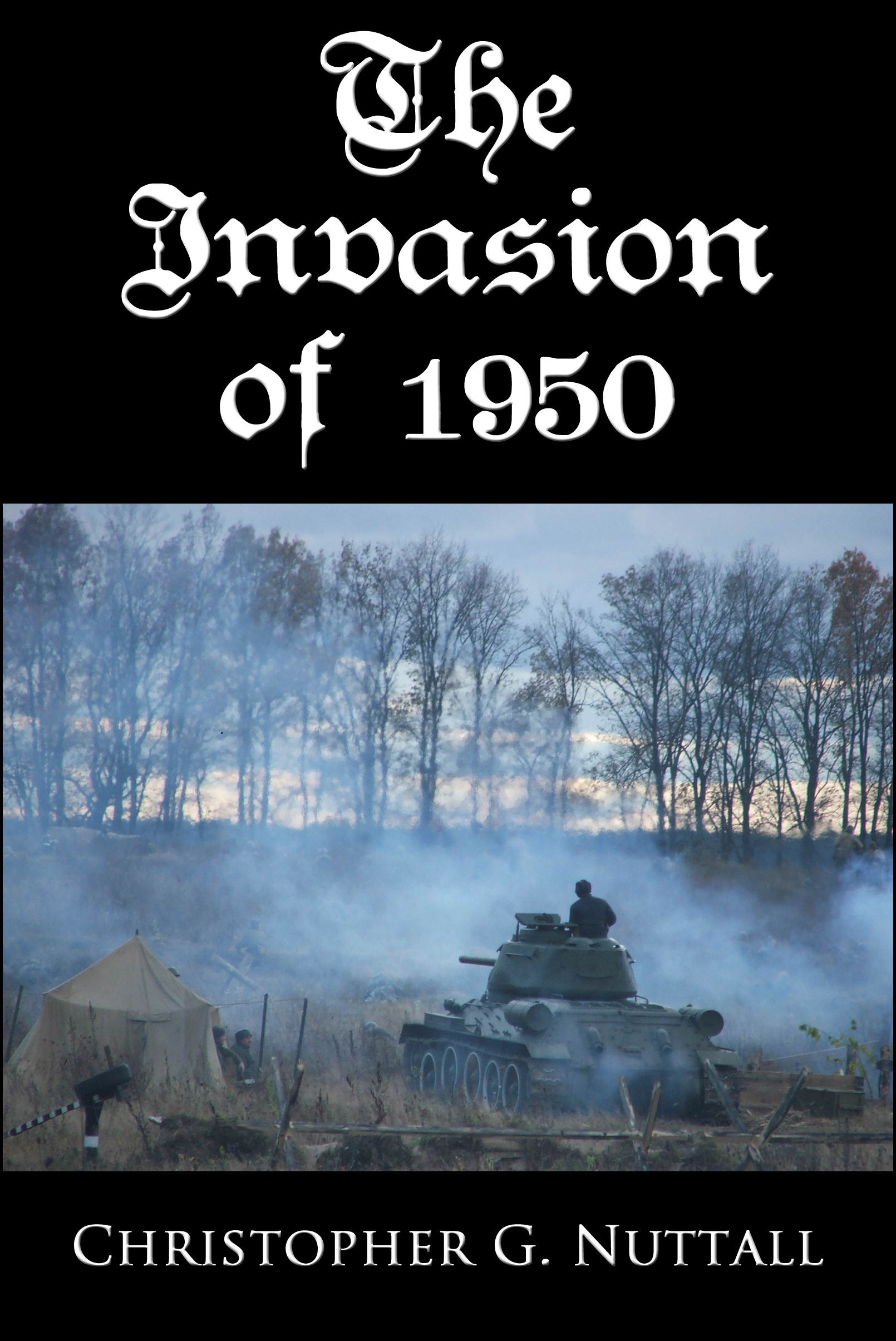
Christopher Nuttall, "The Invasion of 1950" (2013)
Just finished this self-published alt-history (allohistorical) work...
I heartily enjoyed it; worth the time, although it could use some editing. I did approach it, however, as pure escapist entertainment and not alternative history grounded in plausible variation of historical facts. More comments soon.
In the interim, travel over to the author's blog for more info.
I heartily enjoyed it; worth the time, although it could use some editing. I did approach it, however, as pure escapist entertainment and not alternative history grounded in plausible variation of historical facts. More comments soon.
In the interim, travel over to the author's blog for more info.
Labels:
book reviews,
dystopian,
European history,
fascism,
fiction,
German history,
military,
World War II
Wednesday, 18 March 2015
Timur Vermes, "Look Who's Back" (2012)
This is likely one of the most clever, amusing, intriguing and generally enjoyable fiction books I have read in a long time.
Essentially, the premise is that Adolf Hitler awakens with a pounding headache in a Berlin vacant lot in 2011. He has no memory of what has transpired since April 1945, with his last memory of that time being the act of showing Eva Braun his antique pistol. The rest of the story is simply too good to spoil. Vermes combines a singular wit, trenchant political commentary, and thought-provoking representation of how Hitler might understand the contemporary political world (both within Germany, as well as beyond).
Some snippets that I found particularly enjoyable (pagination is from my digital version):
37: “…in the last sixty-six years the number of Soviet soldiers on the territory of the German Reich had fallen substantially, particularly in the Greater Berlin area. The current figure was between thirty and fifty men; in a flash I could see that this afforded the Wehrmacht a far better prospect of victory compared to the last estimate from my general staff of around 2.5 million enemy soldiers on the Eastern Front alone.”
41: “We all know, of course, what to make of our newspapers. The deaf man writes down what the blind man has told him, the village idiot edits it, and their colleagues in the other press houses copy it. Each story is doused afresh with the same stagnant infusion of lies, so that the “splendid” brew can then be served up to a clueless Volk. In this instance, however, I was prepared to be somewhat lenient. So rarely does Fate intervene this strikingly in its own workings that even the smartest minds must find it difficult to comprehend, let alone the mediocre intellects serving our so-called opinion sheets. My brain required the stomach of an ox to digest the other information I managed to unearth.”
48: “What irony: yesterday I was repositioning the 12th Army; today it was magazine racks.”
194: “the so-called reunification of Germany into his expansive lap. I have to concede that this supposed “reunification” was one of the few first-rate lies propagated by the republic. For how could they call it a proper reunification when essential components – such as the aforementioned Silesia granted to Poland, as well as Alsace-Lorraine or Austria – were missing?”
378: “That’s pure gold!” Madame Bellini said when, heavy-hearted, I showed her the report on the “National Democrats” alongside others we had filmed.”
540: “the telephone has to be a telephone, a calendar, a camera and everything else besides. This is dangerous nonsense, the only possible consequence of which is that thousands of our young people will be mown down on the roads because they cannot stop staring into their screens. One of my first undertakings will be to outlaw such telephone devices or allow them only for those inferior racial elements remaining in our society – for the latter I may even make them compulsory. Then they will litter the main thoroughfares of Berlin like squashed hedgehogs.”
541: “Christmas decorations have become more tasteful with the passing of the years. A most disagreeable industrialisation has taken hold. I am not concerned about whether something is kitsch or not, for every example of kitsch harbours a residue of the feelings of the simple man, and since that is the case there will always be the possibility of a development towards real art. No, what really bothers me is that the importance of Father Christmas has grown disproportionally, doubtlessly as a result of Anglo-American cultural infiltration.”
547: “He has also devised a new electoral slogan. It will be plastered at the bottom of all the placards, giving them a common thread. The slogan addresses old virtues, old doubts, and for good measure has a humorous, conciliatory element to win over those pirate voters and other young people. The slogan reads: “It wasn’t all bad.”
Essentially, the premise is that Adolf Hitler awakens with a pounding headache in a Berlin vacant lot in 2011. He has no memory of what has transpired since April 1945, with his last memory of that time being the act of showing Eva Braun his antique pistol. The rest of the story is simply too good to spoil. Vermes combines a singular wit, trenchant political commentary, and thought-provoking representation of how Hitler might understand the contemporary political world (both within Germany, as well as beyond).
Some snippets that I found particularly enjoyable (pagination is from my digital version):
37: “…in the last sixty-six years the number of Soviet soldiers on the territory of the German Reich had fallen substantially, particularly in the Greater Berlin area. The current figure was between thirty and fifty men; in a flash I could see that this afforded the Wehrmacht a far better prospect of victory compared to the last estimate from my general staff of around 2.5 million enemy soldiers on the Eastern Front alone.”
41: “We all know, of course, what to make of our newspapers. The deaf man writes down what the blind man has told him, the village idiot edits it, and their colleagues in the other press houses copy it. Each story is doused afresh with the same stagnant infusion of lies, so that the “splendid” brew can then be served up to a clueless Volk. In this instance, however, I was prepared to be somewhat lenient. So rarely does Fate intervene this strikingly in its own workings that even the smartest minds must find it difficult to comprehend, let alone the mediocre intellects serving our so-called opinion sheets. My brain required the stomach of an ox to digest the other information I managed to unearth.”
48: “What irony: yesterday I was repositioning the 12th Army; today it was magazine racks.”
194: “the so-called reunification of Germany into his expansive lap. I have to concede that this supposed “reunification” was one of the few first-rate lies propagated by the republic. For how could they call it a proper reunification when essential components – such as the aforementioned Silesia granted to Poland, as well as Alsace-Lorraine or Austria – were missing?”
378: “That’s pure gold!” Madame Bellini said when, heavy-hearted, I showed her the report on the “National Democrats” alongside others we had filmed.”
540: “the telephone has to be a telephone, a calendar, a camera and everything else besides. This is dangerous nonsense, the only possible consequence of which is that thousands of our young people will be mown down on the roads because they cannot stop staring into their screens. One of my first undertakings will be to outlaw such telephone devices or allow them only for those inferior racial elements remaining in our society – for the latter I may even make them compulsory. Then they will litter the main thoroughfares of Berlin like squashed hedgehogs.”
541: “Christmas decorations have become more tasteful with the passing of the years. A most disagreeable industrialisation has taken hold. I am not concerned about whether something is kitsch or not, for every example of kitsch harbours a residue of the feelings of the simple man, and since that is the case there will always be the possibility of a development towards real art. No, what really bothers me is that the importance of Father Christmas has grown disproportionally, doubtlessly as a result of Anglo-American cultural infiltration.”
547: “He has also devised a new electoral slogan. It will be plastered at the bottom of all the placards, giving them a common thread. The slogan addresses old virtues, old doubts, and for good measure has a humorous, conciliatory element to win over those pirate voters and other young people. The slogan reads: “It wasn’t all bad.”
Labels:
biography,
book reviews,
dystopian,
European history,
fascism,
fiction,
German history,
racism,
World War II
Monday, 16 March 2015
Monday, 22 December 2014
Murray Rothbard, "Betrayal of the American Right" (2007)
Rothbard is one of the pre-eminent American libertarian thinkers.
This title - written in the 1970s but not published until recently - offers Rothbard's assessment of the diversion of conservative thinking in the United States from libertarianism to statism from the late 19th- to the 1960s.
Rothbard offers a compelling, revisionist narrative history of the intellectual development of libertarian thinking in the United States. He particularly focuses on differences that emerged between libertarians and the Republican Party mainstream around the United States' participation in foreign wars.
Additional notes available soon.
The full text of the book is available at: http://mises.org/library/betrayal-american-right-0
This title - written in the 1970s but not published until recently - offers Rothbard's assessment of the diversion of conservative thinking in the United States from libertarianism to statism from the late 19th- to the 1960s.
Rothbard offers a compelling, revisionist narrative history of the intellectual development of libertarian thinking in the United States. He particularly focuses on differences that emerged between libertarians and the Republican Party mainstream around the United States' participation in foreign wars.
Additional notes available soon.
The full text of the book is available at: http://mises.org/library/betrayal-american-right-0
Wednesday, 8 October 2014
Heike B. Görtemaker, "Life With Hitler" (2011)
This is a fascinating biography of Eva Braun, the woman who for over a decade was Hitler's closest female confidante, if not his mistress.
Görtemaker takes on an aspect of the Nazi regime that has rarely been investigated: given Hitler's (and the majority of the Nazi hierarchy's) stance on the proper comportment and role of women in the regime, how was it that Hitler (and his entourage) maintained his relationship with a single young woman who never bore children, who smoked and drank, and who seems in many respects, the exact opposite of the ideal Aryan woman?
Görtemaker is treading on territory where she has few peers. There have been only three biographies written about Braun. This one is exceptional. The author's investigations being vexed by the glaring holes in archival resources. Many letters and other documents produced by Braun and Hitler have disappeared or been intentionally destroyed. Nonetheless, she is careful to assess shortcomings in the existing evidence (primarily testimony provided by members of Hitler's entourage and Braun's family members), which usually leaves her pointing out that more questions than answers exist about Braun and Hitler's life together.
The book features an exceptional array of rarely seen photographs, both of Braun within her own circle, as well as within Hitler's. A quite different vision of the 'Fuhrer' emerges here, less iconographic and more casual: Hitler and friends at the opera, lounging over lunch, etc.
More to follow...
Görtemaker takes on an aspect of the Nazi regime that has rarely been investigated: given Hitler's (and the majority of the Nazi hierarchy's) stance on the proper comportment and role of women in the regime, how was it that Hitler (and his entourage) maintained his relationship with a single young woman who never bore children, who smoked and drank, and who seems in many respects, the exact opposite of the ideal Aryan woman?
Görtemaker is treading on territory where she has few peers. There have been only three biographies written about Braun. This one is exceptional. The author's investigations being vexed by the glaring holes in archival resources. Many letters and other documents produced by Braun and Hitler have disappeared or been intentionally destroyed. Nonetheless, she is careful to assess shortcomings in the existing evidence (primarily testimony provided by members of Hitler's entourage and Braun's family members), which usually leaves her pointing out that more questions than answers exist about Braun and Hitler's life together.
The book features an exceptional array of rarely seen photographs, both of Braun within her own circle, as well as within Hitler's. A quite different vision of the 'Fuhrer' emerges here, less iconographic and more casual: Hitler and friends at the opera, lounging over lunch, etc.
More to follow...
Labels:
biography,
book reviews,
European history,
fascism,
German history,
World War II
Tuesday, 18 March 2014
Deborah Lipstadt, "The Eichmann Trial" (2011)
In progress.
The New Republic offers an excellent assessment of the book.
You can also watch/listen to Lipstadt discuss the book, in a half-hour talk at University of South Florida, delivered in February 2012.
Additionally, see my discussion of Lipstadt's Denying the Holocaust: The Growing Assault on Truth and Memory (1993).
The New Republic offers an excellent assessment of the book.
You can also watch/listen to Lipstadt discuss the book, in a half-hour talk at University of South Florida, delivered in February 2012.
Additionally, see my discussion of Lipstadt's Denying the Holocaust: The Growing Assault on Truth and Memory (1993).
Wednesday, 12 March 2014
Stephen McGinty, "Camp Z: The Secret Life of Rudolf Hess" (2011)
McGinty's record of Hess' time imprisoned in the United Kingdom, primarily at Mychett House outside London, records a sometimes tragic, sometimes farcical dance between a mysterious Nazi leader and his British guards, doctors, and interrogators.
More to come...
The Daily Mail provided a pretty solid summary, without much critical commentary.
More to come...
The Daily Mail provided a pretty solid summary, without much critical commentary.
Labels:
biography,
book reviews,
European history,
fascism,
German history,
military,
World War II
Monday, 3 March 2014
Patrick Coffey, "American Arsenal: A Century of Waging War" (2013)
The Los Angeles Review of Books offers an excellent review of Coffey's text.
Tuesday, 13 August 2013
Anna Bramwell, "Blood and Soil: Walther Darre & Hitler's 'Green Party'" (1985)
This book is certainly challenging, in that it presents both a significant 'rewriting' of the history of Nazi Germany, an intensive analysis of ideological clashes within German National Socialism, and a troubling apparent sympathy for some aspects of that movement.
Bramwell offers two core theses:
1) Walther Darre was found guilty of war crimes that he should not have been.
2) Echoes of Darre’s philosophies can be found in contemporary Europe, if not globally, thus suggesting that they cannot be regarded as intrinsic to fascistic/national socialist ideology.
Bramwell explores the evolution of Darre’s thought through his pre-Nazi era writings, the policies and pronouncements of the Nazi era, as well as his post-Nazi writing. She notes that Darre’s anti-semitism, given the absence of this position in his pre-Nazi writing, may have been adopted merely as a pragmatic attempt to curry favour with powerful anti-semitic Nazis such as Hitler. She spends a significant amount of effort exploring Darre’s interests in the peasantry, and how his aims for preserving and strengthening Germany’s peasant class did not include the claiming of substantial new lebensraum in the East, nor the use of a vast number of non-German forced labourers for the purposes of maintaining or increasing agricultural output.
You can read it for yourself, if you go to:
http://www.scribd.com/doc/155137318/Bramwell-Anna-Blood-and-Soil-Richard-Walther-Darre-and-Hitler’s-‘Green-Party’
Bramwell offers two core theses:
1) Walther Darre was found guilty of war crimes that he should not have been.
2) Echoes of Darre’s philosophies can be found in contemporary Europe, if not globally, thus suggesting that they cannot be regarded as intrinsic to fascistic/national socialist ideology.
Bramwell explores the evolution of Darre’s thought through his pre-Nazi era writings, the policies and pronouncements of the Nazi era, as well as his post-Nazi writing. She notes that Darre’s anti-semitism, given the absence of this position in his pre-Nazi writing, may have been adopted merely as a pragmatic attempt to curry favour with powerful anti-semitic Nazis such as Hitler. She spends a significant amount of effort exploring Darre’s interests in the peasantry, and how his aims for preserving and strengthening Germany’s peasant class did not include the claiming of substantial new lebensraum in the East, nor the use of a vast number of non-German forced labourers for the purposes of maintaining or increasing agricultural output.
You can read it for yourself, if you go to:
http://www.scribd.com/doc/155137318/Bramwell-Anna-Blood-and-Soil-Richard-Walther-Darre-and-Hitler’s-‘Green-Party’
Tuesday, 9 April 2013
David Irving, "Goebbels: Mastermind of the Third Reich" (1996)
Irving finished his draft of Goebbels in September of 1994, and duly submitted it to St. Martin's Press for review. While the Press made revisions, and did not offer the book for sale in North America, Irving offered the original to readers for free via his website.
There is a short assessment in the Kirkus Review that rings pretty true. If you can't be bothered to follow the link, the review can be summarized as calling the book, "ponderous, tedious, and scurrilously misleading."
The same year that Goebbels was published, Irving lodged a libel suit in the United Kingdom against Deborah Lipstadt, a United States university professor and author of Denying the Holocaust: The Growing Assault on Truth and Memory (1993). As part of the evidence in the Irving v Lipstadt case, Richard Evans offered an assessment of Irving's manipulation of historical records.
All of this being said, a few themes emerged from my reading of Goebbels: Mastermind of the Third Reich (that at over 900 pages - could easily be argued is too long for its own good). I list them below:
1) Irving's sometimes subtle (and sometimes not so subtle) anti-semitism.
For instance, on pg. 195, Irving offers the rather florid sentence: "The government’s Shylocks were determined to eviscerate him now… The hundred pound Dr. Goebbels was equally determined to keep his flesh intact.” Of course, this allusion to the 'vengeful Jew' in Shakespeare's Merchant of Venice plays on a common anti-semitic stereotype while symbolically equating the level of risk Goebbel faced to physical death.
2) Goebbels was a virulent anti-semite who pushed Hitler further than Hitler would have gone on his own
Several times during the book, Irving notes that Goebbels was either pleading with Hitler to take a stronger anti-semitic stance, or that Goebbels was - through independent decisions - compelling stronger actions against Jews from Hitler. This is not a position that Irving attempts to hide. Describing the situation in 1934, on pg. 376, Irving bluntly states, "For the next nine years, Goebbels was the motor, goading his reluctant Fuhrer into ever more radical actions against the Jews.” Similarly, on pg. 656, Irving opines, "For Goebbels there were two problems. Neither the broad German public nor their Fuhrer shared his satanic antisemitism.” Additionally, on pg. 693, Irving suggests, "Hitler told Hans Lammers categorically that he wanted the solution of the Jewish problem postponed until after the war was over—a ruling that re-markably few historians now seem disposed to quote." Ironically, Irving includes the following in the footnote appended to the preceding sentence: "At about the same time [Goebbels] noted [in his diary] that Hitler was relentless on the Jewish question: ‘The Jews must get out of Europe, if necessary by applying the most brutal means.'"
In somewhat more subtle terms, on pg. 369, Irving writes, "[Hitler listens to]… Goebbel’s litanies against their turbulent priests and their arrogant Jews. Hitler finds it hard to get worked up about the Jews, now that he is in power.” With regard to the pogroms of Kristallnacht, Irving suggests Goebbels acted independently of Hitler's directions in bringing about violent anti-semitic actions, "It is plain that [JG] had consulted neither the party’s gauleiters nor the S.A. chief of staff before issuing these instructions.”
Irving has difficulty incorporating some historical realities into his version of history, however. He includes, but seems to miss the obvious contradiction to his claims that statements such as the following pose: "…the Reichstag that September 1936 passed a set of laws circumscribing the rights of Jews and half-Jews in Germany. Goebbels took no part in their drafting…” (pg. 376). If in fall 1936 the Reichstag was passing laws limiting the rights of Jews and those the Nazi regime identified as 'half-Jews', it would suggest that these laws were passed with Hitler's implicit support or at least lack of objection, and that Goebbels could not be identified as a solitary, driven, or exceptional anti-semitic leader within the regime.
3) Practical need dictated ant-semitic actions
While discussion of the early struggles of the Nazi Party is filled with fulminations against what Irving characterizes as the 'dirty tricks' of the Communist and Social Democratic opposition parties, he suggests that the Party's anti-semitism was grounded in the reality of a German society dominated for the worse by Jews (in terms of dominant ownership of key industries, wealth-holding, and occupation of government offices and the judiciary). Once the Party's anti-semitic policies had eliminated the possibility of Jews being able to meaningfully participate in German society, of course, a new threat could be rationalized, that of rebellion by the marginalized, disenfranchised, and victimized. As Irving indicates on pg. 706, "...Goebbels dictated that he saw a major danger in having forty thousand Jews ‘with nothing more to lose’ running loose in the Reich capital.”
4) Offering subtle counter-narratives to cremation as evidence of mass executions
Likely recognizing that his work would be under scrutiny, and yet widely read by less-than-critical readers with a casual interest in Nazi history, Irving inserts some subtle references that suggest attempts to destabilize, if not rewrite dominant historical interpretations based on overwhelming evidence. As indicated in a quotation above, his criticism for 'institutional/professional historians' who are too afraid to be objective about the history of the Nazi era is well-known.
For instance, on pg. 722, Irving states “...Himmler wrote to Gestapo chief Heinrich Müller that... given the high mortality rate in the camps; he ordered all the cadavers ‘of these deceased Jews’ cremated or interred.” On its face, the ambiguity of the quoted phrase ('of those deceased Jews') might be missed, but the implication that the deaths were somehow natural, caused by misfortune or disease, and certainly not part of a process of state-conducted slaughter, is an important re-interpretation of history that Irving is known for. That the Nazi state's laws created this situation in the first place is overlooked.
5) Irving offers subtle rehabilitation of Hitler's and Nazism's reputation
Near the closing of the book, on pg. 916, Irving includes one of Goebbels' last assessments of the efforts to which he had given his life's work. “‘If worse comes to worst,’ he mused, ‘and the Führer dies an honourable death in Berlin, and Europe goes bolshevik, then in five years at most the Führer will have come a legendary figure and national socialism a mythus sanctified by a last grand finale—and all of its mortal errors that are criticized today will have been expunged at one fell swoop.’“ That this statement would be offered without critical commentary or counter narrative implies a dangerously ambiguous re-statement of Goebbels ideas, and given Irving's history, suggests either a stiff middle-finger in the face of his critics and/or an affirmation that much of their criticism may be correct.
6) Irving occasionally lapses into petty, sometimes ridiculous nastiness
Describing one of Goebbel's children, Irving states, "Hellmut Goebbels grows to a solemn, slow-witted mutt of nine, 136 centimetres (four feet six inches) tall, with no greater recorded ambition than to become a Berlin subway driver.” Such an assessment of a boy who spent most of his short life (between the ages of 3 and 9 years old), living in Berlin during World War II seems rather unnecessarily harsh.
7) Irving's use of footnotes sometimes ignores the responsibilities of an historian
On pg. 299, Irving states that in 1933, "The world’s press greeted Goebbels’ crude but effective boycott with uproar (while ignoring the Jewish boycott which had triggered it.).” Such a statement, which Irving had to know would be controversial, and which given criticism that he was prone to play loose with the rules of historical evidence, would greatly benefit from citation to some kind of documentary proof, such as references to a few articles from the 'world's press' to support his claim. None are provided.
Similarly, on pg. 527, Irving states, "“In Rhodes [Goebbels] read that Mr Chamberlain had guaranteed Poland against any aggression.*” The asterisk leads the reader to the following note: "Except, it turned out, aggression by the Soviet Union; a secret addendum made this clear.—It was Ian Colvin of the News Chronicle, whom Goebbels expelled a few days later, who tilted the balance to war by telling Chamberlain, untruthfully, on March 29 that Hitler had already drawn up plans to destroy Poland. However the contingency plan (Hitler’s Case White) was now activated as a result of the British guarantee.”
This addendum is footnoted. The footnote, however, does not seem to relate to the claim regarding Chamberlain, the British guarantee, a secret addendum to said guarantee, Colvin, or Colvin’s conversation with Chamberlain. Instead, the footnotes states, “See the diaries of Bormann; Eberhard (IfZ, Irving collection); and Major Wilhelm Deyhle, Jodl’s staff officer (ND: 1796-PS); also a letter from Col Eduard Wagner to his wife, Mar 30 and Apr 1 (in which latter he wrote ‘gestern bei der Führerentscheidung...’—‘yesterday, when the Führer reached his decision...’). How Bormann, Eberhard, or Deyhle would know about secret addendums to British guarantees with Poland, or what a British journalist discussed with the British Prime Minister is incomprehensible. It is also difficult to understand why Irving would not direct his readers to particular entries in the diaries rather than to the entirety of the books is suspicious.
8) The book is desperately in need of an editor.
Like many self-published books, this text suffers from a multitude of egregious writing flaws and typographical errors that a critical, objective eye would have caught immediately. A few examples of the various types that are found in the book:
OVERWROUGHT LANGUAGE:
Pg. 206 - "With the political wind in Germany now beginning to blow Brown…”. Irving was referring to the colour of the Nazi uniform. Aside from the mixed metaphor, the scatological reading of this phrase gave me a surprised chuckle.
AWKWARD STATEMENTS OF TIME:
Pg. 253 - "Two years later [Goebbels] published a popular edition of his diaries for the coming months…”. Why Irving phrased his sentence this way, instead of something much simpler and clearer, such as "Two years later, Goebbels would publish a popular edition of the diaries he wrote over the next few months," is baffling.
FORMATTING ERRORS:
On pg. 672, clearly there has been a layout error that a fresh eye would have caught. The book states, "“The film pirated And apartments—supposedly for bombed-out Berliners, but the cream of these vacant buildings went to their closest cronies.” The portion following 'pirated' appears again lower on the same page.
SILLY AND SLOPPY ERRORS:
Pg. 743: "“As Hitler reminded Goebbels before this speech, it was proper even now to compare Germany’s situation now with 1933.”
Pg. 860: "“Goebbels sent Hitler a telegram reporting the three hundred thousand new troops. ‘I intend,’ he dictated on the train, ‘to plead with the Führer not to let Speer pick the currents out of my cake.’”
Labels:
biography,
book reviews,
European history,
fascism,
German history,
military,
racism,
World War II
Sunday, 31 March 2013
Sönke Neitzel, Harald Weitzer, "Soldaten: On Fighting, Killing and Dying" (2012)
Neitzel and Weitzer have written a fascinating analysis of two significant bodies of long-overlooked edited transcripts of conversations between German prisoners-of-war secretly recorded in the UK and US during the Second World War. The authors conduct a qualitative content analysis of the discussions, arriving at fascinating insights into how German soldiers, airman, and sailors understood their role in the war. Topics assessed range through obvious concerns such as the soldiers' sense-making regarding fighting and killing (as indicated in the book title), but also addresses their perspectives on less-often or indirectly explored issues such as soldiers' perspective on sexual violence, anti-semitism and racially-motivated violence, and the degree of soldiers' support for the Nazi regime.
The book offers a clear and important discussion of the strengths and weaknesses of content analysis, as well of these records. Any discussion of the records cannot be engaged in without the disclaimer that they are transcriptions of select portions of conversations, sometimes between German soldiers who did not know they were being recorded and sometimes between a German soldier and a British or American 'plant' who was seeking information. On the other hand, as the authors point out, the records does provide very unique perspectives from the point of view of 'regular' German soldiers recorded in informal conversations during the war; before the outcome of the war was obvious, and outside of the fear that any dissent or criticism might result in punishment from the regime.
The book offers intriguing insights that challenges some increasingly popular - although contentious - understandings of German society, such as advanced in Goldhagen's Hitler's Willing Executioners.
More later...
Labels:
book reviews,
European history,
fascism,
German history,
military,
racism,
World War II
Tuesday, 20 November 2012
Deborah Lipstadt, "Denying the Holocaust" (1993)
The subtitle of this book is "The Growing Assault on Truth and Memory." My summary of it is clunky, to say the least. My apologies.
For those interested in the topic of Holocaust denial, this book is already likely familiar; if not its content, for author David Irving claiming that Lipstadt's discussion of his ideas was libellous. More on this case can be found at Emory University's Holocaust Denial on Trial site.
Lipstadt begins at an interesting point, by looking at First World War 'revisionists', trained historians who sought to diminish the idea of German guilt and share the problem out among all of the countries who participated in the war. Some also sought to pin a larger part of the blame on the Allies, particularly for their post-war conduct that almost guaranteed another war.
She also chronicles early efforts - primarily by Frenchmen (such as Rassinier) - to diminish or challenge the severity of the Holocaust. As she notes, early challengers did not attempt to deny the reality of the Holocaust outright, but instead to play down numbers, intentions, and how widespread a phenomenon the institutionalized slaughter was. Additionally, she notes that early claimants also attempted, in what was often a parallel effort, but that was also connected to Americans who were bitter about the US having joined the war, describing Allied practices as being just as bad as those carried out by Nazi Germany.
She also considers the role played by historians within the German historikerstreit; arguments waged over the 1980s regarding the degree of German guilt that should be carried for World War II, and how exceptional the development of national socialism and its values were within Germany.
Lipstadt develops – gradually and yet inexorably – two primary theses: firstly, that over 60 years, Holocaust deniers and their ideological predecessors undertook their efforts as part of a desire to rehabilitate fascism and advance anti-semitism, and secondly, that over the same period Holocaust deniers have worked to have their claims accepted not as hatred or historical falsification, but to generate sympathy for the idea that they are not being accorded access to free speech and open debate, and that their claims are not being assessed with healthy academic objectivity.
Lipstadt reveals how deniers, particularly leading lights such as Harwood, Butz, Ernst Zundel, and the Institute for Historical Research, as well as those functionalized by them, such as Fred Leuchter, have actively trod upon, rejected, and worked directly in the face of the foundational requirements of credible historical scholarship, such as objectivity, careful weighing of evidence, and careful attention to context.
An equally valuable contribution is Lipstadt’s close analysis of how various American universities dealt with attempt during the early 1990s for a revisionist organization to print several ads questioning the reality of the Holocaust. It is through these efforts that we see the flawed logic of citing First Amendment constitutional rights as a rationale for allowing promulgation of anti-semitic faux scholarship regarding the Holocaust. Nonetheless, it is this exact concern that led many institutions and university campus newspaper to allow the ads to be published, even often with the idea that the ads were patently anti-semitic and false, but that they needed to be seen and discussed. As Lipstadt points out, however, the First Amendment does not force anyone to allow someone space to advance views, it simply guarantees that the government’s ability to stop someone from attempting to advance their views is limited. Similarly, she offers that willingness to dispute the reality of the Holocaust with deniers – whose track record is not one of abiding by professional popular rules of conduct when it comes to historical research and debate – gives their stance more credibility and attention than it deserves. Instead of debating deniers, Lipstadt carefully assesses the methodology and motivations of the deniers. Removing their ability to set the terms of debate, she wisely forces deniers to defend their record of scholarship, not to attempt to prove the obvious.
Notes for self:
- Willis Carto was a member of John Birch Society in the late 1940s/early 1950s. This would be about the same time that Ben Klassen was a member of the same organization. (144)
- Lipstadt claims that the ADL sees Carto as the “most important and powerful professional anti-Semite in the United States” (145)
- Francis Parkey Yockey’s Imperium: The Philosophy of History and Politics (1948) called for a new 'imperium' of Western 'Aryan' nations that would rule using the values of Hitlerian National Socialism (146/7)
- Yockey described as “Culture-Distorters” those who mixed races, were egalitarians or believers in human rights, participatory democracy, and Jews. (148)
- In 1975, the Liberty Letter, published by Carto’s Liberty Lobby, was folded into the Spotlight, a tabloid newspaper published by the same organization. The Spotlight contained a wide variety of content, such as Bible analysis, conspiracy theorizing regarding the likes of the Center for Foreign Relations and the Tri-Lateral Commission, as well as advice on avoiding taxes and fighting the IRS. (150)
- Other conspiracies are investigated as a means of attempting to legitimize and popularize the idea that our perspective on historical events can result from falsification or miseducation. (154/5)
- Speaking of the turn to academicizing Holocaust denial, Lipstadt writes, “They attempt to project the appearance of being committed to the very values that they in truth adamantly oppose: reason, critical rules of evidence, and historical distinction.” (217)
For more on Lipstadt, see my discussion of her 2011 book, The Eichmann Trial.
Labels:
book reviews,
German history,
Historiography,
racism,
religion,
World War II
Monday, 18 June 2012
Jean-François Nadeau, "The Canadian Führer: The Life of Adrien Arcand" (2012)
First off, what's with this title? It seems a cheap attempt at generating sales, particularly when, as Nadeau notes in the book, Arcand's interest in fascism was more influenced by Mussolini than Hitler. Losing sight of this element helps to confuse some of Arcand's values, such as his granting Catholicism an essential role in his world view.
Nadeau does provide a useful overview of Arcand's thinking, and makes a significant contribution by providing an in-depth description of Arcand's political, personal, and career trajectory. Unfortunately, the narrative and analysis seem to peter out by the middle of the Second World War period. Perhaps this is a personal desire, but I think it would be quite fascinating to see the level of analysis given Arcand's pre-war thought and activities applied to his post-war output. Nadeau intimates how Arcand how ideologically managed the fall of Nazism and Italian fascism, but we don't get much sense of how his post-war thinking really coalesced. Maybe it didn't. Maybe Arcand was simple too old, or too ill, or too disillusioned to worry about formulating an adapted world view. If so, this interpretation needed to be fleshed out. As it was covered, it seemed more that Nadeau simply lost interest in what Arcand was doing after his stay in an Ontario detention camp during the second half of the war.
Aside from this weakness, the book suffers from some editing issues that are perhaps a result of poor translation or rushed production. For instance, a sentence is almost repeated verbatim on pg. 267 (of the hardcover version).
Similarly, some pictures are missing credit lines. I raise this as an issue because most of the pictures are culled from a ‘private source’. It would be useful to know the archival location of any others.
Finally, some some of the commentary is questionable. For instance, a photo of two men standing in the entrance to a store (?) suggests that people were able to openly wear swastikas in public even during the late 1930s. While this may be true, some wider context for the image could clarify that it was a special event, or even a photo staged to normalize wearing of this type of symbol.
Saturday, 21 April 2012
Hannah Arendt, "Eichmann in Jerusalem" (1964)
The full title of this influential but controversial book is Eichmann in Jerusalem: A Report on the Banality of Evil. It had sat for many years on my 'to read' list. In short, it is a record of the 1960 trial and hanging of Adolf Eichmann, a fairly high-ranking bureaucrat within the political apparatus created in Nazi Germany to manage, and subsequently dispose of, Jews, Gypsies, and other 'undesireables'.
I must admit that for much of the book I could recognize why it was regarded as such an important philosophical and historical reference point. As an early, well-informed and thoughtful assessment of an upper-middle bureaucrat's responsibility within the Nazi extermination apparatus, it is certainly interesting. Of course, in the intervening fifty years or so since the work was published, there have been voluminous materials produced, drawing on more archival materials and interviews, and that give a much more detailed and comprehensive understanding of the historical and political dimensions of the Nazi Germany's racial and politically-motivated concentration, expulsion, and extermination policies.
Where Arendt's text remains particularly impressive and thought-provoking (if only, perhaps, for this author), is in the final chapter discussing the rendering of the court's decision regarding Eichmann's fate, his appeal, and the carrying out of his death sentence. Even more impressive is the 'Epilogue', which considers the legal precedents and ramifications for Israel's kidnapping of Eichmann from Argentina, and Arendt's summary and assessment of the legal arguments of the prosecution and defence. Once again, although many other texts have now been written about both aspects of this case, as an early, concise, and influential document, casual readers who have a good knowledge of Holocaust history could skip forward to these two chapters to gain a good sense of what Arendt was attempting to do.
As I read these final two chapters, I couldn't help but consider the United States' assassination of Osama bin Laden within the context of Arendt's discussion of the criminality of organized mass slaughter and the illegal kidnapping of someone to force them to face trial for their involvement of this crime.
Essentially (spoiler alert!), Arendt's argument might be summed up as resting on two pillars. Firstly, she suggests that Israel should have either had Eichman tried by an international court, or after trying him in their own court, turned him over for carrying out of the sentence to an international body. Secondly, she suggests that what is essential to keep in mind - and that Eichmann's case provides an ideal example of - is that in the case of crimes against humanity we are far more likely to have to deal with 'banal evil'; rather ordinary people who do terrible things based on some flawed but functional rationalizations, than truly sick, cognizant, anti-social and "evil" people. In the case of Germany, the execution apparatus was populated by many, many people, sometimes even including those who were targeted by that machinery. Many of these people 'went along' with the criminal activities simply because the flow of history and morality seemed to be moving in that direction, and so they acquiesced, or believed what they were told was right. As the court commented regarding Eichmann, it was quite likely that in different circumstances he might not have ever been motivated to do what he had done.
In this regard, as Arendt decries Israel's kidnapping of Eichmann from Argentina, as well as their decision to single-handedly try and kill Eichmann, I find myself comparing these conclusions to the treatment of Osama bin Laden by the US. Of course, there are some critical differences: bin Laden did not represent or act in the name of a state, and bin Laden's acts were not therefore not the carrying out of a state's policies. Nonetheless, why the United States did not seek Pakistan's permission to seize bin Laden, and why they unilaterally decided to assassinate someone within another country's sovereign territory without respecting that country's sovereignty over their own space, and without the individual in question having recourse to trial, remains a deeply problematic and vexing aspect of this case. In the case of bin Laden it seems to me, in some respects similar to the case of Eichmann, the country's acting in the name of justice and vengeance (two very different to reconcile motivations) undermined the very foundation of the beliefs that they seemed to be so offended someone else did not respect.
I must admit that for much of the book I could recognize why it was regarded as such an important philosophical and historical reference point. As an early, well-informed and thoughtful assessment of an upper-middle bureaucrat's responsibility within the Nazi extermination apparatus, it is certainly interesting. Of course, in the intervening fifty years or so since the work was published, there have been voluminous materials produced, drawing on more archival materials and interviews, and that give a much more detailed and comprehensive understanding of the historical and political dimensions of the Nazi Germany's racial and politically-motivated concentration, expulsion, and extermination policies.
Where Arendt's text remains particularly impressive and thought-provoking (if only, perhaps, for this author), is in the final chapter discussing the rendering of the court's decision regarding Eichmann's fate, his appeal, and the carrying out of his death sentence. Even more impressive is the 'Epilogue', which considers the legal precedents and ramifications for Israel's kidnapping of Eichmann from Argentina, and Arendt's summary and assessment of the legal arguments of the prosecution and defence. Once again, although many other texts have now been written about both aspects of this case, as an early, concise, and influential document, casual readers who have a good knowledge of Holocaust history could skip forward to these two chapters to gain a good sense of what Arendt was attempting to do.
As I read these final two chapters, I couldn't help but consider the United States' assassination of Osama bin Laden within the context of Arendt's discussion of the criminality of organized mass slaughter and the illegal kidnapping of someone to force them to face trial for their involvement of this crime.
Essentially (spoiler alert!), Arendt's argument might be summed up as resting on two pillars. Firstly, she suggests that Israel should have either had Eichman tried by an international court, or after trying him in their own court, turned him over for carrying out of the sentence to an international body. Secondly, she suggests that what is essential to keep in mind - and that Eichmann's case provides an ideal example of - is that in the case of crimes against humanity we are far more likely to have to deal with 'banal evil'; rather ordinary people who do terrible things based on some flawed but functional rationalizations, than truly sick, cognizant, anti-social and "evil" people. In the case of Germany, the execution apparatus was populated by many, many people, sometimes even including those who were targeted by that machinery. Many of these people 'went along' with the criminal activities simply because the flow of history and morality seemed to be moving in that direction, and so they acquiesced, or believed what they were told was right. As the court commented regarding Eichmann, it was quite likely that in different circumstances he might not have ever been motivated to do what he had done.
In this regard, as Arendt decries Israel's kidnapping of Eichmann from Argentina, as well as their decision to single-handedly try and kill Eichmann, I find myself comparing these conclusions to the treatment of Osama bin Laden by the US. Of course, there are some critical differences: bin Laden did not represent or act in the name of a state, and bin Laden's acts were not therefore not the carrying out of a state's policies. Nonetheless, why the United States did not seek Pakistan's permission to seize bin Laden, and why they unilaterally decided to assassinate someone within another country's sovereign territory without respecting that country's sovereignty over their own space, and without the individual in question having recourse to trial, remains a deeply problematic and vexing aspect of this case. In the case of bin Laden it seems to me, in some respects similar to the case of Eichmann, the country's acting in the name of justice and vengeance (two very different to reconcile motivations) undermined the very foundation of the beliefs that they seemed to be so offended someone else did not respect.
Labels:
biography,
book reviews,
European history,
fascism,
German history,
military,
racism,
World War II
Wednesday, 28 March 2012
Christopher Hibbert, "Benito Mussolini" (1962, rev. 1972)
The sub-title for this classic is "The Rise and Fall of Il Duce."
Hibbert's book appears to be one of those great British cheap paperback reprints about facets of the Second World War that seem to have been produced in great scads during the 1970s.
I don't know nearly enough about Mussolini, other than that he is presented as the somewhat buffoonish Italian parallel to Hitler. Of course, he came to power before Hitler, and was really the leading Fascist politician (hence the name for the ideology that derives from an classic Roman reference) before Hitler began to pursue his search for German lebensraum.
I was somewhat surprised to learn of his early socialist ideological roots, ideas that to some degree stayed with him even to his death. Much like Hitler, however, the allure of power spoke loudly to Mussolini, leading him to increasingly radical solutions where political success to priority over other values. Upon rising to power, Mussolini's desire for grandeur and power led him into a series of ill-advised foreign military adventures: against Egypt, Albania, France, and Greece. The unequivocal disasters that these invasions were compelled Mussolini to repeatedly seek out the assistance of Nazi Germany, diminishing Mussolini's capacity to debate, question, or redirect Hitler's political visions for Europe and the Mediterranean.
Hibbert's book, particularly in its last third, looks at Mussolini from a far more personal perspective than political. This makes sense given that he fell from grace - was rescued by the Nazis and returned to power as the head of the puppet Salo Italian government - and then captured again, and killed with his mistress.
Labels:
biography,
book reviews,
European history,
fascism,
World War I,
World War II
Tuesday, 27 September 2011
Klaus-Michael Mallmann & Martin Cuppers, "Nazi Palestine" (English edition, 2010)
I am of two minds regarding this book, subtitled, "The Plans for the Extermination of the Jews in Palestine."
On one hand, it approaches a subject that is rarely written about, is very well researched, presents a compelling argument, and does not seem to have garnered criticism from experts on the subject. On the other, the translation or editing of the volume is shoddy, which gives the impression that the book was produced in much the same fashion. Additionally, the construction of the book's argument sometimes feels a little heavy-handed - not manufactured - but as if all evidence available leads inexorably towards a very few conclusions.
What does the book argue? Tracing the relationship between the Nazi plans for the Middle East, particularly Palestine, and the nascent Palestinian nationalism movements striving to throw off the colonial presence, Mallman and Cuppers make a convincing case for the Middle East as an overlooked realm of conflict in the Second World War, and one in which anti-Semitism played a pivotal role in bringing the Nazis and Palestinian/Muslim revolutionaries together.
An area where the book falls short, in my estimation (as someone who is not an expert on Middle Eastern history or politics), is in its attempts to link contemporary Palestinian/Israeli conflicts to events of the Second World War-era machinations of the Nazis. The Epilogue does offer an intriguing survey of contemporary positive references to Hitler, Nazis, and Nazi anti-semitic policies in Middle Eastern mass media, that does lend some credence to their argument for a connection between the past and the present.
On a personal note, I found the material discussing how the Nazis opted to build some flexibility into their racial policies, particularly for SS units, when the war on the Eastern front required more soldiers, and one of the candidate populations for willing recruits was Muslim anti-communists from the Caucasus. It was fascinating to read that the Germans were willing to provide halal food and imams for these troops, when the rhetoric of the Nazis more widely known and publicized makes such a compromise hard to conceive of.
On one hand, it approaches a subject that is rarely written about, is very well researched, presents a compelling argument, and does not seem to have garnered criticism from experts on the subject. On the other, the translation or editing of the volume is shoddy, which gives the impression that the book was produced in much the same fashion. Additionally, the construction of the book's argument sometimes feels a little heavy-handed - not manufactured - but as if all evidence available leads inexorably towards a very few conclusions.
What does the book argue? Tracing the relationship between the Nazi plans for the Middle East, particularly Palestine, and the nascent Palestinian nationalism movements striving to throw off the colonial presence, Mallman and Cuppers make a convincing case for the Middle East as an overlooked realm of conflict in the Second World War, and one in which anti-Semitism played a pivotal role in bringing the Nazis and Palestinian/Muslim revolutionaries together.
An area where the book falls short, in my estimation (as someone who is not an expert on Middle Eastern history or politics), is in its attempts to link contemporary Palestinian/Israeli conflicts to events of the Second World War-era machinations of the Nazis. The Epilogue does offer an intriguing survey of contemporary positive references to Hitler, Nazis, and Nazi anti-semitic policies in Middle Eastern mass media, that does lend some credence to their argument for a connection between the past and the present.
On a personal note, I found the material discussing how the Nazis opted to build some flexibility into their racial policies, particularly for SS units, when the war on the Eastern front required more soldiers, and one of the candidate populations for willing recruits was Muslim anti-communists from the Caucasus. It was fascinating to read that the Germans were willing to provide halal food and imams for these troops, when the rhetoric of the Nazis more widely known and publicized makes such a compromise hard to conceive of.
Labels:
book reviews,
fascism,
German history,
Middle East,
racism,
religion,
World War II
Wednesday, 29 June 2011
Deborah Dwork & Robert Jan Van Pelt, "Auschwitz" (1996)
This book is well-written, meticulously researched, chock full of singular illustrations (rare photos of the town of Oswiecim, maps, and design drafts of camp buildings) often drawn from the authors' personal collections, and takes a surprising breadth of approach (considering the development of the Auschwitz-Birkenau concentration camp complex within the 1,000-year history of German colonizing drives towards the East as well as anti-Semitism). In short, this is a really excellent book.
The BBC produced a great documentary, Auschwitz: Inside the Nazi State based on some of the research for this book. The PBS-linked site contains much of the same maps, blueprints, and other materials contained in the book.
Labels:
book reviews,
German history,
racism,
World War II
Subscribe to:
Posts (Atom)