Subtitle: "The Uncensored History of Rock 'n' Roll in America's Loudest City".
The most interesting aspect of this book is its format. Miller has compiled a sequence of direct quotations from well-known rockers, support players, club owners, commentators, and hangers-on of the Detroit rock, punk, and garage rock scene, from the 1960s to the 2000s.
If you're a fan of the Stooges, MC5, Ted Nugent, etc., Detroit Rock City will give you some intriguing insights into how these groups evolved, how they were perceived by their peers, and how they influenced following generations of Detroit players. By the time Miller gets to testimony of figures from the early 1980s, however, the names, relationships, and value begins to overlap and mush together. This confusion may just as much reflect my own musical interests as it does the content. Perhaps if you're a fan of the Gories, the sections on the '80s and '90s will turn your crank. I suspect that the reader that will read this full book with rapt attention is rare indeed, and very likely would have to have lived in Detroit, played with the bands involved, or at least have similar experiences of playing crappy clubs, living in dives, and scarfing down shameless volumes of drugs and alcohol.
David Kirby wrote a very fair review in the Wall Street Journal (because that's where you should go to get your reviews of books about rock'n'roll, right?).
If you're interested in Detroit, you might also visit my notes on Charlie Duff's 2013 Detroit: An American Autopsy.
Reflections by Dr. Gregory Klages on non-fiction books dealing primarily with politics, history, and religion. Significant attention to Canadian content. Mail me/comment if you read anything. I love to hear feedback!
Showing posts with label rock music history. Show all posts
Wednesday, 18 February 2015
Monday, 9 February 2015
R. J. Smith, "The One: The Life and Music of James Brown" (2012)
In progress.
Smith's prose sparkles with enthusiasm for Brown's music, her performative abilities, and his capacity to read an audience. Suggesting that Brown based his opinions on his respect for the person making the over the merits of the argument itself, Smith offers what is perhaps too simple an explanation to reconcile Brown's apparently contradictory, often unpredictable positions on socio-political issues.
The book does give insights into some of Brown's noteworthy excesses, particularly his violence and misogyny. His mother left his life very early, and only returned to it when Brown was successful. Even once she was back in his life (in however minor a presence), he would claim that she had in fact died when he was a boy. His father was distant, and Brown came of age in a violent, unpredictable environment that rewarded bluster backed up by fists, knives, and guns. He served time in jail as a young man, an experience that couldn't help but harden him.
You can read Janet Maslin's positive review of the book in the NY Times.
Smith's prose sparkles with enthusiasm for Brown's music, her performative abilities, and his capacity to read an audience. Suggesting that Brown based his opinions on his respect for the person making the over the merits of the argument itself, Smith offers what is perhaps too simple an explanation to reconcile Brown's apparently contradictory, often unpredictable positions on socio-political issues.
The book does give insights into some of Brown's noteworthy excesses, particularly his violence and misogyny. His mother left his life very early, and only returned to it when Brown was successful. Even once she was back in his life (in however minor a presence), he would claim that she had in fact died when he was a boy. His father was distant, and Brown came of age in a violent, unpredictable environment that rewarded bluster backed up by fists, knives, and guns. He served time in jail as a young man, an experience that couldn't help but harden him.
You can read Janet Maslin's positive review of the book in the NY Times.
Monday, 15 December 2014
Motley Crue, "The Dirt" (2001)
This book, authored by five members of the band, as well as collaborator Neil Strauss (who also assisted with Jenna Jameson's autobiography discussed on this site), chronicles the excesses (alcoholic, drug, sexual, hygienic, emotional, and beyond) of the band Motley Crue from its genesis to the end of the 1990s.
The book is eminently readable. One of the advantages is that it takes a "Pulp Fiction"-esque, post-modern approach to narrative; it offers multiple, divergent versions of events provided by various band members. This approach also serves to allow band members to introduce their own stories, whether it be about their childhood, their relationships, their insecurities, or their legal troubles. Allowing each member to offer their concerns and experiences as credible and unique makes the book more interesting than a straight, single, authoritative narrative. It also reinforces some of the discussion of band differences, collaboration, mutual suspicion, and flawed communication.
Generally, a fun book, a decent read, and better than much of the band's rather glammy version of West coast 80s rock (excepting - of course - their first two albums, which are fantastic).
The book is eminently readable. One of the advantages is that it takes a "Pulp Fiction"-esque, post-modern approach to narrative; it offers multiple, divergent versions of events provided by various band members. This approach also serves to allow band members to introduce their own stories, whether it be about their childhood, their relationships, their insecurities, or their legal troubles. Allowing each member to offer their concerns and experiences as credible and unique makes the book more interesting than a straight, single, authoritative narrative. It also reinforces some of the discussion of band differences, collaboration, mutual suspicion, and flawed communication.
Generally, a fun book, a decent read, and better than much of the band's rather glammy version of West coast 80s rock (excepting - of course - their first two albums, which are fantastic).
Labels:
addiction,
biography,
book reviews,
rock music history
Wednesday, 1 October 2014
Tony Iommi, "Iron Man" (2013)
Sub-titled: "My journey through Heaven & Hell with Black Sabbath".
As do many music autobiographies, this one starts off really fascinating. Iommi talks about his early years: exposure to music, upbringing, early influences, and how he met the people who would later on influence his work and life. Unlike the members of the Beatles or Led Zeppelin, however, the pre-Sabbath years of Black Sabbath members is not particularly widely known. Iommi's story is also unique in that a work injury as a young man left him without a few fingertips on one hand. The resulting experimentation and solutions he arrived at to enable him to play provide some unique insights into his playing style, and thus the 'Sabbath sound'.
Iommi's details on some of Black Sabbath's most notorious exploits are light, unsurprisingly. He does not shy, however, from taking what might be perceived as pot-shots at some of his bandmates, Ozzy included; suggesting, for instance, that Ozzy is rather scatter-brained and lazy.
With Ozzy's departure from the initial Sabbath line-up, Iommi would remain the only person who would play in all permutations of the band working under that name. His perspective on all of these changes, what makes the band continue on (really, what makes Iommi keep working under that band name), would provide compelling reading for a fan. His analysis and depth of discussion really begins to taper off with the end of the Ian Gillan era. Most of the 80s and 90s get slim discussion. To Iommi's credit, perhaps, he admits that several of the releases of this period were sub-par, either being cobbled together with changing line-ups where personalities were not gelling, or products that were rushed out without the sort of reflection and improvement that they might have deserved.
Iommi's work isn't as amusing as Ozzy's "I Am Ozzy", but is far more informative about the musical decisions, particularly of the 1970s, and the Sabbath reunion. See my review of Ozzy's work here.
As do many music autobiographies, this one starts off really fascinating. Iommi talks about his early years: exposure to music, upbringing, early influences, and how he met the people who would later on influence his work and life. Unlike the members of the Beatles or Led Zeppelin, however, the pre-Sabbath years of Black Sabbath members is not particularly widely known. Iommi's story is also unique in that a work injury as a young man left him without a few fingertips on one hand. The resulting experimentation and solutions he arrived at to enable him to play provide some unique insights into his playing style, and thus the 'Sabbath sound'.
Iommi's details on some of Black Sabbath's most notorious exploits are light, unsurprisingly. He does not shy, however, from taking what might be perceived as pot-shots at some of his bandmates, Ozzy included; suggesting, for instance, that Ozzy is rather scatter-brained and lazy.
With Ozzy's departure from the initial Sabbath line-up, Iommi would remain the only person who would play in all permutations of the band working under that name. His perspective on all of these changes, what makes the band continue on (really, what makes Iommi keep working under that band name), would provide compelling reading for a fan. His analysis and depth of discussion really begins to taper off with the end of the Ian Gillan era. Most of the 80s and 90s get slim discussion. To Iommi's credit, perhaps, he admits that several of the releases of this period were sub-par, either being cobbled together with changing line-ups where personalities were not gelling, or products that were rushed out without the sort of reflection and improvement that they might have deserved.
Iommi's work isn't as amusing as Ozzy's "I Am Ozzy", but is far more informative about the musical decisions, particularly of the 1970s, and the Sabbath reunion. See my review of Ozzy's work here.
Labels:
biography,
rock music history,
social history
Monday, 22 September 2014
Sam Sutherland, "Perfect Youth" (2012)
Subtitle: "The Birth of Canadian Punk."
Sutherland weaves a nice series of anecdotal tales culled from the memories of the Canadian punks who were "there" during the emergence of Canada's punk scene in the mid-to-late 1970s. His dogged determination in tracking down people who have left behind their punk roots (some to enter the sanctified realm of boardrooms, some to continue to struggle along in the music biz, and other who have simply moved to struggling...) is admirable and produces real insights into an era that is hard to source.
Sutherland's love of the subject, and of researching his subject, comes across in his writing. It is neither hagiography or shock journalism. It is simple and compassionate story-telling at its best. He conveys the spirit of the people, as well as of the music these people made, which is difficult to find. In this regard, Sutherland does a real service in providing something akin to a shopping list for those who want to find out more about Canadian punk, lends impetus to the effort to preserve these works and extend access to them, and increase awareness of the strong and important influence these bands had within their respective hometowns and (much to my surprise) internationally.
The book was received quite positively by critics, as can be seen in this National Post review, or one in Maclean's, this NOW magazine interview with Sutherland, or a similar author interview in Vice magazine.
Sutherland weaves a nice series of anecdotal tales culled from the memories of the Canadian punks who were "there" during the emergence of Canada's punk scene in the mid-to-late 1970s. His dogged determination in tracking down people who have left behind their punk roots (some to enter the sanctified realm of boardrooms, some to continue to struggle along in the music biz, and other who have simply moved to struggling...) is admirable and produces real insights into an era that is hard to source.
Sutherland's love of the subject, and of researching his subject, comes across in his writing. It is neither hagiography or shock journalism. It is simple and compassionate story-telling at its best. He conveys the spirit of the people, as well as of the music these people made, which is difficult to find. In this regard, Sutherland does a real service in providing something akin to a shopping list for those who want to find out more about Canadian punk, lends impetus to the effort to preserve these works and extend access to them, and increase awareness of the strong and important influence these bands had within their respective hometowns and (much to my surprise) internationally.
The book was received quite positively by critics, as can be seen in this National Post review, or one in Maclean's, this NOW magazine interview with Sutherland, or a similar author interview in Vice magazine.
Monday, 21 July 2014
Keith Richards, "Life" (2010)
Loved much of this book. Witty without being maudlin, honest, and informative. The momentum waned for the last 20% or so, somewhat paralleling the decline in the Rolling Stones' performance, division between Keith and Mick Jagger, etc. The book is fleshed out with a bit of fluff in this section, including cooking advice and a recipe. Nothing wrong with that, I suppose, and it does serve as a reminder that Keith is a human being who has to eat and all that.
You can read excerpts from Life here.
You can listen to a few interviews and Richards' speaking engagements here.
You can read excerpts from Life here.
You can listen to a few interviews and Richards' speaking engagements here.
Tuesday, 15 July 2014
Robert Greenfield, "Ain't It Time We Said Goodbye" (2014)
A former Rolling Stone journalist revisits material he has already written on several times before.
As a brief book devoted to about 10 dates on a tour (half in the UK, and the rest in USA and Canada), Ain't It Time We Said Goodbye is a snapshot of a foundational period in the history of the Stones. The ideas for Exile on Main Street were percolating, the band was still somewhat trigger-shy about touring the US after the disaster at Altamont, and the Stones had decided to leave the UK to evade heavy taxation.
Where the book was most interesting was not its commentary on the 'regular' members of the Stones, but in its profiles of their retinue. Whether discussing the various wives and girlfriends (as well as their relationships - particular Anita Pallenberg and Bianca later-to-be-Jagger), or the supporting musicians and tour workers, Ain't It Time ... offers a unique look into a rock institution in development.
Some of the profiles that help to 'flesh out' people often mentioned in passing with regard to the Stones include:
- Nicky Hopkins: pianist
- Chip Monck (tour operative): joining the Stones entourage for their 1969 American tour, he called lighting cues, selected pre- and post-gig house music, and cleaned up the house post-gig
- Ian Stewart ('Stu'): former member of the Stones, he now set up the drum kit, played piano on a few songs, and drove occasionally
- Bobby Keys: saxophone, 'bigger than life' Texan
- Jim Price: horn section,
- Rose Millar: Mick Taylor's future wife
For those with an eye for details, the book also provides a nice behind-the-scenes perspective on the venues the Stones were playing, and some of the logistical aspects of life on the road.
Kirkus Review pretty much sums it up with a less than laudatory assessment.
As a brief book devoted to about 10 dates on a tour (half in the UK, and the rest in USA and Canada), Ain't It Time We Said Goodbye is a snapshot of a foundational period in the history of the Stones. The ideas for Exile on Main Street were percolating, the band was still somewhat trigger-shy about touring the US after the disaster at Altamont, and the Stones had decided to leave the UK to evade heavy taxation.
Where the book was most interesting was not its commentary on the 'regular' members of the Stones, but in its profiles of their retinue. Whether discussing the various wives and girlfriends (as well as their relationships - particular Anita Pallenberg and Bianca later-to-be-Jagger), or the supporting musicians and tour workers, Ain't It Time ... offers a unique look into a rock institution in development.
Some of the profiles that help to 'flesh out' people often mentioned in passing with regard to the Stones include:
- Nicky Hopkins: pianist
- Chip Monck (tour operative): joining the Stones entourage for their 1969 American tour, he called lighting cues, selected pre- and post-gig house music, and cleaned up the house post-gig
- Ian Stewart ('Stu'): former member of the Stones, he now set up the drum kit, played piano on a few songs, and drove occasionally
- Bobby Keys: saxophone, 'bigger than life' Texan
- Jim Price: horn section,
- Rose Millar: Mick Taylor's future wife
For those with an eye for details, the book also provides a nice behind-the-scenes perspective on the venues the Stones were playing, and some of the logistical aspects of life on the road.
Kirkus Review pretty much sums it up with a less than laudatory assessment.
Labels:
art history,
biography,
book reviews,
rock music history
Thursday, 29 December 2011
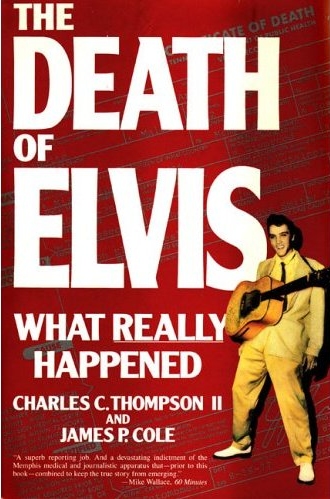
James P. Cole, "The Death of Elvis: What Really Happened?" (1991)
Ever since the early 1990s, when I was researching an article on Elvis' death for my university newspaper, I have found the death of the 'king of rock'n'roll' pretty fascinating. At the time, my interest was spurred by the conclusions of the rather inflated sounding Elvis Presley Commission. This book seems to be generally regarded as one of the less biased, and better researched texts on the topic.
While the book generally presents a fairly convincing case, it is written in the kind of 'crime thriller' rhetoric that intends to make the process of research (conducting interviews and archival digging) more exciting. I have to admit that the process was exciting, in that much of the research was conducted as part of a respected American investigative news program, and/or as part of a legal proceedings growing out of the program's work. Attempts by the authors to occasionally describe their participant's behaviour, or characterizations of what these persons were thinking sometimes rang as amateurish.
In short, the book provides a nice introduction to some of the issues around Presley's death, and given the descriptions of expert testimonies in legal proceedings, helps to build a strong case for the proposal that Presley died of a drug overdose or, at the very least, drug-related causes.
Labels:
book reviews,
rock music history,
U.S.A. history
Friday, 7 January 2011
John Osbourne, "I Am Ozzy" (2009)
Ok, so this is a bit of a departure from the fare I traditionally write about here. I am a big Ozzy fan, however, and this bit of fluff seemed like a nice palate-cleanser for 'on the subway' reading. And it was. There's nothing here that will greatly surprise fans of Ozzy or Sabbath. Most of the stories have been told before. They are entertaining nonetheless, and much of the tone of Ozzy's speaking voice is kept in the text (I presume these are more or less transcribed stories told by Ozzy to some nameless assistant). There is more information than I expected about Ozzy's personal life - his first wife, his kids, and Sharon's role in his life - and much less about the dynamics, discoveries, and excesses of his musical career. For those who've never known much about Ozzy, this is a simple, informative, and pleasing primer. If nothing else, it's a short, simple book that won't tax your brain, while giving you some intriguing insights into the development of the 1970s music industry, and a rock icon who has been reduced to a bit of a parody.
Subscribe to:
Posts (Atom)