Showing posts with label racism. Show all posts

Friday, 15 May 2015

Bettina Stangneth, "Eichmann Before Jerusalem" (2014)

Subtitle: "The Unexamined Life of a Mass Murderer."

Stangneth offers a close, meticulous, and exhaustive analysis of texts produced by Adolf Eichmann between the end of World War II and the early 1960s, when he was captured in Argentina and taken to Israel to stand trial for war crimes. Her book is not for the casual reader. For those with some knowledge of the period, of World War II, of the Holocaust, or of the post-war hunt for Nazis, Stangneth has produced a wealth of knowledge.

Eichmann before Jerusalem holds several critical aspects. Firstly, Stangneth unearths the murky history of documents produced by Eichmann and some of his acquaintances in Argentina. Often referred to as the Sassen papers, these transcripts of audio recordings shed light on Eichmann's post-war thinking, his perceptions of the Nazi era, world politics during the 1950s, and his own culpability in what most would view as horrific crimes. In itself, her explorations of these texts and their history could serve as a single book.

The second value of this text is its exposure of how little Eichmann and other (former?) Nazis did to try to hide themselves. Given the gravity of their crimes, the thin veneer of changed identity these men engaged in, and that many of their friends and family were aware of, is shocking.

Finally, with the abundance of textual resources Stangneth has marshalled, she offers a fascinating psychological profile of Eichmann, revealing how his ideas change over time, how he represented them differently depending on his audience, and particularly how his testimony at his war crimes trial did not correspond with testimony he had recorded previously from in hiding.

I had produced digital extensive notes from the book, and tragically the file was lost. I may someday try to revisit the book and recreate some of these notes. Until then, I can say that this book is very fine history writing, although it is likely a bit of a laborious read for even those interested in the topic. The closest comparison I can make is Adam Tooze's Wages of Destruction, which I commented on in 2010.

The NY Times ran a fair review of the book, written by Steven Aschheim.

Wednesday, 18 March 2015

Timur Vermes, "Look Who's Back" (2012)

This is likely one of the most clever, amusing, intriguing and generally enjoyable fiction books I have read in a long time.

Essentially, the premise is that Adolf Hitler awakens with a pounding headache in a Berlin vacant lot in 2011. He has no memory of what has transpired since April 1945, with his last memory of that time being the act of showing Eva Braun his antique pistol. The rest of the story is simply too good to spoil. Vermes combines a singular wit, trenchant political commentary, and thought-provoking representation of how Hitler might understand the contemporary political world (both within Germany, as well as beyond).

Some snippets that I found particularly enjoyable (pagination is from my digital version):
37: “…in the last sixty-six years the number of Soviet soldiers on the territory of the German Reich had fallen substantially, particularly in the Greater Berlin area. The current figure was between thirty and fifty men; in a flash I could see that this afforded the Wehrmacht a far better prospect of victory compared to the last estimate from my general staff of around 2.5 million enemy soldiers on the Eastern Front alone.”

41: “We all know, of course, what to make of our newspapers. The deaf man writes down what the blind man has told him, the village idiot edits it, and their colleagues in the other press houses copy it. Each story is doused afresh with the same stagnant infusion of lies, so that the “splendid” brew can then be served up to a clueless Volk. In this instance, however, I was prepared to be somewhat lenient. So rarely does Fate intervene this strikingly in its own workings that even the smartest minds must find it difficult to comprehend, let alone the mediocre intellects serving our so-called opinion sheets. My brain required the stomach of an ox to digest the other information I managed to unearth.”

48: “What irony: yesterday I was repositioning the 12th Army; today it was magazine racks.”

194: “the so-called reunification of Germany into his expansive lap. I have to concede that this supposed “reunification” was one of the few first-rate lies propagated by the republic. For how could they call it a proper reunification when essential components – such as the aforementioned Silesia granted to Poland, as well as Alsace-Lorraine or Austria – were missing?”

378: “That’s pure gold!” Madame Bellini said when, heavy-hearted, I showed her the report on the “National Democrats” alongside others we had filmed.”

540: “the telephone has to be a telephone, a calendar, a camera and everything else besides. This is dangerous nonsense, the only possible consequence of which is that thousands of our young people will be mown down on the roads because they cannot stop staring into their screens. One of my first undertakings will be to outlaw such telephone devices or allow them only for those inferior racial elements remaining in our society – for the latter I may even make them compulsory. Then they will litter the main thoroughfares of Berlin like squashed hedgehogs.”

541: “Christmas decorations have become more tasteful with the passing of the years. A most disagreeable industrialisation has taken hold. I am not concerned about whether something is kitsch or not, for every example of kitsch harbours a residue of the feelings of the simple man, and since that is the case there will always be the possibility of a development towards real art. No, what really bothers me is that the importance of Father Christmas has grown disproportionally, doubtlessly as a result of Anglo-American cultural infiltration.”

547: “He has also devised a new electoral slogan. It will be plastered at the bottom of all the placards, giving them a common thread. The slogan addresses old virtues, old doubts, and for good measure has a humorous, conciliatory element to win over those pirate voters and other young people. The slogan reads: “It wasn’t all bad.”


Monday, 9 February 2015

R. J. Smith, "The One: The Life and Music of James Brown" (2012)

In progress.

Smith's prose sparkles with enthusiasm for Brown's music, her performative abilities, and his capacity to read an audience. Suggesting that Brown based his opinions on his respect for the person making the over the merits of the argument itself, Smith offers what is perhaps too simple an explanation to reconcile Brown's apparently contradictory, often unpredictable positions on socio-political issues.

The book does give insights into some of Brown's noteworthy excesses, particularly his violence and misogyny. His mother left his life very early, and only returned to it when Brown was successful. Even once she was back in his life (in however minor a presence), he would claim that she had in fact died when he was a boy. His father was distant, and Brown came of age in a violent, unpredictable environment that rewarded bluster backed up by fists, knives, and guns. He served time in jail as a young man, an experience that couldn't help but harden him.

You can read Janet Maslin's positive review of the book in the NY Times.

Tuesday, 28 October 2014

Deborah Lipstadt, "History on Trial: My Day in Court with a Holocaust Denier" (2005)

This book details Lipstadt's court battle to prove that her assertion that author David Irving had engaged in a long-standing effort to falsify history: selectively using and misrepresenting documents to cast Adolf Hitler in a favourable light, as well as denying the very existence of an intentional, widespread, systematic, and state-sanctioned effort to slaughter Europe's Jewish population.

The case stemmed from claims Lipstadt made in her 1993 book, Denying the Holocaust: The Growing Assault on Truth and Memory, wherein she discussed Irving's work as well as the efforts of other 'deniers'. (See my discussion of the book here). Three years later, Irving sued Lipstadt and her publisher, Penguin, for libel (stemming from the statements in her book). According to British law, the onus was placed on the defendants to prove that their assertions could be supported by evidence.

Working with an impressive team of scholars and legal minds, arrayed against Irving's rather lacklustre and self-managed representation, Lipstadt and Penguin without a doubt brought Irving low. He was publicly shown to work less as a historian than an ideologue, calling into question the integrity of the entirety of his oeuvre. The revelation of his sloppy, highly biased, and clearly flawed use of documentary sources and other archival materials effectively ended his career as a historian. Banned from entering multiple countries, considered persona non grata by respectable publishers, and saddled with a significant financial burden after losing the case, Irving is unlikely to ever widely enter public consciousness other than as a sad, deluded figure.

As a result of the trial, and her unwillingness to compromise or back down from defending her observations, Lipstadt has become a far more widely known scholar and commentator on 20th-century Jewish history, particularly as it relates to the Nazi regime.

Her book is more narrative of the experiences of the trial, and exploration of some of the choices made in her legal team's efforts. In this regard, it is compelling and informative reading. For readers seeking a closer analysis of Irving's work, however, better sources are available, such as the expert analysis of Irving's work carried out for the trial by Richard Evans, Hajo Funke, and Robert Jan van Pelt. (Electronic editions of these can all be found at the Holocaust Denial on Trial website). Trial transcripts can be found at the same site.

I discuss Lipstadt's 1993 book, Denying the Holocaust, here.
I also discuss her 2011 book, The Eichmann Trial, here.
I discuss Irving's 1996 biography of Josef Goebbels here.

Friday, 17 October 2014

Norman Finkelstein, "The Holocaust Industry" (2000, rev. 2003)

Subtitle: "Reflections on the Exploitation of Jewish Suffering".

The book is essentially three essays ('Capitalizing The Holocaust', 'Hoaxers, Hucksters and History', and 'The Double Shakedown'), each arguing - with significant reference to media articles, legal activity, and some archival research - how a cadre of Zionists have co-opted the tragedy of the genocide carried out by Nazis during World War II to privilege Israeli political and economic interests, as well as Zionist advocacy groups outside of Israel.

Given the topic, and more so Finkelstein's position, the book is very, very controversial, and I expect it would prove challenging to pretty well any reader. I know that I am hesitant to even write a summary regarding the book, for fear sloppy language or thinking might make me appear to have some kind of hatred that I do not. The book has been characterized as an anti-Semitic attack (by someone whose mother died in the Nazi genocide, as Finkelstein informs his readers).

I will note a few (related) aspects that I found intriguing:

1) Finkelstein notes the tension, and in some respects competition, that has taken place over the definition (historicizing and politicizing) of the genocide carried out by the Nazis as a set of events. He notes that a cadre of Jews has worked to marginalize the importance of non-Jewish victims, or at the least to point to the necessity of understand Jews' experience of the genocide as the lens through which all other victims' experiences must be viewed.

2) He proposes that this cadre of Jews undertook a re-historicization and political/economic functionalization of the Nazi genocide in large part as a response to the period of military conflicts involving Israel that lasted from the late 1960s through the early 1970s.

3) Finkelstein spends much of the third chapter examining various claims for compensation, as well as 'repatriation' or return of funds and other goods held in several nations' banking systems (particularly Dutch and Swiss banks). He notes US support for investigation of Swiss banks (and the US calls for quick and willing restitution to be made to victims). He raises the disquieting point that if this is the US position, why has it quashed efforts to compensate descendants of slaves, and flattened demands to seek repatriation and return of money and other goods to victims of the Nazi genocide who had deposited their wealth in US banks? As Finkelstein notes, the US was one of the top three recipient countries of financial resources being exported by Jews from the Third Reich.

4) In his revised edition (I'm not sure about the original), Finkelstein occasionally indulges in some unhelpful, annoying and provocative personal attacks and less than professional use of language. In these portions, the book crosses from polemic to screed. Perhaps his indulgence is a product of the deep hostility that Finkelstein's work generated, but it does nothing to reinforce the sense of objective and informed scholarship. This is unfortunate, and helps to lend support to the idea that there might be more to Finkelstein's attacks than a pure desire to correct our understanding of how the world works.

5) Finkelstein is a graduate of Princeton, was being considered for tenure at DePaul University in 2007, and has published widely on the Israel/Palestine conflict (nine books).


Thursday, 19 June 2014

Francis Parker Yockey, "Proclamation of London..." (1949)

Yockey's pamphlet, a proclamation by the European Liberation Front, is an inflammatory anti-Semitic, anti-American screed that advocates for a Pan-European movement that will move away from materialism, capitalism, liberal democracy, communism, and feminism. He suggests instead that Europeans should 'return' to values of faith, authority, and power.

Having broken with the Union Movement, a political organization founded in 1948 by Sir Oswald Mosley, former head of the British Union of Fascists and recently freed British political internee, transplanted American Yockey founded the European Liberation Front.

Fuller comments will follow eventually.

The full text can be found in a multitude of online locations, such as archives.org.

If this text interests you, see also my comments on Ben Klassen's Letters (Vol. 1 & Vol. 2), and William Pierce's Turner Diaries and Hunter.

Tuesday, 17 June 2014

Eric Williams, "Capitalism and Slavery" (1944)

Fuller comments will follow in future.

Williams wrote a highly influential, challenging, detailed history of the relationship between the economic gains to be made in the sugar trade that motivated the British and West Indians to develop and support slavery. The voluminous detail Williams includes reminded me of texts such as Solzhenitsyn's Gulag Archipelago, Tooze's Wages of Sin, and the documentary Shoah. In this respect, the book is not for the faint of heart, nor does it constitute 'light and informative' reading.

Williams' analysis is challenging in that it does not place racism at the forefront of its investigation, but rather sees racism as a contributing factor to economic needs. Williams text is not fiery Marxism, however, but rather close economic analysis, complete with profit and loss reporting, investment track records, and consideration of the sundry interests of landowners, sugar refinery operators, shippers, slave traders, and government.

The text also explores the 'triangular trade' of slaves, sugar, and manufactured goods that provided the foundation for British imperial trade monopolies of the 18th-century.

A bootleg version of the text can be located at: archives.org.

Wednesday, 2 April 2014

Charlie Duff, "Detroit: An American Autopsy" (2013)

A beautiful book. Duff spares no one in his commentary from inside the belly of the corpse that is contemporary Detroit. From the trials faced by emergency responders, police, newspaper folk, regular citizens, the under- and unemployed, the homeless, city politicians, business owners, criminals... they all play a role in the decrepit stage Duff narrates his story upon.

His story is not merciless; he clearly loves the city he grew up in, and returned to. He has family there, who much like the city itself, struggle with decay, loss of dignity, and poor coping mechanisms. They figure in his story as well.

Elegiac in tone, unsparing in its assessment, frightening in its observations, Duff has indeed offered an autopsy for a patient who has died. The city he describes is a new thing, a shell of the destroyed American dream.

Tuesday, 18 March 2014

Deborah Lipstadt, "The Eichmann Trial" (2011)

In progress.

The New Republic offers an excellent assessment of the book.

You can also watch/listen to Lipstadt discuss the book, in a half-hour talk at University of South Florida, delivered in February 2012.

Additionally, see my discussion of Lipstadt's Denying the Holocaust: The Growing Assault on Truth and Memory (1993).

Tuesday, 26 November 2013

Thomas King, "The Inconvenient Indian: A Curious Account of Native People in North America" (2013)

At times humorous, at times bitter, King's exploration of the history of indigenous North American's struggle to co-exist with European settlers up to the 21st-century is concurrently pleasurable and disturbing read.

More to follow.

Thursday, 12 September 2013

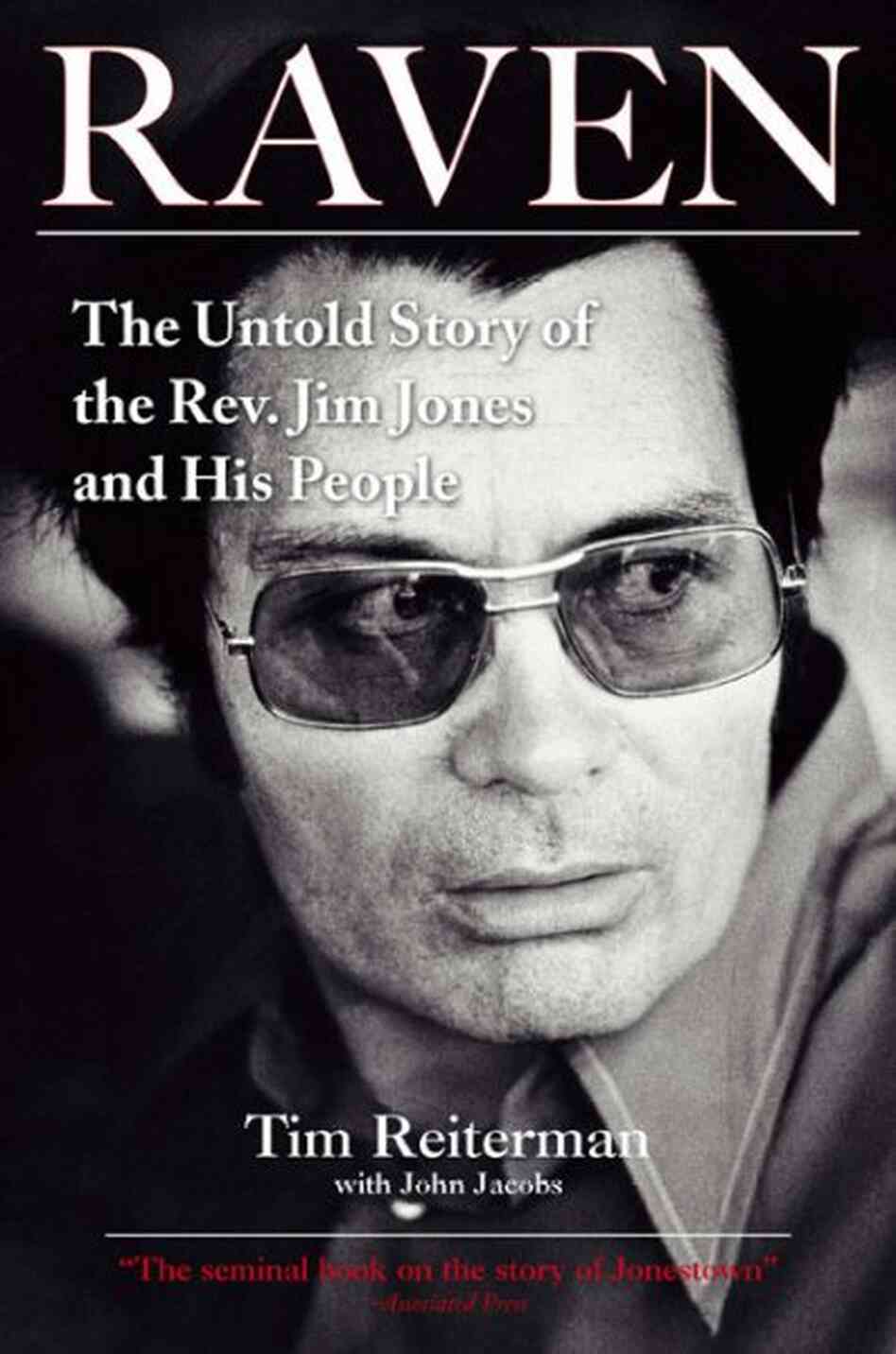
Tim Reiterman, "Raven: The Untold Story of the Rev. Jim Jones and His People" (1982)

A compelling and detailed examination of a strangely overlooked event in recent American social history.

I've finished the book, but have yet to write a summary. Sorry!

Thursday, 29 August 2013

Ben Klassen, "The Klassen Letters, Vol. 1" (1969-1976) [1988] & "Vol. 2" (1976-1981) [1989]

Ben Klassen was a prolific proponent of ‘White’ racial supremacy. In the early 1970s, he founded the Church of the Creator, a US-based organization devoted to establishing exclusive ‘white’ population of the globe, as well as elimination of Christianity and Judaism. Klassen also identified “Jews” as a ‘race’, and hoped for their elimination as well.

The stated purpose for this collection was to provide a record of the evolution in Klassen’s thinking, from the period where he first considered establishing a racially-oriented ‘religion’ through to the establishment of a World Headquarters for the group. During this period, he authored two books that outlined the Church’s philosophy, Nature’s Eternal Religion and The White Man’s Bible.

The Klassen Letters are, at their most basic, a project of blind hubris. Setting aside the philosophic and logical arguments that might be raised against Klassen’s ideology contained therein, the letters – as a collection of texts – are morbidly tedious. An editor could have trimmed the collection down to about a third of the 300 pages, eliminating the frequent repetition of whole paragraphs from letter to letter, which it appears Klassen adopted as almost stock descriptions of his beliefs. Additionally, Klassen includes his frequent solicitations to correspondents to distribute more of his books, as well as the minutiae of pricing and postage costs and procedures. From a social history perspective these details might be of some interest, but as a summary of a leader’s philosophical development they are distracting, at best.

The Klassen Letters do offer some useful information. Although more widely distributed, Klassen’s writing in the Church’s newspaper, Racial Loyalty, leaves some unanswered questions that the Letters resolve.

While Klassen never provides his readers with a clear, definition of who qualifies as ‘White’, in some of the letters he outlines why he is being evasive on this question. He notes (much to my surprise) that establishing a clear line between someone who is ‘white’ and someone who is not is difficult, due to ‘race-mixing.’ He suggests, however, that those who are ‘white’ know this fact incontrovertibly. He also suggests that details of who is ‘white’ can be resolved later, once the more immediate goal of overcoming global Jewish/Judaic dominance is achieved.

In the later letters, Klassen also advances an intriguing position with regard to self-education. Although a proponent of research and critical thinking (at least with regard to information gathered through the ‘mainstream media’), and as an author attempting to ‘educate’ his readers towards adopting a new point of view, Klassen recommends that readers must at a certain point arrive at a position and stop researching it – particularly if that research merely expands or supports the position already established – and move into action.

Tuesday, 13 August 2013

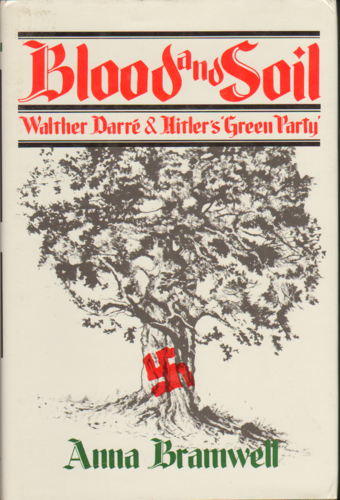
Anna Bramwell, "Blood and Soil: Walther Darre & Hitler's 'Green Party'" (1985)

This book is certainly challenging, in that it presents both a significant 'rewriting' of the history of Nazi Germany, an intensive analysis of ideological clashes within German National Socialism, and a troubling apparent sympathy for some aspects of that movement.

Bramwell offers two core theses:
1) Walther Darre was found guilty of war crimes that he should not have been.
2) Echoes of Darre’s philosophies can be found in contemporary Europe, if not globally, thus suggesting that they cannot be regarded as intrinsic to fascistic/national socialist ideology.

Bramwell explores the evolution of Darre’s thought through his pre-Nazi era writings, the policies and pronouncements of the Nazi era, as well as his post-Nazi writing. She notes that Darre’s anti-semitism, given the absence of this position in his pre-Nazi writing, may have been adopted merely as a pragmatic attempt to curry favour with powerful anti-semitic Nazis such as Hitler. She spends a significant amount of effort exploring Darre’s interests in the peasantry, and how his aims for preserving and strengthening Germany’s peasant class did not include the claiming of substantial new lebensraum in the East, nor the use of a vast number of non-German forced labourers for the purposes of maintaining or increasing agricultural output.


You can read it for yourself, if you go to:
http://www.scribd.com/doc/155137318/Bramwell-Anna-Blood-and-Soil-Richard-Walther-Darre-and-Hitler’s-‘Green-Party’

Monday, 6 May 2013

J.T. Patterson, "The Eve of Destruction" (2012)

The subtitle of this book is, " How 1965 Transformed America."

I've finished the book, but have yet to write a summary. Sorry!

You can listen to/watch the author give a talk on the book at the University of Virginia's Miller Centre (Jan. 2013).

A discussion with the author is available via BookTV.

Some reviews of the book are linked here:
John Wilson, Books & Culture.

Tuesday, 9 April 2013

David Irving, "Goebbels: Mastermind of the Third Reich" (1996)

Irving is, and this is a generous assessment, one of the most controversial aspirants to the title of 'historian' to address the Second World War era. He has been described as a 'revisionist', and a 'denier'. His work appears, at first glance, as impressive; full of lengthy citations of archival and interview sources, criticism of scholarly work, and distinctions that to a casual reader seem to suggest an encyclopedic knowledge of relevant material. As Irving's increasingly erratic and extreme pronouncements indicate a wilder and ever-more problematic approach to history, politics, and professionalism, however, most of his writing has come under criticism. Despite the appearance of meeting scholarly standards, many of his books have been revealed as poorly-founded revisions of commonly accepted and better researched work. Having found Irving's Hitler's War an entertaining read as a teenager, and discovering that Irving had made 'author-approved' versions of many of his works available freely online, I decided that they might merit a new assessment from a more critical perspective.

Irving finished his draft of Goebbels in September of 1994, and duly submitted it to St. Martin's Press for review. While the Press made revisions, and did not offer the book for sale in North America, Irving offered the original to readers for free via his website.

There is a short assessment in the Kirkus Review that rings pretty true. If you can't be bothered to follow the link, the review can be summarized as calling the book, "ponderous, tedious, and scurrilously misleading."

The same year that Goebbels was published, Irving lodged a libel suit in the United Kingdom against Deborah Lipstadt, a United States university professor and author of Denying the Holocaust: The Growing Assault on Truth and Memory (1993). As part of the evidence in the Irving v Lipstadt case, Richard Evans offered an assessment of Irving's manipulation of historical records.


All of this being said, a few themes emerged from my reading of Goebbels: Mastermind of the Third Reich (that at over 900 pages - could easily be argued is too long for its own good). I list them below:

1) Irving's sometimes subtle (and sometimes not so subtle) anti-semitism.
For instance, on pg. 195, Irving offers the rather florid sentence: "The government’s Shylocks were determined to eviscerate him now… The hundred pound Dr. Goebbels was equally determined to keep his flesh intact.” Of course, this allusion to the 'vengeful Jew' in Shakespeare's Merchant of Venice plays on a common anti-semitic stereotype while symbolically equating the level of risk Goebbel faced to physical death.

2) Goebbels was a virulent anti-semite who pushed Hitler further than Hitler would have gone on his own
Several times during the book, Irving notes that Goebbels was either pleading with Hitler to take a stronger anti-semitic stance, or that Goebbels was - through independent decisions - compelling stronger actions against Jews from Hitler. This is not a position that Irving attempts to hide. Describing the situation in 1934, on pg. 376, Irving bluntly states, "For the next nine years, Goebbels was the motor, goading his reluctant Fuhrer into ever more radical actions against the Jews.” Similarly, on pg. 656, Irving opines, "For Goebbels there were two problems. Neither the broad German public nor their Fuhrer shared his satanic antisemitism.” Additionally, on pg. 693, Irving suggests, "Hitler told Hans Lammers categorically that he wanted the solution of the Jewish problem postponed until after the war was over—a ruling that re-markably few historians now seem disposed to quote." Ironically, Irving includes the following in the footnote appended to the preceding sentence: "At about the same time [Goebbels] noted [in his diary] that Hitler was relentless on the Jewish question: ‘The Jews must get out of Europe, if necessary by applying the most brutal means.'"

In somewhat more subtle terms, on pg. 369, Irving writes, "[Hitler listens to]… Goebbel’s litanies against their turbulent priests and their arrogant Jews. Hitler finds it hard to get worked up about the Jews, now that he is in power.” With regard to the pogroms of Kristallnacht, Irving suggests Goebbels acted independently of Hitler's directions in bringing about violent anti-semitic actions, "It is plain that [JG] had consulted neither the party’s gauleiters nor the S.A. chief of staff before issuing these instructions.”

Irving has difficulty incorporating some historical realities into his version of history, however. He includes, but seems to miss the obvious contradiction to his claims that statements such as the following pose: "…the Reichstag that September 1936 passed a set of laws circumscribing the rights of Jews and half-Jews in Germany. Goebbels took no part in their drafting…” (pg. 376). If in fall 1936 the Reichstag was passing laws limiting the rights of Jews and those the Nazi regime identified as 'half-Jews', it would suggest that these laws were passed with Hitler's implicit support or at least lack of objection, and that Goebbels could not be identified as a solitary, driven, or exceptional anti-semitic leader within the regime.

3) Practical need dictated ant-semitic actions
While discussion of the early struggles of the Nazi Party is filled with fulminations against what Irving characterizes as the 'dirty tricks' of the Communist and Social Democratic opposition parties, he suggests that the Party's anti-semitism was grounded in the reality of a German society dominated for the worse by Jews (in terms of dominant ownership of key industries, wealth-holding, and occupation of government offices and the judiciary). Once the Party's anti-semitic policies had eliminated the possibility of Jews being able to meaningfully participate in German society, of course, a new threat could be rationalized, that of rebellion by the marginalized, disenfranchised, and victimized. As Irving indicates on pg. 706, "...Goebbels dictated that he saw a major danger in having forty thousand Jews ‘with nothing more to lose’ running loose in the Reich capital.”

4) Offering subtle counter-narratives to cremation as evidence of mass executions
Likely recognizing that his work would be under scrutiny, and yet widely read by less-than-critical readers with a casual interest in Nazi history, Irving inserts some subtle references that suggest attempts to destabilize, if not rewrite dominant historical interpretations based on overwhelming evidence. As indicated in a quotation above, his criticism for 'institutional/professional historians' who are too afraid to be objective about the history of the Nazi era is well-known.

For instance, on pg. 722, Irving states “...Himmler wrote to Gestapo chief Heinrich Müller that... given the high mortality rate in the camps; he ordered all the cadavers ‘of these deceased Jews’ cremated or interred.” On its face, the ambiguity of the quoted phrase ('of those deceased Jews') might be missed, but the implication that the deaths were somehow natural, caused by misfortune or disease, and certainly not part of a process of state-conducted slaughter, is an important re-interpretation of history that Irving is known for. That the Nazi state's laws created this situation in the first place is overlooked.

5) Irving offers subtle rehabilitation of Hitler's and Nazism's reputation
Near the closing of the book, on pg. 916, Irving includes one of Goebbels' last assessments of the efforts to which he had given his life's work. “‘If worse comes to worst,’ he mused, ‘and the Führer dies an honourable death in Berlin, and Europe goes bolshevik, then in five years at most the Führer will have come a legendary figure and national socialism a mythus sanctified by a last grand finale—and all of its mortal errors that are criticized today will have been expunged at one fell swoop.’“ That this statement would be offered without critical commentary or counter narrative implies a dangerously ambiguous re-statement of Goebbels ideas, and given Irving's history, suggests either a stiff middle-finger in the face of his critics and/or an affirmation that much of their criticism may be correct.

6) Irving occasionally lapses into petty, sometimes ridiculous nastiness
Describing one of Goebbel's children, Irving states, "Hellmut Goebbels grows to a solemn, slow-witted mutt of nine, 136 centimetres (four feet six inches) tall, with no greater recorded ambition than to become a Berlin subway driver.” Such an assessment of a boy who spent most of his short life (between the ages of 3 and 9 years old), living in Berlin during World War II seems rather unnecessarily harsh.

7) Irving's use of footnotes sometimes ignores the responsibilities of an historian
On pg. 299, Irving states that in 1933, "The world’s press greeted Goebbels’ crude but effective boycott with uproar (while ignoring the Jewish boycott which had triggered it.).” Such a statement, which Irving had to know would be controversial, and which given criticism that he was prone to play loose with the rules of historical evidence, would greatly benefit from citation to some kind of documentary proof, such as references to a few articles from the 'world's press' to support his claim. None are provided.

Similarly, on pg. 527, Irving states, "“In Rhodes [Goebbels] read that Mr Chamberlain had guaranteed Poland against any aggression.*” The asterisk leads the reader to the following note: "Except, it turned out, aggression by the Soviet Union; a secret addendum made this clear.—It was Ian Colvin of the News Chronicle, whom Goebbels expelled a few days later, who tilted the balance to war by telling Chamberlain, untruthfully, on March 29 that Hitler had already drawn up plans to destroy Poland. However the contingency plan (Hitler’s Case White) was now activated as a result of the British guarantee.”

This addendum is footnoted. The footnote, however, does not seem to relate to the claim regarding Chamberlain, the British guarantee, a secret addendum to said guarantee, Colvin, or Colvin’s conversation with Chamberlain. Instead, the footnotes states, “See the diaries of Bormann; Eberhard (IfZ, Irving collection); and Major Wilhelm Deyhle, Jodl’s staff officer (ND: 1796-PS); also a letter from Col Eduard Wagner to his wife, Mar 30 and Apr 1 (in which latter he wrote ‘gestern bei der Führerentscheidung...’—‘yesterday, when the Führer reached his decision...’). How Bormann, Eberhard, or Deyhle would know about secret addendums to British guarantees with Poland, or what a British journalist discussed with the British Prime Minister is incomprehensible. It is also difficult to understand why Irving would not direct his readers to particular entries in the diaries rather than to the entirety of the books is suspicious.

8) The book is desperately in need of an editor.
Like many self-published books, this text suffers from a multitude of egregious writing flaws and typographical errors that a critical, objective eye would have caught immediately. A few examples of the various types that are found in the book:

OVERWROUGHT LANGUAGE:
Pg. 206 - "With the political wind in Germany now beginning to blow Brown…”. Irving was referring to the colour of the Nazi uniform. Aside from the mixed metaphor, the scatological reading of this phrase gave me a surprised chuckle.

AWKWARD STATEMENTS OF TIME:
Pg. 253 - "Two years later [Goebbels] published a popular edition of his diaries for the coming months…”. Why Irving phrased his sentence this way, instead of something much simpler and clearer, such as "Two years later, Goebbels would publish a popular edition of the diaries he wrote over the next few months," is baffling.

FORMATTING ERRORS:
On pg. 672, clearly there has been a layout error that a fresh eye would have caught. The book states, "“The film pirated And apartments—supposedly for bombed-out Berliners, but the cream of these vacant buildings went to their closest cronies.” The portion following 'pirated' appears again lower on the same page.

SILLY AND SLOPPY ERRORS:
Pg. 743: "“As Hitler reminded Goebbels before this speech, it was proper even now to compare Germany’s situation now with 1933.”
Pg. 860: "“Goebbels sent Hitler a telegram reporting the three hundred thousand new troops. ‘I intend,’ he dictated on the train, ‘to plead with the Führer not to let Speer pick the currents out of my cake.’”

Sunday, 31 March 2013

Sönke Neitzel, Harald Weitzer, "Soldaten: On Fighting, Killing and Dying" (2012)


Neitzel and Weitzer have written a fascinating analysis of two significant bodies of long-overlooked edited transcripts of conversations between German prisoners-of-war secretly recorded in the UK and US during the Second World War. The authors conduct a qualitative content analysis of the discussions, arriving at fascinating insights into how German soldiers, airman, and sailors understood their role in the war. Topics assessed range through obvious concerns such as the soldiers' sense-making regarding fighting and killing (as indicated in the book title), but also addresses their perspectives on less-often or indirectly explored issues such as soldiers' perspective on sexual violence, anti-semitism and racially-motivated violence, and the degree of soldiers' support for the Nazi regime.

The book offers a clear and important discussion of the strengths and weaknesses of content analysis, as well of these records. Any discussion of the records cannot be engaged in without the disclaimer that they are transcriptions of select portions of conversations, sometimes between German soldiers who did not know they were being recorded and sometimes between a German soldier and a British or American 'plant' who was seeking information. On the other hand, as the authors point out, the records does provide very unique perspectives from the point of view of 'regular' German soldiers recorded in informal conversations during the war; before the outcome of the war was obvious, and outside of the fear that any dissent or criticism might result in punishment from the regime.

The book offers intriguing insights that challenges some increasingly popular - although contentious - understandings of German society, such as advanced in Goldhagen's Hitler's Willing Executioners.

More later...

Saturday, 9 February 2013

Howard Zinn, "A People's History of the United States" (1980)


Book in progress.

You, too, can read this book (for free, no less, online) via History Is A Weapon.

Tuesday, 20 November 2012

Deborah Lipstadt, "Denying the Holocaust" (1993)


The subtitle of this book is "The Growing Assault on Truth and Memory." My summary of it is clunky, to say the least. My apologies.

For those interested in the topic of Holocaust denial, this book is already likely familiar; if not its content, for author David Irving claiming that Lipstadt's discussion of his ideas was libellous. More on this case can be found at Emory University's Holocaust Denial on Trial site.

Lipstadt begins at an interesting point, by looking at First World War 'revisionists', trained historians who sought to diminish the idea of German guilt and share the problem out among all of the countries who participated in the war. Some also sought to pin a larger part of the blame on the Allies, particularly for their post-war conduct that almost guaranteed another war.

She also chronicles early efforts - primarily by Frenchmen (such as Rassinier) - to diminish or challenge the severity of the Holocaust. As she notes, early challengers did not attempt to deny the reality of the Holocaust outright, but instead to play down numbers, intentions, and how widespread a phenomenon the institutionalized slaughter was. Additionally, she notes that early claimants also attempted, in what was often a parallel effort, but that was also connected to Americans who were bitter about the US having joined the war, describing Allied practices as being just as bad as those carried out by Nazi Germany.

She also considers the role played by historians within the German historikerstreit; arguments waged over the 1980s regarding the degree of German guilt that should be carried for World War II, and how exceptional the development of national socialism and its values were within Germany.

Lipstadt develops – gradually and yet inexorably – two primary theses: firstly, that over 60 years, Holocaust deniers and their ideological predecessors undertook their efforts as part of a desire to rehabilitate fascism and advance anti-semitism, and secondly, that over the same period Holocaust deniers have worked to have their claims accepted not as hatred or historical falsification, but to generate sympathy for the idea that they are not being accorded access to free speech and open debate, and that their claims are not being assessed with healthy academic objectivity.

Lipstadt reveals how deniers, particularly leading lights such as Harwood, Butz, Ernst Zundel, and the Institute for Historical Research, as well as those functionalized by them, such as Fred Leuchter, have actively trod upon, rejected, and worked directly in the face of the foundational requirements of credible historical scholarship, such as objectivity, careful weighing of evidence, and careful attention to context.

An equally valuable contribution is Lipstadt’s close analysis of how various American universities dealt with attempt during the early 1990s for a revisionist organization to print several ads questioning the reality of the Holocaust. It is through these efforts that we see the flawed logic of citing First Amendment constitutional rights as a rationale for allowing promulgation of anti-semitic faux scholarship regarding the Holocaust. Nonetheless, it is this exact concern that led many institutions and university campus newspaper to allow the ads to be published, even often with the idea that the ads were patently anti-semitic and false, but that they needed to be seen and discussed. As Lipstadt points out, however, the First Amendment does not force anyone to allow someone space to advance views, it simply guarantees that the government’s ability to stop someone from attempting to advance their views is limited. Similarly, she offers that willingness to dispute the reality of the Holocaust with deniers – whose track record is not one of abiding by professional popular rules of conduct when it comes to historical research and debate – gives their stance more credibility and attention than it deserves. Instead of debating deniers, Lipstadt carefully assesses the methodology and motivations of the deniers. Removing their ability to set the terms of debate, she wisely forces deniers to defend their record of scholarship, not to attempt to prove the obvious.

Notes for self:
- Willis Carto was a member of John Birch Society in the late 1940s/early 1950s. This would be about the same time that Ben Klassen was a member of the same organization. (144)

- Lipstadt claims that the ADL sees Carto as the “most important and powerful professional anti-Semite in the United States” (145)

- Francis Parkey Yockey’s Imperium: The Philosophy of History and Politics (1948) called for a new 'imperium' of Western 'Aryan' nations that would rule using the values of Hitlerian National Socialism (146/7)

- Yockey described as “Culture-Distorters” those who mixed races, were egalitarians or believers in human rights, participatory democracy, and Jews. (148)

- In 1975, the Liberty Letter, published by Carto’s Liberty Lobby, was folded into the Spotlight, a tabloid newspaper published by the same organization. The Spotlight contained a wide variety of content, such as Bible analysis, conspiracy theorizing regarding the likes of the Center for Foreign Relations and the Tri-Lateral Commission, as well as advice on avoiding taxes and fighting the IRS. (150)

- Other conspiracies are investigated as a means of attempting to legitimize and popularize the idea that our perspective on historical events can result from falsification or miseducation. (154/5)

- Speaking of the turn to academicizing Holocaust denial, Lipstadt writes, “They attempt to project the appearance of being committed to the very values that they in truth adamantly oppose: reason, critical rules of evidence, and historical distinction.” (217)

For more on Lipstadt, see my discussion of her 2011 book, The Eichmann Trial.


Saturday, 29 September 2012

Phyllis Goldstein, "A Convenient Hatred" (2011)

Goldstein's 'History of Anti-Semitism', published by Brookline, has been received by respected and knowledgeable reviewers as an informative, objective, compelling overview of a particular type of persistent, irrational hatred.

Goldstein begins with the occupation of Samaria and Judea approximately 700-500 years before the Common Era. Even at this early date, tensions existed between the Jews and populations such as the Egyptians and the Greeks, primarily stemming from religious differences. Jews, of course, are monotheistic, while at this time neither the Greeks nor the Egyptians were. As the policy-makers in their respective domains, both groups expected respect for - if not wholehearted worship - of the gods recognized by the dominant power. In the observation of the Sabbath and other unique religious practices, the Jews not only stood out as 'different' but also flouted the authority of the state.

The rise of Christianity presented a new set of problems for Jews. While Christians were monotheistic, and the figure they respected as their spiritual leader was Jewish, their relationship with Jews hinged on the question of how that leader felt about Judaism (was he a reformer or the Moshiah?), and how the Christians understood the role of Jews in the Christ's death. From early Christianity into the Middle Ages, the response to both questions suggested that Jews were in the wrong (they didn't accept Christ as the Moshiah, their absence from state/imperial power made them easier to blame for their role in the Crucifixion than the Romans, and it was easier to recruit adherents from around the Mediterranean to a de-Judaized version of the Christ's teachings).

Particularly fascinating - at least for this reader - is Goldstein's discussion of how Jews fit into Europe's social order (perhaps better written as 'orders') during the period between the Renaissance and Enlightenment. Competition for economic advantage, and at times protection of what was identified as the 'domestic' advantage of non-Jews, led alternatively to charters of limited but clarified and usually expanded social privileges for Jews - whether in terms of their ability to engage in economic, social, or religious activities - and at other times, repeal or disregard of these charters, and often persecution within or ejection from kingdoms or city-states.

Self-organization by Jewish communities - led in particular by kehillot (something like community councils, but not democratic) - allowed Jews to sometimes exercise their growing numbers and economic power. In particular, Goldstein relates how during the 1550s, Jewish importers organized a boycott of the Adriatic port of Ancona, within an Italian papal state, supported by notable figures such as the Sultan of the Ottoman Empire. The boycott, and pressure from the Sultan, resulted in the release of Spanish Jews who had converted to Christianity, but had nonetheless been imprisoned by the Papal representative (it should be noted that by the time some of the prisoners were released, others had been killed).

Also fascinating was the history of relations between Jews and the Polish kings during this period. Within Poland, the early embrace of rights for Jews within the Kingdom of Poland is often held forth as a significant accomplishment. It cannot be overlooked, however, that these rights were not entrenched in any way, were repealed several times as rulers changed (within the Kingdom, and within territories within the Kingdom), and that pogroms and other forms of persecution still occurred.

The weakest coverage - in the humble opinion of this author, of course - is given to the post-1945 period. It is easy to argue that our familiarity with the concerns and events of recent decades allows us to be more critical of anyone's explanation and summary of them. It is this familiarity, however, that leads me to see what I think is deft management of information and careful phrasing of observations to lend support to Goldstein's position. For instance, in describing the beginning of 1967's "Six Day War", Rosenstein states, "By mid-May, Nassey was convinced that war was inevitable and began making plans for the coming conflict. He closed the Straits of Tiran to ships coming to or from Israel... Those acts, in turn, convinced the Israelis that war was inevitable. On June 5, 1967, war began." (329) Never mentioned is that Israel carried out the first, overwhelming air strike on Egypt that saw the formal outbreak of hostilities. (See, for instance, http://www.sixdaywar.co.uk/timeline.htm .) While Rosenstein might claim that aggressive border skirmishes had already occurred, and that the closure of the Straits of Tiran was an aggressive action against Israel, none of these were enough to begin a war in and of themselves.

This criticism in mind, Rosenstein's book is tremendously useful, and does provide an insightful, interesting, compelling read. It is certainly full of value as an generalist overview to one of the most entrenched, persistent problems of human behaviour of the last two thousand years. Not without shortcomings, these are likely more the result of trying to narrate more than two-thousand years of history in 360 pages than a conscious attempt to falsify history or propagandize.


Monday, 18 June 2012

Jean-François Nadeau, "The Canadian Führer: The Life of Adrien Arcand" (2012)

I wanted to like this book. I was hoping for something that mixed the research quality of Stanley Barrett's Is God a Racist? with the engaging narrative of Warren Kinsella's Web of Hate. The Canadian Fuhrer offers neither.

First off, what's with this title? It seems a cheap attempt at generating sales, particularly when, as Nadeau notes in the book, Arcand's interest in fascism was more influenced by Mussolini than Hitler. Losing sight of this element helps to confuse some of Arcand's values, such as his granting Catholicism an essential role in his world view.

Nadeau does provide a useful overview of Arcand's thinking, and makes a significant contribution by providing an in-depth description of Arcand's political, personal, and career trajectory. Unfortunately, the narrative and analysis seem to peter out by the middle of the Second World War period. Perhaps this is a personal desire, but I think it would be quite fascinating to see the level of analysis given Arcand's pre-war thought and activities applied to his post-war output. Nadeau intimates how Arcand how ideologically managed the fall of Nazism and Italian fascism, but we don't get much sense of how his post-war thinking really coalesced. Maybe it didn't. Maybe Arcand was simple too old, or too ill, or too disillusioned to worry about formulating an adapted world view. If so, this interpretation needed to be fleshed out. As it was covered, it seemed more that Nadeau simply lost interest in what Arcand was doing after his stay in an Ontario detention camp during the second half of the war.

Aside from this weakness, the book suffers from some editing issues that are perhaps a result of poor translation or rushed production. For instance, a sentence is almost repeated verbatim on pg. 267 (of the hardcover version).

Similarly, some pictures are missing credit lines. I raise this as an issue because most of the pictures are culled from a ‘private source’. It would be useful to know the archival location of any others.

Finally, some some of the commentary is questionable. For instance, a photo of two men standing in the entrance to a store (?) suggests that people were able to openly wear swastikas in public even during the late 1930s. While this may be true, some wider context for the image could clarify that it was a special event, or even a photo staged to normalize wearing of this type of symbol.