Showing posts with label dystopian. Show all posts

Wednesday, 14 October 2015

Norman Spinrad, "The Iron Dream" (1972)

Novel read, but comments not yet written.
Consider this a placeholder.

Tuesday, 21 April 2015

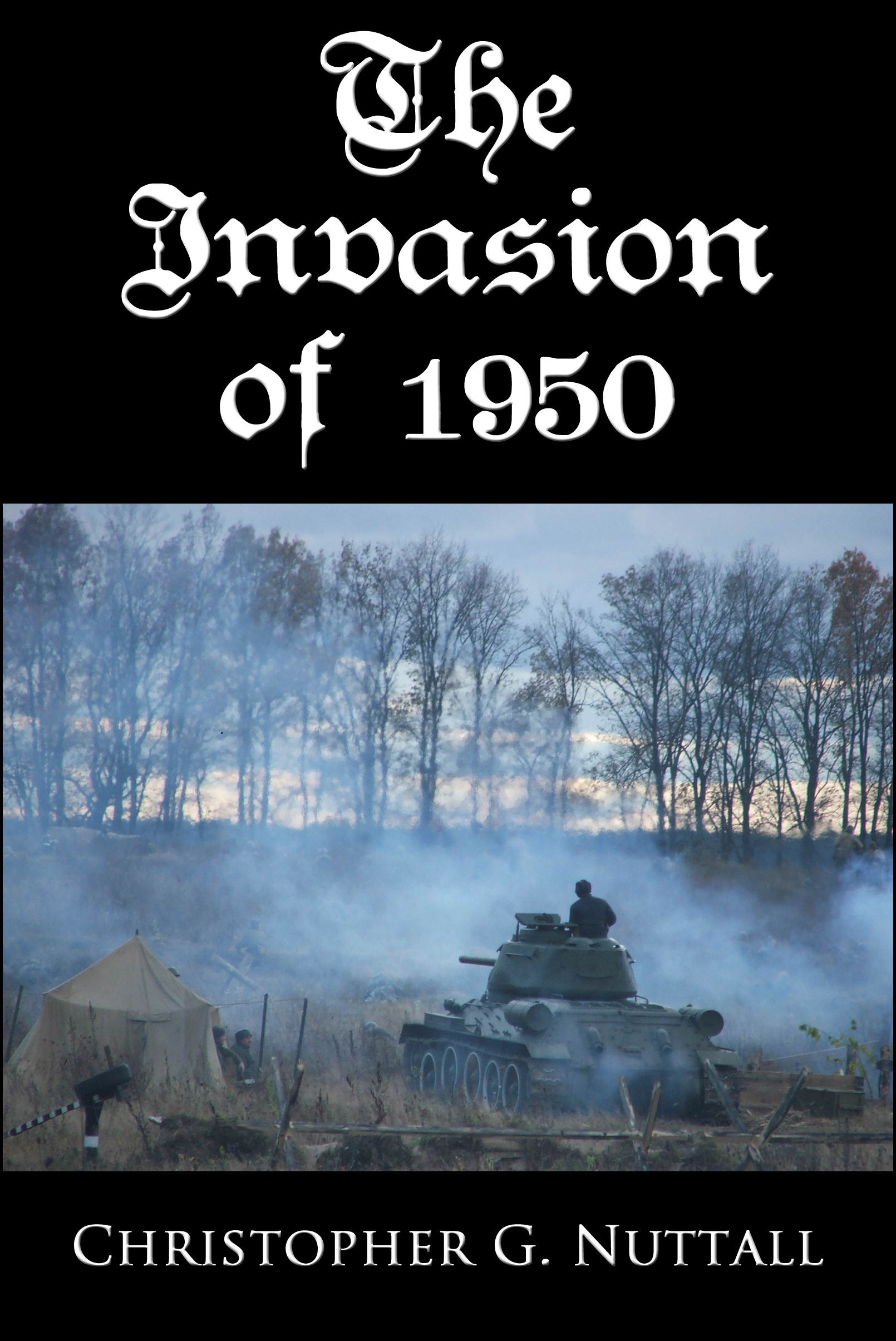
Christopher Nuttall, "The Invasion of 1950" (2013)

Just finished this self-published alt-history (allohistorical) work...

I heartily enjoyed it; worth the time, although it could use some editing. I did approach it, however, as pure escapist entertainment and not alternative history grounded in plausible variation of historical facts. More comments soon.

In the interim, travel over to the author's blog for more info.

Wednesday, 18 March 2015

Timur Vermes, "Look Who's Back" (2012)

This is likely one of the most clever, amusing, intriguing and generally enjoyable fiction books I have read in a long time.

Essentially, the premise is that Adolf Hitler awakens with a pounding headache in a Berlin vacant lot in 2011. He has no memory of what has transpired since April 1945, with his last memory of that time being the act of showing Eva Braun his antique pistol. The rest of the story is simply too good to spoil. Vermes combines a singular wit, trenchant political commentary, and thought-provoking representation of how Hitler might understand the contemporary political world (both within Germany, as well as beyond).

Some snippets that I found particularly enjoyable (pagination is from my digital version):
37: “…in the last sixty-six years the number of Soviet soldiers on the territory of the German Reich had fallen substantially, particularly in the Greater Berlin area. The current figure was between thirty and fifty men; in a flash I could see that this afforded the Wehrmacht a far better prospect of victory compared to the last estimate from my general staff of around 2.5 million enemy soldiers on the Eastern Front alone.”

41: “We all know, of course, what to make of our newspapers. The deaf man writes down what the blind man has told him, the village idiot edits it, and their colleagues in the other press houses copy it. Each story is doused afresh with the same stagnant infusion of lies, so that the “splendid” brew can then be served up to a clueless Volk. In this instance, however, I was prepared to be somewhat lenient. So rarely does Fate intervene this strikingly in its own workings that even the smartest minds must find it difficult to comprehend, let alone the mediocre intellects serving our so-called opinion sheets. My brain required the stomach of an ox to digest the other information I managed to unearth.”

48: “What irony: yesterday I was repositioning the 12th Army; today it was magazine racks.”

194: “the so-called reunification of Germany into his expansive lap. I have to concede that this supposed “reunification” was one of the few first-rate lies propagated by the republic. For how could they call it a proper reunification when essential components – such as the aforementioned Silesia granted to Poland, as well as Alsace-Lorraine or Austria – were missing?”

378: “That’s pure gold!” Madame Bellini said when, heavy-hearted, I showed her the report on the “National Democrats” alongside others we had filmed.”

540: “the telephone has to be a telephone, a calendar, a camera and everything else besides. This is dangerous nonsense, the only possible consequence of which is that thousands of our young people will be mown down on the roads because they cannot stop staring into their screens. One of my first undertakings will be to outlaw such telephone devices or allow them only for those inferior racial elements remaining in our society – for the latter I may even make them compulsory. Then they will litter the main thoroughfares of Berlin like squashed hedgehogs.”

541: “Christmas decorations have become more tasteful with the passing of the years. A most disagreeable industrialisation has taken hold. I am not concerned about whether something is kitsch or not, for every example of kitsch harbours a residue of the feelings of the simple man, and since that is the case there will always be the possibility of a development towards real art. No, what really bothers me is that the importance of Father Christmas has grown disproportionally, doubtlessly as a result of Anglo-American cultural infiltration.”

547: “He has also devised a new electoral slogan. It will be plastered at the bottom of all the placards, giving them a common thread. The slogan addresses old virtues, old doubts, and for good measure has a humorous, conciliatory element to win over those pirate voters and other young people. The slogan reads: “It wasn’t all bad.”


Thursday, 22 January 2015

Thom Hartmann, "Crash of 2016" (2013)

Subtitle: "The Plot to Destroy America and What We Can Do About It".

What most surprised me about this book, and I'm not sure why, is that Hartmann seems to be left-leaning. Concern with financial crashes and plotting out one's financial survival generally seems to be associated with libertarian, conservative ideology.

Essentially, Hartmann tracks out a series of political decisions over the last several decades that indicate a potentially fatal loosening of controls over corporations that have allowed wealth to accumulate in fewer and fewer hands, and gutted the kinds of social policies that kept economic/class disparity under control within the United States. He suggests that this problem comes about cyclically, about every 80 years or so, based on the passing of the people who experienced the horrible outcomes of similar decisions within their own lifetime.

Frugal Musings has a very good, if lengthy, discussion of the book.

Gregory Klages -
Quotations from, and notes on:
Crash of 2016: The Plot to Destroy America and What We Can Do About It

CHAPTER 3: The Crisis Capitalists
"In 1947, two years after the war ended, Friedrich Hayek gathered a large group of economists, historians, journalists, and businessmen to a meeting in Mont Pelerin, Switzerland.

"...what Hayek was unable to do, mainly because he was operating with the catastrophic consequences of his free-market philosophy still fresh in everyone’s mind, Friedman would do—and that’s lead a global counterrevolution against controlled capitalism

"These so-called free-market reforms promoted by the members of the Mont Pelerin Society and later the Chicago Boys do not constitute a legitimate economic theory, as they’ve never worked anywhere they’ve been tried, anywhere in the world. They constitute a religion.

"...two years into Pinochet and the Chicago Boys’ rule, inflation had reached 341 percent—higher than anywhere else in the world. The price of goods increased by 375 percent. GDP decreased by 15 percent. Agriculture production sputtered to a grinding halt. Export values dropped 28 percent and Chile acquired a $280 million trade deficit. And to top everything off, Chile’s unemployment rate skyrocketed from 3 percent—among the lowest in that hemisphere—before Friedman stepped foot in the country to more than 10 percent and, in some parts of the country, as high as 22 percent

CHAPTER 4: A Middle-Class Primer
"The United States has had two great periods of what we today call a middle class. The first was from the 1700s to the mid-1800s, and was fueled by virtually free land for settlers (stolen from the Indians) and free labor (slavery in the South and indentured immigrants in the North). The result was (as de Tocqueville pointed out) the most well-educated, politically active, middle-class “nonaristocrats” in the world.

"...the period between 1947 and 1979 saw unparalleled equitable growth. During these thirty-plus years, the poorest fifth of Americans saw a 116 percent increase in their incomes. The middle fifth, a 111 percent increase. And the top 5 percent saw an 85 percent increase. All income classes shared in the prosperity of the times when the top marginal income tax rate was above 70 percent.

"...progressive taxation, which gave workers more to spend and gave the rich an incentive to pay their workers better to maintain a stable workplace (since if they took the money themselves, it would just mostly go to taxes), thus stimulating demand for more goods and services.

"Whenever top marginal tax rates were relatively high—above 60 percent usually—the economy was at its most stable.

"...in 1944, FDR...proposed a Second Bill of Rights.

These rights included:
"The right to a useful and remunerative job in the industries or shops or farms or mines of the nation; The right to earn enough to provide adequate food and clothing and recreation; The right of every farmer to raise and sell his products at a return which will give him and his family a decent living; The right of every businessman, large and small, to trade in an atmosphere of freedom from unfair competition and domination by monopolies at home or abroad; The right of every family to a decent home; The right to adequate medical care and the opportunity to achieve and enjoy good health; The right to adequate protection from the economic fears of old age, sickness, accident, and unemployment; The right to a good education

"An early instruction manual for the game of Monopoly in 1925 reads, “At the start of the game every player is provided with the same amount of capital and presumably has exactly the same chance of success as every other player. The game ends with one person in possession of all the money. What accounts for the failure of the rest, and what one factor can be singled out to explain the obviously ill-adjusted distributions of the community’s wealth which this situation represents?”

"...not only is the accumulation of vast amounts of wealth in the hands of an elite aristocracy not good for working people, it’s also not good for economies as a whole, which is exactly what the game Monopoly teaches us.

CHAPTER 5: Reagan Kidnapped the Jetsons
"In a 1966 article, TIME magazine looked ahead toward the future and what the rise of automation would mean for average working Americans. It concluded, “By 2000, the machines will be producing so much that everyone in the U.S. will, in effect, be independently wealthy. With Government benefits, even nonworking families will have, by one estimate, an annual income of $30,000–$40,000. How to use leisure meaningfully will be a major problem.” And that was $30,000–$40,000 in 1966 dollars, which would be roughly $199,000 to $260,000 in 2010 dollars.

CHAPTER 6: “Madness”
"That’s exactly what speculators were doing—buying up huge amounts of wheat contracts and holding on to them until they could be sold at a higher price. This had catastrophic effects on the global food supply.

"The force of Globalism,” [John Ralston] Saul writes, “through trade agreements, deregulation and privatization, would seriously weaken the ability of nation-states to act with any political independence.”

“Richer than a majority of nation-states on the planet, free of the geographical and social obligations of these old states, beyond the embarrassing demands of nationalism, freed in fact from the emotional, immeasurable demands of the citizenry, the transnational would be able to organize world affairs in a more rational, efficient manner.”

"Columnist Chrystia Freeland nailed this mind-set perfectly in her 2011 article “The Rise of the New Global Elite,” which ran in The Atlantic magazine. She reported that one influential American hedge fund manager argued that it didn’t matter if the US economy was in peril, because “if the transformation of the world economy lifts four people in China and India out of poverty and into the middle class, and meanwhile means one American drops out of the middle class, that’s not such a bad trade.”

"By 2008, actual commodity sellers and buyers were completely marginalized in the market by speculator banksters, who accounted for 80 percent of all futures purchases. And with their price manipulations, these derivative bombs cratered our economy with high gas prices.

Economist Steve Keen, author of Debunking Economics
"They will always want to lend more money… the banking sector profits by creating debt”...

CHAPTER 7: A Revolution Denied
"The Iroquois Confederation’s “Great Law,” which was a major inspiration for the American Constitution, famously called for all governmental decisions to be made in the context of their impact on “the Seventh Generation” down the line into the future.

CHAPTER 9: Betrayal on the High Court
"...with this decision in place and the law of the land, the First Amendment now protects the “free speech” rights of the presidents of Russia and China and Iran to form corporations in the United States and pour millions of dollars toward supporting or defeating the politicians of their choice. It protects the “right” of the largest polluting corporations on earth to politically destroy any politician who wants to give any more authority to the Environmental Protection Agency. It protects their “right” to elevate to elected status any politician who is willing to dismantle the EPA—or any other government agency that protects or defends the people of America from Royalist predation

"...the bible of legal scholars—the book that the framers of our Constitution had frequently cited and referenced in their deliberations in 1787 in Philadelphia—Sir William Blackstone’s 1765 Commentaries on the Laws of England...

"Stevens recounted the history of the evolution of corporations in America, noting, “Corporations were created, supervised, and conceptualized as quasi-public entities, ‘designed to serve a social function for the state.’

"As a result of Citizens United, outside political spending skyrocketed from just $68 million in the 2006 midterms, to over $304 million in the 2010 midterms. That’s a 400 percent increase in corporate cash influencing elections and buying politicians, just ten months after the Citizens United decision.

CHAPTER 10: Masters of the Universe
"On average, a member of the House of Representatives must raise $5,000 a week for his or her campaign. That means that every morning, Monday through Friday, they must wake up not thinking about governing but about fund-raising—how to scrounge up a thousand bucks that day. In the Senate it’s even worse, at an average of $14,000 a week.152 And those numbers were compiled by PBS before the Citizens United decision—today’s numbers are significantly higher.

American Legislative Exchange Council = ALEC

"...it’s a dating service setting up corporate lobbyists and state legislators,” he told me. “The culmination is the passing of special-interest legislation.”

"I don’t want everybody to vote. Elections are not won by a majority of people. They never have been from the beginning of our country and they are not now. As a matter of fact, our leverage in the elections goes up as the voting populace goes down.”

"It’s no wonder that the American people have played into the hands of the Royalists and, as a result, have very little trust in government. After all, there is no reason why they should, because democratic government, as we once knew it, no longer exists

CHAPTER 11: This Is the End
"...in 1977, Harold E. Davis wrote a brilliant monograph for the Georgia Historical Society titled The Scissors Thesis, or Frustrated Expectations as the Cause of the Revolution in Georgia...

CHAPTER 12: Organized People v. Organized Money
"Artificial entities, such as corporations, limited liability companies, and other entities, established by the laws of any State, the United States, or any foreign state shall have no rights under this Constitution and are subject to regulation by the People, through Federal, State, or local law. The privileges of artificial entities shall be determined by the People, through Federal, State, or local law, and shall not be construed to be inherent or inalienable

"On December 6, 2011, Los Angeles became the first major city in the United States to call for a constitutional amendment to end corporate personhood.

"There have been similar resolutions passed in Boulder, Colorado, and Missoula, Montana, that say corporations are not people and money is not speech.

"I particularly recommend the model put forth by David Cobb at MoveToAmend.org.

"...the headnote to the Santa Clara County 1886 decision that asserted corporations are the same as natural persons in terms of constitutional protections.

"The [U.S.] Supreme Court was beyond their constitutional power when they handed George W. Bush the victory in 2000...

"...the [U.S.] Supreme Court was way beyond their constitutional authority every single time they created out of whole cloth new legal doctrines, such as “separate but equal” in Plessy v. Ferguson, “privacy” in Roe v. Wade, or “corporations are people” in Citizens United v. Federal Election Commission.

Friday, 2 January 2015

William Forstchen, "One Second After" (2009)

Forstchen essentially narrates, through the vision of a typical hero of a US conflict narrative, the struggle for the citizens of a small North Carolina town to survive the year following an electromagnetic pulse (EMP) attack on the continental United States (as well as two other parts of the world).

Characterization is not Forstchen's forté. The narrator is a university history professor, former military man, widower, and father of two teenage girls. The protagonist is a bit of a cutout: former smoker falling back into the habit to manage the awful stress, stepping into difficult situations to do things no one else is willing to do, making good strategic calls for the benefit of the community, etc., etc., etc. Forstchen makes some effort to give the character some more human dimensions; he indicates that although a military man, the narrator served primarily in an administrative/leadership role and had little combat experience, he quickly starts voraciously eyeballing an attractive woman who finds herself stuck in the community, and he loves his dogs.

Where this book is intriguing, however, is as a piece of post-apocalytic/dystopian political fiction. The primary concern of the novel is exploring how societies would choose to govern themselves in the absence of 'higher temporal authority'. In this regard, Forstchen offers intriguing scenarios, poses challenging problems, and considers how they might be most likely resolved. Substantial space is given to describing discussions of the 'town council', explaining the thinking processes underlying decisions, and narrating discussions as options are weighed.

I have two core criticisms with the text. Firstly, there is little consideration given to resistance, dissension, and madness. In a dystopian scenario based on a near-instantaneous collapse of society - even within a somewhat isolated, small population centre - I would expect that many situations would dissolve into shouting matches, pushing and shoving, screaming and hair-pulling, accompanied by acts of desperation and insanity. Although Forstchen addresses looting, pillaging, rape, and cannibalism, these all seem to be marginal acts perpetrated by marginal figures in the story, and are treated clinically. Within the community, self-control and cooperation seems to be the near universal response. Perhaps this strategy was intended to underline the heroic charisma of the leaders, but for a society oriented around a revolutionary, individual rights focus, seems rather idealistic or naive.

Similarly, the enemy - the outsiders - are caricatures. Drug addicts and gang members from a nearby larger population centre, they manage to cobble together a small army to raid and terrorize other communities. While it is entirely possible that these types of groups might exist, it is difficult to see how they would manage to survive for an extended period as travelling marauders, particularly as they would likely not have the technical skills to adapt to the available technology, to generate a food supply once the existing reserves are depleted, and to create a viable leadership that is not constantly battling for dominance against competitors. It is far more likely that most communities would simply not be able to manage floods of refugees, the ravages of disease, and internal squabbling.

Overall, I think Walking Dead offers a more reasonable account of the post-apocalypse than One Second After. Of course, absent the zombies.

You can visit the book website.

Thursday, 23 October 2014

Stephen King, "Cell" (2006)

Meh...
I used to turn to Stephen King novels as 'palate cleansers', something fully to read that wouldn't tax my brain, and to give myself a break from political history books. I can't recall what the last King novel is that I read, but it was likely one from the '80s. Cell crossed by path and as it was fairly short, I thought I might as well poke my toe in the pool and see what King has been up to for the last decade or two.

As the book's title intimates, the storyline revolves around the effects a mysterious 'pulse' emitted from cellphones has on the phones' users. In a few minutes of time, the world seems to have been turned into a maelstrom of neck-biting, flesh-ripping, self-destructive peoploids, chasing each other and the as yet unaffected. The protagonist of the story has just finalized a book deal, and hopes that this change might help save his failed marriage. He is feeling like his life is turning around into something positive, when the zombie apocalypse begins.

For fans of gore and zombies, Cell is a good read. The action starts within the first few pages, and the zombies never disappear as a threat. Sloppy romanticism is kept to a minimum, although King's attempts to undermine it are a little heavy-handed. In particular, most of the efforts to establish a sustained optimism regarding familial or paternal feelings come to naught (and often end in messy death).

The book's ending is a little unsatisfying. Although I'm sure it's intended to be cliffhanger, and perhaps to leave the door open to a sequel, it smacked more of laziness to this reader. It felt like instead of resolving the plot line, King simply stopped writing, got up from his desk and said, "ah, well, that's good enough."

Friday, 5 September 2014

Julie Schumacher, "Dear Committee Members" (2014)

A genuinely good hoot, this book will particularly be appreciated by anyone who has lived or worked in academia above the undergraduate level.

Essentially, it tells the tale - through a series of recommendation letters and requests for help - of a tenured Creative Writing professor at some East Coastish mid- to small-sized US university. He struggles with his own underperformance, as well as with the apparently diminishing respect for his department within the university. The letters tell the tale of romantic failures (his ex-wife and his ex-girlfriend both work for the university), his resistance to technological communication (he writes letters rather than emails, perhaps due to a messy and embarrassing 'reply all' incident where he strives to reignite one of his relationships), students - good and bad - seeking his help in doing everything from gaining publishing contracts to getting jobs at restaurants.

All in all, I laughed out loud multiple times. Schumacher has accurately captured the fish-bowl narcissism and bitterness that contemporary academia feeds. I'm tempted to recommend this book to all students who consider asking me for letters of recommendation.

Saturday, 19 April 2014

Jeff Greenfield, "Then Everything Changed" (2010)

Sub-titled: "Stunning Alternate Histories of American Politics: JFK, RFK, Carter, Ford, Reagan."

What distinguishes this book from many allohistorical texts - particularly those considered with political popular culture (that is a term I can apply to the Kennedy assassinations, no?) - is that the author is genuinely a political insider. He had familiarity with many of the people he writes about, including the Kennedys. He also brings years of experience as a political analyst and commentator. This knowledge has led him to write a book that is more daunting than the average 'science fiction'/casual reader might desire. It is, however, the key to Greenfield's approach.

Much of what Greenfield considers in weighing historical alternatives is based on tweaking a single event, and then looking at the weight of likely political response, particularly in how the negotiation of alliances, strategizing, and campaigning would play itself out in the new circumstances provided by the author's re-imagining. So, for instance, RFK's near-assassination is obviously important, but where the true 'grit' of Greenfield's imagination gains its importance is how he conceives of RFK's electoral chances given the likely messaging his team would have pursued, who the Republicans might have selected as their candidate in response to the changed circumstances, and how their competing messages might have played out in the various electoral colleges. Frankly, fascinating, daunting, exhausting reading that offers much for historians and political junkies alike.

I admit to knowing nothing about Greenfield before I read this book. I picked it up based on an interest in political allohistory.

Wednesday, 2 April 2014

Charlie Duff, "Detroit: An American Autopsy" (2013)

A beautiful book. Duff spares no one in his commentary from inside the belly of the corpse that is contemporary Detroit. From the trials faced by emergency responders, police, newspaper folk, regular citizens, the under- and unemployed, the homeless, city politicians, business owners, criminals... they all play a role in the decrepit stage Duff narrates his story upon.

His story is not merciless; he clearly loves the city he grew up in, and returned to. He has family there, who much like the city itself, struggle with decay, loss of dignity, and poor coping mechanisms. They figure in his story as well.

Elegiac in tone, unsparing in its assessment, frightening in its observations, Duff has indeed offered an autopsy for a patient who has died. The city he describes is a new thing, a shell of the destroyed American dream.

Friday, 20 December 2013

Edward Bellamy, "Looking Backward: 2000-1887" (1888)

Comparable in many ways to Atwood's Handmaid's Tale and Case's Silence Descends. A clever, although bit plodding, exploration of an alternate socio-economic organization of society seen through the eyes of a man who inadvertently and mysteriously slept for 113 years, re-awakening in the year 2000.

More later.

Anthony Burgess, "A Clockwork Orange" (1962)

A delicious read that is more rewarding... or perhaps, surprisingly as rewarding due to its differences... than Kubrick's film adaptation.

More later.

Tuesday, 26 November 2013

James DeMille, "A Strange Manuscript Found in a Copper Cylinder" (1888)

De Mille is a Canadian classical historian, teacher, and perhaps most famously, a fiction author who focused particularly on adventure stories. His biography is available at the Dictionary of Canadian Biography.

This particular story of De Mille's is enjoyable, although sometimes seems a bit heavy compared to contemporary work. Essentially, the plot of A Strange Manuscript... runs thusly: A seagoing ship of educated and leisured men - prone to rather annoying preaching and showy displays of arcane knowledge - discovers a copper cylinder in which is sealed a lengthy manuscript detailing a fantastical story of a man's adventure in a previously undiscovered region of the world that seems to be hidden somewhere in the vicinity of the South Pole. The narrative of the manuscript is occasionally interrupted by the crew of men debating the merits of the story, the veracity of the tale, and the perspective of the storyteller.

The story within the discovered narrative offers an intriguing critique of capitalist society, and the morals such a system is based on. The lost seaman, who is at first adrift with a shipmate, encounters adversities posed by nature - from storms to volcanoes - as well as hostile indigenous peoples who seem bent on eating him and his partner. Only one escapes these pursuers, and ends up in a verdant, productive society hidden within a ring of mountains at the South Pole. The society operates according to values completely contrary to those that seem to operate in the rest of the world, however, idealizing poverty, death, suffering, and servitude as the greatest good for all individuals and society as a whole. Within this world, the paupers, the jailed, those about to be sacrificed are the highest figures, and those to be punished are the wealthy, the selfish, and those who live in the sunlight. Unsurprisingly, our discoverer/narrator struggles to learn about and understand this society, falls in love, confuses his hosts, and seeks to arrange his escape from their overly helpful hands that aim to do him the highest honour of sacrifice and cannibalism.

The entirety of the story can be read and/or downloaded for free from Project Gutenberg.

Monday, 30 September 2013

Max Brooks, "World War Z" (2006)

Full title: "World War Z: An Oral History of the Zombie War."

Not particularly compelling. Not particularly cohesive narrative.

More someday.

Thursday, 6 June 2013

Sarban, "Sound of his Horn" (1952)

A fun little bit of fantasy/sci-fi from the 1950s.

The book tells the story of a British POW who, waking from a medical trauma, finds himself an inmate within a strange Nazi hunting camp, where the prisoners are hunted, assaulted, and killed for the pleasures of the flabby and sadistic Nazi officer class. Stereotypes abound: the Nazi overseer indulges medieval predilections, the camp is populated by the products of Nazi genetic engineering, and technological advances (such as a kind of hyper-electrified fence) are employed side-by-side with throwbacks to the 19th-century (horse-drawn carriages).

A fluffy little bit of allohistory.