Showing posts with label U.S.A. history. Show all posts

Monday, 11 January 2016

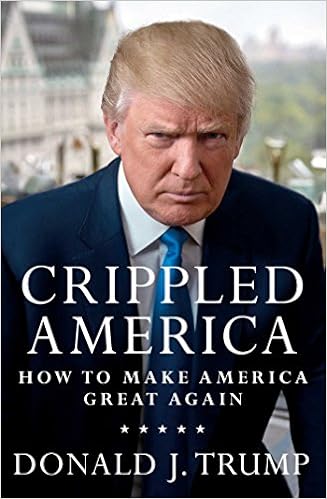
Donald Trump, "Crippled America" (2015)

Over the last decade or so Donald Trump has made a surprising conversion; he's gone from the relative anonymity of business success, to hawker of schlocky business advice books and seminars, to host of a reality tv show parody of business skills, to Tea Party-esque 'birthed', to US Republican party presidential candidate. Among these roles, however, was no experience with government or public service. I wanted to see how the realities of Trump's history might be managed to present him as a serious contender for US leader. His book lived up to every expectation his previous work created.

My review of the book is not based on my perception of Trump's policies, but on my assessment of the book as political biography/manifesto. It was helpful, however, to get a sense of Trump's policy-making logic. The book came across as an extended, unedited interview with little attempt to be reflective. A multitude of contentious assertions are made that sorely require some citation of evidence if they are to be considered as plausible. Annoying self-serving claims such as "I'm a nice guy" are repeated frequently, and give more an impression of insecurity than of the presentation of a self-proclaimed hard-headed pragmatic businessman. The book on the whole is alarming light: little meaningful biographic information, little meaningful policy, shallow analysis largely unattached to any supporting evidence or facts. I can only assume this book was intended, at best, as a fundraising venture. If so, the cover photo should have been rethought… or was purposely intended to be so weird that consumers would buy it simply to figure out what the heck Trump was thinking when he approved it.

Select quotes, with comments:
Preface: You Gotta Believe
“There’s nothing to be joyful about. Because we are not in a joyous situation right now.”

“People say that I have self-confidence. Who knows?”
--- COMMENT: What a strange comment. The rhetorical question hardly seems necessary, but does point to an important concern for Trump. One of Trump's repeated claims is that he's a 'nice guy'. Either he believes he's not, and is trying to convince his reader of something he doesn't believe, or he believes he is and is convinced that no one else believes it. If he's shy about claiming his self-confidence, it would seem he's not sure of his identity. Maybe his claims to being a 'nice guy' are an attempt to convince himself?


“I persevered and went directly to the people, because I don’t need anyone’s financial support, nor do I need anyone’s approval of what I say or do. I just had to do the right thing. I had to do it. I had no choice. I see what’s happening to our country; it’s going to hell. I had to do it.”
--- COMMENT: What confounds me about this comment is the idea that running for president is the only thing Trump could conceive of to do for his country. As a wealthy American business owner, that he had little record of previous public service or engagement suggests that his claim to actions based on moral necessity is weak.


“We need to outline commonsense policies and then knock some heads together if necessary to make them work. The fact is we are over-regulated. People can’t move. They’re stymied. Companies can’t be built. We’re over-regulated.”

“I’m a really nice guy, believe me, I pride myself on being a nice guy but I’m also passionate and determined to make our country great again.”

1. Winning Again
“I realized that with my well-known success story and record of building residential and office buildings and developing public spaces—all the while accumulating personal wealth—I could inspire people to help create the most massive turnaround in American history.”

“I’m not a diplomat who wants everybody else to be happy. I’m a practical businessman who has learned that when you believe in something, you never stop, you never quit, and if you get knocked down, you climb right back up and keep fighting until you win”
--- COMMENT: I find Trump's characterization of the goal of international diplomacy - to make everybody else happy - quite intriguing. Rather than pursuing the interests of the state, the public good, or peace, Trump believes diplomats are simply self-sacrificing do-gooders? Or, is he purposely belittling diplomacy to build a stronger case for aggressive, self-confident, independent action that ignores negative consequences for anyone else he might be trying to co-exist with.


2. Our “Unbiased” Political Media
“…politicians who boldly promise they are going to stand up to our enemies won’t even give direct answers to reporters. I don’t play that game, because I’m a very successful businessman”
--- COMMENTS: What a strange comment, built on a false difference. Why should we believe that business people have any more motivation to be honest and direct with the mass media than Trump characterizes politicians as being? Ironically, only a few pages later, Trump states that he is not, in fact, honest and direct with reporters.


“…you’d think a major news network would take their responsibilities more seriously and use these debates to help the public determine who has the best plan to make our country great again”

“I use the media the way the media uses me—to attract attention”

“…sometimes I make outrageous comments and give them what they want—viewers and readers—in order to make a point. I’m a businessman with a brand to sell.”

“…when they write a story about one of my deals, it doesn’t cost me a cent, and I get more important publicity. I have a mutually profitable two-way relationship with the media—we give each other what we need.”

“…anyone who believes I can use the media is absolutely wrong. Nobody can use the press. It’s too big, too widespread”
--- COMMENT: Another contradictory claim. If he can't 'use the media', then how can he have a 'mutually profitable two-way relationship' with them?


“…every show is trying to make news. The problem is that they aren’t doing their job. They aren’t interested in informing the public.”

“These media companies are owned by billionaires. These are smart people who know which candidates are going to be best for them, and they find a way to support the person they want.”

“…the problem we face in this country with our media. There is such competition that they’re more interested in entertaining their audience than educating them. They like me because I help them attract more viewers. They hate me because they know I don’t need them.”

3. Immigration: Good Walls Make Good Neighbors
“The Mexican government has published pamphlets explaining how to illegally emigrate to the United States.”

4. Foreign Policy: Fighting for Peace
“…building up our military also makes economic sense because it allows us to put real money into the system and put thousands of people back to work.”
--- COMMENT: Intriguing. Spending 'real money' could be done in a multitude of ways that does not put lives at risk. Same for creating jobs. Unless that money is spent in the US, and unless those forces are based in the US, however, it would seem that much of this real money will be spent in foreign ports and on foreign bases, paying foreigners and other countries. Building infrastructure, domestic security, and supporting innovation at home would seem to involve 'real money', create jobs, and keep US money at home.


“We defend Germany.”
--- COMMENT: I wonder if Trump realizes that the Cold War is over, and that the Soviet Union has collapsed. I doubt the Ukraine - arguably the closest conventional national threat to Germany - has any dreams of occupying Germany. In this regard, then, the US 'defence' of Germany lauded by Trump seems to be more of an economic stick to shake to exact compensation, exert power, and pursue US interests in Europe, not something that Germany should be going down on bended knee to pay the US for.


“An Iran with a nuclear weapon would start a nuclear arms race in the Middle East with potentially devastating consequences. The situation would rapidly escalate to being the most dangerous threat Israel has ever faced. And it would force us to use extreme measures in defense of Israel and other allies in the region.”

“I’ve had several Trump-brand products made there.”

“I could make a very important point if I refused to have my goods manufactured there.”

“I have an obligation to all of my employees and to consumers and stockholders to produce the best product at the lowest possible price.”
--- COMMENT: Trump identifies his ethical and moral obligations several times in the book. What is interesting here from a business ethics perspective is the very limited notion of stakeholder theory.


“…it is always important to be flexible—and never reveal our cards. Our politicians talk too much”
--- COMMENT: …and yet, they can apparently also be direct and honest with media, and publish books explaining their policy-making logic, goals, and ethics.


“When dealing with China we need to stand up to them and remind them that it’s bad business to take advantage of your best customer.”
--- COMMENT: An admirable bravado, given the level of US debt that China holds.


“We need to put some of the bill for this transformation on the Saudi Arabians, the South Koreans, the Germans, the Japanese, and the British. We’re protecting them, after all, and they should share in the costs.”

“The new dawn of America has just begun.”
--- COMMENT: I am amazed that any self-respecting politician would still call on this hackneyed image that seems to most often be used by far-right politicians from the Nazis to the 21st-century Greek political party.


5. Education: A Failing Grade
“…today, some teachers and school administrators are more concerned about hurting their students’ feelings or about hearing complaints from parents that they’re being too tough. Instead of becoming more competitive, we’re actually eliminating competition. That’s incredible—and wrong. Competition makes you stronger, it forces you to work harder, to do more.”

“Common Core, No Child Left Behind, and Race to the Top are all programs that take decisions away from parents and local school boards. These programs allow the progressives in the Department of Education to indoctrinate, not educate, our kids. What they are doing does not fit the American model of governance.”

“Anyone who has succeeded in business has survived a lot of failure—but they were tough enough to get back up and try again and again. Kids need to learn that success requires persistence. Self-esteem should come from overcoming challenges and surviving the hard knocks of trying to be better.”

“I’m very much in favor of school choice. Let schools compete for kids. I guarantee that if you forced schools to get better or close because parents didn’t want to enroll their kids there, they would get better. Those schools that weren’t good enough to attract students would close”
--- COMMENT: Or… schools would compete to inflate student's grades, make sure students 'felt good' as much as 'performed', and certainly called upon wealthy donors to help ensure the school had every opportunity that money could buy.


“In too many classrooms, though, we’ve taken away their right to discipline disruptive kids, turning the teachers into babysitters as much as educators.”

“The really good and inspirational teachers burn out under the painful conditions found in too many schools. The bad teachers tend to hang around since they have nowhere else to go. Thus, the paychecks tend to be bigger for the less capable.”

“There is no reason the federal government should profit from student loans. This only makes an already difficult problem worse. The Federal Student Loan Program turned a $41.3 billion profit in 2013.”


6. The Energy Debate: A Lot of Hot Air
“Violent climate “changes” are nothing new. We have even had ice ages. I just don’t happen to believe they are man-made.”
--- COMMENT: Great. This would be an ideal place to provide any kind of evidence other than personal belief. As a project manager/property developer, I do wonder why Trump concludes his perceptions of things are more authoritative than a vast population of environmental scientists.


“…we need to take advantage of every opportunity, including approving the Keystone XL Pipeline.”

7. Health Care Is Making Us All Sick
“This is a subject that has been really important to me for a very long time.”

“…it was only approved because President Obama lied 28 times saying you could keep your doctor and your plan—a fraud and the Republicans should have sued—and meant it”
--- COMMENT: This type of very aggressive claim really requires some kind of evidence and explanation.

“We should hire the most knowledgeable people in the world on this subject and lock them in a room—and not unlock the door until they’ve agreed on the steps we need to take.”
--- COMMENT: A great solution, given how easily and quickly the current policy was decided upon.


8. It’s Still the Economy, Stupid
“I am concerned for the people who can’t buy into the American dream because the financial programs of this country are so tilted in favor of the rich”

“For the past year, the United States has been the one country that has maintained financial stability while Europe and Asia faltered.”
--- COMMENT: American exceptionalism and myopia. Hey, Trump, maybe you should look at the record of your largest international trade partner.


“Ford recently announced that it’s building a $2.5 billion plant in Mexico. Nabisco is moving a big plant from Chicago to Mexico. A German auto company was all set to build a plant in Tennessee, but then it changed its mind and is building it in Mexico instead.”

9. Nice Guys Can Finish First
“I’M A NICE GUY. I really am.”

“I have outlined plenty of policy initiatives. This is not “the politics of hope.” This is “the politics of reality,” which only a strong businessman like me can develop.”
--- COMMENT: I still don't understand how Trump concludes that only businessmen can develop reasonable, workable public policy. Is he really so dismissive of everyone else's skills?


“Me? I speak for the people.”
--- COMMENT: Use of these ambiguous phrases drives me batty. When Trump says 'the people' who is he suggesting he does not represent? Who is not part of the 'people' in the US to Trump?


“…at one time I was a registered Democrat”

“Now I’m a conservative Republican with a big heart. I didn’t decide to become a Republican. That’s who I have always been.”

12. Our Infrastructure Is Crumbling
“…we can create the biggest economic boom in this country since the New Deal when our vast infrastructure was first put into place.”

“On the federal level, this is going to be an expensive investment, no question about that. But in the long run it will more than pay for itself. It will stimulate our economy while it is being built and make it a lot easier to do business when it’s done”
--- COMMENT: See my comments above re: military spending. Trump, which way is the wind blowing?


13. Values
“I was a much better father than I was a husband, always working too much to be the husband my wives wanted me to be.”
--- COMMENT: Another intriguing ethical position. Being a good husband does not have independent, role specific ethical requirements for Trump, but rather success at the role is shaped by the perceptions of others, in this case, his wife.


“In business, I don’t actively make decisions based on my religious beliefs, but those beliefs are there—big-time.”

“It’s not my job to defend the president. President Obama would never defend me.”
--- COMMENT: Mark 12:31, Matthew 22:39, John 15:13, Leviticus 19:18, 1 John 4:11, Luke 6:29.


14. A New Game in Town
“I’m criticized for not issuing elaborate, detailed policy statements. What good are detailed plans if your country doesn’t have the credibility to carry them out—but I issue them anyway.”

“Making America Great Again means taking our country back from the big-money interests.”
--- COMMENT: Wait… Trump is rich enough to not need the media. He's rich enough to not have to pander to financial supporters. So… he's planning to take the country back from himself? Perhaps self-imposed exile?


15. Teaching the Media Dollars and Sense
“People sometimes forget that the newspapers and television stations are profit-making businesses—or at least they’re trying to be.”

“I know that every poll shows that the public doesn’t trust the media. The irony about that is that the media is conducting those polls”
--- COMMENT: Kind of like the rich telling the poor that they plan to take care of the little guy's interests.


16. A Tax Code That Works
“The federal tax code is 74,608 pages long. Nobody can really understand it, not even the accountants who try to help taxpayers fill out their forms”

“Instead of multiple tax brackets with multiple variations, there will be only four brackets: 0%, 10%, 20%, and 25%.”

“This plan will also require companies with off-shore capital to bring that money back to the United States at a repatriation rate of only 10 percent”

My Personal Financials January 7, 2016

Wednesday, 7 October 2015

Frederick S. Lane III, "Obscene Profits" (1999)

Subtitle: "The Entrepreneurs Of Pornography In The Cyber Age."

Read, but comments not yet written.
Consider this a placeholder.

Friday, 11 September 2015

Stephen King, "11/22/63" (2011)

Novel read, comments yet to be posted.
Consider this a placeholder.

Saturday, 18 July 2015

Kevin Lippert, "War Plan Red" (2015)

Subtitle: "The United States' Secret Plan to Invade Canada and Canada's Secret Plan to Invade the United States."

More notes to follow soon.

Lippert's book is disappointingly brief for such a provocative concern. Essentially, he provides a fairly basic outline of Canadian-American relations since the early 1800s, highlighting armed conflicts ranging from all-out wars (War of 1812), to silly skirmishes over concerns such as ownership of a pig.

Much of Lippert's focus is on a rather fanciful Canadian plan for how it might invade the United States if circumstances ever compelled it. This feint - which hardly lives up to the promise of the book's title - was primarily intended as a delaying tactic by which Canada might dampen US enthusiasm for invasion, and destabilize US plans to assault Canada if Canada was ever able to safely and reasonably conclude it was about to be invaded by the United States. That Canada would attempt a pre-emptive invasion of the United States is a stretch of imagination, which is likely one of the reasons Lippert's book takes a rather light-hearted approach to the idea of war between the two countries.

His assessment of US plans to invade Canada are unnecessarily similarly light. Given the traditional dynamics between the two countries, that the US had plans to occupy Canada - from Manifest Destiny onwards - and that it had the capacity to do so (as if physical invasion was even really necessary after NAFTA) would seem reason to approach the idea with more circumspection.

Thursday, 9 July 2015

Debra Weyermann, "Answer Them Nothing" (2011)

Subtitle: "Bringing Down the Polygamous Empire of Warren Jeffs."


Comments to come soon.

If you are interested in this book, you might also be interested in reading my comments on:
Alex Beam, American Crucifixion: The Murder of Joseph Smith (2014),
Matthew Bowman, The Mormon People: The Making of an American Religion (2012).


QUOTATIONS SELECTED BY GREGORY KLAGES:

Prologue: The Raid
"...the worst fallout came from the ocean of depressing photographs epitomized by Life magazine’s September 14, 1953, pictorial essay of the raid and its aftermath. In the article entitled “The Lonely Men of Short Creek,” Life photographers flexed their renowned artistry with photo after photo of Short Creek’s remaining damaged yet stoic men, determined to do their level best to keep life normal for their motherless children."

"With a few notable exceptions, American media continue to fail the public comprehension of what, exactly, FLDS is by modeling its coverage of the sect on a half-century-old Life article."

2: Section 132
"The energy LDS has spent on polygamy seems almost tragic given the fact that the practice was not even part of the movement’s original theology. Even when the charming and dynamic prophet Joseph Smith wedged polygamy into his doctrine years after starting the church, most of his followers were aghast and repulsed."

"Only about 15 percent of Americans were card-carrying members in any denomination at the time…"

"As a young man, Smith, along with his father and other male family members, made a sideline of 'money digging.' A digger utilized magical “peep stones” to inform his client of the location of buried treasures."

"LDS goes apoplectic when Smith’s money-digging career is broached, even blindly denying Smith’s 1826 misdemeanor conviction as 'a disorderly person' after his only unsatisfied customer complained."

"Smith realized he could translate the reformed Egyptian with his money-digging peep stones. To accomplish the translation, Smith sometimes placed the stones in the bottom of a tall hat placed on a table upon which also rested the gold tablets, which were covered by a sheet. Burying his face in the hat, Smith’s peep stones would transform the reformed Egyptian into a form of English that sounded suspiciously like the King James version of the Bible. A 'scribe' physically separated from Smith by a sheet hung from the ceiling would then write down what Smith saw in the stones for what would become The Book of Mormon."

- Yale professor Harold Bloom - his book The American Religion

"Mormon polygamy came to widespread public attention in the 1840s…"

"Smith allowed publication of a polygamy-advocating pamphlet called The Peace Maker in 1842."

"Some historians speculate that Smith may have started 'marrying' outside women as early as 1831, telling a few intensely close associates at the time, but he told his mostly utterly horrified inner circle about God’s mandate for 'plural marriage' around 1841."

"In March 1832, when the Saints were headquartered in Ohio, Smith was dragged from his bed to be tarred, feathered, and beaten senseless by a mob led by the brother of a teenage girl Smith was suspected of seducing. Smith was not permanently injured, but only because the surgeon enlisted to castrate him lost his enthusiasm for the job."

"After Smith’s death, Emma and her sons eventually joined the Reformed Church of Jesus Christ of Latter-Day Saints, which denied the church had ever sanctioned plural marriage."

- "groundbreaking biography of Joseph Smith, the late excommunicated-Mormon historian Fawn Brodie" (No Man Knows My History)

"Having made the historical case for polygamy, Smith was able to fuse it onto his original premise. There couldn’t be monogamy, he argued, because the kingdoms men would rule as Gods after their deaths were to be populated by that man’s children. The more children, the greater the riches of the world. Obviously, one woman could not produce enough children for a respectable kingdom. Anyone demanding monogamy was trying to trick you out of a decent afterlife."

"Joseph Smith had already concluded the Saints would have to set up their own country after Smith’s 1844 bid to become president of the United States failed in a big way."

"Young’s plans for an independent country hit another snag when the United States acquired all of the prophet’s target territories in the 1848 Treaty of Guadalupe Hidalgo ending the Mexican American War."

"In 1856, a catastrophic drought and a series of crop-devastating grasshopper scourges pushed the Saints to the brink of starvation, and Young decided they all needed to recommit to the religion. The Mormon Reformation of 1856–58 was an unbridled festival of fire and brimstone, stoked by fanatical Smith devotees."

"Young also used the Reformation to push polygamy hard. Declaring that 'any man who denied plural marriage was damned'...”

"Young’s demonization of new settlers, combined with his zealous revivalism, culminated in the Mountain Meadows Massacre of 1857, the execution-style murders of 120 men, women, and children on their way from Arkansas to California, traveling in the richest wagon train to ever pass through economically disadvantaged Salt Lake City…"

"Before the [U.S. Civil] war became a total distraction, the antipolygamy Morrill Act passed in 1862. After the war, the Edmonds Act again outlawing polygamy passed in 1882, followed by the merciless 1887 Edmonds-Tucker Act, a furious wrecking ball aimed directly at Brigham Young’s Mormons. Edmonds-Tucker allowed for the seizure of church property valued at more than $50,000 and disincorporated the LDS Church and its Perpetual Emigrating Fund Company critical for bringing thousands of European converts to Utah on the grounds that both entities promoted illegal polygamy."

"President James Buchanan had already removed Brigham Young as territorial governor in 1857…"

"In a landmark 1878 decision, the U.S. Supreme Court ruled that religion did not trump U.S. law, period."

"...president James Buchanan dispatched 2,500 troops to bring the Mormons to heel as early as 1857. That effort fizzled, becoming something of a joke."

"Brigham Young might never have acknowledged it, but his death in 1877 left Mormon leaders free to realistically contemplate their chances…"

"May 1890 when the U.S. Supreme Court ruled in the case of Late Corporation of the Church of Jesus Christ of Latter Day Saints v. United States, upholding the Edmonds-Tucker provision allowing the government to seize LDS property."

"Just three months later, in August 1890, a besieged Wilford Woodruff delivered the Manifesto ending plural marriage."

"Smith, and certainly Young, had inexorably established polygamy as a requirement—not an option—for admittance to the celestial kingdom, which was the whole point of being Mormon. From the instant the Manifesto left Woodruff’s lips, Mormon polygamists argued the explanation was an insultingly transparent political capitulation to a secular entity with no authority to override God’s laws."

"LDS officials are squeamishly evasive about the multistory, fifteen-barrel silo outside Salt Lake City stuffed with four hundred thousand pounds of grain, the food is there to sustain Mormons during the worldwide chaos that will precede the Second Coming…"

"Despite two manifestos from separate prophets who were also talking to God, LDS has not removed the plural marriage revelation. To the contrary, LDS has not restored Smith’s 1835 revelation condemning polygamy — a revelation LDS deleted from the Doctrines and Covenants in 1876 because it conflicted with the revelation ordering polygamy."

"The visit was singed with controversy when it came to light that LDS had baptized Obama’s late mother into the church with its dubious practice of using proxies to stand in for the dead at the ceremony without alerting the deceased’s living family members. Mormon leaders were obliged to walk back the Obama baptism quietly, but outraged Jewish leaders forced a public retraction of LDS postmortem baptisms of Jews murdered in the Holocaust."

"LDS published a training manual in 1998 that portrayed Brigham Young as a monogamous husband. Polygamy is mentioned nowhere in the manual. Among the work’s significant omissions is Mormon doctrine holding that God is himself a polygamist, as is Jesus Christ, whose wives included Mary Magdalene. When questioned by reporters, LDS officials Ronald L. Knighton and Craig Manscill staunchly defended the omissions, saying the manual was not intended as a historical document, only a broad introduction to the Mormon faith. The officials insisted the failure to mention polygamy was legitimate because the practice had been stopped in 1890."

"American Indians, called Lamanites, also carry the blood of ancient Israel but, like many Gentiles who have not yet been converted, don’t realize it. The Book of Mormon teaches that ancient Hebrews traveled to the New World around 600 B.C. in a submarine-like boat, creating an advanced civilization with a number of nineteenth-century amenities. This population eventually split into the “good” tribe of Nephites and the “bad” tribe of Lamanites, who became embroiled in a centuries-long war. After Christ’s crucifixion, he visited the New World and was able to remind the Lamanites of their roots, but they soon forgot and eventually wiped out the Nephites. God cursed the Lamanites with dark skin for their wickedness, but Mormon prophets taught they would again become a 'white and delightsome' people when their memories were restored after the apocalypse."

"Smith’s career as a money digger is fairly well known, but in his book Early Mormonism and the Magic World View, excommunicated Mormon historian D. Michael Quinn discusses at good length the Smith family’s dabbling in other areas of magic and the occult, including necromancy, in which spirits of the dead are conjured up to reveal the future."

"Only the Lutheran Church Missouri Synod equivocates its position on whether Mormonism is a Christian faith. All other major Christian denominations, including Catholics, Baptists, Presbyterian, Episcopalian, and so on, have position statements advising that, among other things, the Mormon belief that there are many gods, that God was a man, that men may become gods, that God and Jesus Christ were polygamists (a detail Smith added after he’d introduced polygamy years later), and that God and Jesus Christ are separate entities, not part of the holy trinity, are inconsistent with Christianity."

"Until 1978, only white males could attain the end goal of deification."

"Explaining that the 1835 revelation was inconsistent with church dogma, LDS leaders removed it from the Doctrines and Covenants in 1876. Despite the fact that it would now appear to be consistent with church dogma, it has not been reinstated..."

3: Bill Walker and the First Case
"...a dogma true for both LDS and FLDS to this day. Only men have the power to elevate their wives into heaven."

"...children are literally considered FLDS priesthood property. Once born, mothers are understood to have no further claim on their babies, and indeed, Warren Jeffs would soon take up the habit of reassigning children willy-nilly to families of his selection, informing the biological mothers that they would never see their kids again."

4: Judge Shumate
"Certain that LDS was now irredeemably apostated, disgusted polygamists began filtering into what is called the Arizona strip some fifty miles east of St. George, founding a community called The Work. It would evolve into FLDS."

5: The New Sheriff
"Mankind are here because they are the offspring of parents who were first brought here from another planet…"

"In both LDS and FLDS, worldly events must be recorded in this life in order to be acknowledged in the next. Joseph Smith urged all his converts to keep punctilious personal journals…"

"...another of Mormonism’s founding tenets: the condemnation of African Americans as actively evil, unsaveable souls whose black skin was the mark of Cain, a curse of God. Black men could not be admitted to the Mormon priesthood."

"Mormon universities and colleges were excluded from national competitions, including sporting competitions. LDS resisted the pressures until 1978, when the prohibition of blacks from holding the priesthood was reversed…"

"...fundamentalist Mormon groups practicing polygamy do not accept the 1978 change. Groups like FLDS still actively portray dark-skinned people as evil and call African Americans 'niggers'…"

6: Dan Fischer and the Lost Boys
"...the land of refuge, where the ten thousand or so FLDS people would soon be tasked with killing every human being on earth."

9: Warren Jeffs
"Fundamentalists marry for 'time' or for 'time and eternity.' Marrying for 'time' is strictly temporal and not such a big deal. Marrying for “time and eternity” means the woman belongs to her husband in perpetuity by God’s iron will…"

"On October 7, 2002, just a month after Rulon [Jeff]’s death, Warren secretly married his first batch of seven of Rulon’s widows. After taking them all upstairs for a little dancing and nuptials, the women were promptly sequestered in rooms lacking the compound’s intercoms to prevent their blabbing about the marriages to anyone else. Warren knew that marrying his father’s women was going to be a community shocker…"

"The number of wives held by Warren Jeffs remains a matter of speculation, but the estimates of ninety-one are certainly low. Myriad ex-FLDS bloggers put the number between two and three hundred. In his dictations, Warren indicates he had almost eighty wives by the end of 2002, and he was just getting started."

"When a young girl was mauled by a stray dog, Warren ordered all the dogs in Short Creek, a community of nearly ten thousand dog owners, to be killed. No selling them or giving them away."

"The spectacularly scenic Canadian lands, with an estimated value of $300 million, were part of the FLDS United Effort Plan trust."

"...the FLDS community in Bountiful, British Columbia, Canada, was in full revolt under the leadership of Winston Blackmore. Warren had excommunicated Blackmore after he forgave a young girl fleeing Short Creek with the boy she wanted to marry, allowing the couple to settle in Canada as husband and wife."

"Warren’s breathless Canadian spy, Jim Oler, told an infuriated Warren many of the thousand FLDS members in the Canadian branch didn’t accept his prophet claims."

"in 2003, Warren Jeffs declared himself prophet."

10: Texas at Bat
"March 25, 2004, with the headline “Corporate Retreat or Prophet’s Refuge?” Mankin published the first of hundreds of scrupulously researched stories about FLDS…"

"In mid-April, FLDS resurrected the elusive David Allred to make the rounds in Schleicher County [Texas], insisting to incredulous town leaders that no matter what it looked like, the property was indeed a corporate retreat hunting lodge."

"It still took a week after this little PR disaster for FLDS attorney Rod Parker to confirm that the property recorded as owned by YFZ Land LLC, was not, in fact, a hunting lodge but “clearly connected” to FLDS."

"Educated about the 'lying for the Lord' and 'bleeding the beast' FLDS mantras, Mankin learned that when Allred said two hundred folks would be coming, he meant two hundred men. Because these were Warren Jeffs’s favored men, all would have at least three, and some more than twenty, wives kept continuously pregnant. Depending on the number of men Warren Jeffs eventually intended to favor, the actual number of FLDS members Texas could expect to receive over time might number well into the thousands."

11: Arizona at Bat, Again
"March 2003, New Times declared war on the sect and the current Secretary of Homeland Security with a seventeen-thousand-word opus, the result of a five-month investigation into FLDS in Colorado City headlined: 'Bound by Fear: Polygamy in Arizona. For Decades the State Has Let a Feudal Colony of Fundamentalist Mormons Force Underage Girls into Illegal Polygamous Marriages.'

"The tiny Colorado City Fire Department received the third largest Homeland Security grant in the state to stave off terrorists—$350,000. Before the Salt Lake Tribune began defending FLDS, it printed an exposé titled “Polygamy on the Dole,” revealing that Colorado City raked in $1.8 million from the Department of Housing and Urban Development to pave streets (Hildale got $94,000) and $2.8 million to build an airport used only by the Jeffs, ostensibly to promote tourism in a community that believes outsiders are trying to kill them…"

"More than 80 percent of FLDS members were on some kind of welfare."

"Short Creek raked in approximately $33 million tax dollars a year for around seven thousand residents, including an estimated $15 million to run the combined Short Creek city governments."

"Republican Arizona state representative Sylvia Allen, arguing in favor of “getting the money” by allowing radioactive uranium mining in the state in 2009, enlightened her apprehensive colleagues with the observation that 'the earth has been here for six thousand years, long before anyone had environmental laws, and somehow it hasn’t been done away with.'"

"In 1877, Young dispatched Daniel Webster Jones from St. George to Arizona’s center, founding the town of Mesa, which today boasts more LDS members than Salt Lake City, some 470,000 Saints, all of them reliable voters."

"Napolitano admitted that, in varying degrees, FLDS met or exceeded all standardized law enforcement criteria to categorize it as a potentially violent cult along the lines of the Branch Davidians at Waco or the militia types at Ruby Ridge."

"Napolitano said she didn’t send investigators into Short Creek to look into child abuse and underage sex charges because she feared for their safety. She added that she didn’t send uniformed police because she feared for their safety, too, and she also feared their presence might ignite unsightly, casualty-producing gun battles."

"Mormonism addresses this kind of dating and matters like the fossil record by saying that God mashed and rolled the earth together from pieces of other, much older planets, meaning the fossil record is the remains of extraterrestrials."

14: The End Begins
Brigham Young, Deseret News, 6 Aug. 1862: "this MONOGAMIC ORDER OF MARRIAGE so esteemed by modern Christians as a HOLY SACRAMENT and DIVINE INSTITUTION is nothing but a system established by a SET OF ROBBERS."

15: Fun on the Run
Warren Jeffs, 29 July, 2005: "The Lord directed that I go to the sun tanning salon and get sun tanned more evenly on their sun tanning beds that have lights, so Naomie and I went and did that in the afternoon."

"Jeffs explained that the Lord had “commanded” the couple “to go mingle with the rich where there was a live band.” The Lord also commanded that the evening be topped off with “some dancing bars, lounges, and the saloons.”

16: Cops and Taxes
"...1992, when the Arizona Law Enforcement Officer Advisory Council (ALEOAC) moved to decertify Colorado City deputy marshal Sam Barlow, who’d already been denied peace officer status in Utah because the FLDS member had three wives. Incredibly, Barlow had been an Arizona cop for twenty years before ALEOAC noticed the little illegal polygamy problem…"

"Barlow pursued his religious persecution case for five years before Arizona, in an astonishing display of gutlessness, dismissed its complaint against him…"

17: Satan’s Accountant
"...the Bountiful Elementary-Secondary School Society (BESS) received $650,000 a year from the Canadian government…"
NOTE: Given that education is a provincial jurisdiction in Canada, perhaps Weyermann means the British Columbia government.

18: Nailed
Record of President Warren Jeffs, 22 Apr. 2005: "This afternoon, I wrote Paula Jeffs, my wife, a note of correction, teaching her that she needs to be more fervent in seeking the Lord’s will, and not just judging what she thinks will beautify the Lord’s house, as the Lord has rejected the materials for the upstairs sheers and drapes. I told her the Lord will accept the drapes out of the present materials temporarily, but after the dedication of the temple, we will replace the drapes made out of materials that do not have a grain in it or a pattern in the material…"

21: The Courts
"...the FLDS lawsuits had a few audacious themes in common…"

"...it embraced a number of troubling themes that would be standard in all the FLDS suits to follow…"

"As FLDS leaders spit and clawed to regain their kingdom, nobody had seen nothin’ yet."

26: The Lives of Others
In 1859, U.S. Army troops erected a monument to the the more than 120 Arkansas men, women, and children killed in the September 1857 Mountain Meadows Massacre, a battle between incoming settlers and Utah Mormons. About 1860, Brigham Young's associates dismantled the monument. "...the U.S. Calvary rebuilt the destroyed monument and kept stubbornly rebuilding it over the next seventy years of continued vandalism. In 1932, a monument was left standing."

Sunday, 14 June 2015

Josh Miller, "A Zombie's History of the United States" (2010)

Subtitle: "From the Massacre at Plymouth Rock to the CIA's Secret War on the Undead."

On the whole, Miller's idea is intriguing. His realization left me somewhat disappointed. While the idea that the United States had a long-standing and difficult relationship with a zombie population, and that understanding this relationship was actually critical to understanding American history, the book was realized as pretty much light entertainment. It is funny in spots and tediously self-consciously attempting to be funny in others.

Sunday, 15 March 2015

Don Fulsom, "Nixon's Darkest Secrets" (2012)

Subtitle: "The Inside Story of America's Most Troubled President".

Fulsom offers a rather challenging interpretation of Richard Nixon's life. While some of his sources are highly reliable, others are extremely questionable. His speculation regarding Nixon's possible complicity in, or at least knowledge of a conspiracy to assassinate President Kennedy seems far-fetched, if not impossible to prove.

Some comments I found noteworthy (pagination corresponds to my digital version):
14: “Relying on exhaustive research into recently declassified government documents and tape recordings, previously published accounts, little-known historical facts and fresh interviews, Nixon’s Darkest Secrets paints a picture of a racist, anti-Semitic, homophobic chief executive who dwelled in a world of dishonesty, paranoia and secrecy, a president whose darkest clandestine maneuvers are only now coming to light, more than fifteen years after his death, and—ironically—through his own words.”

206: “JFK assassination expert Jim Marrs—without knowing about Haldeman’s revelation—asks two perceptive questions about taped “Bay of Pigs” conversations between Nixon and his most trusted adviser: Could they have been circuitously referring to the interlocking connections between CIA agents, anti-Castro Cubans, and mobsters that likely resulted in the Kennedy assassination? Did they themselves have some sort of insider knowledge of this event?”

216: “It is quite possible top elements of the Mob and the CIA decided to send their hired guns against Kennedy instead of Castro. Would Nixon know? After all, he and Hunt had come up with the original ideas they thought JFK later bungled. And Nixon’s tight CIA and Mob contacts undoubtedly kept him completely up-to-date on major related developments. Fletcher Prouty, a former Air Force officer who regularly worked with the CIA on covert operations, has said Nixon “may very well have realized” that such a killing team “was involved” in the Kennedy murder.”

222: “Newly declassified tapes and documents reveal, however, that LBJ was, indeed, ready to play a huge national security card—the treason card—against Nixon’s desperate Watergate gamble. The ex-president was prepared to disclose that, in 1968, for purely political reasons, presidential candidate Nixon had undermined U.S. efforts to end the Vietnam War.”

226: “As President Nixon’s premier spook, E. Howard Hunt was involved not only in the plot to eliminate Jack Anderson, he headed at least one other assassination scheme—a canceled overseas mission to rub out Panamanian strongman Omar Torrijos, according to Newsweek.”

227: “Among many other illegal covert criminal operations Howard Hunt undertook for President Nixon, one stands out as especially seamy. In the immediate aftermath of the 1972 shooting of third-party presidential hopeful George Wallace, Hunt was dispatched to Milwaukee. His mission: to plant campaign literature from Democratic White House aspirant George McGovern at the apartment of Wallace’s attacker, Arthur Bremer. By the time Hunt arrived, however, the FBI had sealed off Bremer’s apartment.” This was disclosed on Nixon tapes released during the 1990s.

239: “In New Orleans in the early 1960s, Hunt worked out of the same office building—perhaps even the same office—as Lee Harvey Oswald. On behalf of the CIA, Hunt had set up a dummy organization called “The Cuban Revolutionary Council” at 544 Camp Street, the same address Oswald put on pro-Castro leaflets he handed out. That very building, which was close to the local offices of both the CIA and the FBI, also housed the detective agency of former FBI agent Guy Banister, who associated with leaders of the CIA, the Mafia, Cuban exile groups, and with suspected JFK assassination plotter David Ferrie.”

239: “Banister and all those with whom he rubbed elbows blamed JFK for the failure of the 1961 CIA-backed invasion of Cuba. They felt the president acted in a cowardly fashion in not providing adequate air cover for the exile invaders. Future president Richard Nixon said Kennedy’s behavior was “near criminal.”22 All parties were keenly interested in ousting, even killing, Castro. Then, there’s the handwritten “Dear Mr. Hunt” letter. In 1975, a JFK assassination researcher in Texas received from an anonymous source a copy of a brief handwritten November 8, 1963 note to a “Mr. Hunt” purportedly from Oswald. The writer asked for “information concerding [sic] my position. I am asking only for information. I am asking that we discuss the matter fully before any steps are taken by me or anyone else. Thank you. (signed) Lee Harvey Oswald.” The letter, which bears a Mexican postmark, was sent to assassination researcher Penn Jones. Three handwriting experts found that the writing was that of Oswald. “Concerning” was also misspelled in a letter Oswald was known to have written in 1961.23 Was E. Howard Hunt the Hunt addressed in the letter? It is highly likely that he was. It just so happens that Hunt was the acting CIA station chief in Mexico City at the time Oswald is supposed to have turned up there, according to Hunt’s biographer.”

242: “…former spook Victor Marchetti—once a close associate of CIA Director Richard Helms. Marchetti was privy to most of the agency’s chief secrets. His take—published in Spotlight just a few days before the CIA leak to the Wilmington paper—held that Hunt would be “sacrificed” to protect the agency’s clandestine services: “The agency is furious with Hunt for having dragged it into the Nixon [Watergate] mess and for having blackmailed it after he was arrested.” Marchetti said the CIA was prepared to “admit” that Hunt was involved in Kennedy’s killing. “The CIA may even go so far as to ‘admit’ that there were three gunmen shooting at Kennedy.”

268: “In 1968, Nixon’s campaign received a secret $549,000 donation from the brutal military government of Greece. Tom Pappas, a Greek-American businessman, self-admitted CIA operative and front man for the Greek junta, delivered the money in cold cash. Through sources he still refuses to reveal, Greek journalist Elias Demetracopoulos…provided this information to Democratic committee chairman Larry O’Brien. Could Nixon’s worries about just what O’Brien might know about this so-called Greek Connection have been one of the reasons for the Watergate burglary? The funds came from the KYP, the Greek intelligence service—an operation subsidized by the CIA. When White House tapes revealed this donation in 1997, Salon columnist Christopher Hitchens observed that “United States law was being broken in two outrageous ways—the supplying of campaign funds by a foreign dictatorship and the recycling of U.S. intelligence money into America’s own electoral process.”

273: “…June 27, 1973. That’s when Attorney General Elliot Richardson told then White House Chief of Staff Alexander Haig that Agnew was under investigation for tax evasion, bribery and extortion.”

277: “On October 10, 1973, Agnew resigned in disgrace in order to stay out of jail. He pleaded no contest to cheating on his income taxes.”

347: “Nixon authority Stanley Kutler observed that Nixon’s resignation speech—blaming Congress for depriving him of a political base—was actually “the opening salvo in his campaign for history.” … Kutler adds an ironic footnote to the resignation speech: “Six years earlier, to the day, Nixon had delivered perhaps the best speech of his career as he accepted the Republican presidential nomination. He had told the nation that he would restore respect for the law. ‘Time is running out,’ he said at that time, ‘for the merchants of crime and corruption in American society.’”

358: “Despite repeated assertions that “I’m not a quitter,” the president knew a quick exit was in order. He also knew a pardon would allow him to keep his fat congressional, vice presidential and presidential pensions. He would also gain taxpayer money for an office and staff—and be provided with Secret Service protection—for the rest of his life. To stay and fight would be to face the certainty of congressional impeachment, conviction, and expulsion without any golden parachute or perks.”

360: “In his 1999 book Shadow, star Washington Post Watergate reporter Bob Woodward revealed that Haig also used the August 1 meeting to deliver to Ford two sheets of yellow legal paper that had been prepared by Fred Buzhardt: “The first sheet contained a handwritten summary of a president’s legal authority to pardon. The second sheet was a draft pardon form that only needed Ford’s signature and Nixon’s name to make it legal.”9 Former Nixon aide Clark Mollenhoff later observed that, “by any normal standard of conflict of interests,” Ford should have been disqualified from even considering a pardon for his lifelong friend and financial benefactor. By appointing Ford vice president, Nixon had increased Ford’s salaries and pensions. Ford went from House minority leader, at $49,500 a year to $200,000 a year as president. And the pension benefits Ford gained “couldn’t have been bought for a million dollars,” according to Mollenhoff. Then there was the side deal—later revoked by Congress—that gave the disgraced Nixon control over all of his tapes and documents. The financial worth of such an arrangement—allowing a crook to keep self-incriminating legal evidence—is hard to estimate. But Nixon spent an estimated $10 million during a long but unsuccessful post-resignation fight to obtain the materials.”


Wednesday, 18 February 2015

Steve Miller, "Detroit Rock City" (2013)

Subtitle: "The Uncensored History of Rock 'n' Roll in America's Loudest City".

The most interesting aspect of this book is its format. Miller has compiled a sequence of direct quotations from well-known rockers, support players, club owners, commentators, and hangers-on of the Detroit rock, punk, and garage rock scene, from the 1960s to the 2000s.

If you're a fan of the Stooges, MC5, Ted Nugent, etc., Detroit Rock City will give you some intriguing insights into how these groups evolved, how they were perceived by their peers, and how they influenced following generations of Detroit players. By the time Miller gets to testimony of figures from the early 1980s, however, the names, relationships, and value begins to overlap and mush together. This confusion may just as much reflect my own musical interests as it does the content. Perhaps if you're a fan of the Gories, the sections on the '80s and '90s will turn your crank. I suspect that the reader that will read this full book with rapt attention is rare indeed, and very likely would have to have lived in Detroit, played with the bands involved, or at least have similar experiences of playing crappy clubs, living in dives, and scarfing down shameless volumes of drugs and alcohol.

David Kirby wrote a very fair review in the Wall Street Journal (because that's where you should go to get your reviews of books about rock'n'roll, right?).

If you're interested in Detroit, you might also visit my notes on Charlie Duff's 2013 Detroit: An American Autopsy.

Monday, 9 February 2015

R. J. Smith, "The One: The Life and Music of James Brown" (2012)

In progress.

Smith's prose sparkles with enthusiasm for Brown's music, her performative abilities, and his capacity to read an audience. Suggesting that Brown based his opinions on his respect for the person making the over the merits of the argument itself, Smith offers what is perhaps too simple an explanation to reconcile Brown's apparently contradictory, often unpredictable positions on socio-political issues.

The book does give insights into some of Brown's noteworthy excesses, particularly his violence and misogyny. His mother left his life very early, and only returned to it when Brown was successful. Even once she was back in his life (in however minor a presence), he would claim that she had in fact died when he was a boy. His father was distant, and Brown came of age in a violent, unpredictable environment that rewarded bluster backed up by fists, knives, and guns. He served time in jail as a young man, an experience that couldn't help but harden him.

You can read Janet Maslin's positive review of the book in the NY Times.

Monday, 2 February 2015

Kim Zetter, "Countdown to Zero Day" (2014)

Zetter, a senior writer at Wired magazine, has done the nearly impossible: she has written an interesting, information dense, sometimes compelling case study of Stuxnet, a computer virus dubbed as the first digital weapon.

Zetter's story is told primarily from the perspective of the code analysts who discovered and 'unpacked' Stuxnet. She certainly offers the kinds of insights and jargon that I suspect those familiar with programming and code-breaking will enjoy, while couching her commentary in enough technological and political history to make it approachable for the intelligent general reader.

In progress.

You can read an excerpt here, courtesy of Wired.

Thursday, 22 January 2015

Thom Hartmann, "Crash of 2016" (2013)

Subtitle: "The Plot to Destroy America and What We Can Do About It".

What most surprised me about this book, and I'm not sure why, is that Hartmann seems to be left-leaning. Concern with financial crashes and plotting out one's financial survival generally seems to be associated with libertarian, conservative ideology.

Essentially, Hartmann tracks out a series of political decisions over the last several decades that indicate a potentially fatal loosening of controls over corporations that have allowed wealth to accumulate in fewer and fewer hands, and gutted the kinds of social policies that kept economic/class disparity under control within the United States. He suggests that this problem comes about cyclically, about every 80 years or so, based on the passing of the people who experienced the horrible outcomes of similar decisions within their own lifetime.

Frugal Musings has a very good, if lengthy, discussion of the book.

Gregory Klages -
Quotations from, and notes on:
Crash of 2016: The Plot to Destroy America and What We Can Do About It

CHAPTER 3: The Crisis Capitalists
"In 1947, two years after the war ended, Friedrich Hayek gathered a large group of economists, historians, journalists, and businessmen to a meeting in Mont Pelerin, Switzerland.

"...what Hayek was unable to do, mainly because he was operating with the catastrophic consequences of his free-market philosophy still fresh in everyone’s mind, Friedman would do—and that’s lead a global counterrevolution against controlled capitalism

"These so-called free-market reforms promoted by the members of the Mont Pelerin Society and later the Chicago Boys do not constitute a legitimate economic theory, as they’ve never worked anywhere they’ve been tried, anywhere in the world. They constitute a religion.

"...two years into Pinochet and the Chicago Boys’ rule, inflation had reached 341 percent—higher than anywhere else in the world. The price of goods increased by 375 percent. GDP decreased by 15 percent. Agriculture production sputtered to a grinding halt. Export values dropped 28 percent and Chile acquired a $280 million trade deficit. And to top everything off, Chile’s unemployment rate skyrocketed from 3 percent—among the lowest in that hemisphere—before Friedman stepped foot in the country to more than 10 percent and, in some parts of the country, as high as 22 percent

CHAPTER 4: A Middle-Class Primer
"The United States has had two great periods of what we today call a middle class. The first was from the 1700s to the mid-1800s, and was fueled by virtually free land for settlers (stolen from the Indians) and free labor (slavery in the South and indentured immigrants in the North). The result was (as de Tocqueville pointed out) the most well-educated, politically active, middle-class “nonaristocrats” in the world.

"...the period between 1947 and 1979 saw unparalleled equitable growth. During these thirty-plus years, the poorest fifth of Americans saw a 116 percent increase in their incomes. The middle fifth, a 111 percent increase. And the top 5 percent saw an 85 percent increase. All income classes shared in the prosperity of the times when the top marginal income tax rate was above 70 percent.

"...progressive taxation, which gave workers more to spend and gave the rich an incentive to pay their workers better to maintain a stable workplace (since if they took the money themselves, it would just mostly go to taxes), thus stimulating demand for more goods and services.

"Whenever top marginal tax rates were relatively high—above 60 percent usually—the economy was at its most stable.

"...in 1944, FDR...proposed a Second Bill of Rights.

These rights included:
"The right to a useful and remunerative job in the industries or shops or farms or mines of the nation; The right to earn enough to provide adequate food and clothing and recreation; The right of every farmer to raise and sell his products at a return which will give him and his family a decent living; The right of every businessman, large and small, to trade in an atmosphere of freedom from unfair competition and domination by monopolies at home or abroad; The right of every family to a decent home; The right to adequate medical care and the opportunity to achieve and enjoy good health; The right to adequate protection from the economic fears of old age, sickness, accident, and unemployment; The right to a good education

"An early instruction manual for the game of Monopoly in 1925 reads, “At the start of the game every player is provided with the same amount of capital and presumably has exactly the same chance of success as every other player. The game ends with one person in possession of all the money. What accounts for the failure of the rest, and what one factor can be singled out to explain the obviously ill-adjusted distributions of the community’s wealth which this situation represents?”

"...not only is the accumulation of vast amounts of wealth in the hands of an elite aristocracy not good for working people, it’s also not good for economies as a whole, which is exactly what the game Monopoly teaches us.

CHAPTER 5: Reagan Kidnapped the Jetsons
"In a 1966 article, TIME magazine looked ahead toward the future and what the rise of automation would mean for average working Americans. It concluded, “By 2000, the machines will be producing so much that everyone in the U.S. will, in effect, be independently wealthy. With Government benefits, even nonworking families will have, by one estimate, an annual income of $30,000–$40,000. How to use leisure meaningfully will be a major problem.” And that was $30,000–$40,000 in 1966 dollars, which would be roughly $199,000 to $260,000 in 2010 dollars.

CHAPTER 6: “Madness”
"That’s exactly what speculators were doing—buying up huge amounts of wheat contracts and holding on to them until they could be sold at a higher price. This had catastrophic effects on the global food supply.

"The force of Globalism,” [John Ralston] Saul writes, “through trade agreements, deregulation and privatization, would seriously weaken the ability of nation-states to act with any political independence.”

“Richer than a majority of nation-states on the planet, free of the geographical and social obligations of these old states, beyond the embarrassing demands of nationalism, freed in fact from the emotional, immeasurable demands of the citizenry, the transnational would be able to organize world affairs in a more rational, efficient manner.”

"Columnist Chrystia Freeland nailed this mind-set perfectly in her 2011 article “The Rise of the New Global Elite,” which ran in The Atlantic magazine. She reported that one influential American hedge fund manager argued that it didn’t matter if the US economy was in peril, because “if the transformation of the world economy lifts four people in China and India out of poverty and into the middle class, and meanwhile means one American drops out of the middle class, that’s not such a bad trade.”

"By 2008, actual commodity sellers and buyers were completely marginalized in the market by speculator banksters, who accounted for 80 percent of all futures purchases. And with their price manipulations, these derivative bombs cratered our economy with high gas prices.

Economist Steve Keen, author of Debunking Economics
"They will always want to lend more money… the banking sector profits by creating debt”...

CHAPTER 7: A Revolution Denied
"The Iroquois Confederation’s “Great Law,” which was a major inspiration for the American Constitution, famously called for all governmental decisions to be made in the context of their impact on “the Seventh Generation” down the line into the future.

CHAPTER 9: Betrayal on the High Court
"...with this decision in place and the law of the land, the First Amendment now protects the “free speech” rights of the presidents of Russia and China and Iran to form corporations in the United States and pour millions of dollars toward supporting or defeating the politicians of their choice. It protects the “right” of the largest polluting corporations on earth to politically destroy any politician who wants to give any more authority to the Environmental Protection Agency. It protects their “right” to elevate to elected status any politician who is willing to dismantle the EPA—or any other government agency that protects or defends the people of America from Royalist predation

"...the bible of legal scholars—the book that the framers of our Constitution had frequently cited and referenced in their deliberations in 1787 in Philadelphia—Sir William Blackstone’s 1765 Commentaries on the Laws of England...

"Stevens recounted the history of the evolution of corporations in America, noting, “Corporations were created, supervised, and conceptualized as quasi-public entities, ‘designed to serve a social function for the state.’

"As a result of Citizens United, outside political spending skyrocketed from just $68 million in the 2006 midterms, to over $304 million in the 2010 midterms. That’s a 400 percent increase in corporate cash influencing elections and buying politicians, just ten months after the Citizens United decision.

CHAPTER 10: Masters of the Universe
"On average, a member of the House of Representatives must raise $5,000 a week for his or her campaign. That means that every morning, Monday through Friday, they must wake up not thinking about governing but about fund-raising—how to scrounge up a thousand bucks that day. In the Senate it’s even worse, at an average of $14,000 a week.152 And those numbers were compiled by PBS before the Citizens United decision—today’s numbers are significantly higher.

American Legislative Exchange Council = ALEC

"...it’s a dating service setting up corporate lobbyists and state legislators,” he told me. “The culmination is the passing of special-interest legislation.”

"I don’t want everybody to vote. Elections are not won by a majority of people. They never have been from the beginning of our country and they are not now. As a matter of fact, our leverage in the elections goes up as the voting populace goes down.”

"It’s no wonder that the American people have played into the hands of the Royalists and, as a result, have very little trust in government. After all, there is no reason why they should, because democratic government, as we once knew it, no longer exists

CHAPTER 11: This Is the End
"...in 1977, Harold E. Davis wrote a brilliant monograph for the Georgia Historical Society titled The Scissors Thesis, or Frustrated Expectations as the Cause of the Revolution in Georgia...

CHAPTER 12: Organized People v. Organized Money
"Artificial entities, such as corporations, limited liability companies, and other entities, established by the laws of any State, the United States, or any foreign state shall have no rights under this Constitution and are subject to regulation by the People, through Federal, State, or local law. The privileges of artificial entities shall be determined by the People, through Federal, State, or local law, and shall not be construed to be inherent or inalienable

"On December 6, 2011, Los Angeles became the first major city in the United States to call for a constitutional amendment to end corporate personhood.

"There have been similar resolutions passed in Boulder, Colorado, and Missoula, Montana, that say corporations are not people and money is not speech.

"I particularly recommend the model put forth by David Cobb at MoveToAmend.org.

"...the headnote to the Santa Clara County 1886 decision that asserted corporations are the same as natural persons in terms of constitutional protections.

"The [U.S.] Supreme Court was beyond their constitutional power when they handed George W. Bush the victory in 2000...

"...the [U.S.] Supreme Court was way beyond their constitutional authority every single time they created out of whole cloth new legal doctrines, such as “separate but equal” in Plessy v. Ferguson, “privacy” in Roe v. Wade, or “corporations are people” in Citizens United v. Federal Election Commission.

Tuesday, 13 January 2015

Matt Bai, "All the Truth is Out" (2014)

Subtitle: "The Week Politics Went Tabloid."

Bai offers a compelling and informative view into the media treatment of two-time US Presidential candidate Gary Hart, concentrating on 1987 accusations of marital infidelity.

I found Bai's work a fascinating profile of a political leader. It's investigation of a 'tipping point' in mass media coverage of America politics is even more intriguing.

Bai's work benefitted from surprising access to Hart and his spouse, as well as conversations with most of the key actors involved in the scandal, from the 'blonde' it was speculated he had caroused with, to newspaper and television news reporters and editors who made decisions about what to cover, when, and how.

Bai offers a convincing portrayal of a fundamental 'sea change' in how the media perceived and talked about political leaders within the United States. This change, likely begun during the 1970s with Watergate's shock to the system, came to its height with the decisions to discuss Hart's personal life (read: infidelity), which seemed to be common knowledge within political circles. The scandal, Bai argues, moved politician's personal lives into the forefront of political discussion, and suggested that aspiring politicians (and those already in the system) could no longer expect that anything was beyond the interest of media outlets.

Bai's access allowed him to not only investigate how the scandal was covered by the media, but to also consider how the scandal played out for Hart. Of course, the scandal effectively sank Hart's presidential campaign (I was surprised that he had actually tried to re-start his campaign later in the election cycle). The scandal, of course, also raised some fundamental personal questions for Hart about what being in politics meant, what values were important, etc.

In some respects, the considerations Bai raises in this regard remind me, ever so slightly, of Michael Ignatieff's reflection on his rather short stint as leader of Canada's Liberal Party. His fate (and eventually his failure), provided grist for much media speculation (as did his predecessor's). You can read my comments on Ignatieff's book, Fire and Ashes, on this site.

Some observations I found worthy of note:
(Pagination corresponds to my digital version.)

245: “E. J. Dionne’s second interview, in the New Hampshire hotel restaurant, when Dionne was pressing Hart on the rumors of affairs, and Hart was growing exasperated. Finally, he told Dionne: “Follow me around. I don’t care. I’m serious. If anybody wants to put a tail on me, go ahead. They’d be very bored.” Hart said this in an annoyed and sarcastic sort of way, in an obvious attempt to make a point. He was “serious” about the sentiment, all right, but only to the extent that a man who had been twice separated from his wife and conducted numerous liaisons over the years, with the full knowledge of his friends in the press corps, could have been serious about such a thing.”

248: “In those days before the Internet, however, the Times circulated hard copies of its magazine to other media a few days early, so editors and producers could pick out anything that might be newsworthy and publicize it in their own weekend editions or Sunday shows.”

250: “Fiedler’s fear was that, given twenty-four hours to strategize, Hart and his team would figure a way to get out in front of the story before the Herald could publish. Probably they would do this by going on the attack against the Herald, accusing the paper of stalking the candidate at his home—an allegation that would quickly turn the story into an argument over the Herald’s tactics, instead of an exposé about Hart’s infidelity.”

505: “…beginning with Watergate and culminating in Gary Hart’s unraveling, the cardinal objective of all political journalism had shifted, from a focus on agendas to a focus on narrow notions of character, from illuminating worldviews to exposing falsehoods. Whatever sense of commonality between candidates and reporters that existed in McGovern’s day had, by the time my generation arrived on the scene, been replaced by a kind of entrenched cold war. We aspired chiefly to show politicians for the impossibly flawed human beings they were—a single-minded pursuit that reduced complex careers to isolated transgressions.”

506: “Predictably, politicians responded to all this with a determination to give us nothing that might aid in the hunt to expose them, even if it meant obscuring the convictions and contradictions that made them actual human beings. Both sides retreated to our respective camps, where we strategized about how to outwit and outflank the other, occasionally to our own benefit but rarely to the voters’.
Maybe this made our media a sharper guardian of the public interest against frauds and hypocrites. But it also made it hard for any thoughtful politician to offer arguments that might be considered nuanced or controversial. And, just as consequential, the post-Hart climate made it much easier for candidates who weren’t especially thoughtful—who didn’t have any complex understanding of governance, or even much affinity for it—to gain national prominence. When a politician could duck any real intellectual scrutiny simply by deriding the evident triviality of the media, when the status quo was to never say anything that required more than ten words’ worth of explanation, then pretty much anyone could rail against the system and glide through the process without having to establish more than a passing familiarity with the issues. As long as you weren’t delinquent on your taxes or having an affair with a stripper or engaged in some other form of rank duplicity, you could run as a “Tea Partier” or a “populist” without ever having to elaborate on what you actually believed or what you would do for the country.”

508: “…between 1997 and 2013, trust in the mass media fell almost ten points. Four decades after the legend of Woodward and Bernstein came into being, only 28 percent of Americans were willing to say that journalists contributed a lot to society’s well-being—a showing that lagged behind almost every other professional group.”

513: “McCain’s burgeoning reputation as a reformer in the Bull Moose tradition had little to do with any actual governing agenda, and almost everything to do with theatrics. As his consultants would later admit, McCain’s gambit was conscious and born of desperation; they knew they would never get the media to follow their candidate if they didn’t create some kind of spectacle and celebrity persona, and they succeeded. McCain earned sudden fame as a truth teller, despite the fact that none of it added up to any coherent idea of how he would actually govern.”

515: “McCain had once thought, perhaps, that his persona as a war hero and maverick Republican would protect him from intimations of scandal, but the reverse turned out to be true. The more compelling a cultural figure you became, the more inevitable your disgrace. The arc of tabloid journalism—now deeply ingrained in even the most elite reaches of the industry—demanded nothing less.”

515: “Whatever one thought of her politics, it’s fair to say nothing on the forty-four-year-old Palin’s résumé qualified her to serve as a president-in-waiting. A former pageant queen, she had cycled through five underwhelming colleges before managing to graduate, and she had been a controversial small-town mayor before her unlikely ascension to the governorship—a job she had held, at that point, for less than two years. Her few, tentative TV interviews as a member of the ticket, for which she was heavily prepped, did nothing to counteract the impression that Palin knew less about foreign policy, in particular, than most casual readers of the newspaper.”

516: “It was as if, rather than having chosen an actual running mate, McCain had tried to reinvigorate his flagging campaign by holding a televised contest for the role, and Palin had made it through all the challenges and battle rounds in which you were locked away in a room full of tarantulas or whatever it was, and here she was, learning her lines in front of us. What Postman called the “supra-ideology” of entertainment—that’s what Palin’s candidacy was all about, and McCain’s embarrassed aides would later admit as much. By then, of course, Palin was more of a superstar than McCain had ever been, and she embodied a new phenomenon in national politics—power as a path to celebrity, rather than the other way around.”

521: ““No Drama Obama” was a misnomer; the candidate was in fact the leading man in a very real drama, an international celebrity who could draw millions of Germans to the Brandenburg Gate just to catch a glimpse, and who would soon be awarded the Nobel Prize for no other reason than having offered himself up to the world. Obama was brilliant and upright, funny and likable, an adequate if unenthusiastic retail politician. More than any of this, though, he was a well-cast protagonist, conjured from familiar story lines and deliberately marketed to inspire us. What, exactly, did Obama believe? What vision of governance guided his thinking, and what new argument did he bring to the arena? This was maddeningly hard to know, then and later. His twin mantras were “hope” and “change,” the rhetorical equivalent of rainbows and unicorns.”

522: “The truth was that Obama had had neither the time nor the burning inclination to work out his ideas or master the intricacies of governing before ascending to the Oval Office, and we in the media hadn’t been very interested in that side of him, anyway. From the start, he was treated more as a pop culture persona than a thought leader. He was a projection on a screen, larger than life but lacking the necessary dimension to propose the kind of bold reassessments that Hart had championed a quarter century earlier.”


Monday, 5 January 2015

Thomas Paine, "Common Sense" (1776)

Notes will follow, eventually.

Full text available via Gutenberg.org

Tuesday, 30 December 2014

Alex Beam, "American Crucifixion: The Murder of Joseph Smith..." (2014)

The full subtitle for this book is: "The Murder of Joseph Smith and the Fate of the Mormon Church."

Page numbers correspond with my digital version, and do not likely reflect hard copy pagination.

Benjamin Moser offers a good analysis of the book in the New York Times.

Some observations that I found particularly intriguing:
54: “The Saints helped the Saints; that was a core tenet of Joseph’s religion. In response to a revelation concerning Enoch, a grandson of Adam and Eve, Joseph encouraged his flock to “consecrate” all their property to the church, which in turn redistributed the collective wealth to families in need. This was pure communism, and it benefited many Mormons who followed Joseph to his first religious base in Kirtland, Ohio, having left their belongings behind them. By 1844, in Nauvoo—Joseph’s “Zion” on the banks of the Mississippi—Joseph had abandoned the law of consecration but had substituted tithing in its place. Observant Mormons agreed to donate one-tenth of their goods or services to the bishop’s storehouse for redistribution to the needy. Joseph often staked newly arrived families to (cramped) living quarters, a house plot, a larder full of supplies, or a portion of a working garden. Converts understood that their fellow Mormons would help them get on their feet, which partially explained the Saints’ missionary successes.”

65: “Around the time that the mass baptisms were ramping up, Joseph embraced Freemasonry, with a passion. There are plenty of reasons he would have opposed Masonry. Upstate New York, where he lived until age twenty-four, was a hotbed of anti-Masonry. The European fraternal order, which had established a beachhead in the New World during the eighteenth century, was widely denounced as a shadowy, atheistic cabal aimed at creating a secret world government. William Morgan, famous for publishing the Masons’ secret codes and rituals in the widely disseminated 1826 book Illusions of Masonry, lived in Batavia, New York, and was supposedly drowned by hostile Masons in the Niagara River. (In a curious twist of fate, his widow, Lucinda, became one of Joseph’s first plural wives.) New York even had its own anti-Masonic political party, which fielded a presidential candidate in 1831. The Book of Mormon, wholly composed in upstate New York, repeatedly condemned the “abominations” of secret societies, with “their secret signs and their secret words . . . [that] they might murder, and plunder, and steal, and commit whoredoms” (Helaman 6:22). On the other hand, Joseph’s father and brother Hyrum were Masons, as were several other prominent Saints. It was hard not to notice that almost everyone who was anyone in southwestern Illinois—the lawyers, judges, and leading businessmen—were also Masons. So, with considerable fanfare, Joseph became an entered apprentice mason on March 15, 1842. After obtaining a waiver from the usual twenty-eight-day waiting period, he attained two higher degrees the following day.”

71: “In April 1844, he preached the most famous sermon of his life, what some regard as one of the most famous sermons ever preached in America. As if on a whim, Joseph turned nearly 2,000 years of Christian belief on its head at a funeral service for his loyal colleague King Follett. Joseph had laid the groundwork for a new world order, and for the foundational ritual for his entire church, but that was in secret. Now, speaking in Nauvoo’s East Grove, under a massive canopy of elm and chestnut trees, he unpacked some of the most radical Christian doctrine ever preached on the American continent…Joseph started out with his boldest statement: “We suppose that God was God from eternity,” he shouted. “I will refute that idea. God that sits enthroned is a man like one of yourselves.” “It is the first principle to know. We may converse with him and that he once was a man like us. God was once as one of us and was on a planet as Jesus was in the flesh. I defy all hell and earth to refute it.” Joseph referred to gods in the plural, because he explained that gods evolved from men and were not created ex nihilo, out of nothing. The raw material of godhead was a form of free intelligence that preexisted our creation. From intelligence, God became a man, then perfected himself to become a god. So did Jesus Christ. And so, Joseph said, can you. “You have got to learn how to be a god yourself in order to save yourself,” he proclaimed, “ —to be priests and kings as all Gods have done–by going from a small degree to another—from exaltation to exaltation—till they are able to sit in glory as with those who sit enthroned.” This became the “doctrine of eternal progression,” the Mormons’ supremely optimistic belief in the perfectibility of men and women living on earth. Joseph freed his followers from the strictures of predestination and the inevitability of sin.”

229: “…the dissidents were calling out Joseph’s startling new theology unveiled in the King Follett sermon, his contention that God was once a man who lived on earth, and advanced spiritually under the tutelage of a preceding god. This was indeed blasphemy against the established Christian church, but could a prophet guided by heavenly revelation blaspheme his own theology? Joseph had already rewritten both the Old and New Testaments and created holy rituals, all of them inspired by his direct communications with God.”

259: “Joseph was recapitulating the famous argument of the King Follett sermon, that just as God was the father of Jesus Christ, “you may suppose that He had a Father also.” “Where was there ever a son without a father? And where was there ever a father without first being a son? Whenever did a tree or anything spring into existence without a progenitor? And everything comes in this way. . . . I despise the idea of being scared to death at such a doctrine, for the Bible is full of it.” He then cited biblical examples of the plurality of gods, claiming, for instance, that “Paul says there are Gods many and Lords many.”* Smith also applied his modest knowledge of Hebrew, pointing out that “Elohim,” the Old Testament word for “god,” is a plural form, and is almost always used plurally when God, or Elohim, creates the world. It was a stretch to argue that the Old Testament Israelites were polytheists, although Joseph did just that. “In the very beginning the Bible shows there is a plurality of Gods beyond the power of refutation,” he declared. “The word Elohim ought to be in the plural all the way through—Gods. The heads of the Gods appointed one God for us; and when you take [that] view of the subject, it sets one free to see all the beauty, holiness and perfection of the Gods.” Biblical scholars have called Elohim an example of the “plural of excellence,” akin to the “plural of majesty,” better known as the “royal we.”

Monday, 29 December 2014

Anthony Tucker-Jones, "The Afghan War" (2014)

Subtitle: "Operation Enduring Freedom 2001-2014."

Some observations I found useful:

Pagination corresponds to my digital version, and should not be seen as consistent with the hard copy.

18: “The very day after 9/11 Bush declared the attacks on the American homeland as acts of war and requested Congress provide the resources to fight the terrorists wherever they might be in the shape of $20 billion. Congress’s response was to approve double this sum. The following day US Secretary of State, Colin Powell, confirmed that Osama bin Laden, believed to be hiding in Afghanistan, was a key suspect.”

20: “Initially, al-Qaeda had planned hijacking a total of ten planes with the intention of crashing them into targets on both coasts of the US. The targets would have included nuclear power plants and tall buildings in California and Washington State. This could have been devastating, but as it was just four planes had the desired effect. The US asked itself what had it done to inspire such an act of hatred by militant members of islam? The international community was also put on notice that such outrages would become more commonplace in the world’s capitals over the next decade.
Following 9/11 the international community immediately rallied to the US. The very next day UN Security Council resolution 1368 and General Assembly resolution 56/1 called for immediate international cooperation to bring the perpetrators to justice. They also called for much broader cooperation against global terrorism and this was followed on 28 September 2001 by UN Security Council resolution 1373. Enacted under Chapter VII of the UN Charter, it required every member state to undertake seventeen measures against all those who support, directly or indirectly, acts of terrorism.
For the very first time the NATO invoked its mutual defence clause on 2 October 2001, whereby an attack on a member state is considered an attack on all.”

76: “NATO assumed control of ISAF in 2003 and expanded its area of responsibility from Kabul to encompass the country’s southern and eastern provinces three years later. This meant bringing the 12,000 American and other Coalition forces in the region under NATO control. It gave ISAF responsibility for the whole of Afghanistan, with around 40,000 troops. The upshot of this was greater integration in the south with the American-led Operation Enduring Freedom. However, the two operations continued to be directed separately, the rationale being that ISAF had a stabilisation and security mission, while OEF was overtly counter-terrorism.”

94: “ISAF was created in accordance with the Bonn Conference in December 2001. NATO assumed leadership of the ISAF operation on 11 August 2003, ending the six-month national rotations. The Alliance became responsible for the command, coordination and planning of the force, including the provision of a force commander and headquarters on the ground in Afghanistan. ISAF’s mandate was initially limited to providing security in and around Kabul. In October 2003, the United Nations extended ISAF’s mandate to cover the whole of Afghanistan (United Nations Security Council Resolution 1510), paving the way for an expansion of the mission across the country.”

127: “Urgent Operational Requirements (UORs) thrown up by the British army’s deployments to Afghanistan and Iraq resulted in the provision of a plethora of new military vehicles. Force protection became the primary focus for armoured vehicles, rather than the more traditional mechanised warfare role. While offensive battle groups still played their part, getting forces from A to B and conducting patrols unscathed in the face of a mounting IED threat became a greater priority. In total some 2,700 vehicles were supplied to the British army during the period November 2008 to April 2011 consisting of 18 different types.”

149: the international intervention in Afghanistan was in many ways a unique operation. While the application of air power and special forces brought the Taliban down, Coalition ground troops were needed to keep the resurgent Taliban at bay and safeguard the fledgling democratic government in Kabul. Like the Balkans Wars of the 1990s, Afghanistan became an unwelcome and often unpopular open-ended military commitment that dragged on for over a decade. As with the war in Bosnia, the campaign in Afghanistan only achieved a precarious peace after more and more ground troops were sucked in.”


Monday, 22 December 2014

Murray Rothbard, "Betrayal of the American Right" (2007)

Rothbard is one of the pre-eminent American libertarian thinkers.

This title - written in the 1970s but not published until recently - offers Rothbard's assessment of the diversion of conservative thinking in the United States from libertarianism to statism from the late 19th- to the 1960s.

Rothbard offers a compelling, revisionist narrative history of the intellectual development of libertarian thinking in the United States. He particularly focuses on differences that emerged between libertarians and the Republican Party mainstream around the United States' participation in foreign wars.

Additional notes available soon.

The full text of the book is available at: http://mises.org/library/betrayal-american-right-0

Wednesday, 3 December 2014

Norah Vincent, "Voluntary Madness" (2008)

Vincent undertook to understand the treatment of mental illness by 'immersing' herself in three different American treatment centres: one a public urban institution, one a private rural institution, and one a private 'progressive' institution in the US mid-west. Not purely a 'tourist' or 'poseur', Vincent believes that she may indeed have some form of mental illness, but her problems are not so debilitating as to render her incapable of researching and writing a book.

Her narrative of time spent in these institutions is believable. She captures details of scenery and thought that those who have spent time in psychiatric wards and asylums, particularly as patients, will recognize. In this regard, the work provides excellent insight, something like the affirmation of experiential commonality that an addict finds in a twelve-step program. She offers the kind of insights that "One Flew Over the Cuckoo's Nest" can't, and yet affirms in many respects that the situation in America's psychiatric institutions has not greatly improved or even changed.

Her desire to understand mental illness, to document its treatment and challenge some of the premises under which treatment is premised, was not convincing, however. Her capacity to stand back (or willingness to believe that she was) from her own mental illness, and to achieve some kind of overarching or privileged critical position, is unconvincing. The very reality that someone was putting up thousands of dollars for her to enter and stay in these institutions separates her experience from that of many people who find themselves in them - particularly when entry is not voluntary, but as incarceration by court order. I would expect that forced membership in the asylum not only alters the experience, it alters the perception of the experience. While Vincent is critical of many of her peers in the 'system', she particularly directs attention to persons incarcerated in the final institution (the nicest of the three) who do not seem to 'want to get better'. Of course they don't want to get better! They were sent there by court order. A system for caring for mental patients based on force by its very nature is likely going to be much different than one based on a preventative healthcare model.

You can read a short excerpt at Smith Magazine.

The Guardian offers a very prescient review.