Comments to follow soon.
Do note, in the interim, that Nock is writing about the First World War.
I used the digital edition produced and distributed by the (Ludwig von) Mises Institute of Alabama.
QUOTATIONS SELECTED, AND NOTES BY GREGORY KLAGES
Chapter I
"…the Governments of Europe are confronted with the inescapable…: they can either tear up the [Versailles] treaty and replace it by an understanding based on justice, or they can stick to the treaty and by so doing protract indefinitely the dismal succession of wars, revolutions, bankruptcies and commercial dislocations that the treaty inaugurated. That is the situation; and it is a situation in which the people of the United States have an interest to preserve—the primary interest of a creditor, and also the interest of a trader who needs a large and stable market. It is idle to suppose that American business can prosper so long as Europe remains in a condition of instability and insolvency."
Chapter II
"Germany, so the official story ran, not only plotted in secret, but she sprung her plot upon a Europe that was wholly unprepared and unsuspecting…"
Chapter III
"The fact is that Europe was as thoroughly organized for war as it could possibly be. The point to which that organization was carried by England, France and Russia, as compared with Germany and Austria, may to some extent be indicated by statistics. In 1913, Russia carried a military establishment (on a peace footing) of 1,284,000 men; France, by an addition of 183,000 men, proposed to raise her peace-establishment to a total of 741,572. Germany, by an addition of 174,373 men, proposed to raise her total to 821,964; and Austria, by additions of 58,505 already made, brought her total up to 473,643. These are the figures of the British War Office, as furnished to the House of Commons in 1913."
"England’s superiority in battleships alone was 112 per cent in 1901, and her superiority rose to nearly 200 per cent in 1904; in which year England spent £42,431,000 on her navy, and Germany £11,659,000. Taking the comparative statistics of naval expenditure from 1900, in which year England spent £32,055,000 on her navy, and Germany spent £7,472,000, down to 1914 it is absolutely impossible to make the figures show that Germany enforced upon the other nations of Europe an unwilling competition in naval armament."
"England’s army-expenditure for 1914 (pre-war figures) was £28 million; £4 million more than Austria’s. Nor was this a sudden emergency-outlay. Going back as far as 1905, we find that she laid out in that year the same amount, £28 million. In that year, Germany and Austria together spent £48 million on their armies; England, France and Russia together spent £94 million on theirs…"
Chapter IV
"France and Russia had been bound by a military convention ever since 17 August, 1892; England and France had been bound since January, 1906, by a similar pact; and this was subsequently extended to include Belgium."
Chapter VI
"Mr. Lloyd George, for example, is one of the cleverest of politicians. We have already considered his two statements; first, that of 4 August, 1917: What are we fighting for? To defeat the most dangerous conspiracy ever plotted against the liberty of nations; carefully, skilfully, insidiously, clandestinely planned in every detail with ruthless, cynical determination. —and then that of 3 March, 1921: For the Allies, German responsibility for the war is fundamental. It is the basis upon which the structure of the treaty of Versailles has been erected, and if that acknowledgment is repudiated or abandoned, the treaty is destroyed....German responsibility for the war must be treated by the Allies as a chose jugĂ©e. A little over two months before Mr. George made this latter utterance, on 23 December, 1920, he said this: The more one reads memoirs and books written in the various countries of what happened before the first of August, 1914, the more one realizes that no one at the head of affairs quite meant war at that stage. It was something into which they glided, or rather staggered and stumbled, perhaps through folly; and a discussion, I have no doubt, would have averted it."
"IF the theory upon which the treaty of Versailles is based, the theory of a single guilty nation, were true, there would be no trouble about saying what the war was fought for. The Allied belligerents would have a simple, straight story to tell; they could describe their aims and intentions clearly in a few words that any one could understand, and their story would be reasonably consistent and not vary greatly from year to year. It would be practically the same story in 1918 as in 1915 or at any time between. In America, indeed, the story did not greatly vary up to the spring of 1917, for the reason that this country was pretty much in the dark about European international relations."
"In Europe and in England, however, the case was different. International relations were better understood by those who were closer to them than we were; more questions were raised and more demands made."
"...the Allies, they were confronted with the politician’s traditional difficulty. They had to say something plausible and satisfactory, which yet must be something that effectively hid the truth of the situation."
"...the official and semi-official statements of the causes of the war and of the war-aims of the Allies are a most curious hotchpotch…"
Chapter VIII
"It was on the eastern frontier, we perceive, therefore—not on the western, where Belgium might have been invaded by France—that all the available Belgian military force was concentrated. Hence, to pretend any longer that the Belgian Government was surprised by the action of Germany, or unprepared to meet it; to picture Germany and Belgium as cat and mouse, to understand the position of Belgium otherwise than that she was one of four solid allies under definite agreement worked out in complete practical detail, is sheer absurdity."
Chapter XVII
"Lloyd George is right in saying that no one really wanted war. What every one wanted, and what every one was trying with might and main to do, was to cook the omelette of economic imperialism without breaking any eggs."
Chapter XVIII
"10 March of the following year [1914], Mr. Asquith, replying to a question in the Commons from Lord Hugh Cecil, denied that England was under an “obligation arising owing to an assurance given by the Ministry in the course of diplomatic negotiations, to send a very large armed force out of this country to operate in Europe.” On 24 March, he made similar denials in reply to questions from Sir W. Byles and Mr. King. On 14 April, Mr. Runciman, in a speech at Birkenhead, denied “in the most categorical way” the existence of a secret understanding with any foreign Power! On 3 May, the Secretary for the Colonies, Mr. Harcourt, declared publicly that he “could conceive no circumstances in which Continental operations would not be a crime against the people of this country.” On 28 June, the under-Secretary for Foreign Affairs, Mr. Acland, declared publicly that “in no European question were we concerned to interfere with a big army.” On 1 July, Lord Loreburn, Lord Chancellor from 1906 to 1912, said “that any British Government would be so guilty towards our country as to take up arms in a foreign quarrel is more than I can believe.” On 28 April, 1914, and again on 11 June, Sir E. Grey confirmed, in the House of Commons, Mr. Asquith's assertion, made 10 and 24 March, 1913, of British freedom from engagements with Continental Powers."
Reflections by Dr. Gregory Klages on non-fiction books dealing primarily with politics, history, and religion. Significant attention to Canadian content. Mail me/comment if you read anything. I love to hear feedback!
Showing posts with label World War I. Show all posts
Sunday, 28 June 2015
Monday, 22 December 2014
Murray Rothbard, "Betrayal of the American Right" (2007)
Rothbard is one of the pre-eminent American libertarian thinkers.
This title - written in the 1970s but not published until recently - offers Rothbard's assessment of the diversion of conservative thinking in the United States from libertarianism to statism from the late 19th- to the 1960s.
Rothbard offers a compelling, revisionist narrative history of the intellectual development of libertarian thinking in the United States. He particularly focuses on differences that emerged between libertarians and the Republican Party mainstream around the United States' participation in foreign wars.
Additional notes available soon.
The full text of the book is available at: http://mises.org/library/betrayal-american-right-0
This title - written in the 1970s but not published until recently - offers Rothbard's assessment of the diversion of conservative thinking in the United States from libertarianism to statism from the late 19th- to the 1960s.
Rothbard offers a compelling, revisionist narrative history of the intellectual development of libertarian thinking in the United States. He particularly focuses on differences that emerged between libertarians and the Republican Party mainstream around the United States' participation in foreign wars.
Additional notes available soon.
The full text of the book is available at: http://mises.org/library/betrayal-american-right-0
Tuesday, 24 June 2014
Leon Trotsky, "From October to Brest Litovsk" (1919)
A leading Russian Bolshevik revolutionary explains why he supported the harsh peace treaty between Russia and Germany in spring 1918.
One intriguing outcome of this treaty is that Russia recognized the political independence of the Ukraine.
A full text version is available at: https://archive.org
The Librivox full audio version is available at: https://archive.org
Thought-provoking or noteworthy excerpts:
PEACE NEGOTIATIONS
For the Ukrainian middle classes, who had seized the power, the most important factor seemed to be the "recognition" of their government by the capitalist governments of Europe. At first the Rada placed itself at the disposal of the Allied imperialists, received from them some pocket money, and immediately thereupon sent their representatives to Brest-Litovsk in order to make a bargain behind the back of the Russian people with the government of Austria-Hungary for the recognition of the legitimate birth of their government. They had hardly taken this first step on the road to "international" existence, when the Kiev diplomacy revealed the same narrow-mindedness and the same moral standards which were always so characteristic of the petty politicians of the Balkan Peninsula. Messrs. Kuehlmann and Czernin certainly had no illusions concerning the solidity of the new participant in the negotiations. But they thought, and correctly so, that the participation of the Kiev delegation complicated the game not without advantage for themselves. At its first appearance at Brest-Litovsk, the Kiev delegation characterized Ukraine as a component part of the Russian Federated Republic that was in progress of formation. This apparently embarrassed the diplomats of the Central[…]
THE SECOND WAR AND THE SIGNING OF PEACE
The point is not to die with honor but to achieve ultimate victory. The Russian Revolution wants to survive, must survive, and must by every means at its disposal avoid fighting an uneven battle and gain time, in the hope that the Western revolutionary movement will come to its aid. German imperialism is still engaged in a fierce annexationist struggle with English and American militarism. Only because of this is the conclusion of peace between Russia and Germany at all possible. We must fully avail ourselves of this situation. The welfare of the Revolution is the highest law. We should accept the peace which we are unable to reject; we must secure a breathing spell to be utilized for intensive work within the country and, especially, for the creation of an army
THE MIDDLE-CLASS INTELLECTUALS IN THE REVOLUTION
Their efforts in one way or another to prop up their spiritual and political helplessness by the science and politics of the bourgeoisie which so overawed them, found its theoretical justification in the teachings of the Mensheviki, who explained that the present revolution was a bourgeois revolution, and therefore could not succeed without the participation of the bourgeoisie in the government. In this way, the natural bloc of Social-Revolutionists and Mensheviki was created, which gave simultaneous expression to the political lukewarmness of the middle-class intellectuals and its relation of vassal to imperialistic liberalism.
The hegemony of the petty bourgeois intellectuals meant, in reality, that the peasantry, which had suddenly been called, through the agency of the military machine, to an organized participation in political life, had, by mere weight of numbers, overshadowed the working class and temporarily dislodged it.
The Soviets of Workingmen's, Soldiers' and Peasants' Deputies meant, under these circumstances, the domination of peasant formlessness over proletarian socialism, and the domination of intellectual radicalism over peasant formlessness. The soviet institution rose so rapidly, and to such prominence, largely because the intellectuals, with their technical knowledge and bourgeois connections, played a leading part in the work of the soviet. It was clear to us, however, that the whole inspiring structure was based upon the deepest inner contradictions, and that its downfall during the next phase of the revolution was quite inevitable
The agitators told the soldiers that the Czarist Government had sent them into slaughter without any rime or reason. But those who replaced the Czar could not in the least change the character of the war, just as they could not find their way clear for a peace campaign. The first months were spent in merely marking time. This tried the patience both of the army and of the Allied Governments, and prompted the drive of June 18, which was demanded by the Allies, who insisted upon the fulfillment of the old Czarist obligations. Scared by their own helplessness and by the growing impatience of the masses, the leaders of the middle class complied with this demand.
THE CAMPAIGN AGAINST THE BOLSHEVIKI
The liberal bourgeoisie understood that it could not subdue the masses without the aid and intercession of the middle-class democracy, which, as we have already pointed out, proved to be temporarily the leader of the revolutionary organizations. Therefore, the immediate object of the political baiting of the Bolsheviki was to raise irreconcilable enmity between our party and the vast masses of the "socialistic intellectuals," who, if they were alienated from the proletariat, could not but come under the sway of the liberal bourgeoisie.
THE DRIVE OF JUNE 18TH
the proletariat's struggle for power would naturally move in the channel of Soviet organizations and could take a more normal course.
THE CONFLICT WITH THE SOVIETS
the difference between the political role of the Soviets and that of the democratic organs of self-government. More than once, the Philistines called our attention to the fact that the new dumas and zemstvos elected on the basis of universal suffrage, were incomparably more democratic than the Soviets and were more suited to represent the population. However, this formal democratic criterion is devoid of serious content in a revolutionary epoch. The significance of the Revolution lies in the rapid changing of the judgment of the masses, in the fact that new and ever new strata of population acquire experience, verify their views of the day before, sweep them aside, work out new ones, desert old leaders and follow new ones in the forward march. During revolutionary times, formally democratic organizations, based upon the ponderous apparatus of universal suffrage, inevitably fall behind the development of the political consciousness of the masses. Quite different are the Soviets.
there are in the Soviet incomparably more serious, more profound guarantees of the direct and immediate relation between the deputy and the electors. A town-duma or zemstvo member is supported by the amorphous mass of electors, which entrusts its full powers to him for a year and then breaks up. The Soviet electors remain always united by the conditions of their work and their existence; the deputy is ever before their eyes, at any moment they can prepare a mandate to him, censure him, recall or replace him with another person.
THE DEMOCRATIC CONFERENCE
Pressed hard on both right and left, the bourgeois democracy tolerated all this dickering, and thereby demonstrated its utter political prostration.
An abyss sprang up between the committees and the soldier masses. Finally the soldiers began to regard the committees with hatred. With increasing frequency delegates from the trenches were arriving in Petrograd and at the sessions of the Petrograd Soviet put the question point blank: "What is to be done further? By whom and how will the war be ended? Why is the Petrograd Soviet silent
THE CONFLICT REGARDING THE PETROGRAD GARRISON
it became clear beyond any doubt that the proposed removal of the Petrograd garrison actually had nothing to do with military purposes, but was forced upon Commander-in-Chief Dukhonin, against his will, by none else but Kerensky, who was striving to clear the capital of the most revolutionary soldiers, i.e., those most hostile to him. But at that time, early in October, our suspicions evoked at first a storm of patriotic indignation.
The Executive Committee refused to affix its seal blindly to the order to transfer two-thirds of the garrison. It was necessary to verify, we said, whether there really were military considerations back of this order, and therefore it was necessary to create an organization for this verification. Thus was born the idea of creating—by the side of the Soldiers' section of the Soviet, i. e., the garrison's political representation—a purely military organization, in the form of a Military Revolutionary Committee, which subsequently acquired enormous power and became the real tool of the October Revolution.
During October the question of the uprising played an important role in our party's inner life. Lenin, who was in hiding in Finland, insisted, in numerous letters, upon more resolute tactics
THE DEMOCRATIC SOVIET AND "PRE-PARLIAMENT"
On October 10th a conspiratory meeting of the Central Committee of our party took place, with Lenin present. The question of the uprising was on the order of the day. By a majority of all against two votes it was decided that the only means of saving the Revolution and the country from final dissolution lay in armed insurrection which must transfer power into the hands of the Soviets.
It was necessary to show the masses by action that the fusionists had led the Revolution into a blind alley. The fight for building up the Soviet power could be carried on only in a revolutionary way. The power must be snatched from the hands of those who had proven incapable of doing any good and were furthermore even losing their capacity for active evil. Their method of working through an artificially picked Pre-Parliament and a conjectural Constituent Assembly, had to be opposed by our political method of mobilizing the forces around the Soviets, through the All-Russian Congress of Soviets and through insurrection. This could be done only by means of an open break, before the eyes of the entire people, with the body created by Tseretelli and his adherents, and by focusing on the Soviet institutions, the entire attention and all the forces of the working class. This is why I proposed the demonstrative withdrawal from the Conference and a revolutionary agitation
WITHDRAWING FROM THE PRE-PARLIAMENT. THE VOICE OF THE FRONT
The bourgeois-fusionist press accused us of striving to kill prematurely the Pre-Parliament, for the very purpose of creating a revolutionary situation.
the leader of the tiny "internationalist" Menshevik group, Martof, explained to us that the withdrawal from the temporary Soviet of the Republic (such was the official appellation of this little-respected institution) would be sensible only in case we proposed immediately to assume an open offensive. But the point is that this is just what we intended. The prosecutors for the liberal bourgeoisie were right, when accusing us of striving to create a revolutionary situation. In open insurrection and direct seizure of power we beheld the only way out of the situation.
"You have forgotten about us," the delegates on foot from the trenches exclaimed at the Soviet meetings. "If you find no way out of the situation, we shall come here ourselves, and with our bayonets we shall disperse our enemies, including you." In the course of a few weeks the Petrograd Council had become the center of attraction for the whole army. After its leading tendency had been changed and new presiding officers elected, its resolutions inspired the exhausted and despondent troops at the front with the hope that the way out of the situation could be practically found in the manner proposed by the Bolsheviks: by publishing the secret treaties and proposing an immediate truce on all fronts.
THE FIRST DAYS OF THE NEW REGIME
the first force for attacking the new government was being hastily organized. In this, the initiative was taken by the Social-Revolutionists and the Mensheviki. In the preceding period they would not, and dared not, take all the power into their own hands. In keeping with their provisional political position, they contented themselves with serving in the coalition government in the capacity of assistants, critics, and benevolent accusers and defenders of the bourgeoisie. During all elections they conscientiously anathematized the liberal bourgeoisie, while in the government they just as regularly combined with it.
THE CADET UPRISING OF OCTOBER 29TH
The skirmishes were assuming an indefinitely prolonged character, and this threatened the revolutionary detachments with demoralization. It was necessary, therefore, to adopt the most determined measures. The task of disarming the cadets was assigned to the commandant of Petropavlovsk fortress,
KERENSKY'S ADVANCE ON PETROGRAD
we decided to appeal directly to the working class. We stated that the success of the revolution was most seriously threatened, and that it was for them—by their energy, initiative, and self-denial—to save and strengthen the regime of proletarian and peasant government. This appeal met with tremendous practical success almost immediately. Thousands of workingmen proceeded toward Kerensky's forces and began digging trenches. The munition workers manned the cannon, themselves obtaining ammunition for them from various stores; requisitioned horses; brought the guns into the necessary positions and adjusted them; organized a commissary department; procured gasoline, motors, automobiles; requisitioned provisions and forage; and put the sanitary trains on a proper footing—created, in short, the entire war machinery, which we had vainly endeavored to create from above.
INTERNAL FRICTION
victory can be insured only by a determined and persistent course. There must be no vacillation. To engage in parleys is dangerous; merely to mark time is suicidal. We are dealing here with the masses, who have never held any power in their hands, who are therefore most wanting in political self-confidence. Any hesitation at revolutionary headquarters demoralizes them immediately. It is only when a revolutionary party steadily and resolutely makes for its goal, that it can help the toilers to overcome their century-old instincts of slavery and lead them on to victory. And only by these means of aggressive charges can victory be achieved with the smallest expenditure of energy and the least number of sacrifices.
The liberal bourgeoisie treated with contempt and indignation the mere idea of the possibility of a working class government and gave free vent to their feelings on the subject, in the innumerable organs at their disposal. Close behind them trailed the intellectuals, who, with all their professions of radicalism and all the socialistic coating of their world-philosophy, are, in the depths of their hearts, completely steeped in slavish worship of bourgeois strength and administrative ability. All these "Socialistic" intellectuals hastily joined the Right and considered the ever-increasing strength of the Soviet government as the clear beginning of the end. After the representatives of the "liberal" professions came the petty officials, the administrative technicians—all those elements which materially and spiritually subsist on the crumbs that fall from the bourgeois table. The opposition of these elements was chiefly passive in character, especially after the crushing of the cadet insurrection; but, nevertheless, it might still seem formidable.
The whole strength of the new government lay in the radicalism of its program and the boldness of its actions. To tie itself up with the Chernofi and Tseretelli factions would mean to bind the new government hand and foot—to deprive it of freedom of action and thereby forfeit the confidence of the masses in the shortest possible time.
THE PRINCIPLES OF DEMOCRACY AND PROLETARIAN DICTATORSHIP
In a society of classes, democratic institutions not only do not eliminate class struggle, but also give to class interests an utterly imperfect expression. The propertied classes always have at their disposal tens and hundreds of means for falsifying, subverting and violating the will of the toilers. And democratic institutions become a still less perfect medium for the expression of the class struggle under revolutionary circumstances. Marx called revolutions "the locomotives of history." Owing to the open and direct struggle for power, the working people acquire much political experience in a short time and pass rapidly from one stage to the next in their development. The ponderous machinery of democratic institutions lags behind this evolution all the more, the bigger the country and the less perfect its technical apparatus.
Kautsky has explained, in a series of articles written with his characteristic pedantry, the interrelation existing between the Social-Revolutionary problems of the proletariat and the regime of political democracy. He tries to prove that for the working class it is always expedient, in the long run, to preserve the essential elements of the democratic order. This is, of course, true as a general rule. But Kautsky has reduced this historical truth to professorial banality. If, in the final analysis, it is to the advantage of the proletariat to introduce its class struggle and even its dictatorship, through the channels of democratic institutions, it does not at all follow that history always affords it the opportunity for attaining this happy consummation. There is nothing in the Marxian theory to warrant the deduction that history always creates such conditions as are most "favorable" to the proletariat.
PEACE NEGOTIATIONS
On the 7th of November, we addressed by wireless an invitation to our Allies and enemies to conclude a general peace. In reply the Allied Governments addressed to General Dukhonin, then commander-in-chief, through their military attaches, a communication stating that further steps to separate peace negotiations would lead to the gravest consequences
On the 22nd of November a truce was signed to discontinue military activities on the entire front from the Baltic to the Black Sea. Once more we requested our Allies to join us and to conduct together with us the peace negotiations. There was no reply, though this time the Allies did not again attempt to frighten us by threats.
the secret of the conduct of the diplomacy of Kuehlmann consisted in that that gentleman was sincerely convinced of our readiness to play a four-handed game with him. His way of reasoning was approximately as follows: Russia needs peace. The Bolsheviki got the power because of their struggle for peace. The Bolsheviki desire to remain in power and this is possible for them only on condition that peace is concluded. It is true that they bound themselves to a definite democratic program of peace, but why do diplomats exist if not for the purpose of making black look white? We Germans will make it easier for the Bolsheviki by covering our plunders by democratic formulas
He would return to us our fine formulas and we should give him a chance to get provinces and peoples for Germany without a protest. In the eyes of the German workers, the annexations by force would thus receive the sanction of the Russian Revolution. When during the discussions, we showed that with us, it was not a matter of empty words or of camouflaging a conspiracy concluded behind the scenes, but a matter of democratic principles for the international life of the community of nations
ADDRESS OF THE PEOPLES COMMISSAR ON FOREIGN AFFAIRS
war speedily wears out its dead capital, demanding that it be continuously replenished. The military power of every single country drawn into the whirlpool of the world massacre was, as a matter of fact, measured by its ability to produce independently and during the war itself, its cannons and shells and the other weapons of destruction.
for a long time, and it was not an accident that it did so. The fact alone that the international politics were for the last fifty years reduced to the construction of the so-called European "balance of power," that is, to a state in which the hostile powers approximately balance one another, this fact alone was bound—when the power and wealth of the present bourgeois nations is considered—to make it a war of an extremely protracted character. That meant first of all the exhaustion of the weaker and economically less developed countries
In order that we might at an indefinite future date conduct negotiations together with our Allies, we should first of all have had to continue the war together with them. And if our country was weakened and exhausted, the continuation of the war, a failure to bring it to a conclusion, would have still further weakened and exhausted it. We should have had to settle the war under conditions still more unfavorable to us.
We could not declare war, for we were too weak. The army had lost all of its internal ties. In order to save our country, to overcome this disorganization, it was imperative to establish the internal coherence of the toilers. This psychological tie can only be created by constructive work in factory, field and workshop. We had to return the masses of laborers, who had been subjected to great and intense suffering—who had experienced catastrophes in the war—to the fields and factories, where they must find themselves again and get a footing in the labor world, and rebuild internal discipline. This was the only way to save the country
THE SECOND WAR AND THE SIGNING OF PEACE
The old army had long ago been hopelessly defeated and was going to pieces, blocking all the roads and byways. The new army, owing to the country's general exhaustion, the fearful disorganization of industries and the means of transportation, was being got together too slowly. Distance was the only serious obstacle in the way of the German invasion
The Rada, through its delegation, had appealed to the governments of the Central Empires for direct military aid against the Soviets, which had by that time completely defeated the Ukrainians
CONCLUSION
When our party took over the government, we knew in advance what difficulties we had to contend with. Economically the country had been exhausted by the war to the very utmost. The revolution had destroyed the old administrative machinery and could not yet create anything to take its place. Millions of workers had been wrested from their normal nooks in the national economy of things, declassified, and physically shattered by the three years' war. The colossal war industries, carried on on an inadequately prepared national foundation, had drained all the lifeblood of the people; and their demobilization was attended with extreme difficulties. The phenomena of economic and political anarchy spread throughout the country. The Russian peasantry had for centuries been held together by barbarian national discipline from below and iron-Czarist rule from above. Economic development had undermined the former, the revolution destroyed the latter. Psychologically, the revolution meant the awakening of a sense of human personality among the peasantry. The anarchic manifestations of this awakening are but the inevitable results of the preceding oppression. A new order of things, an order based on the workers' own control of industry, can come only through gradual and internal elimination of[…]
One intriguing outcome of this treaty is that Russia recognized the political independence of the Ukraine.
A full text version is available at: https://archive.org
The Librivox full audio version is available at: https://archive.org
Thought-provoking or noteworthy excerpts:
PEACE NEGOTIATIONS
For the Ukrainian middle classes, who had seized the power, the most important factor seemed to be the "recognition" of their government by the capitalist governments of Europe. At first the Rada placed itself at the disposal of the Allied imperialists, received from them some pocket money, and immediately thereupon sent their representatives to Brest-Litovsk in order to make a bargain behind the back of the Russian people with the government of Austria-Hungary for the recognition of the legitimate birth of their government. They had hardly taken this first step on the road to "international" existence, when the Kiev diplomacy revealed the same narrow-mindedness and the same moral standards which were always so characteristic of the petty politicians of the Balkan Peninsula. Messrs. Kuehlmann and Czernin certainly had no illusions concerning the solidity of the new participant in the negotiations. But they thought, and correctly so, that the participation of the Kiev delegation complicated the game not without advantage for themselves. At its first appearance at Brest-Litovsk, the Kiev delegation characterized Ukraine as a component part of the Russian Federated Republic that was in progress of formation. This apparently embarrassed the diplomats of the Central[…]
THE SECOND WAR AND THE SIGNING OF PEACE
The point is not to die with honor but to achieve ultimate victory. The Russian Revolution wants to survive, must survive, and must by every means at its disposal avoid fighting an uneven battle and gain time, in the hope that the Western revolutionary movement will come to its aid. German imperialism is still engaged in a fierce annexationist struggle with English and American militarism. Only because of this is the conclusion of peace between Russia and Germany at all possible. We must fully avail ourselves of this situation. The welfare of the Revolution is the highest law. We should accept the peace which we are unable to reject; we must secure a breathing spell to be utilized for intensive work within the country and, especially, for the creation of an army
THE MIDDLE-CLASS INTELLECTUALS IN THE REVOLUTION
Their efforts in one way or another to prop up their spiritual and political helplessness by the science and politics of the bourgeoisie which so overawed them, found its theoretical justification in the teachings of the Mensheviki, who explained that the present revolution was a bourgeois revolution, and therefore could not succeed without the participation of the bourgeoisie in the government. In this way, the natural bloc of Social-Revolutionists and Mensheviki was created, which gave simultaneous expression to the political lukewarmness of the middle-class intellectuals and its relation of vassal to imperialistic liberalism.
The hegemony of the petty bourgeois intellectuals meant, in reality, that the peasantry, which had suddenly been called, through the agency of the military machine, to an organized participation in political life, had, by mere weight of numbers, overshadowed the working class and temporarily dislodged it.
The Soviets of Workingmen's, Soldiers' and Peasants' Deputies meant, under these circumstances, the domination of peasant formlessness over proletarian socialism, and the domination of intellectual radicalism over peasant formlessness. The soviet institution rose so rapidly, and to such prominence, largely because the intellectuals, with their technical knowledge and bourgeois connections, played a leading part in the work of the soviet. It was clear to us, however, that the whole inspiring structure was based upon the deepest inner contradictions, and that its downfall during the next phase of the revolution was quite inevitable
The agitators told the soldiers that the Czarist Government had sent them into slaughter without any rime or reason. But those who replaced the Czar could not in the least change the character of the war, just as they could not find their way clear for a peace campaign. The first months were spent in merely marking time. This tried the patience both of the army and of the Allied Governments, and prompted the drive of June 18, which was demanded by the Allies, who insisted upon the fulfillment of the old Czarist obligations. Scared by their own helplessness and by the growing impatience of the masses, the leaders of the middle class complied with this demand.
THE CAMPAIGN AGAINST THE BOLSHEVIKI
The liberal bourgeoisie understood that it could not subdue the masses without the aid and intercession of the middle-class democracy, which, as we have already pointed out, proved to be temporarily the leader of the revolutionary organizations. Therefore, the immediate object of the political baiting of the Bolsheviki was to raise irreconcilable enmity between our party and the vast masses of the "socialistic intellectuals," who, if they were alienated from the proletariat, could not but come under the sway of the liberal bourgeoisie.
THE DRIVE OF JUNE 18TH
the proletariat's struggle for power would naturally move in the channel of Soviet organizations and could take a more normal course.
THE CONFLICT WITH THE SOVIETS
the difference between the political role of the Soviets and that of the democratic organs of self-government. More than once, the Philistines called our attention to the fact that the new dumas and zemstvos elected on the basis of universal suffrage, were incomparably more democratic than the Soviets and were more suited to represent the population. However, this formal democratic criterion is devoid of serious content in a revolutionary epoch. The significance of the Revolution lies in the rapid changing of the judgment of the masses, in the fact that new and ever new strata of population acquire experience, verify their views of the day before, sweep them aside, work out new ones, desert old leaders and follow new ones in the forward march. During revolutionary times, formally democratic organizations, based upon the ponderous apparatus of universal suffrage, inevitably fall behind the development of the political consciousness of the masses. Quite different are the Soviets.
there are in the Soviet incomparably more serious, more profound guarantees of the direct and immediate relation between the deputy and the electors. A town-duma or zemstvo member is supported by the amorphous mass of electors, which entrusts its full powers to him for a year and then breaks up. The Soviet electors remain always united by the conditions of their work and their existence; the deputy is ever before their eyes, at any moment they can prepare a mandate to him, censure him, recall or replace him with another person.
THE DEMOCRATIC CONFERENCE
Pressed hard on both right and left, the bourgeois democracy tolerated all this dickering, and thereby demonstrated its utter political prostration.
An abyss sprang up between the committees and the soldier masses. Finally the soldiers began to regard the committees with hatred. With increasing frequency delegates from the trenches were arriving in Petrograd and at the sessions of the Petrograd Soviet put the question point blank: "What is to be done further? By whom and how will the war be ended? Why is the Petrograd Soviet silent
THE CONFLICT REGARDING THE PETROGRAD GARRISON
it became clear beyond any doubt that the proposed removal of the Petrograd garrison actually had nothing to do with military purposes, but was forced upon Commander-in-Chief Dukhonin, against his will, by none else but Kerensky, who was striving to clear the capital of the most revolutionary soldiers, i.e., those most hostile to him. But at that time, early in October, our suspicions evoked at first a storm of patriotic indignation.
The Executive Committee refused to affix its seal blindly to the order to transfer two-thirds of the garrison. It was necessary to verify, we said, whether there really were military considerations back of this order, and therefore it was necessary to create an organization for this verification. Thus was born the idea of creating—by the side of the Soldiers' section of the Soviet, i. e., the garrison's political representation—a purely military organization, in the form of a Military Revolutionary Committee, which subsequently acquired enormous power and became the real tool of the October Revolution.
During October the question of the uprising played an important role in our party's inner life. Lenin, who was in hiding in Finland, insisted, in numerous letters, upon more resolute tactics
THE DEMOCRATIC SOVIET AND "PRE-PARLIAMENT"
On October 10th a conspiratory meeting of the Central Committee of our party took place, with Lenin present. The question of the uprising was on the order of the day. By a majority of all against two votes it was decided that the only means of saving the Revolution and the country from final dissolution lay in armed insurrection which must transfer power into the hands of the Soviets.
It was necessary to show the masses by action that the fusionists had led the Revolution into a blind alley. The fight for building up the Soviet power could be carried on only in a revolutionary way. The power must be snatched from the hands of those who had proven incapable of doing any good and were furthermore even losing their capacity for active evil. Their method of working through an artificially picked Pre-Parliament and a conjectural Constituent Assembly, had to be opposed by our political method of mobilizing the forces around the Soviets, through the All-Russian Congress of Soviets and through insurrection. This could be done only by means of an open break, before the eyes of the entire people, with the body created by Tseretelli and his adherents, and by focusing on the Soviet institutions, the entire attention and all the forces of the working class. This is why I proposed the demonstrative withdrawal from the Conference and a revolutionary agitation
WITHDRAWING FROM THE PRE-PARLIAMENT. THE VOICE OF THE FRONT
The bourgeois-fusionist press accused us of striving to kill prematurely the Pre-Parliament, for the very purpose of creating a revolutionary situation.
the leader of the tiny "internationalist" Menshevik group, Martof, explained to us that the withdrawal from the temporary Soviet of the Republic (such was the official appellation of this little-respected institution) would be sensible only in case we proposed immediately to assume an open offensive. But the point is that this is just what we intended. The prosecutors for the liberal bourgeoisie were right, when accusing us of striving to create a revolutionary situation. In open insurrection and direct seizure of power we beheld the only way out of the situation.
"You have forgotten about us," the delegates on foot from the trenches exclaimed at the Soviet meetings. "If you find no way out of the situation, we shall come here ourselves, and with our bayonets we shall disperse our enemies, including you." In the course of a few weeks the Petrograd Council had become the center of attraction for the whole army. After its leading tendency had been changed and new presiding officers elected, its resolutions inspired the exhausted and despondent troops at the front with the hope that the way out of the situation could be practically found in the manner proposed by the Bolsheviks: by publishing the secret treaties and proposing an immediate truce on all fronts.
THE FIRST DAYS OF THE NEW REGIME
the first force for attacking the new government was being hastily organized. In this, the initiative was taken by the Social-Revolutionists and the Mensheviki. In the preceding period they would not, and dared not, take all the power into their own hands. In keeping with their provisional political position, they contented themselves with serving in the coalition government in the capacity of assistants, critics, and benevolent accusers and defenders of the bourgeoisie. During all elections they conscientiously anathematized the liberal bourgeoisie, while in the government they just as regularly combined with it.
THE CADET UPRISING OF OCTOBER 29TH
The skirmishes were assuming an indefinitely prolonged character, and this threatened the revolutionary detachments with demoralization. It was necessary, therefore, to adopt the most determined measures. The task of disarming the cadets was assigned to the commandant of Petropavlovsk fortress,
KERENSKY'S ADVANCE ON PETROGRAD
we decided to appeal directly to the working class. We stated that the success of the revolution was most seriously threatened, and that it was for them—by their energy, initiative, and self-denial—to save and strengthen the regime of proletarian and peasant government. This appeal met with tremendous practical success almost immediately. Thousands of workingmen proceeded toward Kerensky's forces and began digging trenches. The munition workers manned the cannon, themselves obtaining ammunition for them from various stores; requisitioned horses; brought the guns into the necessary positions and adjusted them; organized a commissary department; procured gasoline, motors, automobiles; requisitioned provisions and forage; and put the sanitary trains on a proper footing—created, in short, the entire war machinery, which we had vainly endeavored to create from above.
INTERNAL FRICTION
victory can be insured only by a determined and persistent course. There must be no vacillation. To engage in parleys is dangerous; merely to mark time is suicidal. We are dealing here with the masses, who have never held any power in their hands, who are therefore most wanting in political self-confidence. Any hesitation at revolutionary headquarters demoralizes them immediately. It is only when a revolutionary party steadily and resolutely makes for its goal, that it can help the toilers to overcome their century-old instincts of slavery and lead them on to victory. And only by these means of aggressive charges can victory be achieved with the smallest expenditure of energy and the least number of sacrifices.
The liberal bourgeoisie treated with contempt and indignation the mere idea of the possibility of a working class government and gave free vent to their feelings on the subject, in the innumerable organs at their disposal. Close behind them trailed the intellectuals, who, with all their professions of radicalism and all the socialistic coating of their world-philosophy, are, in the depths of their hearts, completely steeped in slavish worship of bourgeois strength and administrative ability. All these "Socialistic" intellectuals hastily joined the Right and considered the ever-increasing strength of the Soviet government as the clear beginning of the end. After the representatives of the "liberal" professions came the petty officials, the administrative technicians—all those elements which materially and spiritually subsist on the crumbs that fall from the bourgeois table. The opposition of these elements was chiefly passive in character, especially after the crushing of the cadet insurrection; but, nevertheless, it might still seem formidable.
The whole strength of the new government lay in the radicalism of its program and the boldness of its actions. To tie itself up with the Chernofi and Tseretelli factions would mean to bind the new government hand and foot—to deprive it of freedom of action and thereby forfeit the confidence of the masses in the shortest possible time.
THE PRINCIPLES OF DEMOCRACY AND PROLETARIAN DICTATORSHIP
In a society of classes, democratic institutions not only do not eliminate class struggle, but also give to class interests an utterly imperfect expression. The propertied classes always have at their disposal tens and hundreds of means for falsifying, subverting and violating the will of the toilers. And democratic institutions become a still less perfect medium for the expression of the class struggle under revolutionary circumstances. Marx called revolutions "the locomotives of history." Owing to the open and direct struggle for power, the working people acquire much political experience in a short time and pass rapidly from one stage to the next in their development. The ponderous machinery of democratic institutions lags behind this evolution all the more, the bigger the country and the less perfect its technical apparatus.
Kautsky has explained, in a series of articles written with his characteristic pedantry, the interrelation existing between the Social-Revolutionary problems of the proletariat and the regime of political democracy. He tries to prove that for the working class it is always expedient, in the long run, to preserve the essential elements of the democratic order. This is, of course, true as a general rule. But Kautsky has reduced this historical truth to professorial banality. If, in the final analysis, it is to the advantage of the proletariat to introduce its class struggle and even its dictatorship, through the channels of democratic institutions, it does not at all follow that history always affords it the opportunity for attaining this happy consummation. There is nothing in the Marxian theory to warrant the deduction that history always creates such conditions as are most "favorable" to the proletariat.
PEACE NEGOTIATIONS
On the 7th of November, we addressed by wireless an invitation to our Allies and enemies to conclude a general peace. In reply the Allied Governments addressed to General Dukhonin, then commander-in-chief, through their military attaches, a communication stating that further steps to separate peace negotiations would lead to the gravest consequences
On the 22nd of November a truce was signed to discontinue military activities on the entire front from the Baltic to the Black Sea. Once more we requested our Allies to join us and to conduct together with us the peace negotiations. There was no reply, though this time the Allies did not again attempt to frighten us by threats.
the secret of the conduct of the diplomacy of Kuehlmann consisted in that that gentleman was sincerely convinced of our readiness to play a four-handed game with him. His way of reasoning was approximately as follows: Russia needs peace. The Bolsheviki got the power because of their struggle for peace. The Bolsheviki desire to remain in power and this is possible for them only on condition that peace is concluded. It is true that they bound themselves to a definite democratic program of peace, but why do diplomats exist if not for the purpose of making black look white? We Germans will make it easier for the Bolsheviki by covering our plunders by democratic formulas
He would return to us our fine formulas and we should give him a chance to get provinces and peoples for Germany without a protest. In the eyes of the German workers, the annexations by force would thus receive the sanction of the Russian Revolution. When during the discussions, we showed that with us, it was not a matter of empty words or of camouflaging a conspiracy concluded behind the scenes, but a matter of democratic principles for the international life of the community of nations
ADDRESS OF THE PEOPLES COMMISSAR ON FOREIGN AFFAIRS
war speedily wears out its dead capital, demanding that it be continuously replenished. The military power of every single country drawn into the whirlpool of the world massacre was, as a matter of fact, measured by its ability to produce independently and during the war itself, its cannons and shells and the other weapons of destruction.
for a long time, and it was not an accident that it did so. The fact alone that the international politics were for the last fifty years reduced to the construction of the so-called European "balance of power," that is, to a state in which the hostile powers approximately balance one another, this fact alone was bound—when the power and wealth of the present bourgeois nations is considered—to make it a war of an extremely protracted character. That meant first of all the exhaustion of the weaker and economically less developed countries
In order that we might at an indefinite future date conduct negotiations together with our Allies, we should first of all have had to continue the war together with them. And if our country was weakened and exhausted, the continuation of the war, a failure to bring it to a conclusion, would have still further weakened and exhausted it. We should have had to settle the war under conditions still more unfavorable to us.
We could not declare war, for we were too weak. The army had lost all of its internal ties. In order to save our country, to overcome this disorganization, it was imperative to establish the internal coherence of the toilers. This psychological tie can only be created by constructive work in factory, field and workshop. We had to return the masses of laborers, who had been subjected to great and intense suffering—who had experienced catastrophes in the war—to the fields and factories, where they must find themselves again and get a footing in the labor world, and rebuild internal discipline. This was the only way to save the country
THE SECOND WAR AND THE SIGNING OF PEACE
The old army had long ago been hopelessly defeated and was going to pieces, blocking all the roads and byways. The new army, owing to the country's general exhaustion, the fearful disorganization of industries and the means of transportation, was being got together too slowly. Distance was the only serious obstacle in the way of the German invasion
The Rada, through its delegation, had appealed to the governments of the Central Empires for direct military aid against the Soviets, which had by that time completely defeated the Ukrainians
CONCLUSION
When our party took over the government, we knew in advance what difficulties we had to contend with. Economically the country had been exhausted by the war to the very utmost. The revolution had destroyed the old administrative machinery and could not yet create anything to take its place. Millions of workers had been wrested from their normal nooks in the national economy of things, declassified, and physically shattered by the three years' war. The colossal war industries, carried on on an inadequately prepared national foundation, had drained all the lifeblood of the people; and their demobilization was attended with extreme difficulties. The phenomena of economic and political anarchy spread throughout the country. The Russian peasantry had for centuries been held together by barbarian national discipline from below and iron-Czarist rule from above. Economic development had undermined the former, the revolution destroyed the latter. Psychologically, the revolution meant the awakening of a sense of human personality among the peasantry. The anarchic manifestations of this awakening are but the inevitable results of the preceding oppression. A new order of things, an order based on the workers' own control of industry, can come only through gradual and internal elimination of[…]
Labels:
book reviews,
European history,
Soviet history,
World War I
Monday, 3 March 2014
Patrick Coffey, "American Arsenal: A Century of Waging War" (2013)
The Los Angeles Review of Books offers an excellent review of Coffey's text.
Friday, 4 October 2013
Brereton Greenhous, "The Making of Billy Bishop" (2002)
Greenhous has written a fascinating analysis of Bishop's war record, comparing the Canadian First World War aviator's claims about his battle successes against available Allied and German war records, personal correspondence by Bishop, his friends, and his military peers and superiors, to propose a significant falsification has become rooted into Canadian history.
Greenhous presents a compelling case to indicate that much of Bishop's record of kills may have been fabricated. To his credit, Greenhous establishes the compelling reasons which may have led many within the military to seek to create a 'hero', leading to the inflation or exaggeration of Bishop's exploits, as a propagandistic necessity. He supports this analysis with a careful and thorough assessment of documents that might be used to understand or clarify Bishop's claims. His work reveals many holes in Bishop's stories, as well as those offered by superiors to explain their recommendations for Bishop to be provided with honours, as well as occasional falsehoods.
I highly-recommended this book that will leave most readers shaking their heads at how our understanding of the history of almost century-old events can be so fundamentally shaken.
Greenhous presents a compelling case to indicate that much of Bishop's record of kills may have been fabricated. To his credit, Greenhous establishes the compelling reasons which may have led many within the military to seek to create a 'hero', leading to the inflation or exaggeration of Bishop's exploits, as a propagandistic necessity. He supports this analysis with a careful and thorough assessment of documents that might be used to understand or clarify Bishop's claims. His work reveals many holes in Bishop's stories, as well as those offered by superiors to explain their recommendations for Bishop to be provided with honours, as well as occasional falsehoods.
I highly-recommended this book that will leave most readers shaking their heads at how our understanding of the history of almost century-old events can be so fundamentally shaken.
Labels:
biography,
Canadian history,
Historiography,
military,
World War I
Sunday, 31 March 2013
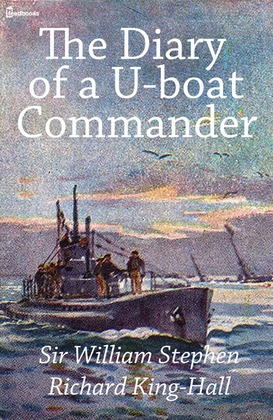
Sir Stephen King-Hall, "Diary of a U-Boat Commander" (1918)
This is a short book dating from the end of the First World War. While an entertaining read, the work is deceptive. It is written in the voice of a German naval officer, as a diary of his reflections. As a social elite, he expects - but at first must only aspire - to command his own Unterseeboot. With experience and attrition in the submarine officer-classes, his desire is eventually successful.
The 'diary' balances between gritty descriptions of life at/under the sea, and provides a convincing narrative of tense battles, fear of attack, and cramped, tense boredom between actions while at sea. While on land, the sailor pines for a distant, but teasingly interested female who is attached to an older, corpulent army officer.
It is the end of the story where the tension begins to fall apart - when it is revealed that the love interest is a Polish spy working for the British, and killed by the Germans for her activities. The 'diary' format begins to become suspect when the officer describes how his life radically changes upon the suspicions that he was complicit in her activities.
Certainly, as can be seen on sites such as Amazon, there are still some who believe that this book is actually a diary written by a German officer. It was, however, written by a British naval officer in 1918. In this respect, the book provides an intriguing view into a British man's view of German society, relationships between the officer class and others within the German navy, and the challenges war faced all men and women with. Of course, these views are all offered based on speculation, by an outsider, and placed within a narrative that is as much about the frustration of love as it is about life as a submariner during wartime.
You can read the entire work for free via the Internet Archive.
Labels:
book reviews,
European history,
fiction,
German history,
World War I
Tuesday, 29 January 2013
Fritz Kreisler, "Four Weeks in the Trenches" (1915)
Kreisler, a famous violinist, served for a short time on Austria-Hungary's Eastern front at the beginning of the First World War. This very short memoir of that experience does not describe a fundamentally unique perspective on war, or offer a soldier's perspective in a particularly novel fashion. The text, however, is intriguingly compelling in that it retains - although tempered by clear description of some of the early horrors of the war - some of the optimism, sense of élan, and bravado that so marked the entry of so many men into the fighting.
For instance, Kreisler writes:
"The very massing together of so many individuals, with every will merged into one that strives with gigantic effort toward a common end, and the consequent simplicity and directness of all purpose, seem to release and unhinge all the primitive, aboriginal forces stored in the human soul, and tend to create the indescribable atmosphere of exultation which envelopes everything and everybody as with a magic cloak."
While I know little about why this book was published, it strikes me that it would have found an eager audience in any country involved in the war in 1915. That it was published in the United States is more than a little curious. That it was acceptable to publish may in part be Kreisler's complete avoidance of talking about politics or attempting to justify, or even explain, the reasons for the war. In this book the war merely happens, and soldiers are expected to fight. Kreisler does, and never once seems to question why, challenge the sacrifices he sees, or is required to make.
The full text of this book is available through Project Gutenberg.
Labels:
book reviews,
European history,
German history,
military,
World War I
Wednesday, 28 March 2012
Christopher Hibbert, "Benito Mussolini" (1962, rev. 1972)
The sub-title for this classic is "The Rise and Fall of Il Duce."
Hibbert's book appears to be one of those great British cheap paperback reprints about facets of the Second World War that seem to have been produced in great scads during the 1970s.
I don't know nearly enough about Mussolini, other than that he is presented as the somewhat buffoonish Italian parallel to Hitler. Of course, he came to power before Hitler, and was really the leading Fascist politician (hence the name for the ideology that derives from an classic Roman reference) before Hitler began to pursue his search for German lebensraum.
I was somewhat surprised to learn of his early socialist ideological roots, ideas that to some degree stayed with him even to his death. Much like Hitler, however, the allure of power spoke loudly to Mussolini, leading him to increasingly radical solutions where political success to priority over other values. Upon rising to power, Mussolini's desire for grandeur and power led him into a series of ill-advised foreign military adventures: against Egypt, Albania, France, and Greece. The unequivocal disasters that these invasions were compelled Mussolini to repeatedly seek out the assistance of Nazi Germany, diminishing Mussolini's capacity to debate, question, or redirect Hitler's political visions for Europe and the Mediterranean.
Hibbert's book, particularly in its last third, looks at Mussolini from a far more personal perspective than political. This makes sense given that he fell from grace - was rescued by the Nazis and returned to power as the head of the puppet Salo Italian government - and then captured again, and killed with his mistress.
Labels:
biography,
book reviews,
European history,
fascism,
World War I,
World War II
Friday, 8 July 2011
Tim Cook, "At the Sharp End: Canadians Fighting the Great War 1914-1916" (2007)
Volume 1 of an awarding-winning two-volume series.
As Cook mentions near the beginning of this opus, he is striving to tell the story of the war as experienced at "the sharp end"; by the Canadian soldiers at the front lines, in the trenches. His narrative closely and effectively weaves excerpts from soldiers' letters and diaries into well-researched information about Canadian troop movements, and technical aspects of the war (ranging from the mechanical - such as how an artillery gun worked, or the evolution of the grenade - to the mundane - such as how the latrines worked (or didn't, as the case may be)). The concentration on the details of daily life, such as why so many soldiers took to smoking, is what makes this book really fascinating. For those who don't have the time or desire to read the whole volume, Chapters 18 through 20 are the best in the book, and the ones that most effectively cover the mechanical and mundane technical details that I find so interesting.
The National Post has published excerpts from the first chapters of the book.
Labels:
book reviews,
Canadian history,
military,
World War I
Subscribe to:
Posts (Atom)