Subtitle: "The Entrepreneurs Of Pornography In The Cyber Age."
Read, but comments not yet written.
Consider this a placeholder.
Reflections by Dr. Gregory Klages on non-fiction books dealing primarily with politics, history, and religion. Significant attention to Canadian content. Mail me/comment if you read anything. I love to hear feedback!
Showing posts with label art history. Show all posts
Wednesday, 7 October 2015
Tuesday, 9 December 2014
Wayne Larsen, "Tom Thomson: Artist of the North" (2011)
Larsen's book is a brief, easy-to-read summary of many popular stories regarding the life of Canadian landscape painter Tom Thomson, who died in Ontario's Algonquin Park during the summer of 1917, under what has become described as 'mysterious circumstances'.
The book, as part of the Dundurn Press Quest Biography series, was conceived to appeal primarily to high school/junior undergraduate readers. This is important to note in evaluating Larsen's work. It is a basic form of biographical summary, written in clear and accessible language. He has not waded deeply into archival resources, and seems to have likely derived most - if not all - of the book from secondary sources.
The book is a fine introduction to Thomson's life, and certainly better than some biographies. That being said, it is not particularly demanding on the reader, and doesn't serve to challenge or question much of the hagiographic treatments of Thomson traditionally offered.
You can listen to a 2011 interview with Larsen here.
The book, as part of the Dundurn Press Quest Biography series, was conceived to appeal primarily to high school/junior undergraduate readers. This is important to note in evaluating Larsen's work. It is a basic form of biographical summary, written in clear and accessible language. He has not waded deeply into archival resources, and seems to have likely derived most - if not all - of the book from secondary sources.
The book is a fine introduction to Thomson's life, and certainly better than some biographies. That being said, it is not particularly demanding on the reader, and doesn't serve to challenge or question much of the hagiographic treatments of Thomson traditionally offered.
You can listen to a 2011 interview with Larsen here.
Tuesday, 15 July 2014
Robert Greenfield, "Ain't It Time We Said Goodbye" (2014)
A former Rolling Stone journalist revisits material he has already written on several times before.
As a brief book devoted to about 10 dates on a tour (half in the UK, and the rest in USA and Canada), Ain't It Time We Said Goodbye is a snapshot of a foundational period in the history of the Stones. The ideas for Exile on Main Street were percolating, the band was still somewhat trigger-shy about touring the US after the disaster at Altamont, and the Stones had decided to leave the UK to evade heavy taxation.
Where the book was most interesting was not its commentary on the 'regular' members of the Stones, but in its profiles of their retinue. Whether discussing the various wives and girlfriends (as well as their relationships - particular Anita Pallenberg and Bianca later-to-be-Jagger), or the supporting musicians and tour workers, Ain't It Time ... offers a unique look into a rock institution in development.
Some of the profiles that help to 'flesh out' people often mentioned in passing with regard to the Stones include:
- Nicky Hopkins: pianist
- Chip Monck (tour operative): joining the Stones entourage for their 1969 American tour, he called lighting cues, selected pre- and post-gig house music, and cleaned up the house post-gig
- Ian Stewart ('Stu'): former member of the Stones, he now set up the drum kit, played piano on a few songs, and drove occasionally
- Bobby Keys: saxophone, 'bigger than life' Texan
- Jim Price: horn section,
- Rose Millar: Mick Taylor's future wife
For those with an eye for details, the book also provides a nice behind-the-scenes perspective on the venues the Stones were playing, and some of the logistical aspects of life on the road.
Kirkus Review pretty much sums it up with a less than laudatory assessment.
As a brief book devoted to about 10 dates on a tour (half in the UK, and the rest in USA and Canada), Ain't It Time We Said Goodbye is a snapshot of a foundational period in the history of the Stones. The ideas for Exile on Main Street were percolating, the band was still somewhat trigger-shy about touring the US after the disaster at Altamont, and the Stones had decided to leave the UK to evade heavy taxation.
Where the book was most interesting was not its commentary on the 'regular' members of the Stones, but in its profiles of their retinue. Whether discussing the various wives and girlfriends (as well as their relationships - particular Anita Pallenberg and Bianca later-to-be-Jagger), or the supporting musicians and tour workers, Ain't It Time ... offers a unique look into a rock institution in development.
Some of the profiles that help to 'flesh out' people often mentioned in passing with regard to the Stones include:
- Nicky Hopkins: pianist
- Chip Monck (tour operative): joining the Stones entourage for their 1969 American tour, he called lighting cues, selected pre- and post-gig house music, and cleaned up the house post-gig
- Ian Stewart ('Stu'): former member of the Stones, he now set up the drum kit, played piano on a few songs, and drove occasionally
- Bobby Keys: saxophone, 'bigger than life' Texan
- Jim Price: horn section,
- Rose Millar: Mick Taylor's future wife
For those with an eye for details, the book also provides a nice behind-the-scenes perspective on the venues the Stones were playing, and some of the logistical aspects of life on the road.
Kirkus Review pretty much sums it up with a less than laudatory assessment.
Labels:
art history,
biography,
book reviews,
rock music history
Thursday, 29 August 2013
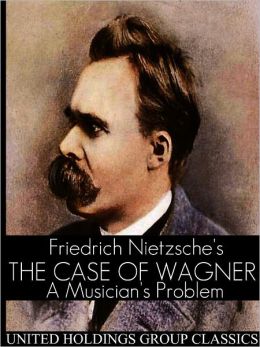
Friedrich Nietzsche, "The Case of Wagner" (1888). Translated by Anthony M. Ludovici (1911).
Nietzsche essentially recognizes Wagner's skill at evocative, indulgent histrionics. This is, however, a skill that Nietzsche sees as indicative of a weak and unmanly approach to art.
Notes of interest to possibly no one else but me (page numbers correspond to my digital edition):
- “And let it be said en passant that if Wagner’s theory was ‘drama is the object, music is only a means’ – his practice was from beginning to end ‘the attitude is the end, drama and even music can never be anything else than means.” p. 47
- “In the theatre, no one brings the finest senses of his art with him, and least of all the artist who works for the theatre, - for here loneliness is lacking; everything perfect does not suffer a witness… In the theatre one becomes mob, herd, woman, Pharisee, electing cattle, patron, idiot – Wagnerite: there, the most personal conscience is bound to submit to the leveling charm of the great multitude, there the neighbour rules, there one becomes a neighbour.” P. 47/48
- “In the solemn, or fiery, swinging movement, first slow and then quick, of old music – one had to do something quite different; one had to dance. The measure which was required for this and the control of certain balanced degrees of time and energy, forced the soul of the listener to continual sobriety of thought. – Upon the counterplay of the cooler currents of air which came from this sobriety, and from the warmer breath of enthusiasm, the charm of all good music rested – Richard Wagner wanted another kind of movement, - he overthrew the physiological first principle of all music before his time. It was no longer a matter of walking or dancing, - we must swim, we must hover…” p. 48
- “…there are two kinds of sufferers: - those that suffer from overflowing vitality, who need Dionysian art and require a tragic insight into, and a tragic outlook upon, the phenomenon life, - and there are those who suffer from reduced vitality, and who crave for repose, quietness, calm seas, or else the intoxication, the spasm, the bewilderment which art and philosophy provide.” p. 51
- “I began to understand Epicurus, the opposite of a Dionysian Greek, and also the Christian who in fact is only a kind of Epicurean, and who, with his belief that ‘faith saves,’ carries the principle of Hedonism as far as possible – far beyond all intellectural honesty…” p. 51
Notes of interest to possibly no one else but me (page numbers correspond to my digital edition):
- “And let it be said en passant that if Wagner’s theory was ‘drama is the object, music is only a means’ – his practice was from beginning to end ‘the attitude is the end, drama and even music can never be anything else than means.” p. 47
- “In the theatre, no one brings the finest senses of his art with him, and least of all the artist who works for the theatre, - for here loneliness is lacking; everything perfect does not suffer a witness… In the theatre one becomes mob, herd, woman, Pharisee, electing cattle, patron, idiot – Wagnerite: there, the most personal conscience is bound to submit to the leveling charm of the great multitude, there the neighbour rules, there one becomes a neighbour.” P. 47/48
- “In the solemn, or fiery, swinging movement, first slow and then quick, of old music – one had to do something quite different; one had to dance. The measure which was required for this and the control of certain balanced degrees of time and energy, forced the soul of the listener to continual sobriety of thought. – Upon the counterplay of the cooler currents of air which came from this sobriety, and from the warmer breath of enthusiasm, the charm of all good music rested – Richard Wagner wanted another kind of movement, - he overthrew the physiological first principle of all music before his time. It was no longer a matter of walking or dancing, - we must swim, we must hover…” p. 48
- “…there are two kinds of sufferers: - those that suffer from overflowing vitality, who need Dionysian art and require a tragic insight into, and a tragic outlook upon, the phenomenon life, - and there are those who suffer from reduced vitality, and who crave for repose, quietness, calm seas, or else the intoxication, the spasm, the bewilderment which art and philosophy provide.” p. 51
- “I began to understand Epicurus, the opposite of a Dionysian Greek, and also the Christian who in fact is only a kind of Epicurean, and who, with his belief that ‘faith saves,’ carries the principle of Hedonism as far as possible – far beyond all intellectural honesty…” p. 51
Labels:
art history,
book reviews,
European history,
German history,
philosophy
Monday, 6 February 2012
Andrew Hussey, "The game of war: the life and death of Guy Debord" (2001)
I'm torn about this book. While reading it I was distracted by Hussey's interjection of personal anecdotes regarding his drinking interviews with Debord associates. These smacked of insecurity, as if Hussey was desperate to assure us that he was 'cool' enough to wander Paris' Left Bank, to share cognac with Alice Becker-Ho, and to mix comfortably and confidently with these notoriously catty theoreticians and revolutionaries.
On the other hand, his explication of Debord's theories at times was rather simplistic. For the common reader, this would be helpful, though I can't help but wonder how many 'common' readers were likely to pick such a book up?
In short, Game of War was akin to an extended Rolling Stone biography. Pithy, loaded with personal insights, and light on philosophical and political insights. I can say, however, that I had never known that Debord once opened a bar in Paris, and designed advertising for the bar before he became involved as a co-manager.
As an addendum, particularly given the title of this book I was disappointed to find that Hussey did not offer a translation (or really even a mention) of Debord's 1987 text that outlined the rules for the kriegspiel he invented (the only version of the text that I have found was the translation in Len Bracken's Guy Debord: Revolutionary, and frankly, the editing quality of that volume was so bad that I can't help but regard anything in the book as being a bit dodgy). As Hussey discusses Debord and Becker-Ho wiling away many days playing this game, and suggests the game was a metaphor in some ways for Debord's later thinking about politics and revolution, this oversight feels significant.
Labels:
art history,
biography,
book reviews,
European history,
French history,
philosophy
Tuesday, 19 October 2010
Roy MacGregor, "Northern Light: The Enduring Mystery of Tom Thomson..." (2010)
I will reserve some of my comments for this book as I have discussed it in the book review below:
Gregory Klages. Review of Roy MacGregor's "Northern Light: The enduring mystery of Tom Thomson and the woman who loved him". American Review of Canadian Studies 41/3 (Fall 2011).
For those interested in research regarding Thomson's death, I also recommend that you look up my chapter entitled "The Many Deaths of Tom Thomson", in Archives and Canadian Narratives, Kathleen Garay & Kristl Verduyn, eds. (Black Point, NS: Fernwood Press, 2011).
For those who can't access these articles, however, I can say the following:
1. The most important aspect of this book is that it is guilty of promulgating a multitude of incorrect or highly dubious claims about Thomson's death and the related activities that followed Thomson's death, many times describing them as if there is no doubt about their truth. The number of times the book incorrectly interprets or represents the historical record in such an egregious way can only be understood as sloppy consideration on the part of the author. All researchers, of course, will be guilty of errors, but these errors should not diminish the likely truth of their conclusions. In the case of this book, they do.
2. The book is frustrating in that it does not source its quotations. When an author decides to not tell the reader where they obtained quotations from, it always suggests to me either a certain sloppiness with regard to collecting data, or perhaps even a certain hesitation to have their work challenged by comparison back to the original sources.
3. The book appears to derive most of its observations from some one else's research, namely - Death On A Painted Lake: The Tom Thomson Tragedy. This fact might also provide the answer to the previous concern, essentially suggesting that the author did not devote as much time to weighing the evidence as attempting to 'write a good yarn' on the foundation of an historical event.
4. The book makes some intriguing observations: firstly, that a photo long identified as Thomson's potential love interest may be incorrectly identified, and secondly, that a forensic specialist has suggested that the skull exhumed in Algonquin Park could be reconstructed to resemble Thomson's visage. Unfortunately, the first does not particularly change the story of Thomson's life, while the second requires significantly more scientific argument to produce reasonable cause to argue for an exhumation of the remains in Algonquin Park - an exhumation, it might be added, that many agree is necessary to resolve one of the mysteries surrounding Thomson's death and burial.
Gregory Klages. Review of Roy MacGregor's "Northern Light: The enduring mystery of Tom Thomson and the woman who loved him". American Review of Canadian Studies 41/3 (Fall 2011).
For those interested in research regarding Thomson's death, I also recommend that you look up my chapter entitled "The Many Deaths of Tom Thomson", in Archives and Canadian Narratives, Kathleen Garay & Kristl Verduyn, eds. (Black Point, NS: Fernwood Press, 2011).
For those who can't access these articles, however, I can say the following:
1. The most important aspect of this book is that it is guilty of promulgating a multitude of incorrect or highly dubious claims about Thomson's death and the related activities that followed Thomson's death, many times describing them as if there is no doubt about their truth. The number of times the book incorrectly interprets or represents the historical record in such an egregious way can only be understood as sloppy consideration on the part of the author. All researchers, of course, will be guilty of errors, but these errors should not diminish the likely truth of their conclusions. In the case of this book, they do.
2. The book is frustrating in that it does not source its quotations. When an author decides to not tell the reader where they obtained quotations from, it always suggests to me either a certain sloppiness with regard to collecting data, or perhaps even a certain hesitation to have their work challenged by comparison back to the original sources.
3. The book appears to derive most of its observations from some one else's research, namely - Death On A Painted Lake: The Tom Thomson Tragedy. This fact might also provide the answer to the previous concern, essentially suggesting that the author did not devote as much time to weighing the evidence as attempting to 'write a good yarn' on the foundation of an historical event.
4. The book makes some intriguing observations: firstly, that a photo long identified as Thomson's potential love interest may be incorrectly identified, and secondly, that a forensic specialist has suggested that the skull exhumed in Algonquin Park could be reconstructed to resemble Thomson's visage. Unfortunately, the first does not particularly change the story of Thomson's life, while the second requires significantly more scientific argument to produce reasonable cause to argue for an exhumation of the remains in Algonquin Park - an exhumation, it might be added, that many agree is necessary to resolve one of the mysteries surrounding Thomson's death and burial.
Labels:
art history,
book reviews,
Canadian history,
Tom Thomson
Subscribe to:
Posts (Atom)