Subtitle: "The Entrepreneurs Of Pornography In The Cyber Age."
Read, but comments not yet written.
Consider this a placeholder.
Reflections by Dr. Gregory Klages on non-fiction books dealing primarily with politics, history, and religion. Significant attention to Canadian content. Mail me/comment if you read anything. I love to hear feedback!
Showing posts with label economics. Show all posts
Wednesday, 7 October 2015
Saturday, 4 July 2015
Butler Schaffer, "A Libertarian Critique of Intellectual Property" (2014)
This is an extended essay published by the libertarian-slanted (Ludwig von) Mises Institute, located in Alabama. Schaffer is an Associate Professor at the Southwestern University School of Law. In 2013, the Institute awarded Schaffer $10,000 for his "lifetime defence of liberty."
Schaffer's argument is not as radical as it might sound. He is not an anarchist. His criticism of intellectual property laws is that they provide incorporated bodies ('artificial' persons recognized by law) with the power to limit, control, and profit from ideas that would better benefit society as part of the creative, communicative commons. He does not suggest that property should be abolished, but that ownership of property should be limited to 'natural' persons, for information that they choose not to send forth into the community. He does raise the prospect, though, that in reality no ideas are built truly independently of the knowledge of others, thus implying that intellectual property laws should be rendered null and void.
QUOTATIONS, AND NOTES by Gregory Klages:
"...only human beings—“persons”—should be respected as property owners; that treating corporations, political institutions, and other abstractions as artificial “persons” represents a source of conflict we ought to reject."
"...the state becomes seen for what it is: an organizational tool of violence that is able to accomplish its purposes only through the willingness of its victims to accord it legitimacy. Such a practice allows lifeless fictions to transcend — and thus demean — the importance of individual human beings."
"...the essence of ownership is found in the capacity to control some resource in furtherance of one’s purposes, such a claim is lost once a product has been released to the public. The situation is similar to that of a person owning oxygen that is contained in a tank, but loses a claim to any quantity that might be released — by a leaky valve — into the air."
"True to their coercive and looting nature, governments have gone so far as to take from the 'public domain' words that belong to no one, and conferred a monopoly copyright upon various institutional interests. The word 'Olympics,' for instance, has been in common usage since at least the eighth century B.C. By political fiat, the International Olympic Committee now enjoys ownership of that word as a state-protected trademark."
"Is the creative process encouraged or hindered by this system of state-conferred monopolies? Creativity—like learning in general — is fostered by cross-fertilization and synthesis."
"The proposition that knowledge and ideas can be made the exclusive property of one who discovers or expresses what was previously unknown, is contrary to the nature of the intelligent mind, whose content is assembled from a mixture of the experiences of others and oneself. Even the language with which one formulates and communicates his or her understanding to others, has been provided by predecessors."
"If we truly believe that the creative process requires the state to grant to inventors and discoverers an immunity from having their works adopted by others, will we insist that modern producers either compensate the descendants of earlier creators for their preliminary work or, in the alternative, abandon their claims to rewards for their “originality”?"
"...the patenting process, as with government regulation generally, is an expensive and time-consuming undertaking that tends to increase industrial concentration."
"The current political mantra, “too big to fail,” is a product of the dysfunctional nature of size when an organization faces energized competition to which it must adapt if it is to survive."
"The state’s creation of patent and copyright interests doesn’t, by itself, prevent innovation by others, but it does erect hurdles that often discourage research…"
Schaffer's argument is not as radical as it might sound. He is not an anarchist. His criticism of intellectual property laws is that they provide incorporated bodies ('artificial' persons recognized by law) with the power to limit, control, and profit from ideas that would better benefit society as part of the creative, communicative commons. He does not suggest that property should be abolished, but that ownership of property should be limited to 'natural' persons, for information that they choose not to send forth into the community. He does raise the prospect, though, that in reality no ideas are built truly independently of the knowledge of others, thus implying that intellectual property laws should be rendered null and void.
QUOTATIONS, AND NOTES by Gregory Klages:
"...only human beings—“persons”—should be respected as property owners; that treating corporations, political institutions, and other abstractions as artificial “persons” represents a source of conflict we ought to reject."
"...the state becomes seen for what it is: an organizational tool of violence that is able to accomplish its purposes only through the willingness of its victims to accord it legitimacy. Such a practice allows lifeless fictions to transcend — and thus demean — the importance of individual human beings."
"...the essence of ownership is found in the capacity to control some resource in furtherance of one’s purposes, such a claim is lost once a product has been released to the public. The situation is similar to that of a person owning oxygen that is contained in a tank, but loses a claim to any quantity that might be released — by a leaky valve — into the air."
"True to their coercive and looting nature, governments have gone so far as to take from the 'public domain' words that belong to no one, and conferred a monopoly copyright upon various institutional interests. The word 'Olympics,' for instance, has been in common usage since at least the eighth century B.C. By political fiat, the International Olympic Committee now enjoys ownership of that word as a state-protected trademark."
"Is the creative process encouraged or hindered by this system of state-conferred monopolies? Creativity—like learning in general — is fostered by cross-fertilization and synthesis."
"The proposition that knowledge and ideas can be made the exclusive property of one who discovers or expresses what was previously unknown, is contrary to the nature of the intelligent mind, whose content is assembled from a mixture of the experiences of others and oneself. Even the language with which one formulates and communicates his or her understanding to others, has been provided by predecessors."
"If we truly believe that the creative process requires the state to grant to inventors and discoverers an immunity from having their works adopted by others, will we insist that modern producers either compensate the descendants of earlier creators for their preliminary work or, in the alternative, abandon their claims to rewards for their “originality”?"
"...the patenting process, as with government regulation generally, is an expensive and time-consuming undertaking that tends to increase industrial concentration."
"The current political mantra, “too big to fail,” is a product of the dysfunctional nature of size when an organization faces energized competition to which it must adapt if it is to survive."
"The state’s creation of patent and copyright interests doesn’t, by itself, prevent innovation by others, but it does erect hurdles that often discourage research…"
Labels:
book reviews,
business,
economics,
law,
philosophy
Thursday, 22 January 2015
Thom Hartmann, "Crash of 2016" (2013)
Subtitle: "The Plot to Destroy America and What We Can Do About It".
What most surprised me about this book, and I'm not sure why, is that Hartmann seems to be left-leaning. Concern with financial crashes and plotting out one's financial survival generally seems to be associated with libertarian, conservative ideology.
Essentially, Hartmann tracks out a series of political decisions over the last several decades that indicate a potentially fatal loosening of controls over corporations that have allowed wealth to accumulate in fewer and fewer hands, and gutted the kinds of social policies that kept economic/class disparity under control within the United States. He suggests that this problem comes about cyclically, about every 80 years or so, based on the passing of the people who experienced the horrible outcomes of similar decisions within their own lifetime.
Frugal Musings has a very good, if lengthy, discussion of the book.
Gregory Klages -
Quotations from, and notes on: Crash of 2016: The Plot to Destroy America and What We Can Do About It
CHAPTER 3: The Crisis Capitalists
"In 1947, two years after the war ended, Friedrich Hayek gathered a large group of economists, historians, journalists, and businessmen to a meeting in Mont Pelerin, Switzerland.
"...what Hayek was unable to do, mainly because he was operating with the catastrophic consequences of his free-market philosophy still fresh in everyone’s mind, Friedman would do—and that’s lead a global counterrevolution against controlled capitalism
"These so-called free-market reforms promoted by the members of the Mont Pelerin Society and later the Chicago Boys do not constitute a legitimate economic theory, as they’ve never worked anywhere they’ve been tried, anywhere in the world. They constitute a religion.
"...two years into Pinochet and the Chicago Boys’ rule, inflation had reached 341 percent—higher than anywhere else in the world. The price of goods increased by 375 percent. GDP decreased by 15 percent. Agriculture production sputtered to a grinding halt. Export values dropped 28 percent and Chile acquired a $280 million trade deficit. And to top everything off, Chile’s unemployment rate skyrocketed from 3 percent—among the lowest in that hemisphere—before Friedman stepped foot in the country to more than 10 percent and, in some parts of the country, as high as 22 percent
CHAPTER 4: A Middle-Class Primer
"The United States has had two great periods of what we today call a middle class. The first was from the 1700s to the mid-1800s, and was fueled by virtually free land for settlers (stolen from the Indians) and free labor (slavery in the South and indentured immigrants in the North). The result was (as de Tocqueville pointed out) the most well-educated, politically active, middle-class “nonaristocrats” in the world.
"...the period between 1947 and 1979 saw unparalleled equitable growth. During these thirty-plus years, the poorest fifth of Americans saw a 116 percent increase in their incomes. The middle fifth, a 111 percent increase. And the top 5 percent saw an 85 percent increase. All income classes shared in the prosperity of the times when the top marginal income tax rate was above 70 percent.
"...progressive taxation, which gave workers more to spend and gave the rich an incentive to pay their workers better to maintain a stable workplace (since if they took the money themselves, it would just mostly go to taxes), thus stimulating demand for more goods and services.
"Whenever top marginal tax rates were relatively high—above 60 percent usually—the economy was at its most stable.
"...in 1944, FDR...proposed a Second Bill of Rights.
These rights included:
"The right to a useful and remunerative job in the industries or shops or farms or mines of the nation; The right to earn enough to provide adequate food and clothing and recreation; The right of every farmer to raise and sell his products at a return which will give him and his family a decent living; The right of every businessman, large and small, to trade in an atmosphere of freedom from unfair competition and domination by monopolies at home or abroad; The right of every family to a decent home; The right to adequate medical care and the opportunity to achieve and enjoy good health; The right to adequate protection from the economic fears of old age, sickness, accident, and unemployment; The right to a good education
"An early instruction manual for the game of Monopoly in 1925 reads, “At the start of the game every player is provided with the same amount of capital and presumably has exactly the same chance of success as every other player. The game ends with one person in possession of all the money. What accounts for the failure of the rest, and what one factor can be singled out to explain the obviously ill-adjusted distributions of the community’s wealth which this situation represents?”
"...not only is the accumulation of vast amounts of wealth in the hands of an elite aristocracy not good for working people, it’s also not good for economies as a whole, which is exactly what the game Monopoly teaches us.
CHAPTER 5: Reagan Kidnapped the Jetsons
"In a 1966 article, TIME magazine looked ahead toward the future and what the rise of automation would mean for average working Americans. It concluded, “By 2000, the machines will be producing so much that everyone in the U.S. will, in effect, be independently wealthy. With Government benefits, even nonworking families will have, by one estimate, an annual income of $30,000–$40,000. How to use leisure meaningfully will be a major problem.” And that was $30,000–$40,000 in 1966 dollars, which would be roughly $199,000 to $260,000 in 2010 dollars.
CHAPTER 6: “Madness”
"That’s exactly what speculators were doing—buying up huge amounts of wheat contracts and holding on to them until they could be sold at a higher price. This had catastrophic effects on the global food supply.
"The force of Globalism,” [John Ralston] Saul writes, “through trade agreements, deregulation and privatization, would seriously weaken the ability of nation-states to act with any political independence.”
“Richer than a majority of nation-states on the planet, free of the geographical and social obligations of these old states, beyond the embarrassing demands of nationalism, freed in fact from the emotional, immeasurable demands of the citizenry, the transnational would be able to organize world affairs in a more rational, efficient manner.”
"Columnist Chrystia Freeland nailed this mind-set perfectly in her 2011 article “The Rise of the New Global Elite,” which ran in The Atlantic magazine. She reported that one influential American hedge fund manager argued that it didn’t matter if the US economy was in peril, because “if the transformation of the world economy lifts four people in China and India out of poverty and into the middle class, and meanwhile means one American drops out of the middle class, that’s not such a bad trade.”
"By 2008, actual commodity sellers and buyers were completely marginalized in the market by speculator banksters, who accounted for 80 percent of all futures purchases. And with their price manipulations, these derivative bombs cratered our economy with high gas prices.
Economist Steve Keen, author of Debunking Economics
"They will always want to lend more money… the banking sector profits by creating debt”...
CHAPTER 7: A Revolution Denied
"The Iroquois Confederation’s “Great Law,” which was a major inspiration for the American Constitution, famously called for all governmental decisions to be made in the context of their impact on “the Seventh Generation” down the line into the future.
CHAPTER 9: Betrayal on the High Court
"...with this decision in place and the law of the land, the First Amendment now protects the “free speech” rights of the presidents of Russia and China and Iran to form corporations in the United States and pour millions of dollars toward supporting or defeating the politicians of their choice. It protects the “right” of the largest polluting corporations on earth to politically destroy any politician who wants to give any more authority to the Environmental Protection Agency. It protects their “right” to elevate to elected status any politician who is willing to dismantle the EPA—or any other government agency that protects or defends the people of America from Royalist predation
"...the bible of legal scholars—the book that the framers of our Constitution had frequently cited and referenced in their deliberations in 1787 in Philadelphia—Sir William Blackstone’s 1765 Commentaries on the Laws of England...
"Stevens recounted the history of the evolution of corporations in America, noting, “Corporations were created, supervised, and conceptualized as quasi-public entities, ‘designed to serve a social function for the state.’
"As a result of Citizens United, outside political spending skyrocketed from just $68 million in the 2006 midterms, to over $304 million in the 2010 midterms. That’s a 400 percent increase in corporate cash influencing elections and buying politicians, just ten months after the Citizens United decision.
CHAPTER 10: Masters of the Universe
"On average, a member of the House of Representatives must raise $5,000 a week for his or her campaign. That means that every morning, Monday through Friday, they must wake up not thinking about governing but about fund-raising—how to scrounge up a thousand bucks that day. In the Senate it’s even worse, at an average of $14,000 a week.152 And those numbers were compiled by PBS before the Citizens United decision—today’s numbers are significantly higher.
American Legislative Exchange Council = ALEC
"...it’s a dating service setting up corporate lobbyists and state legislators,” he told me. “The culmination is the passing of special-interest legislation.”
"I don’t want everybody to vote. Elections are not won by a majority of people. They never have been from the beginning of our country and they are not now. As a matter of fact, our leverage in the elections goes up as the voting populace goes down.”
"It’s no wonder that the American people have played into the hands of the Royalists and, as a result, have very little trust in government. After all, there is no reason why they should, because democratic government, as we once knew it, no longer exists
CHAPTER 11: This Is the End
"...in 1977, Harold E. Davis wrote a brilliant monograph for the Georgia Historical Society titled The Scissors Thesis, or Frustrated Expectations as the Cause of the Revolution in Georgia...
CHAPTER 12: Organized People v. Organized Money
"Artificial entities, such as corporations, limited liability companies, and other entities, established by the laws of any State, the United States, or any foreign state shall have no rights under this Constitution and are subject to regulation by the People, through Federal, State, or local law. The privileges of artificial entities shall be determined by the People, through Federal, State, or local law, and shall not be construed to be inherent or inalienable
"On December 6, 2011, Los Angeles became the first major city in the United States to call for a constitutional amendment to end corporate personhood.
"There have been similar resolutions passed in Boulder, Colorado, and Missoula, Montana, that say corporations are not people and money is not speech.
"I particularly recommend the model put forth by David Cobb at MoveToAmend.org.
"...the headnote to the Santa Clara County 1886 decision that asserted corporations are the same as natural persons in terms of constitutional protections.
"The [U.S.] Supreme Court was beyond their constitutional power when they handed George W. Bush the victory in 2000...
"...the [U.S.] Supreme Court was way beyond their constitutional authority every single time they created out of whole cloth new legal doctrines, such as “separate but equal” in Plessy v. Ferguson, “privacy” in Roe v. Wade, or “corporations are people” in Citizens United v. Federal Election Commission.
What most surprised me about this book, and I'm not sure why, is that Hartmann seems to be left-leaning. Concern with financial crashes and plotting out one's financial survival generally seems to be associated with libertarian, conservative ideology.
Essentially, Hartmann tracks out a series of political decisions over the last several decades that indicate a potentially fatal loosening of controls over corporations that have allowed wealth to accumulate in fewer and fewer hands, and gutted the kinds of social policies that kept economic/class disparity under control within the United States. He suggests that this problem comes about cyclically, about every 80 years or so, based on the passing of the people who experienced the horrible outcomes of similar decisions within their own lifetime.
Frugal Musings has a very good, if lengthy, discussion of the book.
Gregory Klages -
Quotations from, and notes on: Crash of 2016: The Plot to Destroy America and What We Can Do About It
CHAPTER 3: The Crisis Capitalists
"In 1947, two years after the war ended, Friedrich Hayek gathered a large group of economists, historians, journalists, and businessmen to a meeting in Mont Pelerin, Switzerland.
"...what Hayek was unable to do, mainly because he was operating with the catastrophic consequences of his free-market philosophy still fresh in everyone’s mind, Friedman would do—and that’s lead a global counterrevolution against controlled capitalism
"These so-called free-market reforms promoted by the members of the Mont Pelerin Society and later the Chicago Boys do not constitute a legitimate economic theory, as they’ve never worked anywhere they’ve been tried, anywhere in the world. They constitute a religion.
"...two years into Pinochet and the Chicago Boys’ rule, inflation had reached 341 percent—higher than anywhere else in the world. The price of goods increased by 375 percent. GDP decreased by 15 percent. Agriculture production sputtered to a grinding halt. Export values dropped 28 percent and Chile acquired a $280 million trade deficit. And to top everything off, Chile’s unemployment rate skyrocketed from 3 percent—among the lowest in that hemisphere—before Friedman stepped foot in the country to more than 10 percent and, in some parts of the country, as high as 22 percent
CHAPTER 4: A Middle-Class Primer
"The United States has had two great periods of what we today call a middle class. The first was from the 1700s to the mid-1800s, and was fueled by virtually free land for settlers (stolen from the Indians) and free labor (slavery in the South and indentured immigrants in the North). The result was (as de Tocqueville pointed out) the most well-educated, politically active, middle-class “nonaristocrats” in the world.
"...the period between 1947 and 1979 saw unparalleled equitable growth. During these thirty-plus years, the poorest fifth of Americans saw a 116 percent increase in their incomes. The middle fifth, a 111 percent increase. And the top 5 percent saw an 85 percent increase. All income classes shared in the prosperity of the times when the top marginal income tax rate was above 70 percent.
"...progressive taxation, which gave workers more to spend and gave the rich an incentive to pay their workers better to maintain a stable workplace (since if they took the money themselves, it would just mostly go to taxes), thus stimulating demand for more goods and services.
"Whenever top marginal tax rates were relatively high—above 60 percent usually—the economy was at its most stable.
"...in 1944, FDR...proposed a Second Bill of Rights.
These rights included:
"The right to a useful and remunerative job in the industries or shops or farms or mines of the nation; The right to earn enough to provide adequate food and clothing and recreation; The right of every farmer to raise and sell his products at a return which will give him and his family a decent living; The right of every businessman, large and small, to trade in an atmosphere of freedom from unfair competition and domination by monopolies at home or abroad; The right of every family to a decent home; The right to adequate medical care and the opportunity to achieve and enjoy good health; The right to adequate protection from the economic fears of old age, sickness, accident, and unemployment; The right to a good education
"An early instruction manual for the game of Monopoly in 1925 reads, “At the start of the game every player is provided with the same amount of capital and presumably has exactly the same chance of success as every other player. The game ends with one person in possession of all the money. What accounts for the failure of the rest, and what one factor can be singled out to explain the obviously ill-adjusted distributions of the community’s wealth which this situation represents?”
"...not only is the accumulation of vast amounts of wealth in the hands of an elite aristocracy not good for working people, it’s also not good for economies as a whole, which is exactly what the game Monopoly teaches us.
CHAPTER 5: Reagan Kidnapped the Jetsons
"In a 1966 article, TIME magazine looked ahead toward the future and what the rise of automation would mean for average working Americans. It concluded, “By 2000, the machines will be producing so much that everyone in the U.S. will, in effect, be independently wealthy. With Government benefits, even nonworking families will have, by one estimate, an annual income of $30,000–$40,000. How to use leisure meaningfully will be a major problem.” And that was $30,000–$40,000 in 1966 dollars, which would be roughly $199,000 to $260,000 in 2010 dollars.
CHAPTER 6: “Madness”
"That’s exactly what speculators were doing—buying up huge amounts of wheat contracts and holding on to them until they could be sold at a higher price. This had catastrophic effects on the global food supply.
"The force of Globalism,” [John Ralston] Saul writes, “through trade agreements, deregulation and privatization, would seriously weaken the ability of nation-states to act with any political independence.”
“Richer than a majority of nation-states on the planet, free of the geographical and social obligations of these old states, beyond the embarrassing demands of nationalism, freed in fact from the emotional, immeasurable demands of the citizenry, the transnational would be able to organize world affairs in a more rational, efficient manner.”
"Columnist Chrystia Freeland nailed this mind-set perfectly in her 2011 article “The Rise of the New Global Elite,” which ran in The Atlantic magazine. She reported that one influential American hedge fund manager argued that it didn’t matter if the US economy was in peril, because “if the transformation of the world economy lifts four people in China and India out of poverty and into the middle class, and meanwhile means one American drops out of the middle class, that’s not such a bad trade.”
"By 2008, actual commodity sellers and buyers were completely marginalized in the market by speculator banksters, who accounted for 80 percent of all futures purchases. And with their price manipulations, these derivative bombs cratered our economy with high gas prices.
Economist Steve Keen, author of Debunking Economics
"They will always want to lend more money… the banking sector profits by creating debt”...
CHAPTER 7: A Revolution Denied
"The Iroquois Confederation’s “Great Law,” which was a major inspiration for the American Constitution, famously called for all governmental decisions to be made in the context of their impact on “the Seventh Generation” down the line into the future.
CHAPTER 9: Betrayal on the High Court
"...with this decision in place and the law of the land, the First Amendment now protects the “free speech” rights of the presidents of Russia and China and Iran to form corporations in the United States and pour millions of dollars toward supporting or defeating the politicians of their choice. It protects the “right” of the largest polluting corporations on earth to politically destroy any politician who wants to give any more authority to the Environmental Protection Agency. It protects their “right” to elevate to elected status any politician who is willing to dismantle the EPA—or any other government agency that protects or defends the people of America from Royalist predation
"...the bible of legal scholars—the book that the framers of our Constitution had frequently cited and referenced in their deliberations in 1787 in Philadelphia—Sir William Blackstone’s 1765 Commentaries on the Laws of England...
"Stevens recounted the history of the evolution of corporations in America, noting, “Corporations were created, supervised, and conceptualized as quasi-public entities, ‘designed to serve a social function for the state.’
"As a result of Citizens United, outside political spending skyrocketed from just $68 million in the 2006 midterms, to over $304 million in the 2010 midterms. That’s a 400 percent increase in corporate cash influencing elections and buying politicians, just ten months after the Citizens United decision.
CHAPTER 10: Masters of the Universe
"On average, a member of the House of Representatives must raise $5,000 a week for his or her campaign. That means that every morning, Monday through Friday, they must wake up not thinking about governing but about fund-raising—how to scrounge up a thousand bucks that day. In the Senate it’s even worse, at an average of $14,000 a week.152 And those numbers were compiled by PBS before the Citizens United decision—today’s numbers are significantly higher.
American Legislative Exchange Council = ALEC
"...it’s a dating service setting up corporate lobbyists and state legislators,” he told me. “The culmination is the passing of special-interest legislation.”
"I don’t want everybody to vote. Elections are not won by a majority of people. They never have been from the beginning of our country and they are not now. As a matter of fact, our leverage in the elections goes up as the voting populace goes down.”
"It’s no wonder that the American people have played into the hands of the Royalists and, as a result, have very little trust in government. After all, there is no reason why they should, because democratic government, as we once knew it, no longer exists
CHAPTER 11: This Is the End
"...in 1977, Harold E. Davis wrote a brilliant monograph for the Georgia Historical Society titled The Scissors Thesis, or Frustrated Expectations as the Cause of the Revolution in Georgia...
CHAPTER 12: Organized People v. Organized Money
"Artificial entities, such as corporations, limited liability companies, and other entities, established by the laws of any State, the United States, or any foreign state shall have no rights under this Constitution and are subject to regulation by the People, through Federal, State, or local law. The privileges of artificial entities shall be determined by the People, through Federal, State, or local law, and shall not be construed to be inherent or inalienable
"On December 6, 2011, Los Angeles became the first major city in the United States to call for a constitutional amendment to end corporate personhood.
"There have been similar resolutions passed in Boulder, Colorado, and Missoula, Montana, that say corporations are not people and money is not speech.
"I particularly recommend the model put forth by David Cobb at MoveToAmend.org.
"...the headnote to the Santa Clara County 1886 decision that asserted corporations are the same as natural persons in terms of constitutional protections.
"The [U.S.] Supreme Court was beyond their constitutional power when they handed George W. Bush the victory in 2000...
"...the [U.S.] Supreme Court was way beyond their constitutional authority every single time they created out of whole cloth new legal doctrines, such as “separate but equal” in Plessy v. Ferguson, “privacy” in Roe v. Wade, or “corporations are people” in Citizens United v. Federal Election Commission.
Labels:
book reviews,
business,
dystopian,
economics,
fascism,
law,
media criticism,
social history,
U.S.A. history
Monday, 22 December 2014
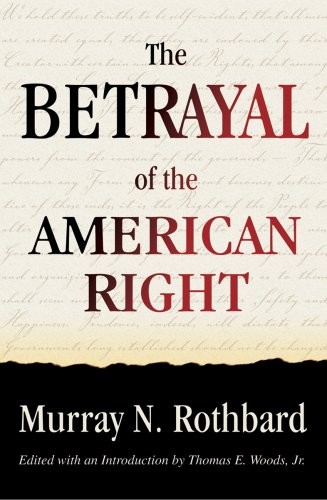
Murray Rothbard, "Betrayal of the American Right" (2007)
Rothbard is one of the pre-eminent American libertarian thinkers.
This title - written in the 1970s but not published until recently - offers Rothbard's assessment of the diversion of conservative thinking in the United States from libertarianism to statism from the late 19th- to the 1960s.
Rothbard offers a compelling, revisionist narrative history of the intellectual development of libertarian thinking in the United States. He particularly focuses on differences that emerged between libertarians and the Republican Party mainstream around the United States' participation in foreign wars.
Additional notes available soon.
The full text of the book is available at: http://mises.org/library/betrayal-american-right-0
This title - written in the 1970s but not published until recently - offers Rothbard's assessment of the diversion of conservative thinking in the United States from libertarianism to statism from the late 19th- to the 1960s.
Rothbard offers a compelling, revisionist narrative history of the intellectual development of libertarian thinking in the United States. He particularly focuses on differences that emerged between libertarians and the Republican Party mainstream around the United States' participation in foreign wars.
Additional notes available soon.
The full text of the book is available at: http://mises.org/library/betrayal-american-right-0
Tuesday, 17 June 2014
Eric Williams, "Capitalism and Slavery" (1944)
Fuller comments will follow in future.
Williams wrote a highly influential, challenging, detailed history of the relationship between the economic gains to be made in the sugar trade that motivated the British and West Indians to develop and support slavery. The voluminous detail Williams includes reminded me of texts such as Solzhenitsyn's Gulag Archipelago, Tooze's Wages of Sin, and the documentary Shoah. In this respect, the book is not for the faint of heart, nor does it constitute 'light and informative' reading.
Williams' analysis is challenging in that it does not place racism at the forefront of its investigation, but rather sees racism as a contributing factor to economic needs. Williams text is not fiery Marxism, however, but rather close economic analysis, complete with profit and loss reporting, investment track records, and consideration of the sundry interests of landowners, sugar refinery operators, shippers, slave traders, and government.
The text also explores the 'triangular trade' of slaves, sugar, and manufactured goods that provided the foundation for British imperial trade monopolies of the 18th-century.
A bootleg version of the text can be located at: archives.org.
Williams wrote a highly influential, challenging, detailed history of the relationship between the economic gains to be made in the sugar trade that motivated the British and West Indians to develop and support slavery. The voluminous detail Williams includes reminded me of texts such as Solzhenitsyn's Gulag Archipelago, Tooze's Wages of Sin, and the documentary Shoah. In this respect, the book is not for the faint of heart, nor does it constitute 'light and informative' reading.
Williams' analysis is challenging in that it does not place racism at the forefront of its investigation, but rather sees racism as a contributing factor to economic needs. Williams text is not fiery Marxism, however, but rather close economic analysis, complete with profit and loss reporting, investment track records, and consideration of the sundry interests of landowners, sugar refinery operators, shippers, slave traders, and government.
The text also explores the 'triangular trade' of slaves, sugar, and manufactured goods that provided the foundation for British imperial trade monopolies of the 18th-century.
A bootleg version of the text can be located at: archives.org.
Labels:
African history,
book reviews,
business,
economics,
European history,
French history,
racism
Wednesday, 2 April 2014
Francis Spufford, "Red Plenty" (2012)
You can read an extract from the book here.
Spufford has created a fairly fun website to support his book.
Monday, 13 January 2014
Gary Weiss, "Ayn Rand Nation" (2012)
This book is subtitled, "The Struggle for America's Soul." More soon.
This was a well-written, thought-provoking work. Having little knowledge of Rand, and sharing what Weiss indicates is the common popular misconception of Rand as a bit of a wacky far-right hack, this book compelled me to rethink my perspective. If nothing else, Rand had a large circle of friends and acolytes who have gone on to positions of political and economic importance, leading among them: Allan Greenspan, former chair of the Federal Reserve.
Labels:
book reviews,
business,
economics,
philosophy,
social history,
U.S.A. history
Saturday, 3 December 2011
Joseph E. Stiglitz & Linda J. Bilmes, "The Three Trillion Dollar War" (2008)
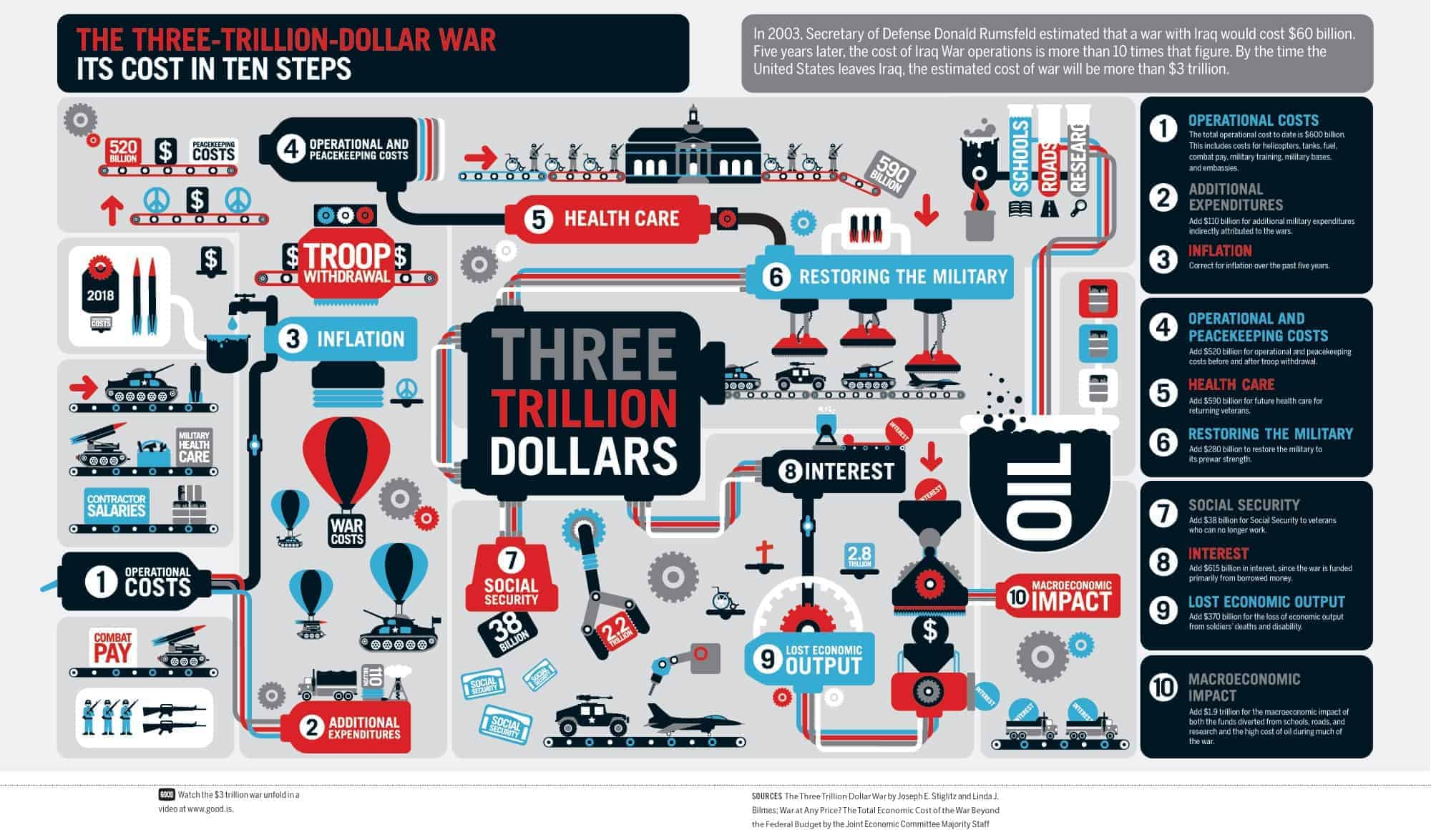
The full title of Stiglitz and Bilmes' much talked about book is The Three Trillion Dollar War: The True Cost of the Iraq Conflict. The central idea they propose in the book is that the way the costs of the war were discussed, by the great unwashed masses, the US government, and the US military, is wildly misleading, either by intention or error. They propose, through using a form of what I will call forensic auditing - for lack of a term I know that will be more correct - to identify heretofore hidden costs of the war, costs of the war that have not been discussed or built into short and long-term US national budgeting, and incidental or related costs of the war that do not go reported in calculations claiming to capture the cost of the war.
A decent, though cursory, outline of the types of costs the book analyses are laid out here:
http://dailyinfographic.com/wp-content/uploads/2011/01/threetrilliondollarwar.jpeg
Excerpts from the book can be read at:
National Public Radio, USA (NPR) - http://www.npr.org/templates/story/story.php?storyId=87855957
Vanity Fair, Apr. 2008 - http://www.vanityfair.com/politics/features/2008/04/stiglitz200804
Labels:
economics,
Middle East,
military,
U.S.A. history
Wednesday, 20 January 2010
Adam Tooze, "Wages of Destruction: The Making and Breaking of the Nazi Economy" (2006).
Adam Tooze, Wages of Destruction: The Making and Breaking of the Nazi Economy (Viking, 2006).
Perhaps I'm getting lazy, but I think this reviewer did a pretty good job of outlining some of the strengths and weaknesses of this book. That being said, my contribution to the discussion is that this is one of the best history books I have read in a long time. It took a subject I expected to be very dry and arcane, and made it interesting and provocative, in a well-researched and well-written package.
Read Alex Harrowell's review at:
A Fistful of Euros.
Perhaps I'm getting lazy, but I think this reviewer did a pretty good job of outlining some of the strengths and weaknesses of this book. That being said, my contribution to the discussion is that this is one of the best history books I have read in a long time. It took a subject I expected to be very dry and arcane, and made it interesting and provocative, in a well-researched and well-written package.
Read Alex Harrowell's review at:
A Fistful of Euros.
Labels:
book reviews,
business,
economics,
European history,
fascism,
German history,
military,
World War II
Subscribe to:
Posts (Atom)