Novel finished, comments not yet written.
Consider this a placeholder.
Follow this link for my comments on Ian Fleming's Casino Royale.
Reflections by Dr. Gregory Klages on non-fiction books dealing primarily with politics, history, and religion. Significant attention to Canadian content. Mail me/comment if you read anything. I love to hear feedback!
Showing posts with label fiction. Show all posts
Wednesday, 9 December 2015
Wednesday, 28 October 2015
Wednesday, 14 October 2015
Friday, 11 September 2015
Sunday, 14 June 2015
Josh Miller, "A Zombie's History of the United States" (2010)
Subtitle: "From the Massacre at Plymouth Rock to the CIA's Secret War on the Undead."
On the whole, Miller's idea is intriguing. His realization left me somewhat disappointed. While the idea that the United States had a long-standing and difficult relationship with a zombie population, and that understanding this relationship was actually critical to understanding American history, the book was realized as pretty much light entertainment. It is funny in spots and tediously self-consciously attempting to be funny in others.
Labels:
book reviews,
fiction,
Historiography,
U.S.A. history
Monday, 27 April 2015
Ian Fleming, "Casino Royale" (1953)
On a lark, I acquired the entirety of Fleming's James Bond novels. I have never read any of these, and have watched only a few of the movies. Nonetheless, I really like the 2002-2003 Penguin release retro covers designed by Richie Fahey. Looking for something light and distracting for bedtime reading at the end of a busy term led me to Bond (James Bond).
This earliest Bond novel surprised me in several ways:
1) Fleming's regular references to Bond's service in the Second World War were a revelation to me. Perhaps it's the cinematic lens (har har) that I was viewing Bond through previously, but I associate him with a more recent type of Cold War modernity than a somewhat grim, post-war emerging hostility between Communism and the West. Casino Royale is definitely set in the latter.
2) I was taken aback by Bond's rather virulent misogyny. Casino Royale's Bond is not the Hefner-esque international playboy heartily enjoying the pleasures of the sexual revolution. He is a lonely, isolated, insecure, suspicious and bitter misogynist. The cinematic Bond is often a suave character who at his core seems generally likeable, if a bit of a hound.
The Bond of Casino Royale oscillates between calling his female counterpart (Vesper Lynd) a 'bitch', then wanting to ask her to marry, and then by the end of the book, returning to his original position even though she had confessed her love for him. Although he admitted a physical attraction to Lynd, he initiates a sexual relationship with her largely to test whether the torture he'd experienced had left him impotent.
3) While concerned with 'products' - quality and exceptional pleasure - the Bond of Casino Royale is not the brand-conscious clothes and technology advertisement of the film franchise. His consumption is more oriented towards 'types' than 'brands' - a particular mix of drink, a style of food, a sort of clothing… not a particular manufacturer or label.
4) I was somewhat shocked by how short the novel was. Perhaps I am unfairly comparing the book to the academic writing I normally read, but this book flashed by in about three nights' reading. It was nice, but left me feeling like there was a lot of depth missing from the story.
Quotations will be posted eventually.
This earliest Bond novel surprised me in several ways:
1) Fleming's regular references to Bond's service in the Second World War were a revelation to me. Perhaps it's the cinematic lens (har har) that I was viewing Bond through previously, but I associate him with a more recent type of Cold War modernity than a somewhat grim, post-war emerging hostility between Communism and the West. Casino Royale is definitely set in the latter.
2) I was taken aback by Bond's rather virulent misogyny. Casino Royale's Bond is not the Hefner-esque international playboy heartily enjoying the pleasures of the sexual revolution. He is a lonely, isolated, insecure, suspicious and bitter misogynist. The cinematic Bond is often a suave character who at his core seems generally likeable, if a bit of a hound.
The Bond of Casino Royale oscillates between calling his female counterpart (Vesper Lynd) a 'bitch', then wanting to ask her to marry, and then by the end of the book, returning to his original position even though she had confessed her love for him. Although he admitted a physical attraction to Lynd, he initiates a sexual relationship with her largely to test whether the torture he'd experienced had left him impotent.
3) While concerned with 'products' - quality and exceptional pleasure - the Bond of Casino Royale is not the brand-conscious clothes and technology advertisement of the film franchise. His consumption is more oriented towards 'types' than 'brands' - a particular mix of drink, a style of food, a sort of clothing… not a particular manufacturer or label.
4) I was somewhat shocked by how short the novel was. Perhaps I am unfairly comparing the book to the academic writing I normally read, but this book flashed by in about three nights' reading. It was nice, but left me feeling like there was a lot of depth missing from the story.
Quotations will be posted eventually.
Labels:
book reviews,
Cold War history,
European history,
fiction,
film history
Tuesday, 21 April 2015
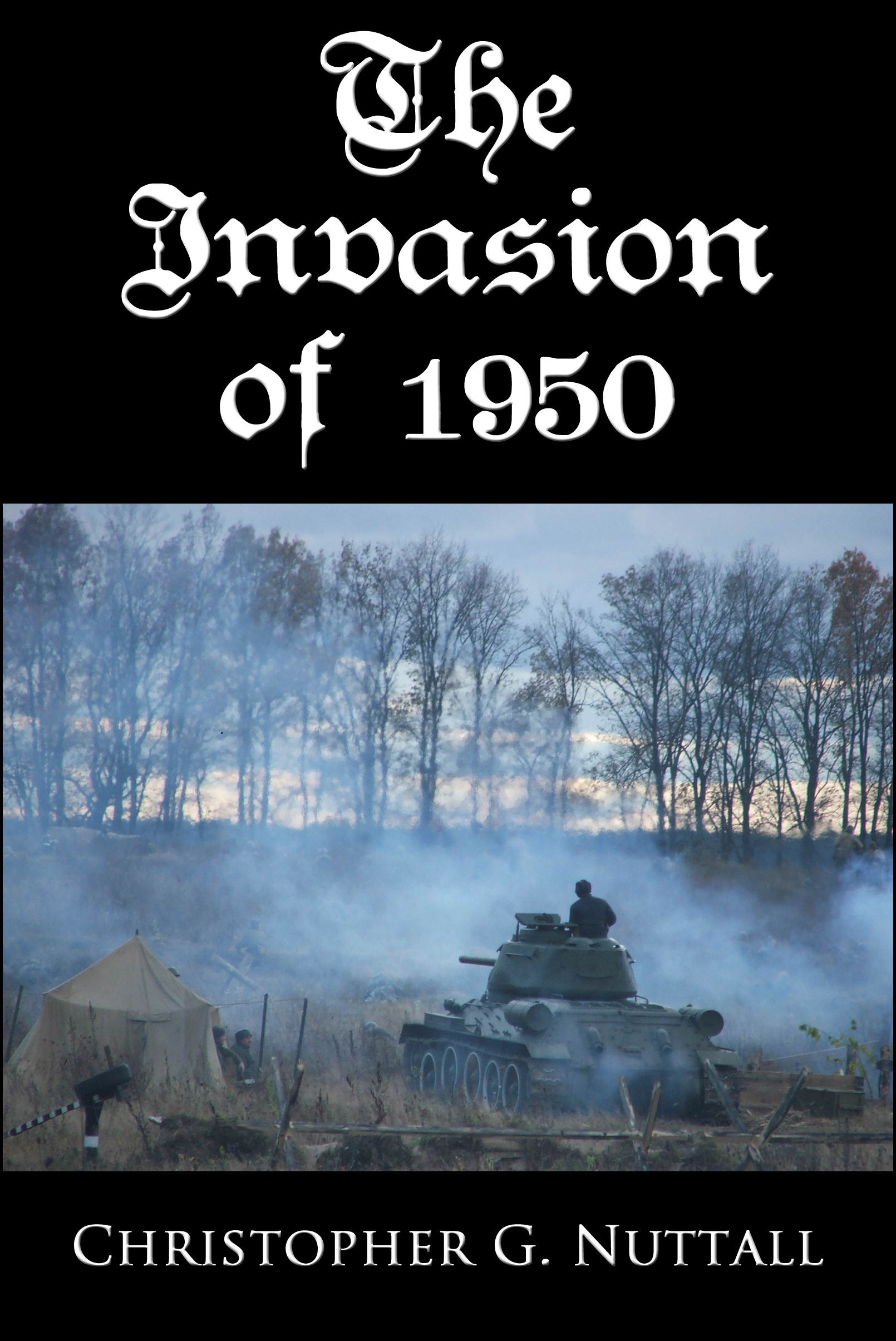
Christopher Nuttall, "The Invasion of 1950" (2013)
Just finished this self-published alt-history (allohistorical) work...
I heartily enjoyed it; worth the time, although it could use some editing. I did approach it, however, as pure escapist entertainment and not alternative history grounded in plausible variation of historical facts. More comments soon.
In the interim, travel over to the author's blog for more info.
I heartily enjoyed it; worth the time, although it could use some editing. I did approach it, however, as pure escapist entertainment and not alternative history grounded in plausible variation of historical facts. More comments soon.
In the interim, travel over to the author's blog for more info.
Labels:
book reviews,
dystopian,
European history,
fascism,
fiction,
German history,
military,
World War II
Wednesday, 18 March 2015
Timur Vermes, "Look Who's Back" (2012)
This is likely one of the most clever, amusing, intriguing and generally enjoyable fiction books I have read in a long time.
Essentially, the premise is that Adolf Hitler awakens with a pounding headache in a Berlin vacant lot in 2011. He has no memory of what has transpired since April 1945, with his last memory of that time being the act of showing Eva Braun his antique pistol. The rest of the story is simply too good to spoil. Vermes combines a singular wit, trenchant political commentary, and thought-provoking representation of how Hitler might understand the contemporary political world (both within Germany, as well as beyond).
Some snippets that I found particularly enjoyable (pagination is from my digital version):
37: “…in the last sixty-six years the number of Soviet soldiers on the territory of the German Reich had fallen substantially, particularly in the Greater Berlin area. The current figure was between thirty and fifty men; in a flash I could see that this afforded the Wehrmacht a far better prospect of victory compared to the last estimate from my general staff of around 2.5 million enemy soldiers on the Eastern Front alone.”
41: “We all know, of course, what to make of our newspapers. The deaf man writes down what the blind man has told him, the village idiot edits it, and their colleagues in the other press houses copy it. Each story is doused afresh with the same stagnant infusion of lies, so that the “splendid” brew can then be served up to a clueless Volk. In this instance, however, I was prepared to be somewhat lenient. So rarely does Fate intervene this strikingly in its own workings that even the smartest minds must find it difficult to comprehend, let alone the mediocre intellects serving our so-called opinion sheets. My brain required the stomach of an ox to digest the other information I managed to unearth.”
48: “What irony: yesterday I was repositioning the 12th Army; today it was magazine racks.”
194: “the so-called reunification of Germany into his expansive lap. I have to concede that this supposed “reunification” was one of the few first-rate lies propagated by the republic. For how could they call it a proper reunification when essential components – such as the aforementioned Silesia granted to Poland, as well as Alsace-Lorraine or Austria – were missing?”
378: “That’s pure gold!” Madame Bellini said when, heavy-hearted, I showed her the report on the “National Democrats” alongside others we had filmed.”
540: “the telephone has to be a telephone, a calendar, a camera and everything else besides. This is dangerous nonsense, the only possible consequence of which is that thousands of our young people will be mown down on the roads because they cannot stop staring into their screens. One of my first undertakings will be to outlaw such telephone devices or allow them only for those inferior racial elements remaining in our society – for the latter I may even make them compulsory. Then they will litter the main thoroughfares of Berlin like squashed hedgehogs.”
541: “Christmas decorations have become more tasteful with the passing of the years. A most disagreeable industrialisation has taken hold. I am not concerned about whether something is kitsch or not, for every example of kitsch harbours a residue of the feelings of the simple man, and since that is the case there will always be the possibility of a development towards real art. No, what really bothers me is that the importance of Father Christmas has grown disproportionally, doubtlessly as a result of Anglo-American cultural infiltration.”
547: “He has also devised a new electoral slogan. It will be plastered at the bottom of all the placards, giving them a common thread. The slogan addresses old virtues, old doubts, and for good measure has a humorous, conciliatory element to win over those pirate voters and other young people. The slogan reads: “It wasn’t all bad.”
Essentially, the premise is that Adolf Hitler awakens with a pounding headache in a Berlin vacant lot in 2011. He has no memory of what has transpired since April 1945, with his last memory of that time being the act of showing Eva Braun his antique pistol. The rest of the story is simply too good to spoil. Vermes combines a singular wit, trenchant political commentary, and thought-provoking representation of how Hitler might understand the contemporary political world (both within Germany, as well as beyond).
Some snippets that I found particularly enjoyable (pagination is from my digital version):
37: “…in the last sixty-six years the number of Soviet soldiers on the territory of the German Reich had fallen substantially, particularly in the Greater Berlin area. The current figure was between thirty and fifty men; in a flash I could see that this afforded the Wehrmacht a far better prospect of victory compared to the last estimate from my general staff of around 2.5 million enemy soldiers on the Eastern Front alone.”
41: “We all know, of course, what to make of our newspapers. The deaf man writes down what the blind man has told him, the village idiot edits it, and their colleagues in the other press houses copy it. Each story is doused afresh with the same stagnant infusion of lies, so that the “splendid” brew can then be served up to a clueless Volk. In this instance, however, I was prepared to be somewhat lenient. So rarely does Fate intervene this strikingly in its own workings that even the smartest minds must find it difficult to comprehend, let alone the mediocre intellects serving our so-called opinion sheets. My brain required the stomach of an ox to digest the other information I managed to unearth.”
48: “What irony: yesterday I was repositioning the 12th Army; today it was magazine racks.”
194: “the so-called reunification of Germany into his expansive lap. I have to concede that this supposed “reunification” was one of the few first-rate lies propagated by the republic. For how could they call it a proper reunification when essential components – such as the aforementioned Silesia granted to Poland, as well as Alsace-Lorraine or Austria – were missing?”
378: “That’s pure gold!” Madame Bellini said when, heavy-hearted, I showed her the report on the “National Democrats” alongside others we had filmed.”
540: “the telephone has to be a telephone, a calendar, a camera and everything else besides. This is dangerous nonsense, the only possible consequence of which is that thousands of our young people will be mown down on the roads because they cannot stop staring into their screens. One of my first undertakings will be to outlaw such telephone devices or allow them only for those inferior racial elements remaining in our society – for the latter I may even make them compulsory. Then they will litter the main thoroughfares of Berlin like squashed hedgehogs.”
541: “Christmas decorations have become more tasteful with the passing of the years. A most disagreeable industrialisation has taken hold. I am not concerned about whether something is kitsch or not, for every example of kitsch harbours a residue of the feelings of the simple man, and since that is the case there will always be the possibility of a development towards real art. No, what really bothers me is that the importance of Father Christmas has grown disproportionally, doubtlessly as a result of Anglo-American cultural infiltration.”
547: “He has also devised a new electoral slogan. It will be plastered at the bottom of all the placards, giving them a common thread. The slogan addresses old virtues, old doubts, and for good measure has a humorous, conciliatory element to win over those pirate voters and other young people. The slogan reads: “It wasn’t all bad.”
Labels:
biography,
book reviews,
dystopian,
European history,
fascism,
fiction,
German history,
racism,
World War II
Monday, 16 March 2015
Friday, 2 January 2015
William Forstchen, "One Second After" (2009)
Forstchen essentially narrates, through the vision of a typical hero of a US conflict narrative, the struggle for the citizens of a small North Carolina town to survive the year following an electromagnetic pulse (EMP) attack on the continental United States (as well as two other parts of the world).
Characterization is not Forstchen's forté. The narrator is a university history professor, former military man, widower, and father of two teenage girls. The protagonist is a bit of a cutout: former smoker falling back into the habit to manage the awful stress, stepping into difficult situations to do things no one else is willing to do, making good strategic calls for the benefit of the community, etc., etc., etc. Forstchen makes some effort to give the character some more human dimensions; he indicates that although a military man, the narrator served primarily in an administrative/leadership role and had little combat experience, he quickly starts voraciously eyeballing an attractive woman who finds herself stuck in the community, and he loves his dogs.
Where this book is intriguing, however, is as a piece of post-apocalytic/dystopian political fiction. The primary concern of the novel is exploring how societies would choose to govern themselves in the absence of 'higher temporal authority'. In this regard, Forstchen offers intriguing scenarios, poses challenging problems, and considers how they might be most likely resolved. Substantial space is given to describing discussions of the 'town council', explaining the thinking processes underlying decisions, and narrating discussions as options are weighed.
I have two core criticisms with the text. Firstly, there is little consideration given to resistance, dissension, and madness. In a dystopian scenario based on a near-instantaneous collapse of society - even within a somewhat isolated, small population centre - I would expect that many situations would dissolve into shouting matches, pushing and shoving, screaming and hair-pulling, accompanied by acts of desperation and insanity. Although Forstchen addresses looting, pillaging, rape, and cannibalism, these all seem to be marginal acts perpetrated by marginal figures in the story, and are treated clinically. Within the community, self-control and cooperation seems to be the near universal response. Perhaps this strategy was intended to underline the heroic charisma of the leaders, but for a society oriented around a revolutionary, individual rights focus, seems rather idealistic or naive.
Similarly, the enemy - the outsiders - are caricatures. Drug addicts and gang members from a nearby larger population centre, they manage to cobble together a small army to raid and terrorize other communities. While it is entirely possible that these types of groups might exist, it is difficult to see how they would manage to survive for an extended period as travelling marauders, particularly as they would likely not have the technical skills to adapt to the available technology, to generate a food supply once the existing reserves are depleted, and to create a viable leadership that is not constantly battling for dominance against competitors. It is far more likely that most communities would simply not be able to manage floods of refugees, the ravages of disease, and internal squabbling.
Overall, I think Walking Dead offers a more reasonable account of the post-apocalypse than One Second After. Of course, absent the zombies.
You can visit the book website.
Characterization is not Forstchen's forté. The narrator is a university history professor, former military man, widower, and father of two teenage girls. The protagonist is a bit of a cutout: former smoker falling back into the habit to manage the awful stress, stepping into difficult situations to do things no one else is willing to do, making good strategic calls for the benefit of the community, etc., etc., etc. Forstchen makes some effort to give the character some more human dimensions; he indicates that although a military man, the narrator served primarily in an administrative/leadership role and had little combat experience, he quickly starts voraciously eyeballing an attractive woman who finds herself stuck in the community, and he loves his dogs.
Where this book is intriguing, however, is as a piece of post-apocalytic/dystopian political fiction. The primary concern of the novel is exploring how societies would choose to govern themselves in the absence of 'higher temporal authority'. In this regard, Forstchen offers intriguing scenarios, poses challenging problems, and considers how they might be most likely resolved. Substantial space is given to describing discussions of the 'town council', explaining the thinking processes underlying decisions, and narrating discussions as options are weighed.
I have two core criticisms with the text. Firstly, there is little consideration given to resistance, dissension, and madness. In a dystopian scenario based on a near-instantaneous collapse of society - even within a somewhat isolated, small population centre - I would expect that many situations would dissolve into shouting matches, pushing and shoving, screaming and hair-pulling, accompanied by acts of desperation and insanity. Although Forstchen addresses looting, pillaging, rape, and cannibalism, these all seem to be marginal acts perpetrated by marginal figures in the story, and are treated clinically. Within the community, self-control and cooperation seems to be the near universal response. Perhaps this strategy was intended to underline the heroic charisma of the leaders, but for a society oriented around a revolutionary, individual rights focus, seems rather idealistic or naive.
Similarly, the enemy - the outsiders - are caricatures. Drug addicts and gang members from a nearby larger population centre, they manage to cobble together a small army to raid and terrorize other communities. While it is entirely possible that these types of groups might exist, it is difficult to see how they would manage to survive for an extended period as travelling marauders, particularly as they would likely not have the technical skills to adapt to the available technology, to generate a food supply once the existing reserves are depleted, and to create a viable leadership that is not constantly battling for dominance against competitors. It is far more likely that most communities would simply not be able to manage floods of refugees, the ravages of disease, and internal squabbling.
Overall, I think Walking Dead offers a more reasonable account of the post-apocalypse than One Second After. Of course, absent the zombies.
You can visit the book website.
Wednesday, 24 December 2014
Joey Comeau, "Overqualified" (2007)
Comeau's short book of cover letters written to various potential employers evokes an occasional chuckle, although when the author attempts to evoke some kind of deeper curiosity or pathos through vague references to a family death or tragedy, he left me cold. The threads are too confusing, too ambiguous, too inconsistent, and in the end, left floating without any kind of consolidation or clarification of their importance.
Frankly, Julie Schumacher's Dear Committee Members (discussed on this site) does much the same job, in a similar fashion, but in a much more readable text.
Thursday, 23 October 2014
Stephen King, "Cell" (2006)
Meh... I used to turn to Stephen King novels as 'palate cleansers', something fully to read that wouldn't tax my brain, and to give myself a break from political history books. I can't recall what the last King novel is that I read, but it was likely one from the '80s. Cell crossed by path and as it was fairly short, I thought I might as well poke my toe in the pool and see what King has been up to for the last decade or two.
As the book's title intimates, the storyline revolves around the effects a mysterious 'pulse' emitted from cellphones has on the phones' users. In a few minutes of time, the world seems to have been turned into a maelstrom of neck-biting, flesh-ripping, self-destructive peoploids, chasing each other and the as yet unaffected. The protagonist of the story has just finalized a book deal, and hopes that this change might help save his failed marriage. He is feeling like his life is turning around into something positive, when the zombie apocalypse begins.
For fans of gore and zombies, Cell is a good read. The action starts within the first few pages, and the zombies never disappear as a threat. Sloppy romanticism is kept to a minimum, although King's attempts to undermine it are a little heavy-handed. In particular, most of the efforts to establish a sustained optimism regarding familial or paternal feelings come to naught (and often end in messy death).
The book's ending is a little unsatisfying. Although I'm sure it's intended to be cliffhanger, and perhaps to leave the door open to a sequel, it smacked more of laziness to this reader. It felt like instead of resolving the plot line, King simply stopped writing, got up from his desk and said, "ah, well, that's good enough."
As the book's title intimates, the storyline revolves around the effects a mysterious 'pulse' emitted from cellphones has on the phones' users. In a few minutes of time, the world seems to have been turned into a maelstrom of neck-biting, flesh-ripping, self-destructive peoploids, chasing each other and the as yet unaffected. The protagonist of the story has just finalized a book deal, and hopes that this change might help save his failed marriage. He is feeling like his life is turning around into something positive, when the zombie apocalypse begins.
For fans of gore and zombies, Cell is a good read. The action starts within the first few pages, and the zombies never disappear as a threat. Sloppy romanticism is kept to a minimum, although King's attempts to undermine it are a little heavy-handed. In particular, most of the efforts to establish a sustained optimism regarding familial or paternal feelings come to naught (and often end in messy death).
The book's ending is a little unsatisfying. Although I'm sure it's intended to be cliffhanger, and perhaps to leave the door open to a sequel, it smacked more of laziness to this reader. It felt like instead of resolving the plot line, King simply stopped writing, got up from his desk and said, "ah, well, that's good enough."
Labels:
book reviews,
dystopian,
fiction,
media criticism
Friday, 5 September 2014
Julie Schumacher, "Dear Committee Members" (2014)
A genuinely good hoot, this book will particularly be appreciated by anyone who has lived or worked in academia above the undergraduate level.
Essentially, it tells the tale - through a series of recommendation letters and requests for help - of a tenured Creative Writing professor at some East Coastish mid- to small-sized US university. He struggles with his own underperformance, as well as with the apparently diminishing respect for his department within the university. The letters tell the tale of romantic failures (his ex-wife and his ex-girlfriend both work for the university), his resistance to technological communication (he writes letters rather than emails, perhaps due to a messy and embarrassing 'reply all' incident where he strives to reignite one of his relationships), students - good and bad - seeking his help in doing everything from gaining publishing contracts to getting jobs at restaurants.
All in all, I laughed out loud multiple times. Schumacher has accurately captured the fish-bowl narcissism and bitterness that contemporary academia feeds. I'm tempted to recommend this book to all students who consider asking me for letters of recommendation.
Essentially, it tells the tale - through a series of recommendation letters and requests for help - of a tenured Creative Writing professor at some East Coastish mid- to small-sized US university. He struggles with his own underperformance, as well as with the apparently diminishing respect for his department within the university. The letters tell the tale of romantic failures (his ex-wife and his ex-girlfriend both work for the university), his resistance to technological communication (he writes letters rather than emails, perhaps due to a messy and embarrassing 'reply all' incident where he strives to reignite one of his relationships), students - good and bad - seeking his help in doing everything from gaining publishing contracts to getting jobs at restaurants.
All in all, I laughed out loud multiple times. Schumacher has accurately captured the fish-bowl narcissism and bitterness that contemporary academia feeds. I'm tempted to recommend this book to all students who consider asking me for letters of recommendation.
Friday, 11 July 2014
Mark Twain, "Adventures of Huckleberry Finn" (1884)
A classic work of American fiction, by an author of universal repute.There really isn't much that I can add to the volumes of analysis that have been offered on this. It remains an enjoyable read over a century later. Racial characterizations of African-Americans - particularly Huck's compadre, Jim* - contrast significantly with contemporary values.
As a copyright-expired text, the full version is available through a number of online sources, such as Archive.org.
The Eric Kemble illustrations for the 1884/1885 edition are available via the University of Virginia.
* When I was about 7 years old, my public school performed Huckleberry Finn as our major play for the year. Despite having no African heritage (or at least not for centuries), I was cast as Jim - in full brown grease paint from head to toe - and I don't recall anyone raising a concern at all. Of course, our school community housed only a single child of what I presume was Caribbean heritage.
As a copyright-expired text, the full version is available through a number of online sources, such as Archive.org.
The Eric Kemble illustrations for the 1884/1885 edition are available via the University of Virginia.
* When I was about 7 years old, my public school performed Huckleberry Finn as our major play for the year. Despite having no African heritage (or at least not for centuries), I was cast as Jim - in full brown grease paint from head to toe - and I don't recall anyone raising a concern at all. Of course, our school community housed only a single child of what I presume was Caribbean heritage.
Monday, 7 July 2014
Stephen Leacock, "Sunshine Sketches of a Little Town" (1912)
Classic Canadian humourous fiction.
This is gentle humour, poking fun at the pride, simplicity, and subtle competitiveness that likely runs through most North American small towns (just as much 100 years ago as it does today). Having spent my teenage years in just such a town as the one Leacock describes, I found much that resonated. The humour, however, was not as witty as another Leacock treasure, Arcadian Adventures of the Idle Rich, that pokes fun at the urban counterparts to those described in Sunshine Sketches....
Labels:
book reviews,
Canadian art,
Canadian history,
fiction
Saturday, 19 April 2014
Jeff Greenfield, "Then Everything Changed" (2010)
Sub-titled: "Stunning Alternate Histories of American Politics: JFK, RFK, Carter, Ford, Reagan."
What distinguishes this book from many allohistorical texts - particularly those considered with political popular culture (that is a term I can apply to the Kennedy assassinations, no?) - is that the author is genuinely a political insider. He had familiarity with many of the people he writes about, including the Kennedys. He also brings years of experience as a political analyst and commentator. This knowledge has led him to write a book that is more daunting than the average 'science fiction'/casual reader might desire. It is, however, the key to Greenfield's approach.
Much of what Greenfield considers in weighing historical alternatives is based on tweaking a single event, and then looking at the weight of likely political response, particularly in how the negotiation of alliances, strategizing, and campaigning would play itself out in the new circumstances provided by the author's re-imagining. So, for instance, RFK's near-assassination is obviously important, but where the true 'grit' of Greenfield's imagination gains its importance is how he conceives of RFK's electoral chances given the likely messaging his team would have pursued, who the Republicans might have selected as their candidate in response to the changed circumstances, and how their competing messages might have played out in the various electoral colleges. Frankly, fascinating, daunting, exhausting reading that offers much for historians and political junkies alike.
I admit to knowing nothing about Greenfield before I read this book. I picked it up based on an interest in political allohistory.
What distinguishes this book from many allohistorical texts - particularly those considered with political popular culture (that is a term I can apply to the Kennedy assassinations, no?) - is that the author is genuinely a political insider. He had familiarity with many of the people he writes about, including the Kennedys. He also brings years of experience as a political analyst and commentator. This knowledge has led him to write a book that is more daunting than the average 'science fiction'/casual reader might desire. It is, however, the key to Greenfield's approach.
Much of what Greenfield considers in weighing historical alternatives is based on tweaking a single event, and then looking at the weight of likely political response, particularly in how the negotiation of alliances, strategizing, and campaigning would play itself out in the new circumstances provided by the author's re-imagining. So, for instance, RFK's near-assassination is obviously important, but where the true 'grit' of Greenfield's imagination gains its importance is how he conceives of RFK's electoral chances given the likely messaging his team would have pursued, who the Republicans might have selected as their candidate in response to the changed circumstances, and how their competing messages might have played out in the various electoral colleges. Frankly, fascinating, daunting, exhausting reading that offers much for historians and political junkies alike.
I admit to knowing nothing about Greenfield before I read this book. I picked it up based on an interest in political allohistory.
Wednesday, 2 April 2014
Francis Spufford, "Red Plenty" (2012)
You can read an extract from the book here.
Spufford has created a fairly fun website to support his book.
Monday, 20 January 2014
Monday, 30 December 2013
Lauren B. Davis, "The Empty Room" (2013)
This is a fascinating consideration of adult female alcoholism.
Davis writes writes with the sympathetic and yet firm knowledge of addicted thinking gained during her own time as an alcoholic. With decades of sobriety, this book is a reflection on what her life might have been like had she not found sobriety. It is insightful. It is frightening. It is humble.
Addicts will find this book particularly compelling, as they are sure to see elements of their own experience described. They will likely see their own flawed thinking, their own rationalizing, their own desires and shortcomings. They will see parallels for the depths they have sunk to and likely kept secret, if they could. They might also read some of the same fears they have felt about admitting to their own addiction, and starting a program of recovery.
My only complaint is that this book ends too quickly. I rarely find fiction to be "page turning." Perhaps I had a particular and special interest in this book, but I finished it in about 24 hours.
Davis writes writes with the sympathetic and yet firm knowledge of addicted thinking gained during her own time as an alcoholic. With decades of sobriety, this book is a reflection on what her life might have been like had she not found sobriety. It is insightful. It is frightening. It is humble.
Addicts will find this book particularly compelling, as they are sure to see elements of their own experience described. They will likely see their own flawed thinking, their own rationalizing, their own desires and shortcomings. They will see parallels for the depths they have sunk to and likely kept secret, if they could. They might also read some of the same fears they have felt about admitting to their own addiction, and starting a program of recovery.
My only complaint is that this book ends too quickly. I rarely find fiction to be "page turning." Perhaps I had a particular and special interest in this book, but I finished it in about 24 hours.
Friday, 20 December 2013
Chester Brown, "Ed the Happy Clown: A Graphic Novel" (1980s)
I've reviewed several Chester Brown works on this blog. The early elements of the Ed story were contained in Brown's Yummy Fur mini-comics. An ex-girlfriend bought me a few in... 1986? I LOVED THEM. They mixed scatological humour ("The Man Who Couldn't Stop", about a man who could not stop defecating) with a rather straight take on the Gospel of Matthew. I was hooked, but could never find the rest. This anthology brings the run of Yummy Fur together, without the Gospel of Matthew material.
More later.
For my review of Brown's Paying for It, go here.
For my review of Brown's Louis Riel, go here.
More later.
For my review of Brown's Paying for It, go here.
For my review of Brown's Louis Riel, go here.
Labels:
book reviews,
Canadian art,
fiction,
Toronto history
Subscribe to:
Posts (Atom)