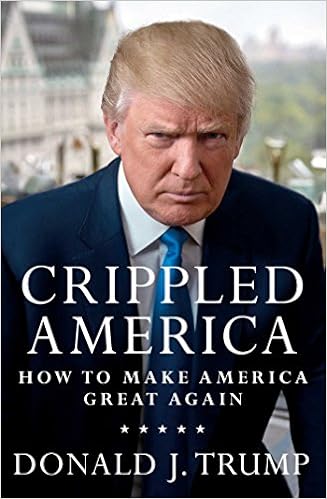
Over the last decade or so Donald Trump has made a surprising conversion; he's gone from the relative anonymity of business success, to hawker of schlocky business advice books and seminars, to host of a reality tv show parody of business skills, to Tea Party-esque 'birthed', to US Republican party presidential candidate. Among these roles, however, was no experience with government or public service. I wanted to see how the realities of Trump's history might be managed to present him as a serious contender for US leader. His book lived up to every expectation his previous work created.
My review of the book is not based on my perception of Trump's policies, but on my assessment of the book as political biography/manifesto. It was helpful, however, to get a sense of Trump's policy-making logic. The book came across as an extended, unedited interview with little attempt to be reflective. A multitude of contentious assertions are made that sorely require some citation of evidence if they are to be considered as plausible. Annoying self-serving claims such as "I'm a nice guy" are repeated frequently, and give more an impression of insecurity than of the presentation of a self-proclaimed hard-headed pragmatic businessman. The book on the whole is alarming light: little meaningful biographic information, little meaningful policy, shallow analysis largely unattached to any supporting evidence or facts. I can only assume this book was intended, at best, as a fundraising venture. If so, the cover photo should have been rethought… or was purposely intended to be so weird that consumers would buy it simply to figure out what the heck Trump was thinking when he approved it.
Select quotes, with comments:
Preface: You Gotta Believe
“There’s nothing to be joyful about. Because we are not in a joyous situation right now.”
“People say that I have self-confidence. Who knows?”
--- COMMENT: What a strange comment. The rhetorical question hardly seems necessary, but does point to an important concern for Trump. One of Trump's repeated claims is that he's a 'nice guy'. Either he believes he's not, and is trying to convince his reader of something he doesn't believe, or he believes he is and is convinced that no one else believes it. If he's shy about claiming his self-confidence, it would seem he's not sure of his identity. Maybe his claims to being a 'nice guy' are an attempt to convince himself?
“I persevered and went directly to the people, because I don’t need anyone’s financial support, nor do I need anyone’s approval of what I say or do. I just had to do the right thing. I had to do it. I had no choice. I see what’s happening to our country; it’s going to hell. I had to do it.”
--- COMMENT: What confounds me about this comment is the idea that running for president is the only thing Trump could conceive of to do for his country. As a wealthy American business owner, that he had little record of previous public service or engagement suggests that his claim to actions based on moral necessity is weak.
“We need to outline commonsense policies and then knock some heads together if necessary to make them work. The fact is we are over-regulated. People can’t move. They’re stymied. Companies can’t be built. We’re over-regulated.”
“I’m a really nice guy, believe me, I pride myself on being a nice guy but I’m also passionate and determined to make our country great again.”
1. Winning Again
“I realized that with my well-known success story and record of building residential and office buildings and developing public spaces—all the while accumulating personal wealth—I could inspire people to help create the most massive turnaround in American history.”
“I’m not a diplomat who wants everybody else to be happy. I’m a practical businessman who has learned that when you believe in something, you never stop, you never quit, and if you get knocked down, you climb right back up and keep fighting until you win”
--- COMMENT: I find Trump's characterization of the goal of international diplomacy - to make everybody else happy - quite intriguing. Rather than pursuing the interests of the state, the public good, or peace, Trump believes diplomats are simply self-sacrificing do-gooders? Or, is he purposely belittling diplomacy to build a stronger case for aggressive, self-confident, independent action that ignores negative consequences for anyone else he might be trying to co-exist with.
2. Our “Unbiased” Political Media
“…politicians who boldly promise they are going to stand up to our enemies won’t even give direct answers to reporters. I don’t play that game, because I’m a very successful businessman”
--- COMMENTS: What a strange comment, built on a false difference. Why should we believe that business people have any more motivation to be honest and direct with the mass media than Trump characterizes politicians as being? Ironically, only a few pages later, Trump states that he is not, in fact, honest and direct with reporters.
“…you’d think a major news network would take their responsibilities more seriously and use these debates to help the public determine who has the best plan to make our country great again”
“I use the media the way the media uses me—to attract attention”
“…sometimes I make outrageous comments and give them what they want—viewers and readers—in order to make a point. I’m a businessman with a brand to sell.”
“…when they write a story about one of my deals, it doesn’t cost me a cent, and I get more important publicity. I have a mutually profitable two-way relationship with the media—we give each other what we need.”
“…anyone who believes I can use the media is absolutely wrong. Nobody can use the press. It’s too big, too widespread”
--- COMMENT: Another contradictory claim. If he can't 'use the media', then how can he have a 'mutually profitable two-way relationship' with them?
“…every show is trying to make news. The problem is that they aren’t doing their job. They aren’t interested in informing the public.”
“These media companies are owned by billionaires. These are smart people who know which candidates are going to be best for them, and they find a way to support the person they want.”
“…the problem we face in this country with our media. There is such competition that they’re more interested in entertaining their audience than educating them. They like me because I help them attract more viewers. They hate me because they know I don’t need them.”
3. Immigration: Good Walls Make Good Neighbors
“The Mexican government has published pamphlets explaining how to illegally emigrate to the United States.”
4. Foreign Policy: Fighting for Peace
“…building up our military also makes economic sense because it allows us to put real money into the system and put thousands of people back to work.”
--- COMMENT: Intriguing. Spending 'real money' could be done in a multitude of ways that does not put lives at risk. Same for creating jobs. Unless that money is spent in the US, and unless those forces are based in the US, however, it would seem that much of this real money will be spent in foreign ports and on foreign bases, paying foreigners and other countries. Building infrastructure, domestic security, and supporting innovation at home would seem to involve 'real money', create jobs, and keep US money at home.
“We defend Germany.”
--- COMMENT: I wonder if Trump realizes that the Cold War is over, and that the Soviet Union has collapsed. I doubt the Ukraine - arguably the closest conventional national threat to Germany - has any dreams of occupying Germany. In this regard, then, the US 'defence' of Germany lauded by Trump seems to be more of an economic stick to shake to exact compensation, exert power, and pursue US interests in Europe, not something that Germany should be going down on bended knee to pay the US for.
“An Iran with a nuclear weapon would start a nuclear arms race in the Middle East with potentially devastating consequences. The situation would rapidly escalate to being the most dangerous threat Israel has ever faced. And it would force us to use extreme measures in defense of Israel and other allies in the region.”
“I’ve had several Trump-brand products made there.”
“I could make a very important point if I refused to have my goods manufactured there.”
“I have an obligation to all of my employees and to consumers and stockholders to produce the best product at the lowest possible price.”
--- COMMENT: Trump identifies his ethical and moral obligations several times in the book. What is interesting here from a business ethics perspective is the very limited notion of stakeholder theory.
“…it is always important to be flexible—and never reveal our cards. Our politicians talk too much”
--- COMMENT: …and yet, they can apparently also be direct and honest with media, and publish books explaining their policy-making logic, goals, and ethics.
“When dealing with China we need to stand up to them and remind them that it’s bad business to take advantage of your best customer.”
--- COMMENT: An admirable bravado, given the level of US debt that China holds.
“We need to put some of the bill for this transformation on the Saudi Arabians, the South Koreans, the Germans, the Japanese, and the British. We’re protecting them, after all, and they should share in the costs.”
“The new dawn of America has just begun.”
--- COMMENT: I am amazed that any self-respecting politician would still call on this hackneyed image that seems to most often be used by far-right politicians from the Nazis to the 21st-century Greek political party.
5. Education: A Failing Grade
“…today, some teachers and school administrators are more concerned about hurting their students’ feelings or about hearing complaints from parents that they’re being too tough. Instead of becoming more competitive, we’re actually eliminating competition. That’s incredible—and wrong. Competition makes you stronger, it forces you to work harder, to do more.”
“Common Core, No Child Left Behind, and Race to the Top are all programs that take decisions away from parents and local school boards. These programs allow the progressives in the Department of Education to indoctrinate, not educate, our kids. What they are doing does not fit the American model of governance.”
“Anyone who has succeeded in business has survived a lot of failure—but they were tough enough to get back up and try again and again. Kids need to learn that success requires persistence. Self-esteem should come from overcoming challenges and surviving the hard knocks of trying to be better.”
“I’m very much in favor of school choice. Let schools compete for kids. I guarantee that if you forced schools to get better or close because parents didn’t want to enroll their kids there, they would get better. Those schools that weren’t good enough to attract students would close”
--- COMMENT: Or… schools would compete to inflate student's grades, make sure students 'felt good' as much as 'performed', and certainly called upon wealthy donors to help ensure the school had every opportunity that money could buy.
“In too many classrooms, though, we’ve taken away their right to discipline disruptive kids, turning the teachers into babysitters as much as educators.”
“The really good and inspirational teachers burn out under the painful conditions found in too many schools. The bad teachers tend to hang around since they have nowhere else to go. Thus, the paychecks tend to be bigger for the less capable.”
“There is no reason the federal government should profit from student loans. This only makes an already difficult problem worse. The Federal Student Loan Program turned a $41.3 billion profit in 2013.”
6. The Energy Debate: A Lot of Hot Air
“Violent climate “changes” are nothing new. We have even had ice ages. I just don’t happen to believe they are man-made.”
--- COMMENT: Great. This would be an ideal place to provide any kind of evidence other than personal belief. As a project manager/property developer, I do wonder why Trump concludes his perceptions of things are more authoritative than a vast population of environmental scientists.
“…we need to take advantage of every opportunity, including approving the Keystone XL Pipeline.”
7. Health Care Is Making Us All Sick
“This is a subject that has been really important to me for a very long time.”
“…it was only approved because President Obama lied 28 times saying you could keep your doctor and your plan—a fraud and the Republicans should have sued—and meant it”
--- COMMENT: This type of very aggressive claim really requires some kind of evidence and explanation.
“We should hire the most knowledgeable people in the world on this subject and lock them in a room—and not unlock the door until they’ve agreed on the steps we need to take.”
--- COMMENT: A great solution, given how easily and quickly the current policy was decided upon.
8. It’s Still the Economy, Stupid
“I am concerned for the people who can’t buy into the American dream because the financial programs of this country are so tilted in favor of the rich”
“For the past year, the United States has been the one country that has maintained financial stability while Europe and Asia faltered.”
--- COMMENT: American exceptionalism and myopia. Hey, Trump, maybe you should look at the record of your largest international trade partner.
“Ford recently announced that it’s building a $2.5 billion plant in Mexico. Nabisco is moving a big plant from Chicago to Mexico. A German auto company was all set to build a plant in Tennessee, but then it changed its mind and is building it in Mexico instead.”
9. Nice Guys Can Finish First
“I’M A NICE GUY. I really am.”
“I have outlined plenty of policy initiatives. This is not “the politics of hope.” This is “the politics of reality,” which only a strong businessman like me can develop.”
--- COMMENT: I still don't understand how Trump concludes that only businessmen can develop reasonable, workable public policy. Is he really so dismissive of everyone else's skills?
“Me? I speak for the people.”
--- COMMENT: Use of these ambiguous phrases drives me batty. When Trump says 'the people' who is he suggesting he does not represent? Who is not part of the 'people' in the US to Trump?
“…at one time I was a registered Democrat”
“Now I’m a conservative Republican with a big heart. I didn’t decide to become a Republican. That’s who I have always been.”
12. Our Infrastructure Is Crumbling
“…we can create the biggest economic boom in this country since the New Deal when our vast infrastructure was first put into place.”
“On the federal level, this is going to be an expensive investment, no question about that. But in the long run it will more than pay for itself. It will stimulate our economy while it is being built and make it a lot easier to do business when it’s done”
--- COMMENT: See my comments above re: military spending. Trump, which way is the wind blowing?
13. Values
“I was a much better father than I was a husband, always working too much to be the husband my wives wanted me to be.”
--- COMMENT: Another intriguing ethical position. Being a good husband does not have independent, role specific ethical requirements for Trump, but rather success at the role is shaped by the perceptions of others, in this case, his wife.
“In business, I don’t actively make decisions based on my religious beliefs, but those beliefs are there—big-time.”
“It’s not my job to defend the president. President Obama would never defend me.”
--- COMMENT: Mark 12:31, Matthew 22:39, John 15:13, Leviticus 19:18, 1 John 4:11, Luke 6:29.
14. A New Game in Town
“I’m criticized for not issuing elaborate, detailed policy statements. What good are detailed plans if your country doesn’t have the credibility to carry them out—but I issue them anyway.”
“Making America Great Again means taking our country back from the big-money interests.”
--- COMMENT: Wait… Trump is rich enough to not need the media. He's rich enough to not have to pander to financial supporters. So… he's planning to take the country back from himself? Perhaps self-imposed exile?
15. Teaching the Media Dollars and Sense
“People sometimes forget that the newspapers and television stations are profit-making businesses—or at least they’re trying to be.”
“I know that every poll shows that the public doesn’t trust the media. The irony about that is that the media is conducting those polls”
--- COMMENT: Kind of like the rich telling the poor that they plan to take care of the little guy's interests.
16. A Tax Code That Works
“The federal tax code is 74,608 pages long. Nobody can really understand it, not even the accountants who try to help taxpayers fill out their forms”
“Instead of multiple tax brackets with multiple variations, there will be only four brackets: 0%, 10%, 20%, and 25%.”
“This plan will also require companies with off-shore capital to bring that money back to the United States at a repatriation rate of only 10 percent”
My Personal Financials January 7, 2016
Reflections by Dr. Gregory Klages on non-fiction books dealing primarily with politics, history, and religion. Significant attention to Canadian content. Mail me/comment if you read anything. I love to hear feedback!
Showing posts with label business. Show all posts
Monday, 11 January 2016
Wednesday, 7 October 2015
Frederick S. Lane III, "Obscene Profits" (1999)
Subtitle: "The Entrepreneurs Of Pornography In The Cyber Age."
Read, but comments not yet written.
Consider this a placeholder.
Read, but comments not yet written.
Consider this a placeholder.
Labels:
art history,
book reviews,
business,
economics,
film history,
law,
media criticism,
pornography,
U.S.A. history
Saturday, 4 July 2015
Butler Schaffer, "A Libertarian Critique of Intellectual Property" (2014)
This is an extended essay published by the libertarian-slanted (Ludwig von) Mises Institute, located in Alabama. Schaffer is an Associate Professor at the Southwestern University School of Law. In 2013, the Institute awarded Schaffer $10,000 for his "lifetime defence of liberty."
Schaffer's argument is not as radical as it might sound. He is not an anarchist. His criticism of intellectual property laws is that they provide incorporated bodies ('artificial' persons recognized by law) with the power to limit, control, and profit from ideas that would better benefit society as part of the creative, communicative commons. He does not suggest that property should be abolished, but that ownership of property should be limited to 'natural' persons, for information that they choose not to send forth into the community. He does raise the prospect, though, that in reality no ideas are built truly independently of the knowledge of others, thus implying that intellectual property laws should be rendered null and void.
QUOTATIONS, AND NOTES by Gregory Klages:
"...only human beings—“persons”—should be respected as property owners; that treating corporations, political institutions, and other abstractions as artificial “persons” represents a source of conflict we ought to reject."
"...the state becomes seen for what it is: an organizational tool of violence that is able to accomplish its purposes only through the willingness of its victims to accord it legitimacy. Such a practice allows lifeless fictions to transcend — and thus demean — the importance of individual human beings."
"...the essence of ownership is found in the capacity to control some resource in furtherance of one’s purposes, such a claim is lost once a product has been released to the public. The situation is similar to that of a person owning oxygen that is contained in a tank, but loses a claim to any quantity that might be released — by a leaky valve — into the air."
"True to their coercive and looting nature, governments have gone so far as to take from the 'public domain' words that belong to no one, and conferred a monopoly copyright upon various institutional interests. The word 'Olympics,' for instance, has been in common usage since at least the eighth century B.C. By political fiat, the International Olympic Committee now enjoys ownership of that word as a state-protected trademark."
"Is the creative process encouraged or hindered by this system of state-conferred monopolies? Creativity—like learning in general — is fostered by cross-fertilization and synthesis."
"The proposition that knowledge and ideas can be made the exclusive property of one who discovers or expresses what was previously unknown, is contrary to the nature of the intelligent mind, whose content is assembled from a mixture of the experiences of others and oneself. Even the language with which one formulates and communicates his or her understanding to others, has been provided by predecessors."
"If we truly believe that the creative process requires the state to grant to inventors and discoverers an immunity from having their works adopted by others, will we insist that modern producers either compensate the descendants of earlier creators for their preliminary work or, in the alternative, abandon their claims to rewards for their “originality”?"
"...the patenting process, as with government regulation generally, is an expensive and time-consuming undertaking that tends to increase industrial concentration."
"The current political mantra, “too big to fail,” is a product of the dysfunctional nature of size when an organization faces energized competition to which it must adapt if it is to survive."
"The state’s creation of patent and copyright interests doesn’t, by itself, prevent innovation by others, but it does erect hurdles that often discourage research…"
Schaffer's argument is not as radical as it might sound. He is not an anarchist. His criticism of intellectual property laws is that they provide incorporated bodies ('artificial' persons recognized by law) with the power to limit, control, and profit from ideas that would better benefit society as part of the creative, communicative commons. He does not suggest that property should be abolished, but that ownership of property should be limited to 'natural' persons, for information that they choose not to send forth into the community. He does raise the prospect, though, that in reality no ideas are built truly independently of the knowledge of others, thus implying that intellectual property laws should be rendered null and void.
QUOTATIONS, AND NOTES by Gregory Klages:
"...only human beings—“persons”—should be respected as property owners; that treating corporations, political institutions, and other abstractions as artificial “persons” represents a source of conflict we ought to reject."
"...the state becomes seen for what it is: an organizational tool of violence that is able to accomplish its purposes only through the willingness of its victims to accord it legitimacy. Such a practice allows lifeless fictions to transcend — and thus demean — the importance of individual human beings."
"...the essence of ownership is found in the capacity to control some resource in furtherance of one’s purposes, such a claim is lost once a product has been released to the public. The situation is similar to that of a person owning oxygen that is contained in a tank, but loses a claim to any quantity that might be released — by a leaky valve — into the air."
"True to their coercive and looting nature, governments have gone so far as to take from the 'public domain' words that belong to no one, and conferred a monopoly copyright upon various institutional interests. The word 'Olympics,' for instance, has been in common usage since at least the eighth century B.C. By political fiat, the International Olympic Committee now enjoys ownership of that word as a state-protected trademark."
"Is the creative process encouraged or hindered by this system of state-conferred monopolies? Creativity—like learning in general — is fostered by cross-fertilization and synthesis."
"The proposition that knowledge and ideas can be made the exclusive property of one who discovers or expresses what was previously unknown, is contrary to the nature of the intelligent mind, whose content is assembled from a mixture of the experiences of others and oneself. Even the language with which one formulates and communicates his or her understanding to others, has been provided by predecessors."
"If we truly believe that the creative process requires the state to grant to inventors and discoverers an immunity from having their works adopted by others, will we insist that modern producers either compensate the descendants of earlier creators for their preliminary work or, in the alternative, abandon their claims to rewards for their “originality”?"
"...the patenting process, as with government regulation generally, is an expensive and time-consuming undertaking that tends to increase industrial concentration."
"The current political mantra, “too big to fail,” is a product of the dysfunctional nature of size when an organization faces energized competition to which it must adapt if it is to survive."
"The state’s creation of patent and copyright interests doesn’t, by itself, prevent innovation by others, but it does erect hurdles that often discourage research…"
Labels:
book reviews,
business,
economics,
law,
philosophy
Thursday, 26 February 2015
Tim Castleman, "8 Hour Bestseller" (2015)
Subtitle: "How to Write Your Bestselling Book in Record Time."
I will write notes someday. For now, consider these:
1. Wouldn't completing a best-selling book in record time make you a little suspicious as an author?
2. Is this the question I'm really trying to answer, or should I be asking: "How can I write my best book in record time?" Perhaps, "how can I write the best book possible without wasting time?"
My short-term summary, however, is that the strategies laid out here could likely be conceived by most people with some critical skills and a cup of coffee. The book serves a purpose, I suppose, but reads more as proof of the author's theory that a profitable self-published and self-marketed digital book doesn't have to be particularly informative or insightful, as long as it has a concerted and well-crafted marketing campaign.
I will write notes someday. For now, consider these:
1. Wouldn't completing a best-selling book in record time make you a little suspicious as an author?
2. Is this the question I'm really trying to answer, or should I be asking: "How can I write my best book in record time?" Perhaps, "how can I write the best book possible without wasting time?"
My short-term summary, however, is that the strategies laid out here could likely be conceived by most people with some critical skills and a cup of coffee. The book serves a purpose, I suppose, but reads more as proof of the author's theory that a profitable self-published and self-marketed digital book doesn't have to be particularly informative or insightful, as long as it has a concerted and well-crafted marketing campaign.
Labels:
book reviews,
business,
e-reader,
education,
media criticism,
product review,
self-help
Monday, 9 February 2015
R. J. Smith, "The One: The Life and Music of James Brown" (2012)
In progress.
Smith's prose sparkles with enthusiasm for Brown's music, her performative abilities, and his capacity to read an audience. Suggesting that Brown based his opinions on his respect for the person making the over the merits of the argument itself, Smith offers what is perhaps too simple an explanation to reconcile Brown's apparently contradictory, often unpredictable positions on socio-political issues.
The book does give insights into some of Brown's noteworthy excesses, particularly his violence and misogyny. His mother left his life very early, and only returned to it when Brown was successful. Even once she was back in his life (in however minor a presence), he would claim that she had in fact died when he was a boy. His father was distant, and Brown came of age in a violent, unpredictable environment that rewarded bluster backed up by fists, knives, and guns. He served time in jail as a young man, an experience that couldn't help but harden him.
You can read Janet Maslin's positive review of the book in the NY Times.
Smith's prose sparkles with enthusiasm for Brown's music, her performative abilities, and his capacity to read an audience. Suggesting that Brown based his opinions on his respect for the person making the over the merits of the argument itself, Smith offers what is perhaps too simple an explanation to reconcile Brown's apparently contradictory, often unpredictable positions on socio-political issues.
The book does give insights into some of Brown's noteworthy excesses, particularly his violence and misogyny. His mother left his life very early, and only returned to it when Brown was successful. Even once she was back in his life (in however minor a presence), he would claim that she had in fact died when he was a boy. His father was distant, and Brown came of age in a violent, unpredictable environment that rewarded bluster backed up by fists, knives, and guns. He served time in jail as a young man, an experience that couldn't help but harden him.
You can read Janet Maslin's positive review of the book in the NY Times.
Monday, 2 February 2015
Kim Zetter, "Countdown to Zero Day" (2014)
Zetter, a senior writer at Wired magazine, has done the nearly impossible: she has written an interesting, information dense, sometimes compelling case study of Stuxnet, a computer virus dubbed as the first digital weapon.
Zetter's story is told primarily from the perspective of the code analysts who discovered and 'unpacked' Stuxnet. She certainly offers the kinds of insights and jargon that I suspect those familiar with programming and code-breaking will enjoy, while couching her commentary in enough technological and political history to make it approachable for the intelligent general reader.
In progress.
You can read an excerpt here, courtesy of Wired.
Zetter's story is told primarily from the perspective of the code analysts who discovered and 'unpacked' Stuxnet. She certainly offers the kinds of insights and jargon that I suspect those familiar with programming and code-breaking will enjoy, while couching her commentary in enough technological and political history to make it approachable for the intelligent general reader.
In progress.
You can read an excerpt here, courtesy of Wired.
Labels:
book reviews,
business,
law,
media criticism,
Middle East,
military,
U.S.A. history
Thursday, 22 January 2015
Thom Hartmann, "Crash of 2016" (2013)
Subtitle: "The Plot to Destroy America and What We Can Do About It".
What most surprised me about this book, and I'm not sure why, is that Hartmann seems to be left-leaning. Concern with financial crashes and plotting out one's financial survival generally seems to be associated with libertarian, conservative ideology.
Essentially, Hartmann tracks out a series of political decisions over the last several decades that indicate a potentially fatal loosening of controls over corporations that have allowed wealth to accumulate in fewer and fewer hands, and gutted the kinds of social policies that kept economic/class disparity under control within the United States. He suggests that this problem comes about cyclically, about every 80 years or so, based on the passing of the people who experienced the horrible outcomes of similar decisions within their own lifetime.
Frugal Musings has a very good, if lengthy, discussion of the book.
Gregory Klages -
Quotations from, and notes on: Crash of 2016: The Plot to Destroy America and What We Can Do About It
CHAPTER 3: The Crisis Capitalists
"In 1947, two years after the war ended, Friedrich Hayek gathered a large group of economists, historians, journalists, and businessmen to a meeting in Mont Pelerin, Switzerland.
"...what Hayek was unable to do, mainly because he was operating with the catastrophic consequences of his free-market philosophy still fresh in everyone’s mind, Friedman would do—and that’s lead a global counterrevolution against controlled capitalism
"These so-called free-market reforms promoted by the members of the Mont Pelerin Society and later the Chicago Boys do not constitute a legitimate economic theory, as they’ve never worked anywhere they’ve been tried, anywhere in the world. They constitute a religion.
"...two years into Pinochet and the Chicago Boys’ rule, inflation had reached 341 percent—higher than anywhere else in the world. The price of goods increased by 375 percent. GDP decreased by 15 percent. Agriculture production sputtered to a grinding halt. Export values dropped 28 percent and Chile acquired a $280 million trade deficit. And to top everything off, Chile’s unemployment rate skyrocketed from 3 percent—among the lowest in that hemisphere—before Friedman stepped foot in the country to more than 10 percent and, in some parts of the country, as high as 22 percent
CHAPTER 4: A Middle-Class Primer
"The United States has had two great periods of what we today call a middle class. The first was from the 1700s to the mid-1800s, and was fueled by virtually free land for settlers (stolen from the Indians) and free labor (slavery in the South and indentured immigrants in the North). The result was (as de Tocqueville pointed out) the most well-educated, politically active, middle-class “nonaristocrats” in the world.
"...the period between 1947 and 1979 saw unparalleled equitable growth. During these thirty-plus years, the poorest fifth of Americans saw a 116 percent increase in their incomes. The middle fifth, a 111 percent increase. And the top 5 percent saw an 85 percent increase. All income classes shared in the prosperity of the times when the top marginal income tax rate was above 70 percent.
"...progressive taxation, which gave workers more to spend and gave the rich an incentive to pay their workers better to maintain a stable workplace (since if they took the money themselves, it would just mostly go to taxes), thus stimulating demand for more goods and services.
"Whenever top marginal tax rates were relatively high—above 60 percent usually—the economy was at its most stable.
"...in 1944, FDR...proposed a Second Bill of Rights.
These rights included:
"The right to a useful and remunerative job in the industries or shops or farms or mines of the nation; The right to earn enough to provide adequate food and clothing and recreation; The right of every farmer to raise and sell his products at a return which will give him and his family a decent living; The right of every businessman, large and small, to trade in an atmosphere of freedom from unfair competition and domination by monopolies at home or abroad; The right of every family to a decent home; The right to adequate medical care and the opportunity to achieve and enjoy good health; The right to adequate protection from the economic fears of old age, sickness, accident, and unemployment; The right to a good education
"An early instruction manual for the game of Monopoly in 1925 reads, “At the start of the game every player is provided with the same amount of capital and presumably has exactly the same chance of success as every other player. The game ends with one person in possession of all the money. What accounts for the failure of the rest, and what one factor can be singled out to explain the obviously ill-adjusted distributions of the community’s wealth which this situation represents?”
"...not only is the accumulation of vast amounts of wealth in the hands of an elite aristocracy not good for working people, it’s also not good for economies as a whole, which is exactly what the game Monopoly teaches us.
CHAPTER 5: Reagan Kidnapped the Jetsons
"In a 1966 article, TIME magazine looked ahead toward the future and what the rise of automation would mean for average working Americans. It concluded, “By 2000, the machines will be producing so much that everyone in the U.S. will, in effect, be independently wealthy. With Government benefits, even nonworking families will have, by one estimate, an annual income of $30,000–$40,000. How to use leisure meaningfully will be a major problem.” And that was $30,000–$40,000 in 1966 dollars, which would be roughly $199,000 to $260,000 in 2010 dollars.
CHAPTER 6: “Madness”
"That’s exactly what speculators were doing—buying up huge amounts of wheat contracts and holding on to them until they could be sold at a higher price. This had catastrophic effects on the global food supply.
"The force of Globalism,” [John Ralston] Saul writes, “through trade agreements, deregulation and privatization, would seriously weaken the ability of nation-states to act with any political independence.”
“Richer than a majority of nation-states on the planet, free of the geographical and social obligations of these old states, beyond the embarrassing demands of nationalism, freed in fact from the emotional, immeasurable demands of the citizenry, the transnational would be able to organize world affairs in a more rational, efficient manner.”
"Columnist Chrystia Freeland nailed this mind-set perfectly in her 2011 article “The Rise of the New Global Elite,” which ran in The Atlantic magazine. She reported that one influential American hedge fund manager argued that it didn’t matter if the US economy was in peril, because “if the transformation of the world economy lifts four people in China and India out of poverty and into the middle class, and meanwhile means one American drops out of the middle class, that’s not such a bad trade.”
"By 2008, actual commodity sellers and buyers were completely marginalized in the market by speculator banksters, who accounted for 80 percent of all futures purchases. And with their price manipulations, these derivative bombs cratered our economy with high gas prices.
Economist Steve Keen, author of Debunking Economics
"They will always want to lend more money… the banking sector profits by creating debt”...
CHAPTER 7: A Revolution Denied
"The Iroquois Confederation’s “Great Law,” which was a major inspiration for the American Constitution, famously called for all governmental decisions to be made in the context of their impact on “the Seventh Generation” down the line into the future.
CHAPTER 9: Betrayal on the High Court
"...with this decision in place and the law of the land, the First Amendment now protects the “free speech” rights of the presidents of Russia and China and Iran to form corporations in the United States and pour millions of dollars toward supporting or defeating the politicians of their choice. It protects the “right” of the largest polluting corporations on earth to politically destroy any politician who wants to give any more authority to the Environmental Protection Agency. It protects their “right” to elevate to elected status any politician who is willing to dismantle the EPA—or any other government agency that protects or defends the people of America from Royalist predation
"...the bible of legal scholars—the book that the framers of our Constitution had frequently cited and referenced in their deliberations in 1787 in Philadelphia—Sir William Blackstone’s 1765 Commentaries on the Laws of England...
"Stevens recounted the history of the evolution of corporations in America, noting, “Corporations were created, supervised, and conceptualized as quasi-public entities, ‘designed to serve a social function for the state.’
"As a result of Citizens United, outside political spending skyrocketed from just $68 million in the 2006 midterms, to over $304 million in the 2010 midterms. That’s a 400 percent increase in corporate cash influencing elections and buying politicians, just ten months after the Citizens United decision.
CHAPTER 10: Masters of the Universe
"On average, a member of the House of Representatives must raise $5,000 a week for his or her campaign. That means that every morning, Monday through Friday, they must wake up not thinking about governing but about fund-raising—how to scrounge up a thousand bucks that day. In the Senate it’s even worse, at an average of $14,000 a week.152 And those numbers were compiled by PBS before the Citizens United decision—today’s numbers are significantly higher.
American Legislative Exchange Council = ALEC
"...it’s a dating service setting up corporate lobbyists and state legislators,” he told me. “The culmination is the passing of special-interest legislation.”
"I don’t want everybody to vote. Elections are not won by a majority of people. They never have been from the beginning of our country and they are not now. As a matter of fact, our leverage in the elections goes up as the voting populace goes down.”
"It’s no wonder that the American people have played into the hands of the Royalists and, as a result, have very little trust in government. After all, there is no reason why they should, because democratic government, as we once knew it, no longer exists
CHAPTER 11: This Is the End
"...in 1977, Harold E. Davis wrote a brilliant monograph for the Georgia Historical Society titled The Scissors Thesis, or Frustrated Expectations as the Cause of the Revolution in Georgia...
CHAPTER 12: Organized People v. Organized Money
"Artificial entities, such as corporations, limited liability companies, and other entities, established by the laws of any State, the United States, or any foreign state shall have no rights under this Constitution and are subject to regulation by the People, through Federal, State, or local law. The privileges of artificial entities shall be determined by the People, through Federal, State, or local law, and shall not be construed to be inherent or inalienable
"On December 6, 2011, Los Angeles became the first major city in the United States to call for a constitutional amendment to end corporate personhood.
"There have been similar resolutions passed in Boulder, Colorado, and Missoula, Montana, that say corporations are not people and money is not speech.
"I particularly recommend the model put forth by David Cobb at MoveToAmend.org.
"...the headnote to the Santa Clara County 1886 decision that asserted corporations are the same as natural persons in terms of constitutional protections.
"The [U.S.] Supreme Court was beyond their constitutional power when they handed George W. Bush the victory in 2000...
"...the [U.S.] Supreme Court was way beyond their constitutional authority every single time they created out of whole cloth new legal doctrines, such as “separate but equal” in Plessy v. Ferguson, “privacy” in Roe v. Wade, or “corporations are people” in Citizens United v. Federal Election Commission.
What most surprised me about this book, and I'm not sure why, is that Hartmann seems to be left-leaning. Concern with financial crashes and plotting out one's financial survival generally seems to be associated with libertarian, conservative ideology.
Essentially, Hartmann tracks out a series of political decisions over the last several decades that indicate a potentially fatal loosening of controls over corporations that have allowed wealth to accumulate in fewer and fewer hands, and gutted the kinds of social policies that kept economic/class disparity under control within the United States. He suggests that this problem comes about cyclically, about every 80 years or so, based on the passing of the people who experienced the horrible outcomes of similar decisions within their own lifetime.
Frugal Musings has a very good, if lengthy, discussion of the book.
Gregory Klages -
Quotations from, and notes on: Crash of 2016: The Plot to Destroy America and What We Can Do About It
CHAPTER 3: The Crisis Capitalists
"In 1947, two years after the war ended, Friedrich Hayek gathered a large group of economists, historians, journalists, and businessmen to a meeting in Mont Pelerin, Switzerland.
"...what Hayek was unable to do, mainly because he was operating with the catastrophic consequences of his free-market philosophy still fresh in everyone’s mind, Friedman would do—and that’s lead a global counterrevolution against controlled capitalism
"These so-called free-market reforms promoted by the members of the Mont Pelerin Society and later the Chicago Boys do not constitute a legitimate economic theory, as they’ve never worked anywhere they’ve been tried, anywhere in the world. They constitute a religion.
"...two years into Pinochet and the Chicago Boys’ rule, inflation had reached 341 percent—higher than anywhere else in the world. The price of goods increased by 375 percent. GDP decreased by 15 percent. Agriculture production sputtered to a grinding halt. Export values dropped 28 percent and Chile acquired a $280 million trade deficit. And to top everything off, Chile’s unemployment rate skyrocketed from 3 percent—among the lowest in that hemisphere—before Friedman stepped foot in the country to more than 10 percent and, in some parts of the country, as high as 22 percent
CHAPTER 4: A Middle-Class Primer
"The United States has had two great periods of what we today call a middle class. The first was from the 1700s to the mid-1800s, and was fueled by virtually free land for settlers (stolen from the Indians) and free labor (slavery in the South and indentured immigrants in the North). The result was (as de Tocqueville pointed out) the most well-educated, politically active, middle-class “nonaristocrats” in the world.
"...the period between 1947 and 1979 saw unparalleled equitable growth. During these thirty-plus years, the poorest fifth of Americans saw a 116 percent increase in their incomes. The middle fifth, a 111 percent increase. And the top 5 percent saw an 85 percent increase. All income classes shared in the prosperity of the times when the top marginal income tax rate was above 70 percent.
"...progressive taxation, which gave workers more to spend and gave the rich an incentive to pay their workers better to maintain a stable workplace (since if they took the money themselves, it would just mostly go to taxes), thus stimulating demand for more goods and services.
"Whenever top marginal tax rates were relatively high—above 60 percent usually—the economy was at its most stable.
"...in 1944, FDR...proposed a Second Bill of Rights.
These rights included:
"The right to a useful and remunerative job in the industries or shops or farms or mines of the nation; The right to earn enough to provide adequate food and clothing and recreation; The right of every farmer to raise and sell his products at a return which will give him and his family a decent living; The right of every businessman, large and small, to trade in an atmosphere of freedom from unfair competition and domination by monopolies at home or abroad; The right of every family to a decent home; The right to adequate medical care and the opportunity to achieve and enjoy good health; The right to adequate protection from the economic fears of old age, sickness, accident, and unemployment; The right to a good education
"An early instruction manual for the game of Monopoly in 1925 reads, “At the start of the game every player is provided with the same amount of capital and presumably has exactly the same chance of success as every other player. The game ends with one person in possession of all the money. What accounts for the failure of the rest, and what one factor can be singled out to explain the obviously ill-adjusted distributions of the community’s wealth which this situation represents?”
"...not only is the accumulation of vast amounts of wealth in the hands of an elite aristocracy not good for working people, it’s also not good for economies as a whole, which is exactly what the game Monopoly teaches us.
CHAPTER 5: Reagan Kidnapped the Jetsons
"In a 1966 article, TIME magazine looked ahead toward the future and what the rise of automation would mean for average working Americans. It concluded, “By 2000, the machines will be producing so much that everyone in the U.S. will, in effect, be independently wealthy. With Government benefits, even nonworking families will have, by one estimate, an annual income of $30,000–$40,000. How to use leisure meaningfully will be a major problem.” And that was $30,000–$40,000 in 1966 dollars, which would be roughly $199,000 to $260,000 in 2010 dollars.
CHAPTER 6: “Madness”
"That’s exactly what speculators were doing—buying up huge amounts of wheat contracts and holding on to them until they could be sold at a higher price. This had catastrophic effects on the global food supply.
"The force of Globalism,” [John Ralston] Saul writes, “through trade agreements, deregulation and privatization, would seriously weaken the ability of nation-states to act with any political independence.”
“Richer than a majority of nation-states on the planet, free of the geographical and social obligations of these old states, beyond the embarrassing demands of nationalism, freed in fact from the emotional, immeasurable demands of the citizenry, the transnational would be able to organize world affairs in a more rational, efficient manner.”
"Columnist Chrystia Freeland nailed this mind-set perfectly in her 2011 article “The Rise of the New Global Elite,” which ran in The Atlantic magazine. She reported that one influential American hedge fund manager argued that it didn’t matter if the US economy was in peril, because “if the transformation of the world economy lifts four people in China and India out of poverty and into the middle class, and meanwhile means one American drops out of the middle class, that’s not such a bad trade.”
"By 2008, actual commodity sellers and buyers were completely marginalized in the market by speculator banksters, who accounted for 80 percent of all futures purchases. And with their price manipulations, these derivative bombs cratered our economy with high gas prices.
Economist Steve Keen, author of Debunking Economics
"They will always want to lend more money… the banking sector profits by creating debt”...
CHAPTER 7: A Revolution Denied
"The Iroquois Confederation’s “Great Law,” which was a major inspiration for the American Constitution, famously called for all governmental decisions to be made in the context of their impact on “the Seventh Generation” down the line into the future.
CHAPTER 9: Betrayal on the High Court
"...with this decision in place and the law of the land, the First Amendment now protects the “free speech” rights of the presidents of Russia and China and Iran to form corporations in the United States and pour millions of dollars toward supporting or defeating the politicians of their choice. It protects the “right” of the largest polluting corporations on earth to politically destroy any politician who wants to give any more authority to the Environmental Protection Agency. It protects their “right” to elevate to elected status any politician who is willing to dismantle the EPA—or any other government agency that protects or defends the people of America from Royalist predation
"...the bible of legal scholars—the book that the framers of our Constitution had frequently cited and referenced in their deliberations in 1787 in Philadelphia—Sir William Blackstone’s 1765 Commentaries on the Laws of England...
"Stevens recounted the history of the evolution of corporations in America, noting, “Corporations were created, supervised, and conceptualized as quasi-public entities, ‘designed to serve a social function for the state.’
"As a result of Citizens United, outside political spending skyrocketed from just $68 million in the 2006 midterms, to over $304 million in the 2010 midterms. That’s a 400 percent increase in corporate cash influencing elections and buying politicians, just ten months after the Citizens United decision.
CHAPTER 10: Masters of the Universe
"On average, a member of the House of Representatives must raise $5,000 a week for his or her campaign. That means that every morning, Monday through Friday, they must wake up not thinking about governing but about fund-raising—how to scrounge up a thousand bucks that day. In the Senate it’s even worse, at an average of $14,000 a week.152 And those numbers were compiled by PBS before the Citizens United decision—today’s numbers are significantly higher.
American Legislative Exchange Council = ALEC
"...it’s a dating service setting up corporate lobbyists and state legislators,” he told me. “The culmination is the passing of special-interest legislation.”
"I don’t want everybody to vote. Elections are not won by a majority of people. They never have been from the beginning of our country and they are not now. As a matter of fact, our leverage in the elections goes up as the voting populace goes down.”
"It’s no wonder that the American people have played into the hands of the Royalists and, as a result, have very little trust in government. After all, there is no reason why they should, because democratic government, as we once knew it, no longer exists
CHAPTER 11: This Is the End
"...in 1977, Harold E. Davis wrote a brilliant monograph for the Georgia Historical Society titled The Scissors Thesis, or Frustrated Expectations as the Cause of the Revolution in Georgia...
CHAPTER 12: Organized People v. Organized Money
"Artificial entities, such as corporations, limited liability companies, and other entities, established by the laws of any State, the United States, or any foreign state shall have no rights under this Constitution and are subject to regulation by the People, through Federal, State, or local law. The privileges of artificial entities shall be determined by the People, through Federal, State, or local law, and shall not be construed to be inherent or inalienable
"On December 6, 2011, Los Angeles became the first major city in the United States to call for a constitutional amendment to end corporate personhood.
"There have been similar resolutions passed in Boulder, Colorado, and Missoula, Montana, that say corporations are not people and money is not speech.
"I particularly recommend the model put forth by David Cobb at MoveToAmend.org.
"...the headnote to the Santa Clara County 1886 decision that asserted corporations are the same as natural persons in terms of constitutional protections.
"The [U.S.] Supreme Court was beyond their constitutional power when they handed George W. Bush the victory in 2000...
"...the [U.S.] Supreme Court was way beyond their constitutional authority every single time they created out of whole cloth new legal doctrines, such as “separate but equal” in Plessy v. Ferguson, “privacy” in Roe v. Wade, or “corporations are people” in Citizens United v. Federal Election Commission.
Labels:
book reviews,
business,
dystopian,
economics,
fascism,
law,
media criticism,
social history,
U.S.A. history
Tuesday, 28 October 2014
Jenna Jameson and Neil Strauss, "How to Make Love Like a Porn Star: A Cautionary Tale" (2004)
Jameson, for those who don't know, is the Madonna of porn. With a carefully managed career, she has graduated from stripping to magazine work to porn to managing what her husband refers to as a "porn conglomerate". She is the name behind what seems to be a very successful group of websites, cellphone services, films, and still collects royalties from the over 50 films she made before going 'indy'.
Her story both fits within and frustrates how sex industry workers are often portrayed. In her autobiography, she outlines a sordid and tragic history of sexual abuse, drug and alcohol abuse, violence, industry corruption, misogyny, alienation from her family... the list goes on. She also, however, suggests that her life experiences led her to the level of financial and career success, as well as personal satisfaction, that she has attained.
The book is well written, on the whole. It combines first-person narrative, comic-book format, simulated diary notes, interview transcripts, photos, and guidance for those seeking to enter the industry. This variety sometimes comes across a scattershot, but does help to break up what might otherwise begin to become monotonous or repetitive. It sparkles with occasional wit, while not glossing over what outsiders suspect about genuinely negative and dysfunctional aspects of making one's living as a sex worker.
If you are interested in this book, you might also peruse my notes regarding:
- "Porn King", the autobiography of John Holmes written by his wife
- Jimmy McDonough's "Big Bosoms and Square Jaws: The Biography of Russ Meyer, King of the Sex Film"
Her story both fits within and frustrates how sex industry workers are often portrayed. In her autobiography, she outlines a sordid and tragic history of sexual abuse, drug and alcohol abuse, violence, industry corruption, misogyny, alienation from her family... the list goes on. She also, however, suggests that her life experiences led her to the level of financial and career success, as well as personal satisfaction, that she has attained.
The book is well written, on the whole. It combines first-person narrative, comic-book format, simulated diary notes, interview transcripts, photos, and guidance for those seeking to enter the industry. This variety sometimes comes across a scattershot, but does help to break up what might otherwise begin to become monotonous or repetitive. It sparkles with occasional wit, while not glossing over what outsiders suspect about genuinely negative and dysfunctional aspects of making one's living as a sex worker.
If you are interested in this book, you might also peruse my notes regarding:
- "Porn King", the autobiography of John Holmes written by his wife
- Jimmy McDonough's "Big Bosoms and Square Jaws: The Biography of Russ Meyer, King of the Sex Film"
Tuesday, 17 June 2014
Eric Williams, "Capitalism and Slavery" (1944)
Fuller comments will follow in future.
Williams wrote a highly influential, challenging, detailed history of the relationship between the economic gains to be made in the sugar trade that motivated the British and West Indians to develop and support slavery. The voluminous detail Williams includes reminded me of texts such as Solzhenitsyn's Gulag Archipelago, Tooze's Wages of Sin, and the documentary Shoah. In this respect, the book is not for the faint of heart, nor does it constitute 'light and informative' reading.
Williams' analysis is challenging in that it does not place racism at the forefront of its investigation, but rather sees racism as a contributing factor to economic needs. Williams text is not fiery Marxism, however, but rather close economic analysis, complete with profit and loss reporting, investment track records, and consideration of the sundry interests of landowners, sugar refinery operators, shippers, slave traders, and government.
The text also explores the 'triangular trade' of slaves, sugar, and manufactured goods that provided the foundation for British imperial trade monopolies of the 18th-century.
A bootleg version of the text can be located at: archives.org.
Williams wrote a highly influential, challenging, detailed history of the relationship between the economic gains to be made in the sugar trade that motivated the British and West Indians to develop and support slavery. The voluminous detail Williams includes reminded me of texts such as Solzhenitsyn's Gulag Archipelago, Tooze's Wages of Sin, and the documentary Shoah. In this respect, the book is not for the faint of heart, nor does it constitute 'light and informative' reading.
Williams' analysis is challenging in that it does not place racism at the forefront of its investigation, but rather sees racism as a contributing factor to economic needs. Williams text is not fiery Marxism, however, but rather close economic analysis, complete with profit and loss reporting, investment track records, and consideration of the sundry interests of landowners, sugar refinery operators, shippers, slave traders, and government.
The text also explores the 'triangular trade' of slaves, sugar, and manufactured goods that provided the foundation for British imperial trade monopolies of the 18th-century.
A bootleg version of the text can be located at: archives.org.
Labels:
African history,
book reviews,
business,
economics,
European history,
French history,
racism
Monday, 7 April 2014
Joe Muto, "An Atheist in the Foxhole" (2013)
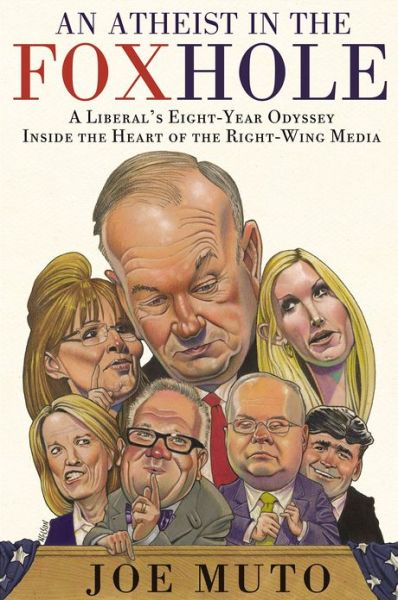
Muto seems to have started off as a pretty run-of-the-mill American mid-west liberal arts university undergraduate without much focus or desire. Not long after graduating, he ends up, as much by luck as by planning, working in New York City for the Fox media empire. Muto makes much of the fact that Fox is viewed as part of the 'enemy' by American Democrats and liberals genuinely. It's frequent and well-known commentators include figures such as Bill O'Reilly, Sean Hannity, Greta Van Susteren, Geraldo Rivera, and Ann Coulter. While not particularly politically-minded, Muto is aware that Fox's positioning may indicate that his politics will clash with his new employer's. After years of employment, during which he bears what he characterizes as petty, although seemingly mostly harmless demands from the likes of O'Reilly, Muto finally opts to leak his 'insider' knowledge to a political blog. He is quickly found out and dismissed.
In short, the greatest value of this book is its intriguing insight into how a contemporary television news-type corporation works, from the perspective of the coffee-fetchers and wrench-turners. For this, Muto has provided an eminently worthy book for university students hoping to break into big media work.
Labels:
biography,
book reviews,
business,
media criticism,
U.S.A. history
Monday, 13 January 2014
Gary Weiss, "Ayn Rand Nation" (2012)
This book is subtitled, "The Struggle for America's Soul." More soon.
This was a well-written, thought-provoking work. Having little knowledge of Rand, and sharing what Weiss indicates is the common popular misconception of Rand as a bit of a wacky far-right hack, this book compelled me to rethink my perspective. If nothing else, Rand had a large circle of friends and acolytes who have gone on to positions of political and economic importance, leading among them: Allan Greenspan, former chair of the Federal Reserve.
Labels:
book reviews,
business,
economics,
philosophy,
social history,
U.S.A. history
Friday, 7 January 2011
Fred McClement, "The Strange Case of Ambrose Small" (1974)
Ambrose Small disappeared mysteriously from the streets of Toronto in 1919, the same day as he and his wife sold their chain of Canadian theatres for over $1.5 million. He handed over a cashier's cheque for $1 million dollars, transacted some other business around the city, and was never heard from again. His disappearance wasn't made public for over two weeks. His body was never found. His fate remains a mystery.
This book, written in the early 1970s, is clearly intended for a popular audience. It lacks footnotes, and makes little effort to indicate sources. That being said, there is almost no writing about the case, so most of the sources were likely newspapers of the time, covering the story or subsequent court cases. In 1960, the provincial police closed the case and tragically disposed of their files related to it.
Overall, this book provides an interesting, if brief glimpse into the rarified Toronto/Canadian upper society during the First World War era. It captures some of the sense of Catholic/Protestant clashes, and the moral ambiguity that revolved around popular entertainment. Unfortunately, the book leaves many questions unanswered, but given its size, the nature of the source material, and the intended audience, it offers an enjoyable, casual read.
This book, written in the early 1970s, is clearly intended for a popular audience. It lacks footnotes, and makes little effort to indicate sources. That being said, there is almost no writing about the case, so most of the sources were likely newspapers of the time, covering the story or subsequent court cases. In 1960, the provincial police closed the case and tragically disposed of their files related to it.
Overall, this book provides an interesting, if brief glimpse into the rarified Toronto/Canadian upper society during the First World War era. It captures some of the sense of Catholic/Protestant clashes, and the moral ambiguity that revolved around popular entertainment. Unfortunately, the book leaves many questions unanswered, but given its size, the nature of the source material, and the intended audience, it offers an enjoyable, casual read.
Labels:
book reviews,
business,
Canadian history,
Toronto history
Sunday, 18 April 2010
Michael Bliss, "Northern Enterprise: Five Centuries of Canadian Business" (1987)
Michael Bliss, Northern Enterprise: Five Centuries of Canadian Business (1987).
As much as I wanted to gain a fuller, better understanding of Canada’s economic and business history, I’m not sure that Five Centuries of Canadian Business was the best choice to satisfy this need.
While the level of detail in this lengthy tome was sometimes appreciated, combined with the dull writing style and often times sacrifice of clarity for inclusion of what can only be remembered as lists of names or businesses, it was difficult to get through. The length of the text obscured the overall thematic development of the book, which only seemed to gather some consistency and clarity of thought when covering the decades following the Second World War. Unfortunately, Bliss’ book remains one of few available options to familiarize yourself with the larger trends and personalities of Canadian business history.
As much as I wanted to gain a fuller, better understanding of Canada’s economic and business history, I’m not sure that Five Centuries of Canadian Business was the best choice to satisfy this need.
While the level of detail in this lengthy tome was sometimes appreciated, combined with the dull writing style and often times sacrifice of clarity for inclusion of what can only be remembered as lists of names or businesses, it was difficult to get through. The length of the text obscured the overall thematic development of the book, which only seemed to gather some consistency and clarity of thought when covering the decades following the Second World War. Unfortunately, Bliss’ book remains one of few available options to familiarize yourself with the larger trends and personalities of Canadian business history.
Wednesday, 20 January 2010
Adam Tooze, "Wages of Destruction: The Making and Breaking of the Nazi Economy" (2006).
Adam Tooze, Wages of Destruction: The Making and Breaking of the Nazi Economy (Viking, 2006).
Perhaps I'm getting lazy, but I think this reviewer did a pretty good job of outlining some of the strengths and weaknesses of this book. That being said, my contribution to the discussion is that this is one of the best history books I have read in a long time. It took a subject I expected to be very dry and arcane, and made it interesting and provocative, in a well-researched and well-written package.
Read Alex Harrowell's review at:
A Fistful of Euros.
Perhaps I'm getting lazy, but I think this reviewer did a pretty good job of outlining some of the strengths and weaknesses of this book. That being said, my contribution to the discussion is that this is one of the best history books I have read in a long time. It took a subject I expected to be very dry and arcane, and made it interesting and provocative, in a well-researched and well-written package.
Read Alex Harrowell's review at:
A Fistful of Euros.
Labels:
book reviews,
business,
economics,
European history,
fascism,
German history,
military,
World War II
Subscribe to:
Posts (Atom)