Novel read, but comments not yet written.
Consider this a placeholder.
Reflections by Dr. Gregory Klages on non-fiction books dealing primarily with politics, history, and religion. Significant attention to Canadian content. Mail me/comment if you read anything. I love to hear feedback!
Showing posts with label fascism. Show all posts
Wednesday, 14 October 2015
Sunday, 7 June 2015
Peter Longerich, "Goebbels: A Biography" (2015)
Just finished. Comments to follow soon.
Two useful reviews:
- Nigel Jones, "Ménage-à-trois with Hitler: the Goebbels’ marriage was a bit crowded," Spectator (UK), 9 May 2015.
- James J. Sheehan, New York Times, 13 May 2015.
Some noteworthy excerpts:
Prologue
In this historical biography, first and foremost concerned with the question of the part played by Goebbels in the leadership of the Third Reich, insights gained into the deficiencies of his personality can help to develop wider perspectives. A particular purpose of this biography is to open the way to an analysis of the construction and modus operandi of the Nazi propaganda apparatus.
The connections, often quite subtle, among his various responsibilities become apparent only through a description of his life.
“Faith Moves Mountains”: Political Beginnings in Berlin
He developed a friendship with the graphic artist Hans Herbert Schweitzer, who designed National Socialist posters under the pseudonym Mjölnir.
“Dare to Live Dangerously!”: Goebbels’s Radicalism and Hitler’s Policy of “Legality”
December 1930
After consulting “Hitler and a large number of experts,” Goebbels came up with a definition of socialism that immediately met with Hitler’s “enthusiastic” approval: “placing the concept of the people above that of the individual.”
CHAPTER 7:
A few weeks later it emerged, either as a result of police inquiries or of a leak by former Party employees, that the assassination attempt had clearly been faked by Goebbels himself—and quite crudely at that. The “explosives” consisted of some jumping jacks and a little gunpowder. That Goebbels wrote up the “assassination attempt” in his diary as a genuine threat shows his relationship to the truth: Having acted out a charade for public consumption, he then recorded it as a fact in his diary.
“Dare to Live Dangerously!”: Goebbels’s Radicalism and Hitler’s Policy of “Legality”
1931.
On March 13, he records in the diary, “someone tried to kill me with a bomb.”
“Dare to Live Dangerously!”: Goebbels’s Radicalism and Hitler’s Policy of “Legality”
In all these disputes it became clear how small Goebbels’s power base within the Party actually was during this phase of the NSDAP’s rapid expansion into a mass movement. In Berlin he had to appear as a radical hothead in order to keep the SA on board, but this in turn created tensions around his attitude to the “legal” course chosen by the Party leader, upon whose support he was so highly dependent.
CHAPTER 7:
Kurt Tucholsky poem of 1928: “Due to bad weather, the revolution will be held indoors.”
“We’re Here to Stay!”: Taking Power
...the head office of the fascist leisure organization Dopolavoro, which impressed Goebbels very much: “We must do something like that. The people at leisure. Sport…"
CHAPTER 13:
The great majority of the public had grown used to manifesting their support for the regime—as was expected of them—in their everyday behavior. This happened, for example, through the officially encouraged “Heil Hitler!” greeting; the wearing of uniforms by a large part of the population, or at least the wearing of insignia to signal their support for the regime; the public display of flags at home; attendance at Party events and mass rallies; donations to street collectors; listening en masse to broadcasts in public squares; the gradual exclusion of Jews, labeled enemies of the state, from normal daily life; and many other ways.
“Taking Firm Control of the Inner Discipline of a People”: Propaganda and Manipulation of the Public Sphere
...let journalists know what areas were out of bounds for critical, or even just independent, reporting. There should never, for example (stated Point 1 on the list of guidelines), be any broad-brush description of “official ceremonial occasions”: This took Goebbels back to one of his favorite themes, the avoidance of “pomp” in the Third Reich. Another rule was that any controversial discussion of proposed legislation was incompatible with the idea of a “Führer state.” Likewise, to discuss the form of government was “intolerable.” When reporting political trials it was undesirable to “discuss in detail false assertions that are the subject of the trial.” One of Goebbels’s guidelines stated succinctly: “Today, the church question has been settled.” With regard to ecclesiastical affairs, in order to avoid confusion as well as adverse reactions from foreign propaganda, only reports from the German News Service should be used. And as far as the much-lamented monotony of the German press was concerned, Goebbels forbade any discussion of press uniformity outright.
...he characterized the attitude now taken by German journalists toward the Nazi regime as “neue Sachlichkeit.”
Goebbels: "We have removed the journalist from his humiliating and demeaning dependence on parties and business interests, thereby placing him in a position of honorable and loyal dependence on the state. For we see the freedom of Germans not in the opportunity to do or not do what one wants, but in the opportunity to integrate freely and responsibly into the higher laws and higher moral commandments of a state.”
...in his cultural address the dictator not only condemned the “vandals” of modern art but also spoke out against “backward-looking people” and their “old-world Teutonic art”—those of Rosenberg’s persuasion, in other words.
These examples show that in 1934–35 Goebbels was by no means the unconstrained sole master and expert helmsman of Germany’s culture and media he liked to claim he was: He had to share control and management
with others.
Goebbels called on the Gestapo to send six members of the cabaret casts who in the meantime had been arrested to a concentration camp for an initial stint of six weeks.
...the trial of five of the performers from the two theaters ended in October 1936 with an acquittal in all cases.
...directive prohibiting all authorities, organizations, and associations from giving the press any instructions or orders. Likewise, no one was entitled to exercise criticism of the press.
The law also introduced the classification of films by the state board of censors: The board was authorized to categorize films as “of political value to the state,” “artistic,” “educational,” or “culturally valuable,” thus exempting the films in question from the entertainment tax. Additionally, the Cinema Law provided for a “Reich film dramaturge” who—independently of the board of censors—was entitled to oversee all film projects at the planning and screenplay stages.
December 15, 1935, Goebbels gave another set-piece lecture at the Kroll Opera to “film creators.” Here he accepted in principle the justification for “entertainment films” but was critical of their “stupidity” and the “assembly- line production of those who followed the same formula.” Almost three years after the “seizure of power,” this was a fairly damning indictment of his own impact on filmmaking,
Among the amenities enjoyed there was a television set, installed in February 1935; the propaganda minister loved watching it with his family, although broadcasting was limited to a few hours and was still at the test stage.
“Never Tire!”: Foreign Policy Successes and Anti-Jewish Policies
In his capacity as head of propaganda for the Reich, Goebbels ordered that “between about 19 and 21 hours today, Tuesday, January 15, the population will spontaneously [sic] attend mass rallies to celebrate victory in the Saar.”
In his speech, broadcast to the nation, he described Christmas as a Christian festival but at the same time claimed it for National Socialism, which in the form of the “national community” had given the command to love your neighbor a “new and unexpected content” in the form of the national community.
“The Tougher the Better!”: The Olympic Year, 1936
It was not until the next day that Hitler and Göring informed him of the decision made the previous night, to which Goebbels pointedly attributed only minor significance in his diary entry: “So we’re getting a bit involved in Spain. Planes etc. Not obvious. Who knows what the point is.”
...placed a wreath on Horst Wessel’s grave
“The Most Important Factors in Our Modern Cultural Life”: Consolidating Nazi Cultural Policies
...lack of support for his “völkisch-Germanic” ambitions, Rosenberg’s mission to “spiritually educate” the whole Nazi movement carried little weight.
...on Goebbels’s initiative artists shown in the Munich “Decadence Exhibition” were branded as “degenerate” even though they were teaching at state art schools or were members of the Prussian Academy of Fine Art.
...in 1937 the Reich Chamber of Fine Art still had 156 Jewish members, mostly art dealers and art publicists.
Even by May 1943, he found himself stating with consternation that “the Reich Culture Chamber is not yet as de-jewified as I intended”; “a whole lot of quarter-Jews, even a few half-Jews, and numbers of Jewish-related are hanging around there.”
Hitler was “extremely” pleased with some photos showing Helga on the Obersalzberg: “Says that if Helga was 20 years older and he was 20 years younger, she would be the wife for him.”
“Don’t Look Around, Keep Marching On!”: The Firebrand as Peacemaker
...the appearance of the three million — a majority of Berlin’s population — was not exactly a display of spontaneous popular enthusiasm. On September 26, for example, there was an article in the Völkischer Beobachter peremptorily commanding “the working Berlin population” to attend the rally en masse. The guarantee of “en masse” participation was achieved—to mention only one detail of the nearly perfect planning for this event—by the German Labor Front. After work ended early, they made the staff fall in and marched them en masse to their allocated sector of the approach roads. It was not easy to escape: If you felt ill, for example, you had to request special permission to leave from the works organizer.
Goebbels: "If I don’t do everything myself, I’m pleased when things go wrong.”
Hitler’s interest in this conversation was far-reaching, as he confided to Goebbels: “We need a prince of the church if we want to break away from Rome. And we must do so. There must be no authority outside Germany
able to give orders to Germans.”
Goebbels: "What I’m doing is trying to incite you. Against any kind of sentimentality. The watchword is not the law but harassment. The Jews have got to get out of Berlin.”
“Maturity Is Only Achieved Through Suffering!”: Preparations for War—from the Munich Agreement to the Attack on Poland
Goebbels arranged with the War Ministry in 1937 that, should war break out, units from his ministry would be put in uniform and “embedded” with the Wehrmacht.
“Our Banners Lead Us On to Victory!”: Between the War in the West and the War in the East
...the dictator made it quite clear to his propaganda minister: “No invasion planned,” although propaganda should encourage fears of invasion by dropping hints “in order to confuse the enemy.”
Goebbels, who after his conversations with Hitler always conscientiously recorded all the Führer’s comments about his foreign policy and military plans, does not report anything in his 1940 diaries about concrete plans for an attack on the Soviet Union. Rather, Goebbels’s entries in his diary for August 1940 show that Hitler intentionally left him in the dark about his war plans.
“Our Banners Lead Us On to Victory!”: Between the War in the West and the War in the East
Some prominent films produced under the Nazis - The Rothschilds, Jud Süss, The Eternal Jew, Bismarck, Ohm Krüger (on which Goebbels himself worked), and Carl Peters, Goodbye, Franziska and Request Concert, I Accuse, Stukas, U-Boat Going Westwards, and The Lützow Squadron
“A Great, a Wonderful Time, in Which a New Reich Will Be Born”: The Attack on the Soviet Union
On August 14 an inter-ministerial conference took place in the Propaganda Ministry at which, among other things, this plan to visibly identify the Jews was discussed.
CHAPTER 23:
Rühmann film The Gasman
Meine Frau Theresa
March 6 Goebbels read a “detailed memorandum prepared by the SD and the police about the final solution of the Jewish question.
Der große König
“We Can See in Our Mind’s Eye a Happy People”: Offensives and Setbacks
Goebbels: "I have no desire to have a 22-year-old eastern Jew—the saboteurs of the anti-Soviet exhibition included types like that—putting a bullet in my guts. I prefer ten Jews in a concentration camp or under the earth than having one in freedom.”
His continuing attempts to eliminate any remnant of the German people’s admiration and respect for Russia and Soviet communism can also be seen as an obsessive attempt to kill off the last germ of this dangerous sickness in himself.
CHAPTER 25:
Hitler’s increasing physical frailty was a growing problem in terms of the deployment of the Führer for propaganda purposes. Thus Goebbels was obliged to note that Hitler “is very unwilling to appear in the weekly newsreels” and kept removing clips in which he was shown
In December 1942 a growing number of reports about the mass murder of Jews in German-occupied Europe began to appear in the international media. On December 17 the Allies published a statement about the systematic murder of the Jews by the Nazi regime;
For the Führer state to be maintained in the absence of the Führer was going to require extraordinary efforts.
Hitler’s public silence had created a vacuum, which the propaganda minister was now entering with a vengeance.
During the evening many people were saying that this meeting represented a sort of quiet coup. [...] Total war is now no longer a matter for a few perceptive men; it’s now supported by the whole nation.
...both were agreed on “what would threaten us all if we became weak in this war”; they had committed themselves so far in the “Jewish question” that “there is no possible chance of escape. And that’s a good thing.” For “experience shows that a movement and a nation which has burned its bridges fights with far fewer reservations than one that still has the possibility of withdrawal.”
“The Masses Have Become Somewhat Skeptical or...Are in the Grip of a Permanent State of Hopelessness”: Crisis as a Permanent State
When they devised the plan for the total destruction of the German people, they were signing their own death warrant.
Horthy’s soft attitude had strengthened Hitler in his view that “the junk of small states which still exists in Europe must be liquidated as quickly as possible.”
The deep depression among the population that Goebbels detected at the end of May had to a significant extent been caused by the excessive use of anti-Semitism.
“I Have No Idea What the Führer’s Going to Do in the End”: The Search for a Way Out
During 1944, apart from his addresses on January 30 and after the July 20 assassination attempt, Hitler made no speeches that were broadcast and did not speak at any major events.
Goebbels’s summary of Hitler’s comments. “Anyone who says A must say B, and now that the Hungarians have begun implementing our Jewish policy they can no longer back out of it. After a certain point the Jewis
While hitherto German propaganda had put forward the thesis that “the Jews,” either as plutocrats or as communists, were the “glue” holding the enemy coalition together (an assertion that Goebbels frequently made both in public and in private), now, in view of the threat of military defeat, it was necessary to emphasize the contradictions within the enemy camp.
...actual instances of vigilantism committed against pilots, he hoped to make an impact in the enemy countries.
“Virtually a Wartime Dictatorship on the Home Front”: Between an Apocalyptic Mood and Total War
There were further trials in the People’s Court lasting until April 1945 with more than 150 people accused of participating in the conspiracy, of whom over a hundred were sentenced to death and hanged.
“But When Will There Be Some Action?”: Downfall
He was also unsuccessful in gaining acceptance for his idea of a Military Auxiliaries Law subjecting all women under thirty to military conscription and thereby recruiting two hundred thousand women as “military auxiliaries.” It was blocked by Bormann and Himmler.
Conclusion
...while the propaganda that was now preparing the German population for a confrontation with Poland justified the use of military means, it also led to this war, which allegedly had been forced on Germany, being seen as an exceptional situation. The result was that after its rapid conclusion the vast majority of the population wanted to return to peacetime conditions.
Two useful reviews:
- Nigel Jones, "Ménage-à-trois with Hitler: the Goebbels’ marriage was a bit crowded," Spectator (UK), 9 May 2015.
- James J. Sheehan, New York Times, 13 May 2015.
Some noteworthy excerpts:
Prologue
In this historical biography, first and foremost concerned with the question of the part played by Goebbels in the leadership of the Third Reich, insights gained into the deficiencies of his personality can help to develop wider perspectives. A particular purpose of this biography is to open the way to an analysis of the construction and modus operandi of the Nazi propaganda apparatus.
The connections, often quite subtle, among his various responsibilities become apparent only through a description of his life.
“Faith Moves Mountains”: Political Beginnings in Berlin
He developed a friendship with the graphic artist Hans Herbert Schweitzer, who designed National Socialist posters under the pseudonym Mjölnir.
“Dare to Live Dangerously!”: Goebbels’s Radicalism and Hitler’s Policy of “Legality”
December 1930
After consulting “Hitler and a large number of experts,” Goebbels came up with a definition of socialism that immediately met with Hitler’s “enthusiastic” approval: “placing the concept of the people above that of the individual.”
CHAPTER 7:
A few weeks later it emerged, either as a result of police inquiries or of a leak by former Party employees, that the assassination attempt had clearly been faked by Goebbels himself—and quite crudely at that. The “explosives” consisted of some jumping jacks and a little gunpowder. That Goebbels wrote up the “assassination attempt” in his diary as a genuine threat shows his relationship to the truth: Having acted out a charade for public consumption, he then recorded it as a fact in his diary.
“Dare to Live Dangerously!”: Goebbels’s Radicalism and Hitler’s Policy of “Legality”
1931.
On March 13, he records in the diary, “someone tried to kill me with a bomb.”
“Dare to Live Dangerously!”: Goebbels’s Radicalism and Hitler’s Policy of “Legality”
In all these disputes it became clear how small Goebbels’s power base within the Party actually was during this phase of the NSDAP’s rapid expansion into a mass movement. In Berlin he had to appear as a radical hothead in order to keep the SA on board, but this in turn created tensions around his attitude to the “legal” course chosen by the Party leader, upon whose support he was so highly dependent.
CHAPTER 7:
Kurt Tucholsky poem of 1928: “Due to bad weather, the revolution will be held indoors.”
“We’re Here to Stay!”: Taking Power
...the head office of the fascist leisure organization Dopolavoro, which impressed Goebbels very much: “We must do something like that. The people at leisure. Sport…"
CHAPTER 13:
The great majority of the public had grown used to manifesting their support for the regime—as was expected of them—in their everyday behavior. This happened, for example, through the officially encouraged “Heil Hitler!” greeting; the wearing of uniforms by a large part of the population, or at least the wearing of insignia to signal their support for the regime; the public display of flags at home; attendance at Party events and mass rallies; donations to street collectors; listening en masse to broadcasts in public squares; the gradual exclusion of Jews, labeled enemies of the state, from normal daily life; and many other ways.
“Taking Firm Control of the Inner Discipline of a People”: Propaganda and Manipulation of the Public Sphere
...let journalists know what areas were out of bounds for critical, or even just independent, reporting. There should never, for example (stated Point 1 on the list of guidelines), be any broad-brush description of “official ceremonial occasions”: This took Goebbels back to one of his favorite themes, the avoidance of “pomp” in the Third Reich. Another rule was that any controversial discussion of proposed legislation was incompatible with the idea of a “Führer state.” Likewise, to discuss the form of government was “intolerable.” When reporting political trials it was undesirable to “discuss in detail false assertions that are the subject of the trial.” One of Goebbels’s guidelines stated succinctly: “Today, the church question has been settled.” With regard to ecclesiastical affairs, in order to avoid confusion as well as adverse reactions from foreign propaganda, only reports from the German News Service should be used. And as far as the much-lamented monotony of the German press was concerned, Goebbels forbade any discussion of press uniformity outright.
...he characterized the attitude now taken by German journalists toward the Nazi regime as “neue Sachlichkeit.”
Goebbels: "We have removed the journalist from his humiliating and demeaning dependence on parties and business interests, thereby placing him in a position of honorable and loyal dependence on the state. For we see the freedom of Germans not in the opportunity to do or not do what one wants, but in the opportunity to integrate freely and responsibly into the higher laws and higher moral commandments of a state.”
...in his cultural address the dictator not only condemned the “vandals” of modern art but also spoke out against “backward-looking people” and their “old-world Teutonic art”—those of Rosenberg’s persuasion, in other words.
These examples show that in 1934–35 Goebbels was by no means the unconstrained sole master and expert helmsman of Germany’s culture and media he liked to claim he was: He had to share control and management
with others.
Goebbels called on the Gestapo to send six members of the cabaret casts who in the meantime had been arrested to a concentration camp for an initial stint of six weeks.
...the trial of five of the performers from the two theaters ended in October 1936 with an acquittal in all cases.
...directive prohibiting all authorities, organizations, and associations from giving the press any instructions or orders. Likewise, no one was entitled to exercise criticism of the press.
The law also introduced the classification of films by the state board of censors: The board was authorized to categorize films as “of political value to the state,” “artistic,” “educational,” or “culturally valuable,” thus exempting the films in question from the entertainment tax. Additionally, the Cinema Law provided for a “Reich film dramaturge” who—independently of the board of censors—was entitled to oversee all film projects at the planning and screenplay stages.
December 15, 1935, Goebbels gave another set-piece lecture at the Kroll Opera to “film creators.” Here he accepted in principle the justification for “entertainment films” but was critical of their “stupidity” and the “assembly- line production of those who followed the same formula.” Almost three years after the “seizure of power,” this was a fairly damning indictment of his own impact on filmmaking,
Among the amenities enjoyed there was a television set, installed in February 1935; the propaganda minister loved watching it with his family, although broadcasting was limited to a few hours and was still at the test stage.
“Never Tire!”: Foreign Policy Successes and Anti-Jewish Policies
In his capacity as head of propaganda for the Reich, Goebbels ordered that “between about 19 and 21 hours today, Tuesday, January 15, the population will spontaneously [sic] attend mass rallies to celebrate victory in the Saar.”
In his speech, broadcast to the nation, he described Christmas as a Christian festival but at the same time claimed it for National Socialism, which in the form of the “national community” had given the command to love your neighbor a “new and unexpected content” in the form of the national community.
“The Tougher the Better!”: The Olympic Year, 1936
It was not until the next day that Hitler and Göring informed him of the decision made the previous night, to which Goebbels pointedly attributed only minor significance in his diary entry: “So we’re getting a bit involved in Spain. Planes etc. Not obvious. Who knows what the point is.”
...placed a wreath on Horst Wessel’s grave
“The Most Important Factors in Our Modern Cultural Life”: Consolidating Nazi Cultural Policies
...lack of support for his “völkisch-Germanic” ambitions, Rosenberg’s mission to “spiritually educate” the whole Nazi movement carried little weight.
...on Goebbels’s initiative artists shown in the Munich “Decadence Exhibition” were branded as “degenerate” even though they were teaching at state art schools or were members of the Prussian Academy of Fine Art.
...in 1937 the Reich Chamber of Fine Art still had 156 Jewish members, mostly art dealers and art publicists.
Even by May 1943, he found himself stating with consternation that “the Reich Culture Chamber is not yet as de-jewified as I intended”; “a whole lot of quarter-Jews, even a few half-Jews, and numbers of Jewish-related are hanging around there.”
Hitler was “extremely” pleased with some photos showing Helga on the Obersalzberg: “Says that if Helga was 20 years older and he was 20 years younger, she would be the wife for him.”
“Don’t Look Around, Keep Marching On!”: The Firebrand as Peacemaker
...the appearance of the three million — a majority of Berlin’s population — was not exactly a display of spontaneous popular enthusiasm. On September 26, for example, there was an article in the Völkischer Beobachter peremptorily commanding “the working Berlin population” to attend the rally en masse. The guarantee of “en masse” participation was achieved—to mention only one detail of the nearly perfect planning for this event—by the German Labor Front. After work ended early, they made the staff fall in and marched them en masse to their allocated sector of the approach roads. It was not easy to escape: If you felt ill, for example, you had to request special permission to leave from the works organizer.
Goebbels: "If I don’t do everything myself, I’m pleased when things go wrong.”
Hitler’s interest in this conversation was far-reaching, as he confided to Goebbels: “We need a prince of the church if we want to break away from Rome. And we must do so. There must be no authority outside Germany
able to give orders to Germans.”
Goebbels: "What I’m doing is trying to incite you. Against any kind of sentimentality. The watchword is not the law but harassment. The Jews have got to get out of Berlin.”
“Maturity Is Only Achieved Through Suffering!”: Preparations for War—from the Munich Agreement to the Attack on Poland
Goebbels arranged with the War Ministry in 1937 that, should war break out, units from his ministry would be put in uniform and “embedded” with the Wehrmacht.
“Our Banners Lead Us On to Victory!”: Between the War in the West and the War in the East
...the dictator made it quite clear to his propaganda minister: “No invasion planned,” although propaganda should encourage fears of invasion by dropping hints “in order to confuse the enemy.”
Goebbels, who after his conversations with Hitler always conscientiously recorded all the Führer’s comments about his foreign policy and military plans, does not report anything in his 1940 diaries about concrete plans for an attack on the Soviet Union. Rather, Goebbels’s entries in his diary for August 1940 show that Hitler intentionally left him in the dark about his war plans.
“Our Banners Lead Us On to Victory!”: Between the War in the West and the War in the East
Some prominent films produced under the Nazis - The Rothschilds, Jud Süss, The Eternal Jew, Bismarck, Ohm Krüger (on which Goebbels himself worked), and Carl Peters, Goodbye, Franziska and Request Concert, I Accuse, Stukas, U-Boat Going Westwards, and The Lützow Squadron
“A Great, a Wonderful Time, in Which a New Reich Will Be Born”: The Attack on the Soviet Union
On August 14 an inter-ministerial conference took place in the Propaganda Ministry at which, among other things, this plan to visibly identify the Jews was discussed.
CHAPTER 23:
Rühmann film The Gasman
Meine Frau Theresa
March 6 Goebbels read a “detailed memorandum prepared by the SD and the police about the final solution of the Jewish question.
Der große König
“We Can See in Our Mind’s Eye a Happy People”: Offensives and Setbacks
Goebbels: "I have no desire to have a 22-year-old eastern Jew—the saboteurs of the anti-Soviet exhibition included types like that—putting a bullet in my guts. I prefer ten Jews in a concentration camp or under the earth than having one in freedom.”
His continuing attempts to eliminate any remnant of the German people’s admiration and respect for Russia and Soviet communism can also be seen as an obsessive attempt to kill off the last germ of this dangerous sickness in himself.
CHAPTER 25:
Hitler’s increasing physical frailty was a growing problem in terms of the deployment of the Führer for propaganda purposes. Thus Goebbels was obliged to note that Hitler “is very unwilling to appear in the weekly newsreels” and kept removing clips in which he was shown
In December 1942 a growing number of reports about the mass murder of Jews in German-occupied Europe began to appear in the international media. On December 17 the Allies published a statement about the systematic murder of the Jews by the Nazi regime;
For the Führer state to be maintained in the absence of the Führer was going to require extraordinary efforts.
Hitler’s public silence had created a vacuum, which the propaganda minister was now entering with a vengeance.
During the evening many people were saying that this meeting represented a sort of quiet coup. [...] Total war is now no longer a matter for a few perceptive men; it’s now supported by the whole nation.
...both were agreed on “what would threaten us all if we became weak in this war”; they had committed themselves so far in the “Jewish question” that “there is no possible chance of escape. And that’s a good thing.” For “experience shows that a movement and a nation which has burned its bridges fights with far fewer reservations than one that still has the possibility of withdrawal.”
“The Masses Have Become Somewhat Skeptical or...Are in the Grip of a Permanent State of Hopelessness”: Crisis as a Permanent State
When they devised the plan for the total destruction of the German people, they were signing their own death warrant.
Horthy’s soft attitude had strengthened Hitler in his view that “the junk of small states which still exists in Europe must be liquidated as quickly as possible.”
The deep depression among the population that Goebbels detected at the end of May had to a significant extent been caused by the excessive use of anti-Semitism.
“I Have No Idea What the Führer’s Going to Do in the End”: The Search for a Way Out
During 1944, apart from his addresses on January 30 and after the July 20 assassination attempt, Hitler made no speeches that were broadcast and did not speak at any major events.
Goebbels’s summary of Hitler’s comments. “Anyone who says A must say B, and now that the Hungarians have begun implementing our Jewish policy they can no longer back out of it. After a certain point the Jewis
While hitherto German propaganda had put forward the thesis that “the Jews,” either as plutocrats or as communists, were the “glue” holding the enemy coalition together (an assertion that Goebbels frequently made both in public and in private), now, in view of the threat of military defeat, it was necessary to emphasize the contradictions within the enemy camp.
...actual instances of vigilantism committed against pilots, he hoped to make an impact in the enemy countries.
“Virtually a Wartime Dictatorship on the Home Front”: Between an Apocalyptic Mood and Total War
There were further trials in the People’s Court lasting until April 1945 with more than 150 people accused of participating in the conspiracy, of whom over a hundred were sentenced to death and hanged.
“But When Will There Be Some Action?”: Downfall
He was also unsuccessful in gaining acceptance for his idea of a Military Auxiliaries Law subjecting all women under thirty to military conscription and thereby recruiting two hundred thousand women as “military auxiliaries.” It was blocked by Bormann and Himmler.
Conclusion
...while the propaganda that was now preparing the German population for a confrontation with Poland justified the use of military means, it also led to this war, which allegedly had been forced on Germany, being seen as an exceptional situation. The result was that after its rapid conclusion the vast majority of the population wanted to return to peacetime conditions.
Labels:
biography,
book reviews,
European history,
fascism,
German history,
World War II
Friday, 15 May 2015
Bettina Stangneth, "Eichmann Before Jerusalem" (2014)
Subtitle: "The Unexamined Life of a Mass Murderer."
Stangneth offers a close, meticulous, and exhaustive analysis of texts produced by Adolf Eichmann between the end of World War II and the early 1960s, when he was captured in Argentina and taken to Israel to stand trial for war crimes. Her book is not for the casual reader. For those with some knowledge of the period, of World War II, of the Holocaust, or of the post-war hunt for Nazis, Stangneth has produced a wealth of knowledge.
Eichmann before Jerusalem holds several critical aspects. Firstly, Stangneth unearths the murky history of documents produced by Eichmann and some of his acquaintances in Argentina. Often referred to as the Sassen papers, these transcripts of audio recordings shed light on Eichmann's post-war thinking, his perceptions of the Nazi era, world politics during the 1950s, and his own culpability in what most would view as horrific crimes. In itself, her explorations of these texts and their history could serve as a single book.
The second value of this text is its exposure of how little Eichmann and other (former?) Nazis did to try to hide themselves. Given the gravity of their crimes, the thin veneer of changed identity these men engaged in, and that many of their friends and family were aware of, is shocking.
Finally, with the abundance of textual resources Stangneth has marshalled, she offers a fascinating psychological profile of Eichmann, revealing how his ideas change over time, how he represented them differently depending on his audience, and particularly how his testimony at his war crimes trial did not correspond with testimony he had recorded previously from in hiding.
I had produced digital extensive notes from the book, and tragically the file was lost. I may someday try to revisit the book and recreate some of these notes. Until then, I can say that this book is very fine history writing, although it is likely a bit of a laborious read for even those interested in the topic. The closest comparison I can make is Adam Tooze's Wages of Destruction, which I commented on in 2010.
The NY Times ran a fair review of the book, written by Steven Aschheim.
Stangneth offers a close, meticulous, and exhaustive analysis of texts produced by Adolf Eichmann between the end of World War II and the early 1960s, when he was captured in Argentina and taken to Israel to stand trial for war crimes. Her book is not for the casual reader. For those with some knowledge of the period, of World War II, of the Holocaust, or of the post-war hunt for Nazis, Stangneth has produced a wealth of knowledge.
Eichmann before Jerusalem holds several critical aspects. Firstly, Stangneth unearths the murky history of documents produced by Eichmann and some of his acquaintances in Argentina. Often referred to as the Sassen papers, these transcripts of audio recordings shed light on Eichmann's post-war thinking, his perceptions of the Nazi era, world politics during the 1950s, and his own culpability in what most would view as horrific crimes. In itself, her explorations of these texts and their history could serve as a single book.
The second value of this text is its exposure of how little Eichmann and other (former?) Nazis did to try to hide themselves. Given the gravity of their crimes, the thin veneer of changed identity these men engaged in, and that many of their friends and family were aware of, is shocking.
Finally, with the abundance of textual resources Stangneth has marshalled, she offers a fascinating psychological profile of Eichmann, revealing how his ideas change over time, how he represented them differently depending on his audience, and particularly how his testimony at his war crimes trial did not correspond with testimony he had recorded previously from in hiding.
I had produced digital extensive notes from the book, and tragically the file was lost. I may someday try to revisit the book and recreate some of these notes. Until then, I can say that this book is very fine history writing, although it is likely a bit of a laborious read for even those interested in the topic. The closest comparison I can make is Adam Tooze's Wages of Destruction, which I commented on in 2010.
The NY Times ran a fair review of the book, written by Steven Aschheim.
Tuesday, 21 April 2015
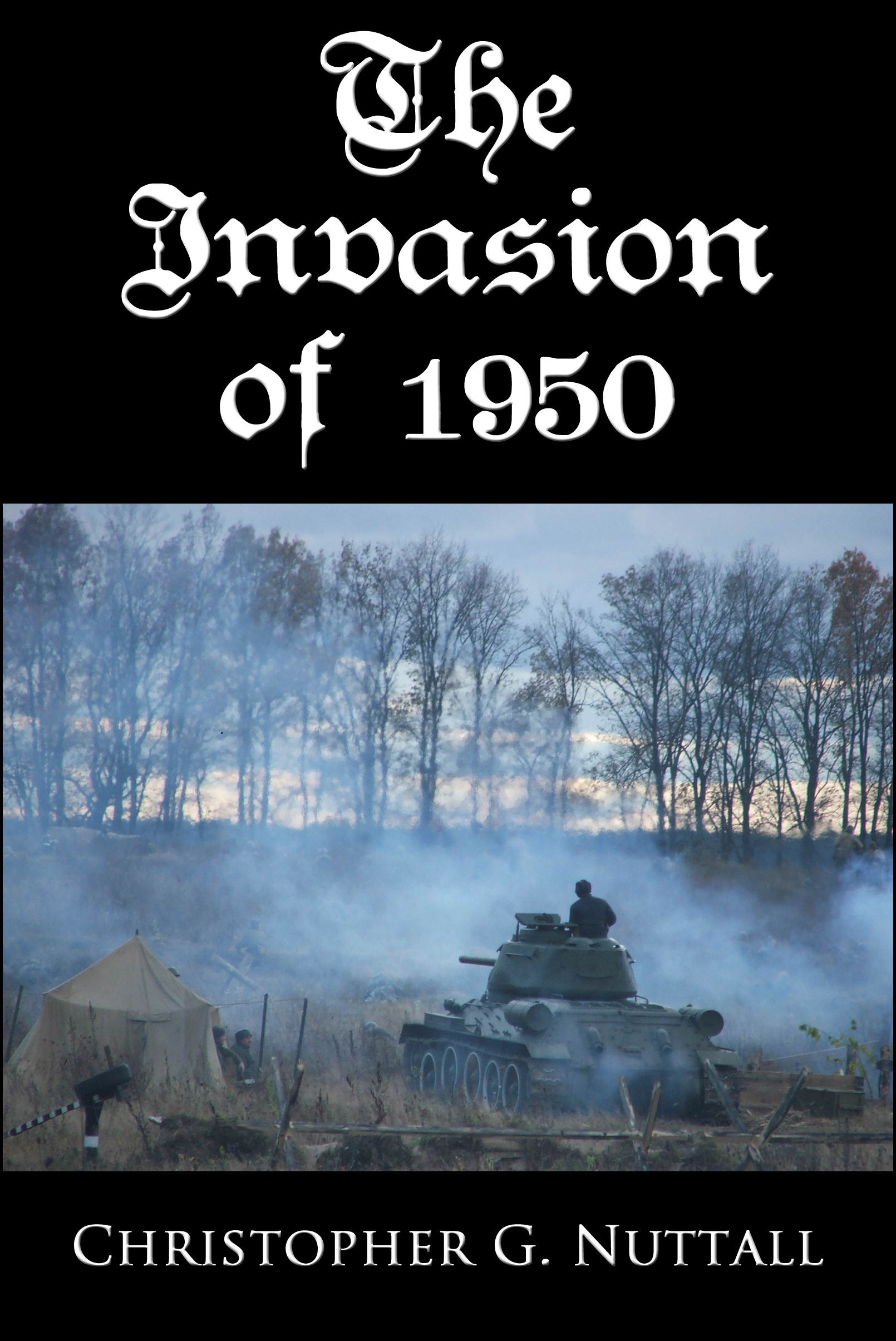
Christopher Nuttall, "The Invasion of 1950" (2013)
Just finished this self-published alt-history (allohistorical) work...
I heartily enjoyed it; worth the time, although it could use some editing. I did approach it, however, as pure escapist entertainment and not alternative history grounded in plausible variation of historical facts. More comments soon.
In the interim, travel over to the author's blog for more info.
I heartily enjoyed it; worth the time, although it could use some editing. I did approach it, however, as pure escapist entertainment and not alternative history grounded in plausible variation of historical facts. More comments soon.
In the interim, travel over to the author's blog for more info.
Labels:
book reviews,
dystopian,
European history,
fascism,
fiction,
German history,
military,
World War II
Wednesday, 18 March 2015
Timur Vermes, "Look Who's Back" (2012)
This is likely one of the most clever, amusing, intriguing and generally enjoyable fiction books I have read in a long time.
Essentially, the premise is that Adolf Hitler awakens with a pounding headache in a Berlin vacant lot in 2011. He has no memory of what has transpired since April 1945, with his last memory of that time being the act of showing Eva Braun his antique pistol. The rest of the story is simply too good to spoil. Vermes combines a singular wit, trenchant political commentary, and thought-provoking representation of how Hitler might understand the contemporary political world (both within Germany, as well as beyond).
Some snippets that I found particularly enjoyable (pagination is from my digital version):
37: “…in the last sixty-six years the number of Soviet soldiers on the territory of the German Reich had fallen substantially, particularly in the Greater Berlin area. The current figure was between thirty and fifty men; in a flash I could see that this afforded the Wehrmacht a far better prospect of victory compared to the last estimate from my general staff of around 2.5 million enemy soldiers on the Eastern Front alone.”
41: “We all know, of course, what to make of our newspapers. The deaf man writes down what the blind man has told him, the village idiot edits it, and their colleagues in the other press houses copy it. Each story is doused afresh with the same stagnant infusion of lies, so that the “splendid” brew can then be served up to a clueless Volk. In this instance, however, I was prepared to be somewhat lenient. So rarely does Fate intervene this strikingly in its own workings that even the smartest minds must find it difficult to comprehend, let alone the mediocre intellects serving our so-called opinion sheets. My brain required the stomach of an ox to digest the other information I managed to unearth.”
48: “What irony: yesterday I was repositioning the 12th Army; today it was magazine racks.”
194: “the so-called reunification of Germany into his expansive lap. I have to concede that this supposed “reunification” was one of the few first-rate lies propagated by the republic. For how could they call it a proper reunification when essential components – such as the aforementioned Silesia granted to Poland, as well as Alsace-Lorraine or Austria – were missing?”
378: “That’s pure gold!” Madame Bellini said when, heavy-hearted, I showed her the report on the “National Democrats” alongside others we had filmed.”
540: “the telephone has to be a telephone, a calendar, a camera and everything else besides. This is dangerous nonsense, the only possible consequence of which is that thousands of our young people will be mown down on the roads because they cannot stop staring into their screens. One of my first undertakings will be to outlaw such telephone devices or allow them only for those inferior racial elements remaining in our society – for the latter I may even make them compulsory. Then they will litter the main thoroughfares of Berlin like squashed hedgehogs.”
541: “Christmas decorations have become more tasteful with the passing of the years. A most disagreeable industrialisation has taken hold. I am not concerned about whether something is kitsch or not, for every example of kitsch harbours a residue of the feelings of the simple man, and since that is the case there will always be the possibility of a development towards real art. No, what really bothers me is that the importance of Father Christmas has grown disproportionally, doubtlessly as a result of Anglo-American cultural infiltration.”
547: “He has also devised a new electoral slogan. It will be plastered at the bottom of all the placards, giving them a common thread. The slogan addresses old virtues, old doubts, and for good measure has a humorous, conciliatory element to win over those pirate voters and other young people. The slogan reads: “It wasn’t all bad.”
Essentially, the premise is that Adolf Hitler awakens with a pounding headache in a Berlin vacant lot in 2011. He has no memory of what has transpired since April 1945, with his last memory of that time being the act of showing Eva Braun his antique pistol. The rest of the story is simply too good to spoil. Vermes combines a singular wit, trenchant political commentary, and thought-provoking representation of how Hitler might understand the contemporary political world (both within Germany, as well as beyond).
Some snippets that I found particularly enjoyable (pagination is from my digital version):
37: “…in the last sixty-six years the number of Soviet soldiers on the territory of the German Reich had fallen substantially, particularly in the Greater Berlin area. The current figure was between thirty and fifty men; in a flash I could see that this afforded the Wehrmacht a far better prospect of victory compared to the last estimate from my general staff of around 2.5 million enemy soldiers on the Eastern Front alone.”
41: “We all know, of course, what to make of our newspapers. The deaf man writes down what the blind man has told him, the village idiot edits it, and their colleagues in the other press houses copy it. Each story is doused afresh with the same stagnant infusion of lies, so that the “splendid” brew can then be served up to a clueless Volk. In this instance, however, I was prepared to be somewhat lenient. So rarely does Fate intervene this strikingly in its own workings that even the smartest minds must find it difficult to comprehend, let alone the mediocre intellects serving our so-called opinion sheets. My brain required the stomach of an ox to digest the other information I managed to unearth.”
48: “What irony: yesterday I was repositioning the 12th Army; today it was magazine racks.”
194: “the so-called reunification of Germany into his expansive lap. I have to concede that this supposed “reunification” was one of the few first-rate lies propagated by the republic. For how could they call it a proper reunification when essential components – such as the aforementioned Silesia granted to Poland, as well as Alsace-Lorraine or Austria – were missing?”
378: “That’s pure gold!” Madame Bellini said when, heavy-hearted, I showed her the report on the “National Democrats” alongside others we had filmed.”
540: “the telephone has to be a telephone, a calendar, a camera and everything else besides. This is dangerous nonsense, the only possible consequence of which is that thousands of our young people will be mown down on the roads because they cannot stop staring into their screens. One of my first undertakings will be to outlaw such telephone devices or allow them only for those inferior racial elements remaining in our society – for the latter I may even make them compulsory. Then they will litter the main thoroughfares of Berlin like squashed hedgehogs.”
541: “Christmas decorations have become more tasteful with the passing of the years. A most disagreeable industrialisation has taken hold. I am not concerned about whether something is kitsch or not, for every example of kitsch harbours a residue of the feelings of the simple man, and since that is the case there will always be the possibility of a development towards real art. No, what really bothers me is that the importance of Father Christmas has grown disproportionally, doubtlessly as a result of Anglo-American cultural infiltration.”
547: “He has also devised a new electoral slogan. It will be plastered at the bottom of all the placards, giving them a common thread. The slogan addresses old virtues, old doubts, and for good measure has a humorous, conciliatory element to win over those pirate voters and other young people. The slogan reads: “It wasn’t all bad.”
Labels:
biography,
book reviews,
dystopian,
European history,
fascism,
fiction,
German history,
racism,
World War II
Thursday, 22 January 2015
Thom Hartmann, "Crash of 2016" (2013)
Subtitle: "The Plot to Destroy America and What We Can Do About It".
What most surprised me about this book, and I'm not sure why, is that Hartmann seems to be left-leaning. Concern with financial crashes and plotting out one's financial survival generally seems to be associated with libertarian, conservative ideology.
Essentially, Hartmann tracks out a series of political decisions over the last several decades that indicate a potentially fatal loosening of controls over corporations that have allowed wealth to accumulate in fewer and fewer hands, and gutted the kinds of social policies that kept economic/class disparity under control within the United States. He suggests that this problem comes about cyclically, about every 80 years or so, based on the passing of the people who experienced the horrible outcomes of similar decisions within their own lifetime.
Frugal Musings has a very good, if lengthy, discussion of the book.
Gregory Klages -
Quotations from, and notes on: Crash of 2016: The Plot to Destroy America and What We Can Do About It
CHAPTER 3: The Crisis Capitalists
"In 1947, two years after the war ended, Friedrich Hayek gathered a large group of economists, historians, journalists, and businessmen to a meeting in Mont Pelerin, Switzerland.
"...what Hayek was unable to do, mainly because he was operating with the catastrophic consequences of his free-market philosophy still fresh in everyone’s mind, Friedman would do—and that’s lead a global counterrevolution against controlled capitalism
"These so-called free-market reforms promoted by the members of the Mont Pelerin Society and later the Chicago Boys do not constitute a legitimate economic theory, as they’ve never worked anywhere they’ve been tried, anywhere in the world. They constitute a religion.
"...two years into Pinochet and the Chicago Boys’ rule, inflation had reached 341 percent—higher than anywhere else in the world. The price of goods increased by 375 percent. GDP decreased by 15 percent. Agriculture production sputtered to a grinding halt. Export values dropped 28 percent and Chile acquired a $280 million trade deficit. And to top everything off, Chile’s unemployment rate skyrocketed from 3 percent—among the lowest in that hemisphere—before Friedman stepped foot in the country to more than 10 percent and, in some parts of the country, as high as 22 percent
CHAPTER 4: A Middle-Class Primer
"The United States has had two great periods of what we today call a middle class. The first was from the 1700s to the mid-1800s, and was fueled by virtually free land for settlers (stolen from the Indians) and free labor (slavery in the South and indentured immigrants in the North). The result was (as de Tocqueville pointed out) the most well-educated, politically active, middle-class “nonaristocrats” in the world.
"...the period between 1947 and 1979 saw unparalleled equitable growth. During these thirty-plus years, the poorest fifth of Americans saw a 116 percent increase in their incomes. The middle fifth, a 111 percent increase. And the top 5 percent saw an 85 percent increase. All income classes shared in the prosperity of the times when the top marginal income tax rate was above 70 percent.
"...progressive taxation, which gave workers more to spend and gave the rich an incentive to pay their workers better to maintain a stable workplace (since if they took the money themselves, it would just mostly go to taxes), thus stimulating demand for more goods and services.
"Whenever top marginal tax rates were relatively high—above 60 percent usually—the economy was at its most stable.
"...in 1944, FDR...proposed a Second Bill of Rights.
These rights included:
"The right to a useful and remunerative job in the industries or shops or farms or mines of the nation; The right to earn enough to provide adequate food and clothing and recreation; The right of every farmer to raise and sell his products at a return which will give him and his family a decent living; The right of every businessman, large and small, to trade in an atmosphere of freedom from unfair competition and domination by monopolies at home or abroad; The right of every family to a decent home; The right to adequate medical care and the opportunity to achieve and enjoy good health; The right to adequate protection from the economic fears of old age, sickness, accident, and unemployment; The right to a good education
"An early instruction manual for the game of Monopoly in 1925 reads, “At the start of the game every player is provided with the same amount of capital and presumably has exactly the same chance of success as every other player. The game ends with one person in possession of all the money. What accounts for the failure of the rest, and what one factor can be singled out to explain the obviously ill-adjusted distributions of the community’s wealth which this situation represents?”
"...not only is the accumulation of vast amounts of wealth in the hands of an elite aristocracy not good for working people, it’s also not good for economies as a whole, which is exactly what the game Monopoly teaches us.
CHAPTER 5: Reagan Kidnapped the Jetsons
"In a 1966 article, TIME magazine looked ahead toward the future and what the rise of automation would mean for average working Americans. It concluded, “By 2000, the machines will be producing so much that everyone in the U.S. will, in effect, be independently wealthy. With Government benefits, even nonworking families will have, by one estimate, an annual income of $30,000–$40,000. How to use leisure meaningfully will be a major problem.” And that was $30,000–$40,000 in 1966 dollars, which would be roughly $199,000 to $260,000 in 2010 dollars.
CHAPTER 6: “Madness”
"That’s exactly what speculators were doing—buying up huge amounts of wheat contracts and holding on to them until they could be sold at a higher price. This had catastrophic effects on the global food supply.
"The force of Globalism,” [John Ralston] Saul writes, “through trade agreements, deregulation and privatization, would seriously weaken the ability of nation-states to act with any political independence.”
“Richer than a majority of nation-states on the planet, free of the geographical and social obligations of these old states, beyond the embarrassing demands of nationalism, freed in fact from the emotional, immeasurable demands of the citizenry, the transnational would be able to organize world affairs in a more rational, efficient manner.”
"Columnist Chrystia Freeland nailed this mind-set perfectly in her 2011 article “The Rise of the New Global Elite,” which ran in The Atlantic magazine. She reported that one influential American hedge fund manager argued that it didn’t matter if the US economy was in peril, because “if the transformation of the world economy lifts four people in China and India out of poverty and into the middle class, and meanwhile means one American drops out of the middle class, that’s not such a bad trade.”
"By 2008, actual commodity sellers and buyers were completely marginalized in the market by speculator banksters, who accounted for 80 percent of all futures purchases. And with their price manipulations, these derivative bombs cratered our economy with high gas prices.
Economist Steve Keen, author of Debunking Economics
"They will always want to lend more money… the banking sector profits by creating debt”...
CHAPTER 7: A Revolution Denied
"The Iroquois Confederation’s “Great Law,” which was a major inspiration for the American Constitution, famously called for all governmental decisions to be made in the context of their impact on “the Seventh Generation” down the line into the future.
CHAPTER 9: Betrayal on the High Court
"...with this decision in place and the law of the land, the First Amendment now protects the “free speech” rights of the presidents of Russia and China and Iran to form corporations in the United States and pour millions of dollars toward supporting or defeating the politicians of their choice. It protects the “right” of the largest polluting corporations on earth to politically destroy any politician who wants to give any more authority to the Environmental Protection Agency. It protects their “right” to elevate to elected status any politician who is willing to dismantle the EPA—or any other government agency that protects or defends the people of America from Royalist predation
"...the bible of legal scholars—the book that the framers of our Constitution had frequently cited and referenced in their deliberations in 1787 in Philadelphia—Sir William Blackstone’s 1765 Commentaries on the Laws of England...
"Stevens recounted the history of the evolution of corporations in America, noting, “Corporations were created, supervised, and conceptualized as quasi-public entities, ‘designed to serve a social function for the state.’
"As a result of Citizens United, outside political spending skyrocketed from just $68 million in the 2006 midterms, to over $304 million in the 2010 midterms. That’s a 400 percent increase in corporate cash influencing elections and buying politicians, just ten months after the Citizens United decision.
CHAPTER 10: Masters of the Universe
"On average, a member of the House of Representatives must raise $5,000 a week for his or her campaign. That means that every morning, Monday through Friday, they must wake up not thinking about governing but about fund-raising—how to scrounge up a thousand bucks that day. In the Senate it’s even worse, at an average of $14,000 a week.152 And those numbers were compiled by PBS before the Citizens United decision—today’s numbers are significantly higher.
American Legislative Exchange Council = ALEC
"...it’s a dating service setting up corporate lobbyists and state legislators,” he told me. “The culmination is the passing of special-interest legislation.”
"I don’t want everybody to vote. Elections are not won by a majority of people. They never have been from the beginning of our country and they are not now. As a matter of fact, our leverage in the elections goes up as the voting populace goes down.”
"It’s no wonder that the American people have played into the hands of the Royalists and, as a result, have very little trust in government. After all, there is no reason why they should, because democratic government, as we once knew it, no longer exists
CHAPTER 11: This Is the End
"...in 1977, Harold E. Davis wrote a brilliant monograph for the Georgia Historical Society titled The Scissors Thesis, or Frustrated Expectations as the Cause of the Revolution in Georgia...
CHAPTER 12: Organized People v. Organized Money
"Artificial entities, such as corporations, limited liability companies, and other entities, established by the laws of any State, the United States, or any foreign state shall have no rights under this Constitution and are subject to regulation by the People, through Federal, State, or local law. The privileges of artificial entities shall be determined by the People, through Federal, State, or local law, and shall not be construed to be inherent or inalienable
"On December 6, 2011, Los Angeles became the first major city in the United States to call for a constitutional amendment to end corporate personhood.
"There have been similar resolutions passed in Boulder, Colorado, and Missoula, Montana, that say corporations are not people and money is not speech.
"I particularly recommend the model put forth by David Cobb at MoveToAmend.org.
"...the headnote to the Santa Clara County 1886 decision that asserted corporations are the same as natural persons in terms of constitutional protections.
"The [U.S.] Supreme Court was beyond their constitutional power when they handed George W. Bush the victory in 2000...
"...the [U.S.] Supreme Court was way beyond their constitutional authority every single time they created out of whole cloth new legal doctrines, such as “separate but equal” in Plessy v. Ferguson, “privacy” in Roe v. Wade, or “corporations are people” in Citizens United v. Federal Election Commission.
What most surprised me about this book, and I'm not sure why, is that Hartmann seems to be left-leaning. Concern with financial crashes and plotting out one's financial survival generally seems to be associated with libertarian, conservative ideology.
Essentially, Hartmann tracks out a series of political decisions over the last several decades that indicate a potentially fatal loosening of controls over corporations that have allowed wealth to accumulate in fewer and fewer hands, and gutted the kinds of social policies that kept economic/class disparity under control within the United States. He suggests that this problem comes about cyclically, about every 80 years or so, based on the passing of the people who experienced the horrible outcomes of similar decisions within their own lifetime.
Frugal Musings has a very good, if lengthy, discussion of the book.
Gregory Klages -
Quotations from, and notes on: Crash of 2016: The Plot to Destroy America and What We Can Do About It
CHAPTER 3: The Crisis Capitalists
"In 1947, two years after the war ended, Friedrich Hayek gathered a large group of economists, historians, journalists, and businessmen to a meeting in Mont Pelerin, Switzerland.
"...what Hayek was unable to do, mainly because he was operating with the catastrophic consequences of his free-market philosophy still fresh in everyone’s mind, Friedman would do—and that’s lead a global counterrevolution against controlled capitalism
"These so-called free-market reforms promoted by the members of the Mont Pelerin Society and later the Chicago Boys do not constitute a legitimate economic theory, as they’ve never worked anywhere they’ve been tried, anywhere in the world. They constitute a religion.
"...two years into Pinochet and the Chicago Boys’ rule, inflation had reached 341 percent—higher than anywhere else in the world. The price of goods increased by 375 percent. GDP decreased by 15 percent. Agriculture production sputtered to a grinding halt. Export values dropped 28 percent and Chile acquired a $280 million trade deficit. And to top everything off, Chile’s unemployment rate skyrocketed from 3 percent—among the lowest in that hemisphere—before Friedman stepped foot in the country to more than 10 percent and, in some parts of the country, as high as 22 percent
CHAPTER 4: A Middle-Class Primer
"The United States has had two great periods of what we today call a middle class. The first was from the 1700s to the mid-1800s, and was fueled by virtually free land for settlers (stolen from the Indians) and free labor (slavery in the South and indentured immigrants in the North). The result was (as de Tocqueville pointed out) the most well-educated, politically active, middle-class “nonaristocrats” in the world.
"...the period between 1947 and 1979 saw unparalleled equitable growth. During these thirty-plus years, the poorest fifth of Americans saw a 116 percent increase in their incomes. The middle fifth, a 111 percent increase. And the top 5 percent saw an 85 percent increase. All income classes shared in the prosperity of the times when the top marginal income tax rate was above 70 percent.
"...progressive taxation, which gave workers more to spend and gave the rich an incentive to pay their workers better to maintain a stable workplace (since if they took the money themselves, it would just mostly go to taxes), thus stimulating demand for more goods and services.
"Whenever top marginal tax rates were relatively high—above 60 percent usually—the economy was at its most stable.
"...in 1944, FDR...proposed a Second Bill of Rights.
These rights included:
"The right to a useful and remunerative job in the industries or shops or farms or mines of the nation; The right to earn enough to provide adequate food and clothing and recreation; The right of every farmer to raise and sell his products at a return which will give him and his family a decent living; The right of every businessman, large and small, to trade in an atmosphere of freedom from unfair competition and domination by monopolies at home or abroad; The right of every family to a decent home; The right to adequate medical care and the opportunity to achieve and enjoy good health; The right to adequate protection from the economic fears of old age, sickness, accident, and unemployment; The right to a good education
"An early instruction manual for the game of Monopoly in 1925 reads, “At the start of the game every player is provided with the same amount of capital and presumably has exactly the same chance of success as every other player. The game ends with one person in possession of all the money. What accounts for the failure of the rest, and what one factor can be singled out to explain the obviously ill-adjusted distributions of the community’s wealth which this situation represents?”
"...not only is the accumulation of vast amounts of wealth in the hands of an elite aristocracy not good for working people, it’s also not good for economies as a whole, which is exactly what the game Monopoly teaches us.
CHAPTER 5: Reagan Kidnapped the Jetsons
"In a 1966 article, TIME magazine looked ahead toward the future and what the rise of automation would mean for average working Americans. It concluded, “By 2000, the machines will be producing so much that everyone in the U.S. will, in effect, be independently wealthy. With Government benefits, even nonworking families will have, by one estimate, an annual income of $30,000–$40,000. How to use leisure meaningfully will be a major problem.” And that was $30,000–$40,000 in 1966 dollars, which would be roughly $199,000 to $260,000 in 2010 dollars.
CHAPTER 6: “Madness”
"That’s exactly what speculators were doing—buying up huge amounts of wheat contracts and holding on to them until they could be sold at a higher price. This had catastrophic effects on the global food supply.
"The force of Globalism,” [John Ralston] Saul writes, “through trade agreements, deregulation and privatization, would seriously weaken the ability of nation-states to act with any political independence.”
“Richer than a majority of nation-states on the planet, free of the geographical and social obligations of these old states, beyond the embarrassing demands of nationalism, freed in fact from the emotional, immeasurable demands of the citizenry, the transnational would be able to organize world affairs in a more rational, efficient manner.”
"Columnist Chrystia Freeland nailed this mind-set perfectly in her 2011 article “The Rise of the New Global Elite,” which ran in The Atlantic magazine. She reported that one influential American hedge fund manager argued that it didn’t matter if the US economy was in peril, because “if the transformation of the world economy lifts four people in China and India out of poverty and into the middle class, and meanwhile means one American drops out of the middle class, that’s not such a bad trade.”
"By 2008, actual commodity sellers and buyers were completely marginalized in the market by speculator banksters, who accounted for 80 percent of all futures purchases. And with their price manipulations, these derivative bombs cratered our economy with high gas prices.
Economist Steve Keen, author of Debunking Economics
"They will always want to lend more money… the banking sector profits by creating debt”...
CHAPTER 7: A Revolution Denied
"The Iroquois Confederation’s “Great Law,” which was a major inspiration for the American Constitution, famously called for all governmental decisions to be made in the context of their impact on “the Seventh Generation” down the line into the future.
CHAPTER 9: Betrayal on the High Court
"...with this decision in place and the law of the land, the First Amendment now protects the “free speech” rights of the presidents of Russia and China and Iran to form corporations in the United States and pour millions of dollars toward supporting or defeating the politicians of their choice. It protects the “right” of the largest polluting corporations on earth to politically destroy any politician who wants to give any more authority to the Environmental Protection Agency. It protects their “right” to elevate to elected status any politician who is willing to dismantle the EPA—or any other government agency that protects or defends the people of America from Royalist predation
"...the bible of legal scholars—the book that the framers of our Constitution had frequently cited and referenced in their deliberations in 1787 in Philadelphia—Sir William Blackstone’s 1765 Commentaries on the Laws of England...
"Stevens recounted the history of the evolution of corporations in America, noting, “Corporations were created, supervised, and conceptualized as quasi-public entities, ‘designed to serve a social function for the state.’
"As a result of Citizens United, outside political spending skyrocketed from just $68 million in the 2006 midterms, to over $304 million in the 2010 midterms. That’s a 400 percent increase in corporate cash influencing elections and buying politicians, just ten months after the Citizens United decision.
CHAPTER 10: Masters of the Universe
"On average, a member of the House of Representatives must raise $5,000 a week for his or her campaign. That means that every morning, Monday through Friday, they must wake up not thinking about governing but about fund-raising—how to scrounge up a thousand bucks that day. In the Senate it’s even worse, at an average of $14,000 a week.152 And those numbers were compiled by PBS before the Citizens United decision—today’s numbers are significantly higher.
American Legislative Exchange Council = ALEC
"...it’s a dating service setting up corporate lobbyists and state legislators,” he told me. “The culmination is the passing of special-interest legislation.”
"I don’t want everybody to vote. Elections are not won by a majority of people. They never have been from the beginning of our country and they are not now. As a matter of fact, our leverage in the elections goes up as the voting populace goes down.”
"It’s no wonder that the American people have played into the hands of the Royalists and, as a result, have very little trust in government. After all, there is no reason why they should, because democratic government, as we once knew it, no longer exists
CHAPTER 11: This Is the End
"...in 1977, Harold E. Davis wrote a brilliant monograph for the Georgia Historical Society titled The Scissors Thesis, or Frustrated Expectations as the Cause of the Revolution in Georgia...
CHAPTER 12: Organized People v. Organized Money
"Artificial entities, such as corporations, limited liability companies, and other entities, established by the laws of any State, the United States, or any foreign state shall have no rights under this Constitution and are subject to regulation by the People, through Federal, State, or local law. The privileges of artificial entities shall be determined by the People, through Federal, State, or local law, and shall not be construed to be inherent or inalienable
"On December 6, 2011, Los Angeles became the first major city in the United States to call for a constitutional amendment to end corporate personhood.
"There have been similar resolutions passed in Boulder, Colorado, and Missoula, Montana, that say corporations are not people and money is not speech.
"I particularly recommend the model put forth by David Cobb at MoveToAmend.org.
"...the headnote to the Santa Clara County 1886 decision that asserted corporations are the same as natural persons in terms of constitutional protections.
"The [U.S.] Supreme Court was beyond their constitutional power when they handed George W. Bush the victory in 2000...
"...the [U.S.] Supreme Court was way beyond their constitutional authority every single time they created out of whole cloth new legal doctrines, such as “separate but equal” in Plessy v. Ferguson, “privacy” in Roe v. Wade, or “corporations are people” in Citizens United v. Federal Election Commission.
Labels:
book reviews,
business,
dystopian,
economics,
fascism,
law,
media criticism,
social history,
U.S.A. history
Monday, 22 December 2014
Murray Rothbard, "Betrayal of the American Right" (2007)
Rothbard is one of the pre-eminent American libertarian thinkers.
This title - written in the 1970s but not published until recently - offers Rothbard's assessment of the diversion of conservative thinking in the United States from libertarianism to statism from the late 19th- to the 1960s.
Rothbard offers a compelling, revisionist narrative history of the intellectual development of libertarian thinking in the United States. He particularly focuses on differences that emerged between libertarians and the Republican Party mainstream around the United States' participation in foreign wars.
Additional notes available soon.
The full text of the book is available at: http://mises.org/library/betrayal-american-right-0
This title - written in the 1970s but not published until recently - offers Rothbard's assessment of the diversion of conservative thinking in the United States from libertarianism to statism from the late 19th- to the 1960s.
Rothbard offers a compelling, revisionist narrative history of the intellectual development of libertarian thinking in the United States. He particularly focuses on differences that emerged between libertarians and the Republican Party mainstream around the United States' participation in foreign wars.
Additional notes available soon.
The full text of the book is available at: http://mises.org/library/betrayal-american-right-0
Tuesday, 28 October 2014
Deborah Lipstadt, "History on Trial: My Day in Court with a Holocaust Denier" (2005)
This book details Lipstadt's court battle to prove that her assertion that author David Irving had engaged in a long-standing effort to falsify history: selectively using and misrepresenting documents to cast Adolf Hitler in a favourable light, as well as denying the very existence of an intentional, widespread, systematic, and state-sanctioned effort to slaughter Europe's Jewish population.
The case stemmed from claims Lipstadt made in her 1993 book, Denying the Holocaust: The Growing Assault on Truth and Memory, wherein she discussed Irving's work as well as the efforts of other 'deniers'. (See my discussion of the book here). Three years later, Irving sued Lipstadt and her publisher, Penguin, for libel (stemming from the statements in her book). According to British law, the onus was placed on the defendants to prove that their assertions could be supported by evidence.
Working with an impressive team of scholars and legal minds, arrayed against Irving's rather lacklustre and self-managed representation, Lipstadt and Penguin without a doubt brought Irving low. He was publicly shown to work less as a historian than an ideologue, calling into question the integrity of the entirety of his oeuvre. The revelation of his sloppy, highly biased, and clearly flawed use of documentary sources and other archival materials effectively ended his career as a historian. Banned from entering multiple countries, considered persona non grata by respectable publishers, and saddled with a significant financial burden after losing the case, Irving is unlikely to ever widely enter public consciousness other than as a sad, deluded figure.
As a result of the trial, and her unwillingness to compromise or back down from defending her observations, Lipstadt has become a far more widely known scholar and commentator on 20th-century Jewish history, particularly as it relates to the Nazi regime.
Her book is more narrative of the experiences of the trial, and exploration of some of the choices made in her legal team's efforts. In this regard, it is compelling and informative reading. For readers seeking a closer analysis of Irving's work, however, better sources are available, such as the expert analysis of Irving's work carried out for the trial by Richard Evans, Hajo Funke, and Robert Jan van Pelt. (Electronic editions of these can all be found at the Holocaust Denial on Trial website). Trial transcripts can be found at the same site.
I discuss Lipstadt's 1993 book, Denying the Holocaust, here.
I also discuss her 2011 book, The Eichmann Trial, here.
I discuss Irving's 1996 biography of Josef Goebbels here.
The case stemmed from claims Lipstadt made in her 1993 book, Denying the Holocaust: The Growing Assault on Truth and Memory, wherein she discussed Irving's work as well as the efforts of other 'deniers'. (See my discussion of the book here). Three years later, Irving sued Lipstadt and her publisher, Penguin, for libel (stemming from the statements in her book). According to British law, the onus was placed on the defendants to prove that their assertions could be supported by evidence.
Working with an impressive team of scholars and legal minds, arrayed against Irving's rather lacklustre and self-managed representation, Lipstadt and Penguin without a doubt brought Irving low. He was publicly shown to work less as a historian than an ideologue, calling into question the integrity of the entirety of his oeuvre. The revelation of his sloppy, highly biased, and clearly flawed use of documentary sources and other archival materials effectively ended his career as a historian. Banned from entering multiple countries, considered persona non grata by respectable publishers, and saddled with a significant financial burden after losing the case, Irving is unlikely to ever widely enter public consciousness other than as a sad, deluded figure.
As a result of the trial, and her unwillingness to compromise or back down from defending her observations, Lipstadt has become a far more widely known scholar and commentator on 20th-century Jewish history, particularly as it relates to the Nazi regime.
Her book is more narrative of the experiences of the trial, and exploration of some of the choices made in her legal team's efforts. In this regard, it is compelling and informative reading. For readers seeking a closer analysis of Irving's work, however, better sources are available, such as the expert analysis of Irving's work carried out for the trial by Richard Evans, Hajo Funke, and Robert Jan van Pelt. (Electronic editions of these can all be found at the Holocaust Denial on Trial website). Trial transcripts can be found at the same site.
I discuss Lipstadt's 1993 book, Denying the Holocaust, here.
I also discuss her 2011 book, The Eichmann Trial, here.
I discuss Irving's 1996 biography of Josef Goebbels here.
Wednesday, 8 October 2014
Heike B. Görtemaker, "Life With Hitler" (2011)
This is a fascinating biography of Eva Braun, the woman who for over a decade was Hitler's closest female confidante, if not his mistress.
Görtemaker takes on an aspect of the Nazi regime that has rarely been investigated: given Hitler's (and the majority of the Nazi hierarchy's) stance on the proper comportment and role of women in the regime, how was it that Hitler (and his entourage) maintained his relationship with a single young woman who never bore children, who smoked and drank, and who seems in many respects, the exact opposite of the ideal Aryan woman?
Görtemaker is treading on territory where she has few peers. There have been only three biographies written about Braun. This one is exceptional. The author's investigations being vexed by the glaring holes in archival resources. Many letters and other documents produced by Braun and Hitler have disappeared or been intentionally destroyed. Nonetheless, she is careful to assess shortcomings in the existing evidence (primarily testimony provided by members of Hitler's entourage and Braun's family members), which usually leaves her pointing out that more questions than answers exist about Braun and Hitler's life together.
The book features an exceptional array of rarely seen photographs, both of Braun within her own circle, as well as within Hitler's. A quite different vision of the 'Fuhrer' emerges here, less iconographic and more casual: Hitler and friends at the opera, lounging over lunch, etc.
More to follow...
Görtemaker takes on an aspect of the Nazi regime that has rarely been investigated: given Hitler's (and the majority of the Nazi hierarchy's) stance on the proper comportment and role of women in the regime, how was it that Hitler (and his entourage) maintained his relationship with a single young woman who never bore children, who smoked and drank, and who seems in many respects, the exact opposite of the ideal Aryan woman?
Görtemaker is treading on territory where she has few peers. There have been only three biographies written about Braun. This one is exceptional. The author's investigations being vexed by the glaring holes in archival resources. Many letters and other documents produced by Braun and Hitler have disappeared or been intentionally destroyed. Nonetheless, she is careful to assess shortcomings in the existing evidence (primarily testimony provided by members of Hitler's entourage and Braun's family members), which usually leaves her pointing out that more questions than answers exist about Braun and Hitler's life together.
The book features an exceptional array of rarely seen photographs, both of Braun within her own circle, as well as within Hitler's. A quite different vision of the 'Fuhrer' emerges here, less iconographic and more casual: Hitler and friends at the opera, lounging over lunch, etc.
More to follow...
Labels:
biography,
book reviews,
European history,
fascism,
German history,
World War II
Thursday, 19 June 2014
Francis Parker Yockey, "Proclamation of London..." (1949)
Yockey's pamphlet, a proclamation by the European Liberation Front, is an inflammatory anti-Semitic, anti-American screed that advocates for a Pan-European movement that will move away from materialism, capitalism, liberal democracy, communism, and feminism. He suggests instead that Europeans should 'return' to values of faith, authority, and power.
Having broken with the Union Movement, a political organization founded in 1948 by Sir Oswald Mosley, former head of the British Union of Fascists and recently freed British political internee, transplanted American Yockey founded the European Liberation Front.
Fuller comments will follow eventually.
The full text can be found in a multitude of online locations, such as archives.org.
If this text interests you, see also my comments on Ben Klassen's Letters (Vol. 1 & Vol. 2), and William Pierce's Turner Diaries and Hunter.
Having broken with the Union Movement, a political organization founded in 1948 by Sir Oswald Mosley, former head of the British Union of Fascists and recently freed British political internee, transplanted American Yockey founded the European Liberation Front.
Fuller comments will follow eventually.
The full text can be found in a multitude of online locations, such as archives.org.
If this text interests you, see also my comments on Ben Klassen's Letters (Vol. 1 & Vol. 2), and William Pierce's Turner Diaries and Hunter.
Labels:
book reviews,
Cold War history,
European history,
fascism,
racism
Tuesday, 20 May 2014
Anne Applebaum, "Iron Curtain" (2013)
The subtitle for this book is: "The Crushing of Eastern Europe, 1945-1956."
Applebaum is the author of the critically-acclaimed Gulag, and the spouse of Poland's Foreign Minister.
Applebaum's scholarship is impressive. She has mined a voluminous and multi-language body of archival material that has only become available in the last few decades. She has also, apparently, conducted interviews with an abundance of former Communist Party workers, members of the Communist youth associations, etc. She manages to tell a compelling story clearly, making the relationships between the Central/East European countries and their overseers in the Soviet Union clear.
Essentially, Applebaum divides the Soviet era into two periods, that running from 1944 through to 1949 (the consolidation of Soviet power), and the period of 1949 to 1956 (the period she describes as "High Stalinism", as well as the immediate aftermath of Stalin's reign).
Notes of relevance to possibly no one but me (page numbers correspond to my digital edition):
p. 193 – “In the eighteenth century, Edmund Burke wrote admiringly of the ‘little platoons,’ the small social organizations from which, he believed, public spirit arose (and which he thought were threatened by the French Revolution). In the nineteenth century, Alexander de Tocqueville wrote equally enthusiastically of the ‘associations’ that ‘Americans of all ages, all conditions, and all dispositions constantly form.’ He concluded that they helped ward off dictatorship: ‘If men are to be remain civilized or to become so, the art of associating together must grow and improve.’
p. 406 - Jakub Berman was both culture minister, as well as head of secret police. Noted from Toranska, Oni: Stalin’s Polish Puppets. 1988.
p. 516 – Noting that some Poles actually sought to bring their factories closer to Marxist-oriented worker-management, Applebaum quotes Hungarian intellectual Eörsi: “That is the common trap of all quasi-revolutionary systems: the people begin to take seriously the real message of the officially declared ideology and the nationalized heroes of the system.” (From: page 110. Hegedus, “The Petofi Circle…” Journal of Communist Studies and Transition Politics 113,2, pp. 108-122.
Applebaum is the author of the critically-acclaimed Gulag, and the spouse of Poland's Foreign Minister.
Applebaum's scholarship is impressive. She has mined a voluminous and multi-language body of archival material that has only become available in the last few decades. She has also, apparently, conducted interviews with an abundance of former Communist Party workers, members of the Communist youth associations, etc. She manages to tell a compelling story clearly, making the relationships between the Central/East European countries and their overseers in the Soviet Union clear.
Essentially, Applebaum divides the Soviet era into two periods, that running from 1944 through to 1949 (the consolidation of Soviet power), and the period of 1949 to 1956 (the period she describes as "High Stalinism", as well as the immediate aftermath of Stalin's reign).
Notes of relevance to possibly no one but me (page numbers correspond to my digital edition):
p. 193 – “In the eighteenth century, Edmund Burke wrote admiringly of the ‘little platoons,’ the small social organizations from which, he believed, public spirit arose (and which he thought were threatened by the French Revolution). In the nineteenth century, Alexander de Tocqueville wrote equally enthusiastically of the ‘associations’ that ‘Americans of all ages, all conditions, and all dispositions constantly form.’ He concluded that they helped ward off dictatorship: ‘If men are to be remain civilized or to become so, the art of associating together must grow and improve.’
p. 406 - Jakub Berman was both culture minister, as well as head of secret police. Noted from Toranska, Oni: Stalin’s Polish Puppets. 1988.
p. 516 – Noting that some Poles actually sought to bring their factories closer to Marxist-oriented worker-management, Applebaum quotes Hungarian intellectual Eörsi: “That is the common trap of all quasi-revolutionary systems: the people begin to take seriously the real message of the officially declared ideology and the nationalized heroes of the system.” (From: page 110. Hegedus, “The Petofi Circle…” Journal of Communist Studies and Transition Politics 113,2, pp. 108-122.
Tuesday, 18 March 2014
Deborah Lipstadt, "The Eichmann Trial" (2011)
In progress.
The New Republic offers an excellent assessment of the book.
You can also watch/listen to Lipstadt discuss the book, in a half-hour talk at University of South Florida, delivered in February 2012.
Additionally, see my discussion of Lipstadt's Denying the Holocaust: The Growing Assault on Truth and Memory (1993).
The New Republic offers an excellent assessment of the book.
You can also watch/listen to Lipstadt discuss the book, in a half-hour talk at University of South Florida, delivered in February 2012.
Additionally, see my discussion of Lipstadt's Denying the Holocaust: The Growing Assault on Truth and Memory (1993).
Wednesday, 12 March 2014
Stephen McGinty, "Camp Z: The Secret Life of Rudolf Hess" (2011)
McGinty's record of Hess' time imprisoned in the United Kingdom, primarily at Mychett House outside London, records a sometimes tragic, sometimes farcical dance between a mysterious Nazi leader and his British guards, doctors, and interrogators.
More to come...
The Daily Mail provided a pretty solid summary, without much critical commentary.
More to come...
The Daily Mail provided a pretty solid summary, without much critical commentary.
Labels:
biography,
book reviews,
European history,
fascism,
German history,
military,
World War II
Wednesday, 30 October 2013
Jon Atack, "A Piece of Blue Sky: Scientology, Dianetics and L. Ron Hubbard Exposed" (pub. 1990, rev. 2013)
After reading Jenna Miscavige Hill's memoir of her time spent as an adherent of Scientology, I wanted to know more about the 'theological' and administrative details of the organization. (See my earlier review of Hill's book here.)
Atack's book is well-regarded, and was written long before the recent spate of bad publicity for Scientology that followed the high-profile departures of ex-pat Canadian turned Hollywood director, Paul Haggis, followed by television actress Leah Rimini. Perhaps worst of all for Scientology was/is the split between long-time Scientologist and public advocate Tom Cruise and his third wife, allegedly over concerns related to how to incorporate Scientological principles into their family life.
Keeping in mind that it was not written by a professional author or journalist, A Piece of Blue Sky does an impressive job in difficult conditions, of raising some fundamental doubts regarding many of the claims offered by the Church of Scientology about its own history, practices, and values. Unlike Hill's book, Atack's deals less with personal experiences than it does try to use Scientology's documents, supplemented by interview and correspondence materials with other formerly high-ranking Scientologists, as well as court records produced from relevant cases concerned with Scientology, to establish an institutional timeline and expose of the Church's structure, operational values, and 'theology'. (I use theology in marks due to the fact that Scientology does not worship a higher power, as do many other religions, but believes that aspects of this higher power need to be 'freed' from within ourselves.)
Generally speaking, Atack's book is excellent. It certainly could benefit from the help of a good editor, but the impressive work Atack has done in providing an initial exposure of Scientology is admirable and informative.
Atack's book is well-regarded, and was written long before the recent spate of bad publicity for Scientology that followed the high-profile departures of ex-pat Canadian turned Hollywood director, Paul Haggis, followed by television actress Leah Rimini. Perhaps worst of all for Scientology was/is the split between long-time Scientologist and public advocate Tom Cruise and his third wife, allegedly over concerns related to how to incorporate Scientological principles into their family life.
Keeping in mind that it was not written by a professional author or journalist, A Piece of Blue Sky does an impressive job in difficult conditions, of raising some fundamental doubts regarding many of the claims offered by the Church of Scientology about its own history, practices, and values. Unlike Hill's book, Atack's deals less with personal experiences than it does try to use Scientology's documents, supplemented by interview and correspondence materials with other formerly high-ranking Scientologists, as well as court records produced from relevant cases concerned with Scientology, to establish an institutional timeline and expose of the Church's structure, operational values, and 'theology'. (I use theology in marks due to the fact that Scientology does not worship a higher power, as do many other religions, but believes that aspects of this higher power need to be 'freed' from within ourselves.)
Generally speaking, Atack's book is excellent. It certainly could benefit from the help of a good editor, but the impressive work Atack has done in providing an initial exposure of Scientology is admirable and informative.
Labels:
biography,
book reviews,
fascism,
fraternal groups,
philosophy,
religion,
self-help,
social history
Thursday, 29 August 2013
Ben Klassen, "The Klassen Letters, Vol. 1" (1969-1976) [1988] & "Vol. 2" (1976-1981) [1989]
Ben Klassen was a prolific proponent of ‘White’ racial supremacy. In the early 1970s, he founded the Church of the Creator, a US-based organization devoted to establishing exclusive ‘white’ population of the globe, as well as elimination of Christianity and Judaism. Klassen also identified “Jews” as a ‘race’, and hoped for their elimination as well.
The stated purpose for this collection was to provide a record of the evolution in Klassen’s thinking, from the period where he first considered establishing a racially-oriented ‘religion’ through to the establishment of a World Headquarters for the group. During this period, he authored two books that outlined the Church’s philosophy, Nature’s Eternal Religion and The White Man’s Bible.
The Klassen Letters are, at their most basic, a project of blind hubris. Setting aside the philosophic and logical arguments that might be raised against Klassen’s ideology contained therein, the letters – as a collection of texts – are morbidly tedious. An editor could have trimmed the collection down to about a third of the 300 pages, eliminating the frequent repetition of whole paragraphs from letter to letter, which it appears Klassen adopted as almost stock descriptions of his beliefs. Additionally, Klassen includes his frequent solicitations to correspondents to distribute more of his books, as well as the minutiae of pricing and postage costs and procedures. From a social history perspective these details might be of some interest, but as a summary of a leader’s philosophical development they are distracting, at best.
The Klassen Letters do offer some useful information. Although more widely distributed, Klassen’s writing in the Church’s newspaper, Racial Loyalty, leaves some unanswered questions that the Letters resolve.
While Klassen never provides his readers with a clear, definition of who qualifies as ‘White’, in some of the letters he outlines why he is being evasive on this question. He notes (much to my surprise) that establishing a clear line between someone who is ‘white’ and someone who is not is difficult, due to ‘race-mixing.’ He suggests, however, that those who are ‘white’ know this fact incontrovertibly. He also suggests that details of who is ‘white’ can be resolved later, once the more immediate goal of overcoming global Jewish/Judaic dominance is achieved.
In the later letters, Klassen also advances an intriguing position with regard to self-education. Although a proponent of research and critical thinking (at least with regard to information gathered through the ‘mainstream media’), and as an author attempting to ‘educate’ his readers towards adopting a new point of view, Klassen recommends that readers must at a certain point arrive at a position and stop researching it – particularly if that research merely expands or supports the position already established – and move into action.
The stated purpose for this collection was to provide a record of the evolution in Klassen’s thinking, from the period where he first considered establishing a racially-oriented ‘religion’ through to the establishment of a World Headquarters for the group. During this period, he authored two books that outlined the Church’s philosophy, Nature’s Eternal Religion and The White Man’s Bible.
The Klassen Letters are, at their most basic, a project of blind hubris. Setting aside the philosophic and logical arguments that might be raised against Klassen’s ideology contained therein, the letters – as a collection of texts – are morbidly tedious. An editor could have trimmed the collection down to about a third of the 300 pages, eliminating the frequent repetition of whole paragraphs from letter to letter, which it appears Klassen adopted as almost stock descriptions of his beliefs. Additionally, Klassen includes his frequent solicitations to correspondents to distribute more of his books, as well as the minutiae of pricing and postage costs and procedures. From a social history perspective these details might be of some interest, but as a summary of a leader’s philosophical development they are distracting, at best.
The Klassen Letters do offer some useful information. Although more widely distributed, Klassen’s writing in the Church’s newspaper, Racial Loyalty, leaves some unanswered questions that the Letters resolve.
While Klassen never provides his readers with a clear, definition of who qualifies as ‘White’, in some of the letters he outlines why he is being evasive on this question. He notes (much to my surprise) that establishing a clear line between someone who is ‘white’ and someone who is not is difficult, due to ‘race-mixing.’ He suggests, however, that those who are ‘white’ know this fact incontrovertibly. He also suggests that details of who is ‘white’ can be resolved later, once the more immediate goal of overcoming global Jewish/Judaic dominance is achieved.
In the later letters, Klassen also advances an intriguing position with regard to self-education. Although a proponent of research and critical thinking (at least with regard to information gathered through the ‘mainstream media’), and as an author attempting to ‘educate’ his readers towards adopting a new point of view, Klassen recommends that readers must at a certain point arrive at a position and stop researching it – particularly if that research merely expands or supports the position already established – and move into action.
Labels:
biography,
book reviews,
fascism,
philosophy,
racism,
religion,
social history,
U.S.A. history
Tuesday, 13 August 2013
Anna Bramwell, "Blood and Soil: Walther Darre & Hitler's 'Green Party'" (1985)
This book is certainly challenging, in that it presents both a significant 'rewriting' of the history of Nazi Germany, an intensive analysis of ideological clashes within German National Socialism, and a troubling apparent sympathy for some aspects of that movement.
Bramwell offers two core theses:
1) Walther Darre was found guilty of war crimes that he should not have been.
2) Echoes of Darre’s philosophies can be found in contemporary Europe, if not globally, thus suggesting that they cannot be regarded as intrinsic to fascistic/national socialist ideology.
Bramwell explores the evolution of Darre’s thought through his pre-Nazi era writings, the policies and pronouncements of the Nazi era, as well as his post-Nazi writing. She notes that Darre’s anti-semitism, given the absence of this position in his pre-Nazi writing, may have been adopted merely as a pragmatic attempt to curry favour with powerful anti-semitic Nazis such as Hitler. She spends a significant amount of effort exploring Darre’s interests in the peasantry, and how his aims for preserving and strengthening Germany’s peasant class did not include the claiming of substantial new lebensraum in the East, nor the use of a vast number of non-German forced labourers for the purposes of maintaining or increasing agricultural output.
You can read it for yourself, if you go to:
http://www.scribd.com/doc/155137318/Bramwell-Anna-Blood-and-Soil-Richard-Walther-Darre-and-Hitler’s-‘Green-Party’
Bramwell offers two core theses:
1) Walther Darre was found guilty of war crimes that he should not have been.
2) Echoes of Darre’s philosophies can be found in contemporary Europe, if not globally, thus suggesting that they cannot be regarded as intrinsic to fascistic/national socialist ideology.
Bramwell explores the evolution of Darre’s thought through his pre-Nazi era writings, the policies and pronouncements of the Nazi era, as well as his post-Nazi writing. She notes that Darre’s anti-semitism, given the absence of this position in his pre-Nazi writing, may have been adopted merely as a pragmatic attempt to curry favour with powerful anti-semitic Nazis such as Hitler. She spends a significant amount of effort exploring Darre’s interests in the peasantry, and how his aims for preserving and strengthening Germany’s peasant class did not include the claiming of substantial new lebensraum in the East, nor the use of a vast number of non-German forced labourers for the purposes of maintaining or increasing agricultural output.
You can read it for yourself, if you go to:
http://www.scribd.com/doc/155137318/Bramwell-Anna-Blood-and-Soil-Richard-Walther-Darre-and-Hitler’s-‘Green-Party’
Thursday, 6 June 2013
Sarban, "Sound of his Horn" (1952)
A fun little bit of fantasy/sci-fi from the 1950s.
The book tells the story of a British POW who, waking from a medical trauma, finds himself an inmate within a strange Nazi hunting camp, where the prisoners are hunted, assaulted, and killed for the pleasures of the flabby and sadistic Nazi officer class. Stereotypes abound: the Nazi overseer indulges medieval predilections, the camp is populated by the products of Nazi genetic engineering, and technological advances (such as a kind of hyper-electrified fence) are employed side-by-side with throwbacks to the 19th-century (horse-drawn carriages).
A fluffy little bit of allohistory.
The book tells the story of a British POW who, waking from a medical trauma, finds himself an inmate within a strange Nazi hunting camp, where the prisoners are hunted, assaulted, and killed for the pleasures of the flabby and sadistic Nazi officer class. Stereotypes abound: the Nazi overseer indulges medieval predilections, the camp is populated by the products of Nazi genetic engineering, and technological advances (such as a kind of hyper-electrified fence) are employed side-by-side with throwbacks to the 19th-century (horse-drawn carriages).
A fluffy little bit of allohistory.
Tuesday, 9 April 2013
David Irving, "Goebbels: Mastermind of the Third Reich" (1996)
Irving finished his draft of Goebbels in September of 1994, and duly submitted it to St. Martin's Press for review. While the Press made revisions, and did not offer the book for sale in North America, Irving offered the original to readers for free via his website.
There is a short assessment in the Kirkus Review that rings pretty true. If you can't be bothered to follow the link, the review can be summarized as calling the book, "ponderous, tedious, and scurrilously misleading."
The same year that Goebbels was published, Irving lodged a libel suit in the United Kingdom against Deborah Lipstadt, a United States university professor and author of Denying the Holocaust: The Growing Assault on Truth and Memory (1993). As part of the evidence in the Irving v Lipstadt case, Richard Evans offered an assessment of Irving's manipulation of historical records.
All of this being said, a few themes emerged from my reading of Goebbels: Mastermind of the Third Reich (that at over 900 pages - could easily be argued is too long for its own good). I list them below:
1) Irving's sometimes subtle (and sometimes not so subtle) anti-semitism.
For instance, on pg. 195, Irving offers the rather florid sentence: "The government’s Shylocks were determined to eviscerate him now… The hundred pound Dr. Goebbels was equally determined to keep his flesh intact.” Of course, this allusion to the 'vengeful Jew' in Shakespeare's Merchant of Venice plays on a common anti-semitic stereotype while symbolically equating the level of risk Goebbel faced to physical death.
2) Goebbels was a virulent anti-semite who pushed Hitler further than Hitler would have gone on his own
Several times during the book, Irving notes that Goebbels was either pleading with Hitler to take a stronger anti-semitic stance, or that Goebbels was - through independent decisions - compelling stronger actions against Jews from Hitler. This is not a position that Irving attempts to hide. Describing the situation in 1934, on pg. 376, Irving bluntly states, "For the next nine years, Goebbels was the motor, goading his reluctant Fuhrer into ever more radical actions against the Jews.” Similarly, on pg. 656, Irving opines, "For Goebbels there were two problems. Neither the broad German public nor their Fuhrer shared his satanic antisemitism.” Additionally, on pg. 693, Irving suggests, "Hitler told Hans Lammers categorically that he wanted the solution of the Jewish problem postponed until after the war was over—a ruling that re-markably few historians now seem disposed to quote." Ironically, Irving includes the following in the footnote appended to the preceding sentence: "At about the same time [Goebbels] noted [in his diary] that Hitler was relentless on the Jewish question: ‘The Jews must get out of Europe, if necessary by applying the most brutal means.'"
In somewhat more subtle terms, on pg. 369, Irving writes, "[Hitler listens to]… Goebbel’s litanies against their turbulent priests and their arrogant Jews. Hitler finds it hard to get worked up about the Jews, now that he is in power.” With regard to the pogroms of Kristallnacht, Irving suggests Goebbels acted independently of Hitler's directions in bringing about violent anti-semitic actions, "It is plain that [JG] had consulted neither the party’s gauleiters nor the S.A. chief of staff before issuing these instructions.”
Irving has difficulty incorporating some historical realities into his version of history, however. He includes, but seems to miss the obvious contradiction to his claims that statements such as the following pose: "…the Reichstag that September 1936 passed a set of laws circumscribing the rights of Jews and half-Jews in Germany. Goebbels took no part in their drafting…” (pg. 376). If in fall 1936 the Reichstag was passing laws limiting the rights of Jews and those the Nazi regime identified as 'half-Jews', it would suggest that these laws were passed with Hitler's implicit support or at least lack of objection, and that Goebbels could not be identified as a solitary, driven, or exceptional anti-semitic leader within the regime.
3) Practical need dictated ant-semitic actions
While discussion of the early struggles of the Nazi Party is filled with fulminations against what Irving characterizes as the 'dirty tricks' of the Communist and Social Democratic opposition parties, he suggests that the Party's anti-semitism was grounded in the reality of a German society dominated for the worse by Jews (in terms of dominant ownership of key industries, wealth-holding, and occupation of government offices and the judiciary). Once the Party's anti-semitic policies had eliminated the possibility of Jews being able to meaningfully participate in German society, of course, a new threat could be rationalized, that of rebellion by the marginalized, disenfranchised, and victimized. As Irving indicates on pg. 706, "...Goebbels dictated that he saw a major danger in having forty thousand Jews ‘with nothing more to lose’ running loose in the Reich capital.”
4) Offering subtle counter-narratives to cremation as evidence of mass executions
Likely recognizing that his work would be under scrutiny, and yet widely read by less-than-critical readers with a casual interest in Nazi history, Irving inserts some subtle references that suggest attempts to destabilize, if not rewrite dominant historical interpretations based on overwhelming evidence. As indicated in a quotation above, his criticism for 'institutional/professional historians' who are too afraid to be objective about the history of the Nazi era is well-known.
For instance, on pg. 722, Irving states “...Himmler wrote to Gestapo chief Heinrich Müller that... given the high mortality rate in the camps; he ordered all the cadavers ‘of these deceased Jews’ cremated or interred.” On its face, the ambiguity of the quoted phrase ('of those deceased Jews') might be missed, but the implication that the deaths were somehow natural, caused by misfortune or disease, and certainly not part of a process of state-conducted slaughter, is an important re-interpretation of history that Irving is known for. That the Nazi state's laws created this situation in the first place is overlooked.
5) Irving offers subtle rehabilitation of Hitler's and Nazism's reputation
Near the closing of the book, on pg. 916, Irving includes one of Goebbels' last assessments of the efforts to which he had given his life's work. “‘If worse comes to worst,’ he mused, ‘and the Führer dies an honourable death in Berlin, and Europe goes bolshevik, then in five years at most the Führer will have come a legendary figure and national socialism a mythus sanctified by a last grand finale—and all of its mortal errors that are criticized today will have been expunged at one fell swoop.’“ That this statement would be offered without critical commentary or counter narrative implies a dangerously ambiguous re-statement of Goebbels ideas, and given Irving's history, suggests either a stiff middle-finger in the face of his critics and/or an affirmation that much of their criticism may be correct.
6) Irving occasionally lapses into petty, sometimes ridiculous nastiness
Describing one of Goebbel's children, Irving states, "Hellmut Goebbels grows to a solemn, slow-witted mutt of nine, 136 centimetres (four feet six inches) tall, with no greater recorded ambition than to become a Berlin subway driver.” Such an assessment of a boy who spent most of his short life (between the ages of 3 and 9 years old), living in Berlin during World War II seems rather unnecessarily harsh.
7) Irving's use of footnotes sometimes ignores the responsibilities of an historian
On pg. 299, Irving states that in 1933, "The world’s press greeted Goebbels’ crude but effective boycott with uproar (while ignoring the Jewish boycott which had triggered it.).” Such a statement, which Irving had to know would be controversial, and which given criticism that he was prone to play loose with the rules of historical evidence, would greatly benefit from citation to some kind of documentary proof, such as references to a few articles from the 'world's press' to support his claim. None are provided.
Similarly, on pg. 527, Irving states, "“In Rhodes [Goebbels] read that Mr Chamberlain had guaranteed Poland against any aggression.*” The asterisk leads the reader to the following note: "Except, it turned out, aggression by the Soviet Union; a secret addendum made this clear.—It was Ian Colvin of the News Chronicle, whom Goebbels expelled a few days later, who tilted the balance to war by telling Chamberlain, untruthfully, on March 29 that Hitler had already drawn up plans to destroy Poland. However the contingency plan (Hitler’s Case White) was now activated as a result of the British guarantee.”
This addendum is footnoted. The footnote, however, does not seem to relate to the claim regarding Chamberlain, the British guarantee, a secret addendum to said guarantee, Colvin, or Colvin’s conversation with Chamberlain. Instead, the footnotes states, “See the diaries of Bormann; Eberhard (IfZ, Irving collection); and Major Wilhelm Deyhle, Jodl’s staff officer (ND: 1796-PS); also a letter from Col Eduard Wagner to his wife, Mar 30 and Apr 1 (in which latter he wrote ‘gestern bei der Führerentscheidung...’—‘yesterday, when the Führer reached his decision...’). How Bormann, Eberhard, or Deyhle would know about secret addendums to British guarantees with Poland, or what a British journalist discussed with the British Prime Minister is incomprehensible. It is also difficult to understand why Irving would not direct his readers to particular entries in the diaries rather than to the entirety of the books is suspicious.
8) The book is desperately in need of an editor.
Like many self-published books, this text suffers from a multitude of egregious writing flaws and typographical errors that a critical, objective eye would have caught immediately. A few examples of the various types that are found in the book:
OVERWROUGHT LANGUAGE:
Pg. 206 - "With the political wind in Germany now beginning to blow Brown…”. Irving was referring to the colour of the Nazi uniform. Aside from the mixed metaphor, the scatological reading of this phrase gave me a surprised chuckle.
AWKWARD STATEMENTS OF TIME:
Pg. 253 - "Two years later [Goebbels] published a popular edition of his diaries for the coming months…”. Why Irving phrased his sentence this way, instead of something much simpler and clearer, such as "Two years later, Goebbels would publish a popular edition of the diaries he wrote over the next few months," is baffling.
FORMATTING ERRORS:
On pg. 672, clearly there has been a layout error that a fresh eye would have caught. The book states, "“The film pirated And apartments—supposedly for bombed-out Berliners, but the cream of these vacant buildings went to their closest cronies.” The portion following 'pirated' appears again lower on the same page.
SILLY AND SLOPPY ERRORS:
Pg. 743: "“As Hitler reminded Goebbels before this speech, it was proper even now to compare Germany’s situation now with 1933.”
Pg. 860: "“Goebbels sent Hitler a telegram reporting the three hundred thousand new troops. ‘I intend,’ he dictated on the train, ‘to plead with the Führer not to let Speer pick the currents out of my cake.’”
Labels:
biography,
book reviews,
European history,
fascism,
German history,
military,
racism,
World War II
Sunday, 31 March 2013
Sönke Neitzel, Harald Weitzer, "Soldaten: On Fighting, Killing and Dying" (2012)
Neitzel and Weitzer have written a fascinating analysis of two significant bodies of long-overlooked edited transcripts of conversations between German prisoners-of-war secretly recorded in the UK and US during the Second World War. The authors conduct a qualitative content analysis of the discussions, arriving at fascinating insights into how German soldiers, airman, and sailors understood their role in the war. Topics assessed range through obvious concerns such as the soldiers' sense-making regarding fighting and killing (as indicated in the book title), but also addresses their perspectives on less-often or indirectly explored issues such as soldiers' perspective on sexual violence, anti-semitism and racially-motivated violence, and the degree of soldiers' support for the Nazi regime.
The book offers a clear and important discussion of the strengths and weaknesses of content analysis, as well of these records. Any discussion of the records cannot be engaged in without the disclaimer that they are transcriptions of select portions of conversations, sometimes between German soldiers who did not know they were being recorded and sometimes between a German soldier and a British or American 'plant' who was seeking information. On the other hand, as the authors point out, the records does provide very unique perspectives from the point of view of 'regular' German soldiers recorded in informal conversations during the war; before the outcome of the war was obvious, and outside of the fear that any dissent or criticism might result in punishment from the regime.
The book offers intriguing insights that challenges some increasingly popular - although contentious - understandings of German society, such as advanced in Goldhagen's Hitler's Willing Executioners.
More later...
Labels:
book reviews,
European history,
fascism,
German history,
military,
racism,
World War II
Wednesday, 9 January 2013
David Wallechinsky, "Tyrants" (2006)
Subtitle: "The World's 20 Worst Living Dictators"
I have to admit that I was a little cynical about this book when I first picked it up. It was the kind of thing that I decided to read as a bit of a palate-cleanser, or when I didn't feel I could give my full attention to more meaningful reading.
Essentially, Wallechinsky has written short profiles of twenty dictators, organized as a series of discrete profiles of varying length and detail. In many ways, his approach reminds me of the CIA nation summaries. He usually tries to give a sense of the long-term trajectory of a state and people's development, he never loses sight of the fact that these set-ups are primarily backdrops for the 'real' story he is trying to tell. Most of his profiles try to give some sort of insights into the personal development of authoritarian leaders, such as their family background (where the information is available, and in many cases it is sketchy. He narrates their political ascent to power, where such information is available, with an eye to casting the figure as perpetually bloodthirsty and aggressive, or in a few cases as well-meaning politicians who were somehow spoiled by power.
Tyrants could very easily have gone the route of merely pandering to the often shocking habits of dictators: the excesses of their personal lives, the inconsistencies between their public pronouncements and private lives, and the arcane cults of personality that they work to develop. Wallechinsky does not shy from discussing these things, but also turns his attention to political initiatives, international policies, relations with dissident political bodies within their countries, and domestic issues such as poverty, oppression, and electoral malfeasance.
Generally speaking, the book serves as a good, though reductive overview of the tyrants in question, and the countries they lead. Although, of course, information for some of the countries has already gotten out of date, for other countries, such as Syria, for instance, it provides a handy, quick reference source to familiarize yourself with the key players, groups, and issues.
Subscribe to:
Posts (Atom)


+06.43.36.png)