Zetter, a senior writer at Wired magazine, has done the nearly impossible: she has written an interesting, information dense, sometimes compelling case study of Stuxnet, a computer virus dubbed as the first digital weapon.
Zetter's story is told primarily from the perspective of the code analysts who discovered and 'unpacked' Stuxnet. She certainly offers the kinds of insights and jargon that I suspect those familiar with programming and code-breaking will enjoy, while couching her commentary in enough technological and political history to make it approachable for the intelligent general reader.
In progress.
You can read an excerpt here, courtesy of Wired.
Reflections by Dr. Gregory Klages on non-fiction books dealing primarily with politics, history, and religion. Significant attention to Canadian content. Mail me/comment if you read anything. I love to hear feedback!
Showing posts with label Middle East. Show all posts
Monday, 2 February 2015
Monday, 29 December 2014
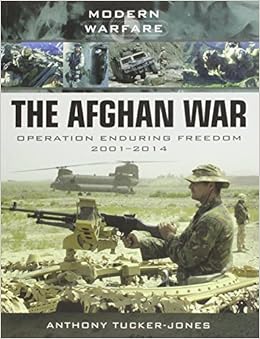
Anthony Tucker-Jones, "The Afghan War" (2014)
Subtitle: "Operation Enduring Freedom 2001-2014."
Some observations I found useful:
Pagination corresponds to my digital version, and should not be seen as consistent with the hard copy.
18: “The very day after 9/11 Bush declared the attacks on the American homeland as acts of war and requested Congress provide the resources to fight the terrorists wherever they might be in the shape of $20 billion. Congress’s response was to approve double this sum. The following day US Secretary of State, Colin Powell, confirmed that Osama bin Laden, believed to be hiding in Afghanistan, was a key suspect.”
20: “Initially, al-Qaeda had planned hijacking a total of ten planes with the intention of crashing them into targets on both coasts of the US. The targets would have included nuclear power plants and tall buildings in California and Washington State. This could have been devastating, but as it was just four planes had the desired effect. The US asked itself what had it done to inspire such an act of hatred by militant members of islam? The international community was also put on notice that such outrages would become more commonplace in the world’s capitals over the next decade.
Following 9/11 the international community immediately rallied to the US. The very next day UN Security Council resolution 1368 and General Assembly resolution 56/1 called for immediate international cooperation to bring the perpetrators to justice. They also called for much broader cooperation against global terrorism and this was followed on 28 September 2001 by UN Security Council resolution 1373. Enacted under Chapter VII of the UN Charter, it required every member state to undertake seventeen measures against all those who support, directly or indirectly, acts of terrorism.
For the very first time the NATO invoked its mutual defence clause on 2 October 2001, whereby an attack on a member state is considered an attack on all.”
76: “NATO assumed control of ISAF in 2003 and expanded its area of responsibility from Kabul to encompass the country’s southern and eastern provinces three years later. This meant bringing the 12,000 American and other Coalition forces in the region under NATO control. It gave ISAF responsibility for the whole of Afghanistan, with around 40,000 troops. The upshot of this was greater integration in the south with the American-led Operation Enduring Freedom. However, the two operations continued to be directed separately, the rationale being that ISAF had a stabilisation and security mission, while OEF was overtly counter-terrorism.”
94: “ISAF was created in accordance with the Bonn Conference in December 2001. NATO assumed leadership of the ISAF operation on 11 August 2003, ending the six-month national rotations. The Alliance became responsible for the command, coordination and planning of the force, including the provision of a force commander and headquarters on the ground in Afghanistan. ISAF’s mandate was initially limited to providing security in and around Kabul. In October 2003, the United Nations extended ISAF’s mandate to cover the whole of Afghanistan (United Nations Security Council Resolution 1510), paving the way for an expansion of the mission across the country.”
127: “Urgent Operational Requirements (UORs) thrown up by the British army’s deployments to Afghanistan and Iraq resulted in the provision of a plethora of new military vehicles. Force protection became the primary focus for armoured vehicles, rather than the more traditional mechanised warfare role. While offensive battle groups still played their part, getting forces from A to B and conducting patrols unscathed in the face of a mounting IED threat became a greater priority. In total some 2,700 vehicles were supplied to the British army during the period November 2008 to April 2011 consisting of 18 different types.”
149: the international intervention in Afghanistan was in many ways a unique operation. While the application of air power and special forces brought the Taliban down, Coalition ground troops were needed to keep the resurgent Taliban at bay and safeguard the fledgling democratic government in Kabul. Like the Balkans Wars of the 1990s, Afghanistan became an unwelcome and often unpopular open-ended military commitment that dragged on for over a decade. As with the war in Bosnia, the campaign in Afghanistan only achieved a precarious peace after more and more ground troops were sucked in.”
Some observations I found useful:
Pagination corresponds to my digital version, and should not be seen as consistent with the hard copy.
18: “The very day after 9/11 Bush declared the attacks on the American homeland as acts of war and requested Congress provide the resources to fight the terrorists wherever they might be in the shape of $20 billion. Congress’s response was to approve double this sum. The following day US Secretary of State, Colin Powell, confirmed that Osama bin Laden, believed to be hiding in Afghanistan, was a key suspect.”
20: “Initially, al-Qaeda had planned hijacking a total of ten planes with the intention of crashing them into targets on both coasts of the US. The targets would have included nuclear power plants and tall buildings in California and Washington State. This could have been devastating, but as it was just four planes had the desired effect. The US asked itself what had it done to inspire such an act of hatred by militant members of islam? The international community was also put on notice that such outrages would become more commonplace in the world’s capitals over the next decade.
Following 9/11 the international community immediately rallied to the US. The very next day UN Security Council resolution 1368 and General Assembly resolution 56/1 called for immediate international cooperation to bring the perpetrators to justice. They also called for much broader cooperation against global terrorism and this was followed on 28 September 2001 by UN Security Council resolution 1373. Enacted under Chapter VII of the UN Charter, it required every member state to undertake seventeen measures against all those who support, directly or indirectly, acts of terrorism.
For the very first time the NATO invoked its mutual defence clause on 2 October 2001, whereby an attack on a member state is considered an attack on all.”
76: “NATO assumed control of ISAF in 2003 and expanded its area of responsibility from Kabul to encompass the country’s southern and eastern provinces three years later. This meant bringing the 12,000 American and other Coalition forces in the region under NATO control. It gave ISAF responsibility for the whole of Afghanistan, with around 40,000 troops. The upshot of this was greater integration in the south with the American-led Operation Enduring Freedom. However, the two operations continued to be directed separately, the rationale being that ISAF had a stabilisation and security mission, while OEF was overtly counter-terrorism.”
94: “ISAF was created in accordance with the Bonn Conference in December 2001. NATO assumed leadership of the ISAF operation on 11 August 2003, ending the six-month national rotations. The Alliance became responsible for the command, coordination and planning of the force, including the provision of a force commander and headquarters on the ground in Afghanistan. ISAF’s mandate was initially limited to providing security in and around Kabul. In October 2003, the United Nations extended ISAF’s mandate to cover the whole of Afghanistan (United Nations Security Council Resolution 1510), paving the way for an expansion of the mission across the country.”
127: “Urgent Operational Requirements (UORs) thrown up by the British army’s deployments to Afghanistan and Iraq resulted in the provision of a plethora of new military vehicles. Force protection became the primary focus for armoured vehicles, rather than the more traditional mechanised warfare role. While offensive battle groups still played their part, getting forces from A to B and conducting patrols unscathed in the face of a mounting IED threat became a greater priority. In total some 2,700 vehicles were supplied to the British army during the period November 2008 to April 2011 consisting of 18 different types.”
149: the international intervention in Afghanistan was in many ways a unique operation. While the application of air power and special forces brought the Taliban down, Coalition ground troops were needed to keep the resurgent Taliban at bay and safeguard the fledgling democratic government in Kabul. Like the Balkans Wars of the 1990s, Afghanistan became an unwelcome and often unpopular open-ended military commitment that dragged on for over a decade. As with the war in Bosnia, the campaign in Afghanistan only achieved a precarious peace after more and more ground troops were sucked in.”
Labels:
book reviews,
Middle East,
military,
U.S.A. history,
U.S.A. politics
Friday, 17 October 2014
Norman Finkelstein, "The Holocaust Industry" (2000, rev. 2003)
Subtitle: "Reflections on the Exploitation of Jewish Suffering".
The book is essentially three essays ('Capitalizing The Holocaust', 'Hoaxers, Hucksters and History', and 'The Double Shakedown'), each arguing - with significant reference to media articles, legal activity, and some archival research - how a cadre of Zionists have co-opted the tragedy of the genocide carried out by Nazis during World War II to privilege Israeli political and economic interests, as well as Zionist advocacy groups outside of Israel.
Given the topic, and more so Finkelstein's position, the book is very, very controversial, and I expect it would prove challenging to pretty well any reader. I know that I am hesitant to even write a summary regarding the book, for fear sloppy language or thinking might make me appear to have some kind of hatred that I do not. The book has been characterized as an anti-Semitic attack (by someone whose mother died in the Nazi genocide, as Finkelstein informs his readers).
I will note a few (related) aspects that I found intriguing:
1) Finkelstein notes the tension, and in some respects competition, that has taken place over the definition (historicizing and politicizing) of the genocide carried out by the Nazis as a set of events. He notes that a cadre of Jews has worked to marginalize the importance of non-Jewish victims, or at the least to point to the necessity of understand Jews' experience of the genocide as the lens through which all other victims' experiences must be viewed.
2) He proposes that this cadre of Jews undertook a re-historicization and political/economic functionalization of the Nazi genocide in large part as a response to the period of military conflicts involving Israel that lasted from the late 1960s through the early 1970s.
3) Finkelstein spends much of the third chapter examining various claims for compensation, as well as 'repatriation' or return of funds and other goods held in several nations' banking systems (particularly Dutch and Swiss banks). He notes US support for investigation of Swiss banks (and the US calls for quick and willing restitution to be made to victims). He raises the disquieting point that if this is the US position, why has it quashed efforts to compensate descendants of slaves, and flattened demands to seek repatriation and return of money and other goods to victims of the Nazi genocide who had deposited their wealth in US banks? As Finkelstein notes, the US was one of the top three recipient countries of financial resources being exported by Jews from the Third Reich.
4) In his revised edition (I'm not sure about the original), Finkelstein occasionally indulges in some unhelpful, annoying and provocative personal attacks and less than professional use of language. In these portions, the book crosses from polemic to screed. Perhaps his indulgence is a product of the deep hostility that Finkelstein's work generated, but it does nothing to reinforce the sense of objective and informed scholarship. This is unfortunate, and helps to lend support to the idea that there might be more to Finkelstein's attacks than a pure desire to correct our understanding of how the world works.
5) Finkelstein is a graduate of Princeton, was being considered for tenure at DePaul University in 2007, and has published widely on the Israel/Palestine conflict (nine books).
The book is essentially three essays ('Capitalizing The Holocaust', 'Hoaxers, Hucksters and History', and 'The Double Shakedown'), each arguing - with significant reference to media articles, legal activity, and some archival research - how a cadre of Zionists have co-opted the tragedy of the genocide carried out by Nazis during World War II to privilege Israeli political and economic interests, as well as Zionist advocacy groups outside of Israel.
Given the topic, and more so Finkelstein's position, the book is very, very controversial, and I expect it would prove challenging to pretty well any reader. I know that I am hesitant to even write a summary regarding the book, for fear sloppy language or thinking might make me appear to have some kind of hatred that I do not. The book has been characterized as an anti-Semitic attack (by someone whose mother died in the Nazi genocide, as Finkelstein informs his readers).
I will note a few (related) aspects that I found intriguing:
1) Finkelstein notes the tension, and in some respects competition, that has taken place over the definition (historicizing and politicizing) of the genocide carried out by the Nazis as a set of events. He notes that a cadre of Jews has worked to marginalize the importance of non-Jewish victims, or at the least to point to the necessity of understand Jews' experience of the genocide as the lens through which all other victims' experiences must be viewed.
2) He proposes that this cadre of Jews undertook a re-historicization and political/economic functionalization of the Nazi genocide in large part as a response to the period of military conflicts involving Israel that lasted from the late 1960s through the early 1970s.
3) Finkelstein spends much of the third chapter examining various claims for compensation, as well as 'repatriation' or return of funds and other goods held in several nations' banking systems (particularly Dutch and Swiss banks). He notes US support for investigation of Swiss banks (and the US calls for quick and willing restitution to be made to victims). He raises the disquieting point that if this is the US position, why has it quashed efforts to compensate descendants of slaves, and flattened demands to seek repatriation and return of money and other goods to victims of the Nazi genocide who had deposited their wealth in US banks? As Finkelstein notes, the US was one of the top three recipient countries of financial resources being exported by Jews from the Third Reich.
4) In his revised edition (I'm not sure about the original), Finkelstein occasionally indulges in some unhelpful, annoying and provocative personal attacks and less than professional use of language. In these portions, the book crosses from polemic to screed. Perhaps his indulgence is a product of the deep hostility that Finkelstein's work generated, but it does nothing to reinforce the sense of objective and informed scholarship. This is unfortunate, and helps to lend support to the idea that there might be more to Finkelstein's attacks than a pure desire to correct our understanding of how the world works.
5) Finkelstein is a graduate of Princeton, was being considered for tenure at DePaul University in 2007, and has published widely on the Israel/Palestine conflict (nine books).
Monday, 28 July 2014
John Hagee, "Four Blood Moons" (2013)
Full title: "Four Blood Moons: Something is About to Change."
Hagee is one of those unique type of fire-and-brimstone tele-vangelists that only the United States can seem to create. Among his peers he is perhaps particularly noteworthy for his outspoken defence of Israel, and his calls for 'good Christians' to rise to advocate for and give active support to Israel. Tying his affection for Israel with numerology and a particularist reading of 'astronomical' symbolism (Hagee strives to clarify that his work is NOT astrology), he attempts to convince readers that the world is on the verge of a significant moment in Christian history that presages the return of 'the Saviour'.
Even as someone with a less-than-extensive knowledge of Biblical scripture, Hagee's book is rife with contradictions and questionable interpretations. Once I'm finished the book, I will strive to document these.
Here's a link to a related article by Hagee written for the Christian Post.
Hagee's interpretations are not only controversial among those who decry use of the Bible as prophetic (or fact), but among Christians as well. For instance, see the Beginning and End blog's and End Time blog's refutation of the 'four blood moons' interpretation by Hagee.
Hagee is one of those unique type of fire-and-brimstone tele-vangelists that only the United States can seem to create. Among his peers he is perhaps particularly noteworthy for his outspoken defence of Israel, and his calls for 'good Christians' to rise to advocate for and give active support to Israel. Tying his affection for Israel with numerology and a particularist reading of 'astronomical' symbolism (Hagee strives to clarify that his work is NOT astrology), he attempts to convince readers that the world is on the verge of a significant moment in Christian history that presages the return of 'the Saviour'.
Even as someone with a less-than-extensive knowledge of Biblical scripture, Hagee's book is rife with contradictions and questionable interpretations. Once I'm finished the book, I will strive to document these.
Here's a link to a related article by Hagee written for the Christian Post.
Hagee's interpretations are not only controversial among those who decry use of the Bible as prophetic (or fact), but among Christians as well. For instance, see the Beginning and End blog's and End Time blog's refutation of the 'four blood moons' interpretation by Hagee.
Tuesday, 18 March 2014
Deborah Lipstadt, "The Eichmann Trial" (2011)
In progress.
The New Republic offers an excellent assessment of the book.
You can also watch/listen to Lipstadt discuss the book, in a half-hour talk at University of South Florida, delivered in February 2012.
Additionally, see my discussion of Lipstadt's Denying the Holocaust: The Growing Assault on Truth and Memory (1993).
The New Republic offers an excellent assessment of the book.
You can also watch/listen to Lipstadt discuss the book, in a half-hour talk at University of South Florida, delivered in February 2012.
Additionally, see my discussion of Lipstadt's Denying the Holocaust: The Growing Assault on Truth and Memory (1993).
Saturday, 8 February 2014
Graeme Smith, "The Dogs are Eating Them Now" (2013)
A brilliant reflection on over a decade of (interrupted) on-the-ground coverage of Canada and its allies war in Afghanistan. Eminently readable, compelling, and disturbing.
Labels:
book reviews,
Canadian history,
Canadian politics,
Middle East,
military
Wednesday, 18 September 2013
Friday, 31 May 2013
Bart Ehrman, "The New Testament: A Historical Introduction..." (2003)
The full subtitle of this text is: "A Historical Introduction to the Early Christian Writings."
I've temporarily discontinued reading this book, but fully intend to return to it. Sorry!http://www.bartdehrman.com/books/nt_early_writingsR4.htm
Labels:
book reviews,
Middle East,
philosophy,
religion,
social history
Wednesday, 9 January 2013
David Wallechinsky, "Tyrants" (2006)
Subtitle: "The World's 20 Worst Living Dictators"
I have to admit that I was a little cynical about this book when I first picked it up. It was the kind of thing that I decided to read as a bit of a palate-cleanser, or when I didn't feel I could give my full attention to more meaningful reading.
Essentially, Wallechinsky has written short profiles of twenty dictators, organized as a series of discrete profiles of varying length and detail. In many ways, his approach reminds me of the CIA nation summaries. He usually tries to give a sense of the long-term trajectory of a state and people's development, he never loses sight of the fact that these set-ups are primarily backdrops for the 'real' story he is trying to tell. Most of his profiles try to give some sort of insights into the personal development of authoritarian leaders, such as their family background (where the information is available, and in many cases it is sketchy. He narrates their political ascent to power, where such information is available, with an eye to casting the figure as perpetually bloodthirsty and aggressive, or in a few cases as well-meaning politicians who were somehow spoiled by power.
Tyrants could very easily have gone the route of merely pandering to the often shocking habits of dictators: the excesses of their personal lives, the inconsistencies between their public pronouncements and private lives, and the arcane cults of personality that they work to develop. Wallechinsky does not shy from discussing these things, but also turns his attention to political initiatives, international policies, relations with dissident political bodies within their countries, and domestic issues such as poverty, oppression, and electoral malfeasance.
Generally speaking, the book serves as a good, though reductive overview of the tyrants in question, and the countries they lead. Although, of course, information for some of the countries has already gotten out of date, for other countries, such as Syria, for instance, it provides a handy, quick reference source to familiarize yourself with the key players, groups, and issues.
Saturday, 3 December 2011
Joseph E. Stiglitz & Linda J. Bilmes, "The Three Trillion Dollar War" (2008)
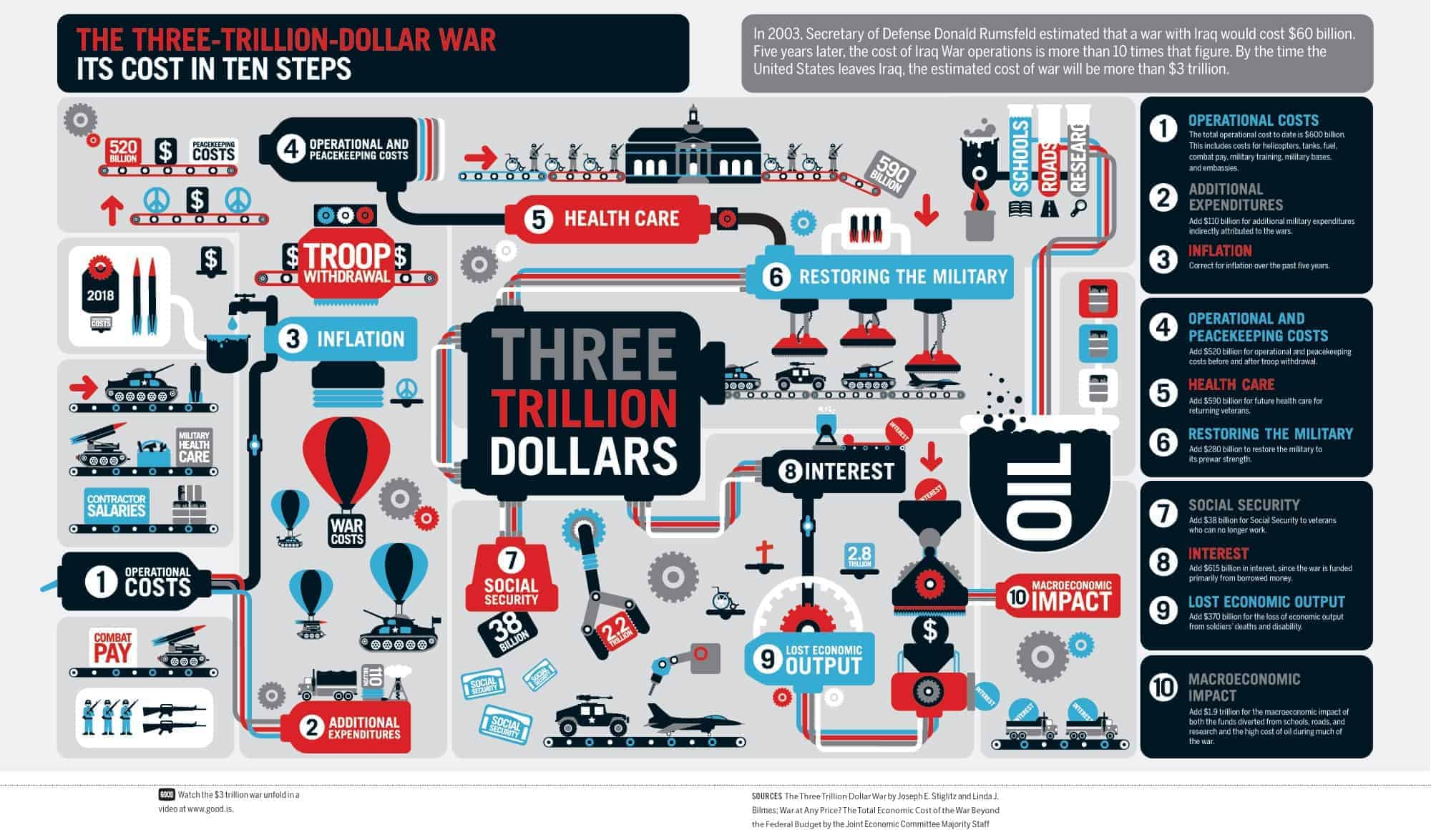
The full title of Stiglitz and Bilmes' much talked about book is The Three Trillion Dollar War: The True Cost of the Iraq Conflict. The central idea they propose in the book is that the way the costs of the war were discussed, by the great unwashed masses, the US government, and the US military, is wildly misleading, either by intention or error. They propose, through using a form of what I will call forensic auditing - for lack of a term I know that will be more correct - to identify heretofore hidden costs of the war, costs of the war that have not been discussed or built into short and long-term US national budgeting, and incidental or related costs of the war that do not go reported in calculations claiming to capture the cost of the war.
A decent, though cursory, outline of the types of costs the book analyses are laid out here:
http://dailyinfographic.com/wp-content/uploads/2011/01/threetrilliondollarwar.jpeg
Excerpts from the book can be read at:
National Public Radio, USA (NPR) - http://www.npr.org/templates/story/story.php?storyId=87855957
Vanity Fair, Apr. 2008 - http://www.vanityfair.com/politics/features/2008/04/stiglitz200804
Labels:
economics,
Middle East,
military,
U.S.A. history
Monday, 7 November 2011
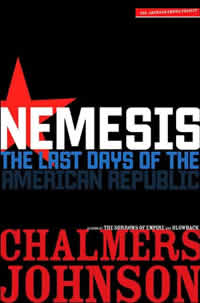
Chalmers Johnson, "Nemesis: The Last Days of the American Republic" (2007)
Nemesis is the third in Johnson's 'American Empire Trilogy'. Dan Clendenin offers a succinct, accurate summary of the series at Journey with Jesus.
You can read significant portions of the text via Google Books.
All too often I write these summaries several weeks after having finished the text in question. This presents dangers and advantages. On one hand, the objectivity provided by some temporal distance from the reading experience helps to test the impressions made by the book. On the other, even the most thought-provoking ideas from the most well-written book – ideas that might benefit from prolonged consideration - can simply get lost in the challenges of managing daily life. To a certain degree, this is how I now experience Nemesis.
The book impressed me enough that I started to make notes. The notes were written on the back of a receipt, however, and do not go beyond cryptic comments such as, “pg. 73 – quote”.
Johnson’s American Empire Trilogy is an inspiring, chilling assessment of how the United States has developed as a global power since the Second World War, how that empire is likely to precipitously decline in the next few decades, and what the reasons for that decline currently appear to be. Nemesis explores the rise of a military state, where spending and policy prioritization is often driven by the needs of the military, the lobbyists hired by military contractors, and the elected officials and political constituencies who have come to depend on American domestic military spending. The need to pursue this sort of spending, and to control the domestic political process to allow the USA to carry out aggressive and often semi-secret military initiatives abroad also have led to a deteriorization in the practice of democracy in the country. The particular example explored in Nemesis is the growth of the Central Intelligence Agency, which can largely function (particularly in the waging of aggressive actions beyond the United States’ borders) without the consent of Congress, and is answerable only to the President, not Americans as a whole.
The increasing extension of the United States as a military empire – and by this I mean its creation of physical military facilities and properties explicitly intended to provide semi-permanent operating bases in foreign countries – holds significant risks for the country. While it calls for ongoing and significant spending, it also creates a certain tension between the countries who grow dependent – willingly or not – on that US military presence, while at the same time hating it and the cultural and political presumptions that they represent.
Johnson also explores, in a particularly scathing and informative chapter, the ridiculous record of US experimentation and investment in the militarization of space. He also wisely directs his readers’ attention to the very real problems – too rarely considered - that military conflict in space would pose. I was fascinated to read, for instance, the near instantaneous destruction that even a small explosion would likely cause for almost all satellites (aggressive or not, friendly or not). It is easy for us to forget how destructive something as minor as a screw flying through orbit at hundreds of kilometers an hour can be. Consider what fragments of an exploding satellite or ICBM would do the US military GPS satellite network.
A few last items purely of interest to me, I'm sure follow:
- pg. 73: Johnson quotes Michael Ignatieff, from the NY Times, 5 Jan. 2003: "Ever since George Washington warned his countrymen against foreign entanglements, empire abroad hasbeen seen as the republic's permanent temptation and its potential nemesis. Yet what word but 'empire' describes the awesome thing that America is becoming? It is the only nation that polices the world through five global military commands; maintains more than a million men and women at arms on four continents; deploys carrier battle groups on watch in every ocean; guarantees the survival of countries from Israel to South Korea; drives the wheels of global trade and commerce; and fills the hearts and minds of an entire planet with its dreams and desires."
- pg. 82: "the United States, protected from its inception to about 1940 by tariffs on manufactured importss that averaged 44 percent"
- pg. 89: "Imperialism and militarism will ultimately breach the separation of powers created to prevent tyranny and defend liberty. ...Rome and Britain are archetypes of the dilemma of combining democracy at home with an empire abroad. In the Roman case, they decided to hang on to the empire and lost their democracy. In the British case, they chose the opposite: in order to remain democratic they dumped their empire and military apparatus after World War II. For us [Americans], the choice is between the Roman and British precedents."
Here is a February 2007 Democracy Now! interview with Chalmers Johnson, regarding Nemesis.
Labels:
book reviews,
Cold War history,
Middle East,
military,
U.S.A. history
Tuesday, 4 October 2011
Gwynne Dyer, "The Mess They Made: The Middle East After Iraq" (2007)
Dyer has written a captivating, approachable, opinionated and authoritative discussion of how the war in Iraq came about, and how, built on a foundation of ill-thought out strategic choices, the long-term unintended and unforeseen consequences of that war might have devastating effects for US foreign policy goals.
One strength of Dyer’s approach is that he does not write in a way that depends on a deep familiarity with the historical, political, military or social conditions within which the war occurs. He certainly writes far above a “Middle Eastern conflict for Dummies” text; perhaps it might be called “Middle Eastern conflict for young diplomats”.
Key to Dyer’s analysis is consideration of three factors often touted as justifications for concern with Iraq, if not the second US war on the region. The first is the idea that Saddam Hussein was tantamount to a Middle Eastern Hitler, seeking lebensraum and riches from his immediate neightbours. Second, is the prospect of Hussein’s Iraq having capacity – if not using – weapons of mass destruction (WMDs). The third is the threat radical, militant Islam, particularly Shias, was believed to posed.
As Dyer clearly lays out, it is quite likely that the initial conflict that brought the US into direct conflict with Iraq, the invasion of Kuwait, represented a fundamental breakdown in communication between two cooperating, if not allied nations. The US had supported Iraq in its decade-long war with Iran, and the record suggests that Iraq believed – such as in its discussions with Madeleine Albright – that the US was not opposed to the invasion of Kuwait. Telescoping this problem into the future, illustrated by other examples, it is easy to see how US intervention in the region has often been intended to play forces off against each other, to limit the expansion of any particular force, and particularly during the presidency of G.W. Bush, to ensure that no meaningful counter-force to US dominance could arise in areas of US-concern, if not the globe. As the need to address US debt rises, as global powers rise to counter US hegemony, and as the nature of political power changes during the 21st century, however, the US may find itself facing a region with a deeply entrenched hostility to the US, and bent on avenging a previous generation’s humiliations.
The second concern presents an interesting dilemma. As most people know now, Iraq did not possess WMDs. It is even quite likely that the US knew this going into the second war. What is not often talked about is the widespread awareness that Iraq had already used chemical and biological weapons in its 1980s war with Iran, uses that were sanctioned, if not assisted by the US. Having armed an ally, much as was done in Afghanistan with the mujahideen, the US found itself within a decade, having to fight against a country armed largely with US weaponry. The argument that has been used to sabre-rattle against Iran is very similar to that which was used to justify attacking Iraq: Iran may have nuclear weapons, or be seeking the capacity to build them. Dyer observes that the economy of the country precludes its ability to generate a meaningful nuclear development program, let alone an arsenal that could provide any kind of sensible deterrent to Israel’s overwhelming nuclear armaments. For these reasons, the proposal that Iran might develop nuclear weapons should not be taken too seriously.
Finally, with regard to the rise of a militant stream of devout Shia Muslims, Dyer suggests that the cadre of radicals is not reflective of the larger Shia sensibilities. Additionally, if there is radicalization, it is as a result of US activities, not the other way around. In this respect, the rather unreasonable US response to 9/11, parsing the events as an act of war by a nation rather than as a terrible but singular terrorist attack, has hastened the downfall of the United States as it strives to fund multiple foreign wars, fight terrorism at home and abroad, and see its economy and politics succumb to a dangerous form of singularism of goal and absolutism of control.
Perhaps the most effective and thought-provoking chapter of The Mess They Made is the one Dyer devotes to exploring the role of Israel in the Middle East. From his perspective, political division within Israel, and the competing desires to achieve peace while not yielding any territory acquired through military conquest has served to exacerbate tensions surrounding Israel’s future. Noting its substantial military buildup (Israel has more nuclear missiles than Britain, for instance, and has not been shy in suggesting that it would use them if necessary, and not just on Arab neighbours), Dyer suggests that if it seeks lasting peace, or at least hopes to indicate a willingness to bargain in good faith with its neighbours, it will need to at some point accept a two-state solution with Palestine. When considered with respect to waning US power, and growing enmity towards the US in the Middle East, and the important role the US has played in supporting Israel internationally for the last fifty years, the implications are substantial. The next generation could see growing pressure on Israel to come to the table regarding Palestine, and a growing militarism from within Israel as a response to the perceived threat of growing demands from its neighbours. This militarism might serve to be particularly dangerous in light of the significantly diminished military, particularly offensive, capacity of the country’s neighbours.
Labels:
book reviews,
Middle East,
military,
U.S.A. history
Tuesday, 27 September 2011
Klaus-Michael Mallmann & Martin Cuppers, "Nazi Palestine" (English edition, 2010)
I am of two minds regarding this book, subtitled, "The Plans for the Extermination of the Jews in Palestine."
On one hand, it approaches a subject that is rarely written about, is very well researched, presents a compelling argument, and does not seem to have garnered criticism from experts on the subject. On the other, the translation or editing of the volume is shoddy, which gives the impression that the book was produced in much the same fashion. Additionally, the construction of the book's argument sometimes feels a little heavy-handed - not manufactured - but as if all evidence available leads inexorably towards a very few conclusions.
What does the book argue? Tracing the relationship between the Nazi plans for the Middle East, particularly Palestine, and the nascent Palestinian nationalism movements striving to throw off the colonial presence, Mallman and Cuppers make a convincing case for the Middle East as an overlooked realm of conflict in the Second World War, and one in which anti-Semitism played a pivotal role in bringing the Nazis and Palestinian/Muslim revolutionaries together.
An area where the book falls short, in my estimation (as someone who is not an expert on Middle Eastern history or politics), is in its attempts to link contemporary Palestinian/Israeli conflicts to events of the Second World War-era machinations of the Nazis. The Epilogue does offer an intriguing survey of contemporary positive references to Hitler, Nazis, and Nazi anti-semitic policies in Middle Eastern mass media, that does lend some credence to their argument for a connection between the past and the present.
On a personal note, I found the material discussing how the Nazis opted to build some flexibility into their racial policies, particularly for SS units, when the war on the Eastern front required more soldiers, and one of the candidate populations for willing recruits was Muslim anti-communists from the Caucasus. It was fascinating to read that the Germans were willing to provide halal food and imams for these troops, when the rhetoric of the Nazis more widely known and publicized makes such a compromise hard to conceive of.
On one hand, it approaches a subject that is rarely written about, is very well researched, presents a compelling argument, and does not seem to have garnered criticism from experts on the subject. On the other, the translation or editing of the volume is shoddy, which gives the impression that the book was produced in much the same fashion. Additionally, the construction of the book's argument sometimes feels a little heavy-handed - not manufactured - but as if all evidence available leads inexorably towards a very few conclusions.
What does the book argue? Tracing the relationship between the Nazi plans for the Middle East, particularly Palestine, and the nascent Palestinian nationalism movements striving to throw off the colonial presence, Mallman and Cuppers make a convincing case for the Middle East as an overlooked realm of conflict in the Second World War, and one in which anti-Semitism played a pivotal role in bringing the Nazis and Palestinian/Muslim revolutionaries together.
An area where the book falls short, in my estimation (as someone who is not an expert on Middle Eastern history or politics), is in its attempts to link contemporary Palestinian/Israeli conflicts to events of the Second World War-era machinations of the Nazis. The Epilogue does offer an intriguing survey of contemporary positive references to Hitler, Nazis, and Nazi anti-semitic policies in Middle Eastern mass media, that does lend some credence to their argument for a connection between the past and the present.
On a personal note, I found the material discussing how the Nazis opted to build some flexibility into their racial policies, particularly for SS units, when the war on the Eastern front required more soldiers, and one of the candidate populations for willing recruits was Muslim anti-communists from the Caucasus. It was fascinating to read that the Germans were willing to provide halal food and imams for these troops, when the rhetoric of the Nazis more widely known and publicized makes such a compromise hard to conceive of.
Labels:
book reviews,
fascism,
German history,
Middle East,
racism,
religion,
World War II
Subscribe to:
Posts (Atom)