Book finished. Comments not yet written.
Consider this a placeholder.
Reflections by Dr. Gregory Klages on non-fiction books dealing primarily with politics, history, and religion. Significant attention to Canadian content. Mail me/comment if you read anything. I love to hear feedback!
Showing posts with label Historiography. Show all posts
Tuesday, 8 December 2015
Tuesday, 4 August 2015
Tuesday, 23 June 2015
Joan Didion, "The Year of Magical Thinking" (2006)
Didion explores a critical year in her life in its immediate aftermath. Her daughter experiences a near-fatal medical condition. Her husband dies at home in front of her. In short, her world stops, lets her off, and then proceeds to drive over a cliff. She is left standing at the top, watching, and wondering what the hell happened.
Grief is a funny thing, perhaps like addiction. It's difficult to explain to those who haven't been there, and to them, any description makes the experience seem silly and indulgent. Any description seems incomplete, though, inadequate to the strength of the emotions felt and not felt.
Didion's book is both frustrating and touching. I chalk this up to the idea that it was written less for her audience than for herself. It is almost like a diary… like having a coffee with someone who is grieving, and who is thinking out loud. Her writing is compelling. Her thinking is circular, repetitive, and obsessive. She second-guesses her decision, plays scenarios (important and innocuous) over and over through her thoughts, and members and re-members her memories, attempting to construct a clear, linear, comprehensible narrative that explains what she is feeling.
Jim Murdoch offers a very insightful review.
Some noteworthy quotations:
- Chapter 5: "one more case of maintaining a fixed focus on the clear blue sky from which the plane fell…"
I just really like this image. It captures grief so well.
- Chapter 15: "John would wait until I came uptown at eleven or so to have dinner with me. We would walk to Coco Pazzo on those hot July nights and split an order of pasta and a salad at one of the little unreserved tables in the bar. I do not think we ever discussed the convention during these late dinners. On the Sunday afternoon before it began I had talked him into going uptown with me to a Louis Farrakhan event that never materialized, and between the improvisational nature of the scheduling and the walk back downtown from 125th Street his tolerance for the 1992 Democratic convention was pretty much exhausted. Still. He waited every night to eat with me. I thought about all this on the Tower C escalator and suddenly it occurred to me: I had spent a minute or two on this escalator thinking about the November night in 2003 before we flew to Paris and about those July nights in 1992 when we would eat late at Coco Pazzo and about the afternoon we had stood around 125th Street waiting for the Louis Farrakhan event that never happened."
This section reminds me of Gertrude Stein's 'Making of Americans'. There's something about the elliptical narrative, the fruitless repetition that is observed but unstoppable which resides somewhere between obsession and compulsion which is fascinating.
- Chapter 22: "if we are to live ourselves there comes a point at which we must relinquish the dead, let them go, keep them dead."
This suggestion resonates, but is difficult to reconcile with my interest in memorialization, public history, and myth-making.
Grief is a funny thing, perhaps like addiction. It's difficult to explain to those who haven't been there, and to them, any description makes the experience seem silly and indulgent. Any description seems incomplete, though, inadequate to the strength of the emotions felt and not felt.
Didion's book is both frustrating and touching. I chalk this up to the idea that it was written less for her audience than for herself. It is almost like a diary… like having a coffee with someone who is grieving, and who is thinking out loud. Her writing is compelling. Her thinking is circular, repetitive, and obsessive. She second-guesses her decision, plays scenarios (important and innocuous) over and over through her thoughts, and members and re-members her memories, attempting to construct a clear, linear, comprehensible narrative that explains what she is feeling.
Jim Murdoch offers a very insightful review.
Some noteworthy quotations:
- Chapter 5: "one more case of maintaining a fixed focus on the clear blue sky from which the plane fell…"
I just really like this image. It captures grief so well.
- Chapter 15: "John would wait until I came uptown at eleven or so to have dinner with me. We would walk to Coco Pazzo on those hot July nights and split an order of pasta and a salad at one of the little unreserved tables in the bar. I do not think we ever discussed the convention during these late dinners. On the Sunday afternoon before it began I had talked him into going uptown with me to a Louis Farrakhan event that never materialized, and between the improvisational nature of the scheduling and the walk back downtown from 125th Street his tolerance for the 1992 Democratic convention was pretty much exhausted. Still. He waited every night to eat with me. I thought about all this on the Tower C escalator and suddenly it occurred to me: I had spent a minute or two on this escalator thinking about the November night in 2003 before we flew to Paris and about those July nights in 1992 when we would eat late at Coco Pazzo and about the afternoon we had stood around 125th Street waiting for the Louis Farrakhan event that never happened."
This section reminds me of Gertrude Stein's 'Making of Americans'. There's something about the elliptical narrative, the fruitless repetition that is observed but unstoppable which resides somewhere between obsession and compulsion which is fascinating.
- Chapter 22: "if we are to live ourselves there comes a point at which we must relinquish the dead, let them go, keep them dead."
This suggestion resonates, but is difficult to reconcile with my interest in memorialization, public history, and myth-making.
Labels:
addiction,
biography,
book reviews,
Historiography,
mental health,
self-help
Sunday, 14 June 2015
Josh Miller, "A Zombie's History of the United States" (2010)
Subtitle: "From the Massacre at Plymouth Rock to the CIA's Secret War on the Undead."
On the whole, Miller's idea is intriguing. His realization left me somewhat disappointed. While the idea that the United States had a long-standing and difficult relationship with a zombie population, and that understanding this relationship was actually critical to understanding American history, the book was realized as pretty much light entertainment. It is funny in spots and tediously self-consciously attempting to be funny in others.
Labels:
book reviews,
fiction,
Historiography,
U.S.A. history
Tuesday, 13 January 2015
Matt Bai, "All the Truth is Out" (2014)
Subtitle: "The Week Politics Went Tabloid."
Bai offers a compelling and informative view into the media treatment of two-time US Presidential candidate Gary Hart, concentrating on 1987 accusations of marital infidelity.
I found Bai's work a fascinating profile of a political leader. It's investigation of a 'tipping point' in mass media coverage of America politics is even more intriguing.
Bai's work benefitted from surprising access to Hart and his spouse, as well as conversations with most of the key actors involved in the scandal, from the 'blonde' it was speculated he had caroused with, to newspaper and television news reporters and editors who made decisions about what to cover, when, and how.
Bai offers a convincing portrayal of a fundamental 'sea change' in how the media perceived and talked about political leaders within the United States. This change, likely begun during the 1970s with Watergate's shock to the system, came to its height with the decisions to discuss Hart's personal life (read: infidelity), which seemed to be common knowledge within political circles. The scandal, Bai argues, moved politician's personal lives into the forefront of political discussion, and suggested that aspiring politicians (and those already in the system) could no longer expect that anything was beyond the interest of media outlets.
Bai's access allowed him to not only investigate how the scandal was covered by the media, but to also consider how the scandal played out for Hart. Of course, the scandal effectively sank Hart's presidential campaign (I was surprised that he had actually tried to re-start his campaign later in the election cycle). The scandal, of course, also raised some fundamental personal questions for Hart about what being in politics meant, what values were important, etc.
In some respects, the considerations Bai raises in this regard remind me, ever so slightly, of Michael Ignatieff's reflection on his rather short stint as leader of Canada's Liberal Party. His fate (and eventually his failure), provided grist for much media speculation (as did his predecessor's). You can read my comments on Ignatieff's book, Fire and Ashes, on this site.
Some observations I found worthy of note:
(Pagination corresponds to my digital version.)
245: “E. J. Dionne’s second interview, in the New Hampshire hotel restaurant, when Dionne was pressing Hart on the rumors of affairs, and Hart was growing exasperated. Finally, he told Dionne: “Follow me around. I don’t care. I’m serious. If anybody wants to put a tail on me, go ahead. They’d be very bored.” Hart said this in an annoyed and sarcastic sort of way, in an obvious attempt to make a point. He was “serious” about the sentiment, all right, but only to the extent that a man who had been twice separated from his wife and conducted numerous liaisons over the years, with the full knowledge of his friends in the press corps, could have been serious about such a thing.”
248: “In those days before the Internet, however, the Times circulated hard copies of its magazine to other media a few days early, so editors and producers could pick out anything that might be newsworthy and publicize it in their own weekend editions or Sunday shows.”
250: “Fiedler’s fear was that, given twenty-four hours to strategize, Hart and his team would figure a way to get out in front of the story before the Herald could publish. Probably they would do this by going on the attack against the Herald, accusing the paper of stalking the candidate at his home—an allegation that would quickly turn the story into an argument over the Herald’s tactics, instead of an exposé about Hart’s infidelity.”
505: “…beginning with Watergate and culminating in Gary Hart’s unraveling, the cardinal objective of all political journalism had shifted, from a focus on agendas to a focus on narrow notions of character, from illuminating worldviews to exposing falsehoods. Whatever sense of commonality between candidates and reporters that existed in McGovern’s day had, by the time my generation arrived on the scene, been replaced by a kind of entrenched cold war. We aspired chiefly to show politicians for the impossibly flawed human beings they were—a single-minded pursuit that reduced complex careers to isolated transgressions.”
506: “Predictably, politicians responded to all this with a determination to give us nothing that might aid in the hunt to expose them, even if it meant obscuring the convictions and contradictions that made them actual human beings. Both sides retreated to our respective camps, where we strategized about how to outwit and outflank the other, occasionally to our own benefit but rarely to the voters’.
Maybe this made our media a sharper guardian of the public interest against frauds and hypocrites. But it also made it hard for any thoughtful politician to offer arguments that might be considered nuanced or controversial. And, just as consequential, the post-Hart climate made it much easier for candidates who weren’t especially thoughtful—who didn’t have any complex understanding of governance, or even much affinity for it—to gain national prominence. When a politician could duck any real intellectual scrutiny simply by deriding the evident triviality of the media, when the status quo was to never say anything that required more than ten words’ worth of explanation, then pretty much anyone could rail against the system and glide through the process without having to establish more than a passing familiarity with the issues. As long as you weren’t delinquent on your taxes or having an affair with a stripper or engaged in some other form of rank duplicity, you could run as a “Tea Partier” or a “populist” without ever having to elaborate on what you actually believed or what you would do for the country.”
508: “…between 1997 and 2013, trust in the mass media fell almost ten points. Four decades after the legend of Woodward and Bernstein came into being, only 28 percent of Americans were willing to say that journalists contributed a lot to society’s well-being—a showing that lagged behind almost every other professional group.”
513: “McCain’s burgeoning reputation as a reformer in the Bull Moose tradition had little to do with any actual governing agenda, and almost everything to do with theatrics. As his consultants would later admit, McCain’s gambit was conscious and born of desperation; they knew they would never get the media to follow their candidate if they didn’t create some kind of spectacle and celebrity persona, and they succeeded. McCain earned sudden fame as a truth teller, despite the fact that none of it added up to any coherent idea of how he would actually govern.”
515: “McCain had once thought, perhaps, that his persona as a war hero and maverick Republican would protect him from intimations of scandal, but the reverse turned out to be true. The more compelling a cultural figure you became, the more inevitable your disgrace. The arc of tabloid journalism—now deeply ingrained in even the most elite reaches of the industry—demanded nothing less.”
515: “Whatever one thought of her politics, it’s fair to say nothing on the forty-four-year-old Palin’s résumé qualified her to serve as a president-in-waiting. A former pageant queen, she had cycled through five underwhelming colleges before managing to graduate, and she had been a controversial small-town mayor before her unlikely ascension to the governorship—a job she had held, at that point, for less than two years. Her few, tentative TV interviews as a member of the ticket, for which she was heavily prepped, did nothing to counteract the impression that Palin knew less about foreign policy, in particular, than most casual readers of the newspaper.”
516: “It was as if, rather than having chosen an actual running mate, McCain had tried to reinvigorate his flagging campaign by holding a televised contest for the role, and Palin had made it through all the challenges and battle rounds in which you were locked away in a room full of tarantulas or whatever it was, and here she was, learning her lines in front of us. What Postman called the “supra-ideology” of entertainment—that’s what Palin’s candidacy was all about, and McCain’s embarrassed aides would later admit as much. By then, of course, Palin was more of a superstar than McCain had ever been, and she embodied a new phenomenon in national politics—power as a path to celebrity, rather than the other way around.”
521: ““No Drama Obama” was a misnomer; the candidate was in fact the leading man in a very real drama, an international celebrity who could draw millions of Germans to the Brandenburg Gate just to catch a glimpse, and who would soon be awarded the Nobel Prize for no other reason than having offered himself up to the world. Obama was brilliant and upright, funny and likable, an adequate if unenthusiastic retail politician. More than any of this, though, he was a well-cast protagonist, conjured from familiar story lines and deliberately marketed to inspire us. What, exactly, did Obama believe? What vision of governance guided his thinking, and what new argument did he bring to the arena? This was maddeningly hard to know, then and later. His twin mantras were “hope” and “change,” the rhetorical equivalent of rainbows and unicorns.”
522: “The truth was that Obama had had neither the time nor the burning inclination to work out his ideas or master the intricacies of governing before ascending to the Oval Office, and we in the media hadn’t been very interested in that side of him, anyway. From the start, he was treated more as a pop culture persona than a thought leader. He was a projection on a screen, larger than life but lacking the necessary dimension to propose the kind of bold reassessments that Hart had championed a quarter century earlier.”
Bai offers a compelling and informative view into the media treatment of two-time US Presidential candidate Gary Hart, concentrating on 1987 accusations of marital infidelity.
I found Bai's work a fascinating profile of a political leader. It's investigation of a 'tipping point' in mass media coverage of America politics is even more intriguing.
Bai's work benefitted from surprising access to Hart and his spouse, as well as conversations with most of the key actors involved in the scandal, from the 'blonde' it was speculated he had caroused with, to newspaper and television news reporters and editors who made decisions about what to cover, when, and how.
Bai offers a convincing portrayal of a fundamental 'sea change' in how the media perceived and talked about political leaders within the United States. This change, likely begun during the 1970s with Watergate's shock to the system, came to its height with the decisions to discuss Hart's personal life (read: infidelity), which seemed to be common knowledge within political circles. The scandal, Bai argues, moved politician's personal lives into the forefront of political discussion, and suggested that aspiring politicians (and those already in the system) could no longer expect that anything was beyond the interest of media outlets.
Bai's access allowed him to not only investigate how the scandal was covered by the media, but to also consider how the scandal played out for Hart. Of course, the scandal effectively sank Hart's presidential campaign (I was surprised that he had actually tried to re-start his campaign later in the election cycle). The scandal, of course, also raised some fundamental personal questions for Hart about what being in politics meant, what values were important, etc.
In some respects, the considerations Bai raises in this regard remind me, ever so slightly, of Michael Ignatieff's reflection on his rather short stint as leader of Canada's Liberal Party. His fate (and eventually his failure), provided grist for much media speculation (as did his predecessor's). You can read my comments on Ignatieff's book, Fire and Ashes, on this site.
Some observations I found worthy of note:
(Pagination corresponds to my digital version.)
245: “E. J. Dionne’s second interview, in the New Hampshire hotel restaurant, when Dionne was pressing Hart on the rumors of affairs, and Hart was growing exasperated. Finally, he told Dionne: “Follow me around. I don’t care. I’m serious. If anybody wants to put a tail on me, go ahead. They’d be very bored.” Hart said this in an annoyed and sarcastic sort of way, in an obvious attempt to make a point. He was “serious” about the sentiment, all right, but only to the extent that a man who had been twice separated from his wife and conducted numerous liaisons over the years, with the full knowledge of his friends in the press corps, could have been serious about such a thing.”
248: “In those days before the Internet, however, the Times circulated hard copies of its magazine to other media a few days early, so editors and producers could pick out anything that might be newsworthy and publicize it in their own weekend editions or Sunday shows.”
250: “Fiedler’s fear was that, given twenty-four hours to strategize, Hart and his team would figure a way to get out in front of the story before the Herald could publish. Probably they would do this by going on the attack against the Herald, accusing the paper of stalking the candidate at his home—an allegation that would quickly turn the story into an argument over the Herald’s tactics, instead of an exposé about Hart’s infidelity.”
505: “…beginning with Watergate and culminating in Gary Hart’s unraveling, the cardinal objective of all political journalism had shifted, from a focus on agendas to a focus on narrow notions of character, from illuminating worldviews to exposing falsehoods. Whatever sense of commonality between candidates and reporters that existed in McGovern’s day had, by the time my generation arrived on the scene, been replaced by a kind of entrenched cold war. We aspired chiefly to show politicians for the impossibly flawed human beings they were—a single-minded pursuit that reduced complex careers to isolated transgressions.”
506: “Predictably, politicians responded to all this with a determination to give us nothing that might aid in the hunt to expose them, even if it meant obscuring the convictions and contradictions that made them actual human beings. Both sides retreated to our respective camps, where we strategized about how to outwit and outflank the other, occasionally to our own benefit but rarely to the voters’.
Maybe this made our media a sharper guardian of the public interest against frauds and hypocrites. But it also made it hard for any thoughtful politician to offer arguments that might be considered nuanced or controversial. And, just as consequential, the post-Hart climate made it much easier for candidates who weren’t especially thoughtful—who didn’t have any complex understanding of governance, or even much affinity for it—to gain national prominence. When a politician could duck any real intellectual scrutiny simply by deriding the evident triviality of the media, when the status quo was to never say anything that required more than ten words’ worth of explanation, then pretty much anyone could rail against the system and glide through the process without having to establish more than a passing familiarity with the issues. As long as you weren’t delinquent on your taxes or having an affair with a stripper or engaged in some other form of rank duplicity, you could run as a “Tea Partier” or a “populist” without ever having to elaborate on what you actually believed or what you would do for the country.”
508: “…between 1997 and 2013, trust in the mass media fell almost ten points. Four decades after the legend of Woodward and Bernstein came into being, only 28 percent of Americans were willing to say that journalists contributed a lot to society’s well-being—a showing that lagged behind almost every other professional group.”
513: “McCain’s burgeoning reputation as a reformer in the Bull Moose tradition had little to do with any actual governing agenda, and almost everything to do with theatrics. As his consultants would later admit, McCain’s gambit was conscious and born of desperation; they knew they would never get the media to follow their candidate if they didn’t create some kind of spectacle and celebrity persona, and they succeeded. McCain earned sudden fame as a truth teller, despite the fact that none of it added up to any coherent idea of how he would actually govern.”
515: “McCain had once thought, perhaps, that his persona as a war hero and maverick Republican would protect him from intimations of scandal, but the reverse turned out to be true. The more compelling a cultural figure you became, the more inevitable your disgrace. The arc of tabloid journalism—now deeply ingrained in even the most elite reaches of the industry—demanded nothing less.”
515: “Whatever one thought of her politics, it’s fair to say nothing on the forty-four-year-old Palin’s résumé qualified her to serve as a president-in-waiting. A former pageant queen, she had cycled through five underwhelming colleges before managing to graduate, and she had been a controversial small-town mayor before her unlikely ascension to the governorship—a job she had held, at that point, for less than two years. Her few, tentative TV interviews as a member of the ticket, for which she was heavily prepped, did nothing to counteract the impression that Palin knew less about foreign policy, in particular, than most casual readers of the newspaper.”
516: “It was as if, rather than having chosen an actual running mate, McCain had tried to reinvigorate his flagging campaign by holding a televised contest for the role, and Palin had made it through all the challenges and battle rounds in which you were locked away in a room full of tarantulas or whatever it was, and here she was, learning her lines in front of us. What Postman called the “supra-ideology” of entertainment—that’s what Palin’s candidacy was all about, and McCain’s embarrassed aides would later admit as much. By then, of course, Palin was more of a superstar than McCain had ever been, and she embodied a new phenomenon in national politics—power as a path to celebrity, rather than the other way around.”
521: ““No Drama Obama” was a misnomer; the candidate was in fact the leading man in a very real drama, an international celebrity who could draw millions of Germans to the Brandenburg Gate just to catch a glimpse, and who would soon be awarded the Nobel Prize for no other reason than having offered himself up to the world. Obama was brilliant and upright, funny and likable, an adequate if unenthusiastic retail politician. More than any of this, though, he was a well-cast protagonist, conjured from familiar story lines and deliberately marketed to inspire us. What, exactly, did Obama believe? What vision of governance guided his thinking, and what new argument did he bring to the arena? This was maddeningly hard to know, then and later. His twin mantras were “hope” and “change,” the rhetorical equivalent of rainbows and unicorns.”
522: “The truth was that Obama had had neither the time nor the burning inclination to work out his ideas or master the intricacies of governing before ascending to the Oval Office, and we in the media hadn’t been very interested in that side of him, anyway. From the start, he was treated more as a pop culture persona than a thought leader. He was a projection on a screen, larger than life but lacking the necessary dimension to propose the kind of bold reassessments that Hart had championed a quarter century earlier.”
Labels:
biography,
book reviews,
Historiography,
media criticism,
U.S.A. history
Tuesday, 28 October 2014
Deborah Lipstadt, "History on Trial: My Day in Court with a Holocaust Denier" (2005)
This book details Lipstadt's court battle to prove that her assertion that author David Irving had engaged in a long-standing effort to falsify history: selectively using and misrepresenting documents to cast Adolf Hitler in a favourable light, as well as denying the very existence of an intentional, widespread, systematic, and state-sanctioned effort to slaughter Europe's Jewish population.
The case stemmed from claims Lipstadt made in her 1993 book, Denying the Holocaust: The Growing Assault on Truth and Memory, wherein she discussed Irving's work as well as the efforts of other 'deniers'. (See my discussion of the book here). Three years later, Irving sued Lipstadt and her publisher, Penguin, for libel (stemming from the statements in her book). According to British law, the onus was placed on the defendants to prove that their assertions could be supported by evidence.
Working with an impressive team of scholars and legal minds, arrayed against Irving's rather lacklustre and self-managed representation, Lipstadt and Penguin without a doubt brought Irving low. He was publicly shown to work less as a historian than an ideologue, calling into question the integrity of the entirety of his oeuvre. The revelation of his sloppy, highly biased, and clearly flawed use of documentary sources and other archival materials effectively ended his career as a historian. Banned from entering multiple countries, considered persona non grata by respectable publishers, and saddled with a significant financial burden after losing the case, Irving is unlikely to ever widely enter public consciousness other than as a sad, deluded figure.
As a result of the trial, and her unwillingness to compromise or back down from defending her observations, Lipstadt has become a far more widely known scholar and commentator on 20th-century Jewish history, particularly as it relates to the Nazi regime.
Her book is more narrative of the experiences of the trial, and exploration of some of the choices made in her legal team's efforts. In this regard, it is compelling and informative reading. For readers seeking a closer analysis of Irving's work, however, better sources are available, such as the expert analysis of Irving's work carried out for the trial by Richard Evans, Hajo Funke, and Robert Jan van Pelt. (Electronic editions of these can all be found at the Holocaust Denial on Trial website). Trial transcripts can be found at the same site.
I discuss Lipstadt's 1993 book, Denying the Holocaust, here.
I also discuss her 2011 book, The Eichmann Trial, here.
I discuss Irving's 1996 biography of Josef Goebbels here.
The case stemmed from claims Lipstadt made in her 1993 book, Denying the Holocaust: The Growing Assault on Truth and Memory, wherein she discussed Irving's work as well as the efforts of other 'deniers'. (See my discussion of the book here). Three years later, Irving sued Lipstadt and her publisher, Penguin, for libel (stemming from the statements in her book). According to British law, the onus was placed on the defendants to prove that their assertions could be supported by evidence.
Working with an impressive team of scholars and legal minds, arrayed against Irving's rather lacklustre and self-managed representation, Lipstadt and Penguin without a doubt brought Irving low. He was publicly shown to work less as a historian than an ideologue, calling into question the integrity of the entirety of his oeuvre. The revelation of his sloppy, highly biased, and clearly flawed use of documentary sources and other archival materials effectively ended his career as a historian. Banned from entering multiple countries, considered persona non grata by respectable publishers, and saddled with a significant financial burden after losing the case, Irving is unlikely to ever widely enter public consciousness other than as a sad, deluded figure.
As a result of the trial, and her unwillingness to compromise or back down from defending her observations, Lipstadt has become a far more widely known scholar and commentator on 20th-century Jewish history, particularly as it relates to the Nazi regime.
Her book is more narrative of the experiences of the trial, and exploration of some of the choices made in her legal team's efforts. In this regard, it is compelling and informative reading. For readers seeking a closer analysis of Irving's work, however, better sources are available, such as the expert analysis of Irving's work carried out for the trial by Richard Evans, Hajo Funke, and Robert Jan van Pelt. (Electronic editions of these can all be found at the Holocaust Denial on Trial website). Trial transcripts can be found at the same site.
I discuss Lipstadt's 1993 book, Denying the Holocaust, here.
I also discuss her 2011 book, The Eichmann Trial, here.
I discuss Irving's 1996 biography of Josef Goebbels here.
Friday, 17 October 2014
Norman Finkelstein, "The Holocaust Industry" (2000, rev. 2003)
Subtitle: "Reflections on the Exploitation of Jewish Suffering".
The book is essentially three essays ('Capitalizing The Holocaust', 'Hoaxers, Hucksters and History', and 'The Double Shakedown'), each arguing - with significant reference to media articles, legal activity, and some archival research - how a cadre of Zionists have co-opted the tragedy of the genocide carried out by Nazis during World War II to privilege Israeli political and economic interests, as well as Zionist advocacy groups outside of Israel.
Given the topic, and more so Finkelstein's position, the book is very, very controversial, and I expect it would prove challenging to pretty well any reader. I know that I am hesitant to even write a summary regarding the book, for fear sloppy language or thinking might make me appear to have some kind of hatred that I do not. The book has been characterized as an anti-Semitic attack (by someone whose mother died in the Nazi genocide, as Finkelstein informs his readers).
I will note a few (related) aspects that I found intriguing:
1) Finkelstein notes the tension, and in some respects competition, that has taken place over the definition (historicizing and politicizing) of the genocide carried out by the Nazis as a set of events. He notes that a cadre of Jews has worked to marginalize the importance of non-Jewish victims, or at the least to point to the necessity of understand Jews' experience of the genocide as the lens through which all other victims' experiences must be viewed.
2) He proposes that this cadre of Jews undertook a re-historicization and political/economic functionalization of the Nazi genocide in large part as a response to the period of military conflicts involving Israel that lasted from the late 1960s through the early 1970s.
3) Finkelstein spends much of the third chapter examining various claims for compensation, as well as 'repatriation' or return of funds and other goods held in several nations' banking systems (particularly Dutch and Swiss banks). He notes US support for investigation of Swiss banks (and the US calls for quick and willing restitution to be made to victims). He raises the disquieting point that if this is the US position, why has it quashed efforts to compensate descendants of slaves, and flattened demands to seek repatriation and return of money and other goods to victims of the Nazi genocide who had deposited their wealth in US banks? As Finkelstein notes, the US was one of the top three recipient countries of financial resources being exported by Jews from the Third Reich.
4) In his revised edition (I'm not sure about the original), Finkelstein occasionally indulges in some unhelpful, annoying and provocative personal attacks and less than professional use of language. In these portions, the book crosses from polemic to screed. Perhaps his indulgence is a product of the deep hostility that Finkelstein's work generated, but it does nothing to reinforce the sense of objective and informed scholarship. This is unfortunate, and helps to lend support to the idea that there might be more to Finkelstein's attacks than a pure desire to correct our understanding of how the world works.
5) Finkelstein is a graduate of Princeton, was being considered for tenure at DePaul University in 2007, and has published widely on the Israel/Palestine conflict (nine books).
The book is essentially three essays ('Capitalizing The Holocaust', 'Hoaxers, Hucksters and History', and 'The Double Shakedown'), each arguing - with significant reference to media articles, legal activity, and some archival research - how a cadre of Zionists have co-opted the tragedy of the genocide carried out by Nazis during World War II to privilege Israeli political and economic interests, as well as Zionist advocacy groups outside of Israel.
Given the topic, and more so Finkelstein's position, the book is very, very controversial, and I expect it would prove challenging to pretty well any reader. I know that I am hesitant to even write a summary regarding the book, for fear sloppy language or thinking might make me appear to have some kind of hatred that I do not. The book has been characterized as an anti-Semitic attack (by someone whose mother died in the Nazi genocide, as Finkelstein informs his readers).
I will note a few (related) aspects that I found intriguing:
1) Finkelstein notes the tension, and in some respects competition, that has taken place over the definition (historicizing and politicizing) of the genocide carried out by the Nazis as a set of events. He notes that a cadre of Jews has worked to marginalize the importance of non-Jewish victims, or at the least to point to the necessity of understand Jews' experience of the genocide as the lens through which all other victims' experiences must be viewed.
2) He proposes that this cadre of Jews undertook a re-historicization and political/economic functionalization of the Nazi genocide in large part as a response to the period of military conflicts involving Israel that lasted from the late 1960s through the early 1970s.
3) Finkelstein spends much of the third chapter examining various claims for compensation, as well as 'repatriation' or return of funds and other goods held in several nations' banking systems (particularly Dutch and Swiss banks). He notes US support for investigation of Swiss banks (and the US calls for quick and willing restitution to be made to victims). He raises the disquieting point that if this is the US position, why has it quashed efforts to compensate descendants of slaves, and flattened demands to seek repatriation and return of money and other goods to victims of the Nazi genocide who had deposited their wealth in US banks? As Finkelstein notes, the US was one of the top three recipient countries of financial resources being exported by Jews from the Third Reich.
4) In his revised edition (I'm not sure about the original), Finkelstein occasionally indulges in some unhelpful, annoying and provocative personal attacks and less than professional use of language. In these portions, the book crosses from polemic to screed. Perhaps his indulgence is a product of the deep hostility that Finkelstein's work generated, but it does nothing to reinforce the sense of objective and informed scholarship. This is unfortunate, and helps to lend support to the idea that there might be more to Finkelstein's attacks than a pure desire to correct our understanding of how the world works.
5) Finkelstein is a graduate of Princeton, was being considered for tenure at DePaul University in 2007, and has published widely on the Israel/Palestine conflict (nine books).
Thursday, 7 August 2014
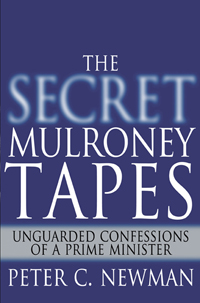
Peter Newman, "The Secret Mulroney Tapes" (2005)
Subtitle: "The Unguarded Confessions of a Prime Minister."
Newman, commentator emeritus on Canadian politics, published an unprecedented and very controversial view into a former Prime Minister's work, as culled from extensive interviews conducted with Brian Mulroney (Canadian Prime Minister from 1984 through 1993).
Newman claimed to have Mulroney's tacit agreement to publish a book of Mulroney's years of leadership, as long as the book did not come out until Mulroney left office. Later, Mulroney apparently rethought this plan, and decided to write his own book. Newman's response was to deliver transcripts of tapes he made in conversation with Mulroney, as well as with aides, along with his own analysis.
The book was primarily controversial because it's unvarnished foul language and Mulroney's clear vindictiveness made Mulroney appear bitter, venal, and uncouth. Mulroney's camp was also frustrated as Newman's book came out a year before Mulroney's autobiography.
Newman's original title for a book on Mulroney's leadership was "Burden of Power." The Secret Mulroney Tapes smacks of being written in a bit of a hurry. There are a few overlaps in the content, and Newman's hyperbole sometimes goes over the top. While he made an effort to treat Mulroney fairly, the clear sense emerges within the book that Newman finds Mulroney less than attractive. Some of his editorial choices may have been intended to reveal how the stress of leadership can take a toll on a good person. Alternatively, the book also could be seen as revealing what type of personality characteristics are required to become leaders.
Following the book's release, Mulroney sued Newman over ownership of the tapes as well as to how profits from the book would be distributed. By summer 2006, Mulroney had withdrawn his suit, but neither party has revealed the terms of settlement.
Allan Gregg interviews Peter Newman on the book.
Brian Mulroney's tongue-in-cheek response.
I've also discussed Newman's When the Gods Changed: The Death of Liberal Canada (2013) in this blog.
Newman, commentator emeritus on Canadian politics, published an unprecedented and very controversial view into a former Prime Minister's work, as culled from extensive interviews conducted with Brian Mulroney (Canadian Prime Minister from 1984 through 1993).
Newman claimed to have Mulroney's tacit agreement to publish a book of Mulroney's years of leadership, as long as the book did not come out until Mulroney left office. Later, Mulroney apparently rethought this plan, and decided to write his own book. Newman's response was to deliver transcripts of tapes he made in conversation with Mulroney, as well as with aides, along with his own analysis.
The book was primarily controversial because it's unvarnished foul language and Mulroney's clear vindictiveness made Mulroney appear bitter, venal, and uncouth. Mulroney's camp was also frustrated as Newman's book came out a year before Mulroney's autobiography.
Newman's original title for a book on Mulroney's leadership was "Burden of Power." The Secret Mulroney Tapes smacks of being written in a bit of a hurry. There are a few overlaps in the content, and Newman's hyperbole sometimes goes over the top. While he made an effort to treat Mulroney fairly, the clear sense emerges within the book that Newman finds Mulroney less than attractive. Some of his editorial choices may have been intended to reveal how the stress of leadership can take a toll on a good person. Alternatively, the book also could be seen as revealing what type of personality characteristics are required to become leaders.
Following the book's release, Mulroney sued Newman over ownership of the tapes as well as to how profits from the book would be distributed. By summer 2006, Mulroney had withdrawn his suit, but neither party has revealed the terms of settlement.
Allan Gregg interviews Peter Newman on the book.
Brian Mulroney's tongue-in-cheek response.
I've also discussed Newman's When the Gods Changed: The Death of Liberal Canada (2013) in this blog.
Wednesday, 23 July 2014
J. D'Agata, J. Fingal, "The Lifespan of a Fact" (2012)
Fascinating reading. An 'essayist' more than willing to take liberties with facts about the context of a teenager's suicide in Las Vegas, and a fact-checker hired to review his work battle over the nature of truth-telling and journalistic practice.
Even the layout of this book is intriguing, which allows the reader to follow the original piece, as submitted, with the conversations between the fact-checker, author, and editor.
Labels:
book reviews,
Historiography,
media criticism,
social history
Saturday, 19 April 2014
Jeff Greenfield, "Then Everything Changed" (2010)
Sub-titled: "Stunning Alternate Histories of American Politics: JFK, RFK, Carter, Ford, Reagan."
What distinguishes this book from many allohistorical texts - particularly those considered with political popular culture (that is a term I can apply to the Kennedy assassinations, no?) - is that the author is genuinely a political insider. He had familiarity with many of the people he writes about, including the Kennedys. He also brings years of experience as a political analyst and commentator. This knowledge has led him to write a book that is more daunting than the average 'science fiction'/casual reader might desire. It is, however, the key to Greenfield's approach.
Much of what Greenfield considers in weighing historical alternatives is based on tweaking a single event, and then looking at the weight of likely political response, particularly in how the negotiation of alliances, strategizing, and campaigning would play itself out in the new circumstances provided by the author's re-imagining. So, for instance, RFK's near-assassination is obviously important, but where the true 'grit' of Greenfield's imagination gains its importance is how he conceives of RFK's electoral chances given the likely messaging his team would have pursued, who the Republicans might have selected as their candidate in response to the changed circumstances, and how their competing messages might have played out in the various electoral colleges. Frankly, fascinating, daunting, exhausting reading that offers much for historians and political junkies alike.
I admit to knowing nothing about Greenfield before I read this book. I picked it up based on an interest in political allohistory.
What distinguishes this book from many allohistorical texts - particularly those considered with political popular culture (that is a term I can apply to the Kennedy assassinations, no?) - is that the author is genuinely a political insider. He had familiarity with many of the people he writes about, including the Kennedys. He also brings years of experience as a political analyst and commentator. This knowledge has led him to write a book that is more daunting than the average 'science fiction'/casual reader might desire. It is, however, the key to Greenfield's approach.
Much of what Greenfield considers in weighing historical alternatives is based on tweaking a single event, and then looking at the weight of likely political response, particularly in how the negotiation of alliances, strategizing, and campaigning would play itself out in the new circumstances provided by the author's re-imagining. So, for instance, RFK's near-assassination is obviously important, but where the true 'grit' of Greenfield's imagination gains its importance is how he conceives of RFK's electoral chances given the likely messaging his team would have pursued, who the Republicans might have selected as their candidate in response to the changed circumstances, and how their competing messages might have played out in the various electoral colleges. Frankly, fascinating, daunting, exhausting reading that offers much for historians and political junkies alike.
I admit to knowing nothing about Greenfield before I read this book. I picked it up based on an interest in political allohistory.
Wednesday, 2 April 2014
Francis Spufford, "Red Plenty" (2012)
You can read an extract from the book here.
Spufford has created a fairly fun website to support his book.
Tuesday, 18 March 2014
Deborah Lipstadt, "The Eichmann Trial" (2011)
In progress.
The New Republic offers an excellent assessment of the book.
You can also watch/listen to Lipstadt discuss the book, in a half-hour talk at University of South Florida, delivered in February 2012.
Additionally, see my discussion of Lipstadt's Denying the Holocaust: The Growing Assault on Truth and Memory (1993).
The New Republic offers an excellent assessment of the book.
You can also watch/listen to Lipstadt discuss the book, in a half-hour talk at University of South Florida, delivered in February 2012.
Additionally, see my discussion of Lipstadt's Denying the Holocaust: The Growing Assault on Truth and Memory (1993).
Thursday, 30 January 2014
James Fitzgerald, "What Disturbs Our Blood" (2010)
The genealogical tale as Shakespearean-scale tragic suspense novel. A truly alternative history with certain commonalities to Gordon Sheppard's "Ha!" Suicide, psychotherapy, the wisdom of the medical establishment meets the inscrutable dark dogs of depression.
Fitzgerald's family history is intimately connected to medical innovation in Canada. His predecessors were instrumental in developing public vaccination programs and advancing allergy research. His family tree also exhibits an alarming prevalence of mental health problems, particularly depression and suicidal ideation. Fitzgerald narrates his investigation of his own mental health issues, as he attempts to locate himself within his family history, and his predecessors' dogmatic commitment to work, attempts to manage familial dysfunction, and coping with anxiety and insecurity.
Tuesday, 26 November 2013
Thomas King, "The Inconvenient Indian: A Curious Account of Native People in North America" (2013)
At times humorous, at times bitter, King's exploration of the history of indigenous North American's struggle to co-exist with European settlers up to the 21st-century is concurrently pleasurable and disturbing read.
More to follow.
More to follow.
Friday, 4 October 2013
Brereton Greenhous, "The Making of Billy Bishop" (2002)
Greenhous has written a fascinating analysis of Bishop's war record, comparing the Canadian First World War aviator's claims about his battle successes against available Allied and German war records, personal correspondence by Bishop, his friends, and his military peers and superiors, to propose a significant falsification has become rooted into Canadian history.
Greenhous presents a compelling case to indicate that much of Bishop's record of kills may have been fabricated. To his credit, Greenhous establishes the compelling reasons which may have led many within the military to seek to create a 'hero', leading to the inflation or exaggeration of Bishop's exploits, as a propagandistic necessity. He supports this analysis with a careful and thorough assessment of documents that might be used to understand or clarify Bishop's claims. His work reveals many holes in Bishop's stories, as well as those offered by superiors to explain their recommendations for Bishop to be provided with honours, as well as occasional falsehoods.
I highly-recommended this book that will leave most readers shaking their heads at how our understanding of the history of almost century-old events can be so fundamentally shaken.
Greenhous presents a compelling case to indicate that much of Bishop's record of kills may have been fabricated. To his credit, Greenhous establishes the compelling reasons which may have led many within the military to seek to create a 'hero', leading to the inflation or exaggeration of Bishop's exploits, as a propagandistic necessity. He supports this analysis with a careful and thorough assessment of documents that might be used to understand or clarify Bishop's claims. His work reveals many holes in Bishop's stories, as well as those offered by superiors to explain their recommendations for Bishop to be provided with honours, as well as occasional falsehoods.
I highly-recommended this book that will leave most readers shaking their heads at how our understanding of the history of almost century-old events can be so fundamentally shaken.
Labels:
biography,
Canadian history,
Historiography,
military,
World War I
Thursday, 4 July 2013
Geoffrey Reaume, Remembrance of Patients Past (2000, rep. 2009)
The sub-title for this book is: "Patient Life at the Toronto Hospital for the Insane, 1870-1940."
I've finished the book, but have yet to write a summary. Sorry!
York University (Toronto, ON) published an article discussing the book.
I've finished the book, but have yet to write a summary. Sorry!
York University (Toronto, ON) published an article discussing the book.
Tuesday, 11 June 2013
Guy St-Denis, "Tecumseh's Bones" (2010)
St-Denis writes a fascinating genealogy of speculation and claims regarding the final resting place of the remains of Shawnee chief Tecumseh, whose contributions to Canada's defence during the War of 1812 was a critical contribution. He died in 1813, during the Battle of the Thames. His archival scholarship is wide-ranging and apparently meticulous.
Tecumseh's Bones does suffer from some weaknesses, however, that are a little surprising within a book from an academic press. Noting them is invaluable for me, however, as they relate mostly to lessons for my own history writing. (St-Denis has attempted a study similar to one I am undertaking on another topic.)
1) The book does not place its discussion within any sort of academic framework or context, either regarding historiographic practice, public history, etc. Without any consideration of what the state of academic research regarding Tecumseh and his final resting place was at the point this book was written, it is difficult to understand what compelled St-Denis to undertake his effort, or to gauge his success in contributing something new to our understanding of this issue. Additionally, I believe St-Denis has 'missed the train' when he opted to not consider how his research might compel us to think differently about myth-making's relationship to public history, whether within southern Ontario, Canada, or globally. This concern is certainly popular, the relevant materials are not particularly onerous to read, and if the concern was that these considerations would not have been of interest to a wider audience, they could have easily been hived off into a separate chapter.
2) The sheer density of information - the detailed tracking of the to'ing and fro'ing of correspondence, conversations, and letters to the editor - quickly becomes mentally exhausting. Without some effort to 'pack' his work within some kind of organizational framework, with signposts provided to help orient the reader, this book quickly gains the feel of a laundry list of documents, references, ideas, and claims. There is certainly nothing wrong with that kind of information processing. I would hope, however, that the author would be able to provide the reader with the benefit of his long-term engagement with the material, and to provide larger proposals of meaning-making for the reader. For instance, what is significant about some new proposal for where Tecumseh's bones laid? If discussion of a new claim is the focus of a chapter, how does that information fundamentally change what we already know and believe? If the information is essentially the shuffling of details within an already detailed spectrum of information, perhaps the degree of detail provided was not necessary.
3) The book is short. That is not a problem, but I wonder if perhaps this was closer to an essay that was exaggerated into a book. The provision of a lengthy chronology (representing in a more clearly organized fashion what was included in the body of the book) suggests 'padding'. On the other hand, provision of some academic context and weight would have helped to expand the importance the book could play in our understanding of history writing, as well as the events and issues St-Denis discusses.
Tecumseh's Bones does suffer from some weaknesses, however, that are a little surprising within a book from an academic press. Noting them is invaluable for me, however, as they relate mostly to lessons for my own history writing. (St-Denis has attempted a study similar to one I am undertaking on another topic.)
1) The book does not place its discussion within any sort of academic framework or context, either regarding historiographic practice, public history, etc. Without any consideration of what the state of academic research regarding Tecumseh and his final resting place was at the point this book was written, it is difficult to understand what compelled St-Denis to undertake his effort, or to gauge his success in contributing something new to our understanding of this issue. Additionally, I believe St-Denis has 'missed the train' when he opted to not consider how his research might compel us to think differently about myth-making's relationship to public history, whether within southern Ontario, Canada, or globally. This concern is certainly popular, the relevant materials are not particularly onerous to read, and if the concern was that these considerations would not have been of interest to a wider audience, they could have easily been hived off into a separate chapter.
2) The sheer density of information - the detailed tracking of the to'ing and fro'ing of correspondence, conversations, and letters to the editor - quickly becomes mentally exhausting. Without some effort to 'pack' his work within some kind of organizational framework, with signposts provided to help orient the reader, this book quickly gains the feel of a laundry list of documents, references, ideas, and claims. There is certainly nothing wrong with that kind of information processing. I would hope, however, that the author would be able to provide the reader with the benefit of his long-term engagement with the material, and to provide larger proposals of meaning-making for the reader. For instance, what is significant about some new proposal for where Tecumseh's bones laid? If discussion of a new claim is the focus of a chapter, how does that information fundamentally change what we already know and believe? If the information is essentially the shuffling of details within an already detailed spectrum of information, perhaps the degree of detail provided was not necessary.
3) The book is short. That is not a problem, but I wonder if perhaps this was closer to an essay that was exaggerated into a book. The provision of a lengthy chronology (representing in a more clearly organized fashion what was included in the body of the book) suggests 'padding'. On the other hand, provision of some academic context and weight would have helped to expand the importance the book could play in our understanding of history writing, as well as the events and issues St-Denis discusses.
Labels:
book reviews,
Canadian history,
Historiography,
military,
U.S.A. history
Tuesday, 20 November 2012
Deborah Lipstadt, "Denying the Holocaust" (1993)
The subtitle of this book is "The Growing Assault on Truth and Memory." My summary of it is clunky, to say the least. My apologies.
For those interested in the topic of Holocaust denial, this book is already likely familiar; if not its content, for author David Irving claiming that Lipstadt's discussion of his ideas was libellous. More on this case can be found at Emory University's Holocaust Denial on Trial site.
Lipstadt begins at an interesting point, by looking at First World War 'revisionists', trained historians who sought to diminish the idea of German guilt and share the problem out among all of the countries who participated in the war. Some also sought to pin a larger part of the blame on the Allies, particularly for their post-war conduct that almost guaranteed another war.
She also chronicles early efforts - primarily by Frenchmen (such as Rassinier) - to diminish or challenge the severity of the Holocaust. As she notes, early challengers did not attempt to deny the reality of the Holocaust outright, but instead to play down numbers, intentions, and how widespread a phenomenon the institutionalized slaughter was. Additionally, she notes that early claimants also attempted, in what was often a parallel effort, but that was also connected to Americans who were bitter about the US having joined the war, describing Allied practices as being just as bad as those carried out by Nazi Germany.
She also considers the role played by historians within the German historikerstreit; arguments waged over the 1980s regarding the degree of German guilt that should be carried for World War II, and how exceptional the development of national socialism and its values were within Germany.
Lipstadt develops – gradually and yet inexorably – two primary theses: firstly, that over 60 years, Holocaust deniers and their ideological predecessors undertook their efforts as part of a desire to rehabilitate fascism and advance anti-semitism, and secondly, that over the same period Holocaust deniers have worked to have their claims accepted not as hatred or historical falsification, but to generate sympathy for the idea that they are not being accorded access to free speech and open debate, and that their claims are not being assessed with healthy academic objectivity.
Lipstadt reveals how deniers, particularly leading lights such as Harwood, Butz, Ernst Zundel, and the Institute for Historical Research, as well as those functionalized by them, such as Fred Leuchter, have actively trod upon, rejected, and worked directly in the face of the foundational requirements of credible historical scholarship, such as objectivity, careful weighing of evidence, and careful attention to context.
An equally valuable contribution is Lipstadt’s close analysis of how various American universities dealt with attempt during the early 1990s for a revisionist organization to print several ads questioning the reality of the Holocaust. It is through these efforts that we see the flawed logic of citing First Amendment constitutional rights as a rationale for allowing promulgation of anti-semitic faux scholarship regarding the Holocaust. Nonetheless, it is this exact concern that led many institutions and university campus newspaper to allow the ads to be published, even often with the idea that the ads were patently anti-semitic and false, but that they needed to be seen and discussed. As Lipstadt points out, however, the First Amendment does not force anyone to allow someone space to advance views, it simply guarantees that the government’s ability to stop someone from attempting to advance their views is limited. Similarly, she offers that willingness to dispute the reality of the Holocaust with deniers – whose track record is not one of abiding by professional popular rules of conduct when it comes to historical research and debate – gives their stance more credibility and attention than it deserves. Instead of debating deniers, Lipstadt carefully assesses the methodology and motivations of the deniers. Removing their ability to set the terms of debate, she wisely forces deniers to defend their record of scholarship, not to attempt to prove the obvious.
Notes for self:
- Willis Carto was a member of John Birch Society in the late 1940s/early 1950s. This would be about the same time that Ben Klassen was a member of the same organization. (144)
- Lipstadt claims that the ADL sees Carto as the “most important and powerful professional anti-Semite in the United States” (145)
- Francis Parkey Yockey’s Imperium: The Philosophy of History and Politics (1948) called for a new 'imperium' of Western 'Aryan' nations that would rule using the values of Hitlerian National Socialism (146/7)
- Yockey described as “Culture-Distorters” those who mixed races, were egalitarians or believers in human rights, participatory democracy, and Jews. (148)
- In 1975, the Liberty Letter, published by Carto’s Liberty Lobby, was folded into the Spotlight, a tabloid newspaper published by the same organization. The Spotlight contained a wide variety of content, such as Bible analysis, conspiracy theorizing regarding the likes of the Center for Foreign Relations and the Tri-Lateral Commission, as well as advice on avoiding taxes and fighting the IRS. (150)
- Other conspiracies are investigated as a means of attempting to legitimize and popularize the idea that our perspective on historical events can result from falsification or miseducation. (154/5)
- Speaking of the turn to academicizing Holocaust denial, Lipstadt writes, “They attempt to project the appearance of being committed to the very values that they in truth adamantly oppose: reason, critical rules of evidence, and historical distinction.” (217)
For more on Lipstadt, see my discussion of her 2011 book, The Eichmann Trial.
Labels:
book reviews,
German history,
Historiography,
racism,
religion,
World War II
Monday, 20 June 2011
David Aaronovitch, "Voodoo Histories: The Role of the Conspiracy Theory in Shaping Modern History" (2009)
Christopher Hart nicely summarizes the message of the book in the 3 May 2009, (London, U.K.) Sunday Times.
"Voodoo Histories is... much more than a prolonged sneer at human folly, ignoble fun though that always is. It is also a serious inquiry into why conspiracy theories appeal, and Aaronovitch’s theories are consistently reasonable, persuasive and humane. The complexity of our society is clearly a factor, and the frigid non-humanity of so many of our transactions. Real connections are few and far between, so some people start to invent their own."
The text explores a number of popular 20th-century conspiracy theories, as well as some that are more obscure (or at least obscure outside of the UK). No surprises that significant chapters or portions of chapters are devoted to: the Protocols of the Elders of Zion, Pearl Harbour, the Kennedy assassinations, the death of Marilyn Monroe, speculations around the book Holy Blood, Holy Grail, and 9/11. I was a bit surprised to discover that there was not a chapter dealing with speculations surrounding the first moon landing (or all of them?) being faked.
I would have preferred that Aaronovitch spent a bit more time trying to understand in some more objective sense the reasons for conspiracy theory creation, and the popularity of the practice in 20th-century societies. He does tackle this, but usually as a bit of an aside alongside his explorations of particular conspiracy speculations. My desire for such a chapter, however, may stem more from wanting this book to read like an academic text, rather than a book for a popular audience.
Aaronovitch closes the book with a few key claims regarding conspiracy theories:
1) "[c]onspiracy theories originate and are largely circulated among the educated and middle class" (338)
2) "overarching theories are formulated by the politically defeated and taken up by the socially defeated, deriving 'from the concrete experience of modernity by losers who will not go softly into the night but instead rage against it.' ...If it can be proved that there has been a conspiracy... then their defeat is not the product of their own inherent weakness or unpopularity, let alone their mistakes; it is due to the almost demonic ruthlessness of their enemy." (340)
3) "the possibility that conspiracy theories are history as written by the losers confers a kind of underdog's truth upon them." (342)
4) Conspiracist fantasies are "much more problematic when the theorist is someone who is seen as being repulsive or dangerous and/or whose targets are people like yourself." (346)
5) "That conspiracism is, at bottom, a symptom of paranoia subsequently became an anti-conspiracist cliche, and it's easy to see why. In modern society, paranoia seems omnipresent. (351) ... this impulse to grasp half-baked and damaging but attractive notions of why the world is as it is could be replaced through emotional literacy." (352)
6) Humans are intolerant of ignoring important causes. We invent stories to explain important events, even when they cannot be tested against - or test poorly against - reality. (354)
Subscribe to:
Posts (Atom)