Showing posts with label Quebec. Show all posts

Friday, 25 September 2015

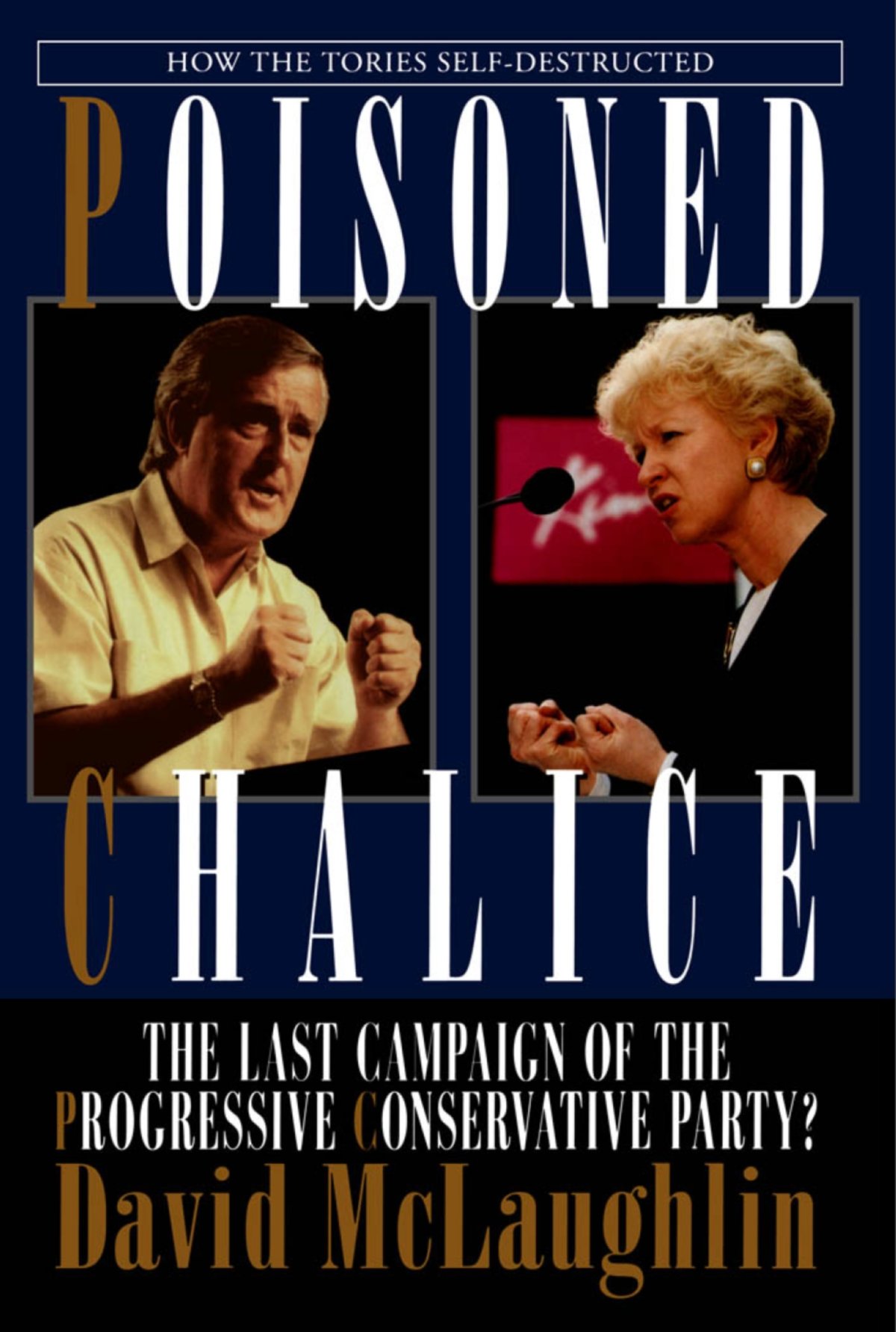
David McLaughlin, "Poisoned Chalice" (1994)

Subtitle: "The Last Campaign of the Progressive Conservative Party?"

McLaughlin wrote a fascinating insider's tale of how the federal Progressive Conservative Party of Canada firstly decided on Kim Campbell as the replacement for outgoing, highly controversial Prime Minister Brian Mulroney, making Campbell Canada's first female Prime Minister, and secondly, how the CPC and Campbell's soon-to-follow election campaign resulted in the utter and complete decimation of the party in the polls.

As most Canadians know, the rhetorical question used as the sub-title for McLaughlin's book was soon answered. Within a decade the Progressive Conservative Party had been essentially colonized and folded into it's former challenger, the Reform/Alliance party, and renamed as the Conservative Party of Canada. By the mid-2000s, the CPC would govern Canada for at least a decade. How things change.

As an insider to the events he narrates, McLaughlin includes fascinating snippets of the day-to-day strangeness out of which the Campbell leadership and election campaigns were built upon. Some of his stories smack of honesty that many of his peers might not have wanted aired publicly, particularly when the PCPC might still have harboured hope to survive into the late 1990s.

Along with providing insights into Campbell's personality, the book also provides useful insights into how federal politics operates in Canada (and how it a federal party can operate poorly). For those interested in Canadian politics, Poisoned Chalice also provides a useful set of crib notes on the emerging lights in Canada's then-'conservative' political community, from Hugh Segal to Jean Charest… figures who would in the 2000s be critical points of reference for Canada's political observers.

Tuesday, 30 December 2014

Justin Trudeau, "Common Ground" (2014)


Notes will follow, eventually.

Pg. 119 - "...the blogger, who had been telling his readers I was destined for failure, gave me a respectful nod on his website for taking the time to answer his questions. This was a small thing... but it reinforced my belief that today's activists and supporters expect and deserve direct engagement through the digital media."

Pg. 152 - With regard to progress on issues related to Canada's relationship to First Nations' peoples: "With the notable exception of Paul Martin, who through the Kelowna Accord created a framework and principles to tackle so many of these problems... significant progress has eluded most of our prime ministers."

Pg. 185 - A "First Nations prayer" that Justin Trudeau read at his brother's funeral:
O Great Spirit whose voice I hear in the winds, and whose breath gives life to all the world, hear me.
I stand before you: one of your many children,
I am small and weak; I need your strength and wisdom.
Let me walk in beauty, and make my eyes ever behold the red and purple sunset.
Make my hands respect the things you have made, my ears sharp to hear your voice.
Make me wise so that I may understand the things you have taught my people.
Let me learn the lessons you have hidden in every leaf and rock.
I seek strength, not to be greater than my brothers, but to fight my greatest enemy, myself.
Make me always ready to come to you with clean hands and straight eyes,
So when life fades, as the fading sunset, my spirit may come to you without shame.


For those interested in this book, you might also read my comments on related titles:
- Peter Newman, When the Gods Changed: The Death of Liberal Canada
- Michael Ignatieff, Fire and Ashes: Success and Failure in Politics
- Lawrence Martin, Harperland
- Brian Topp, How We Almost Gave the Tories the Boot

Tuesday, 14 October 2014

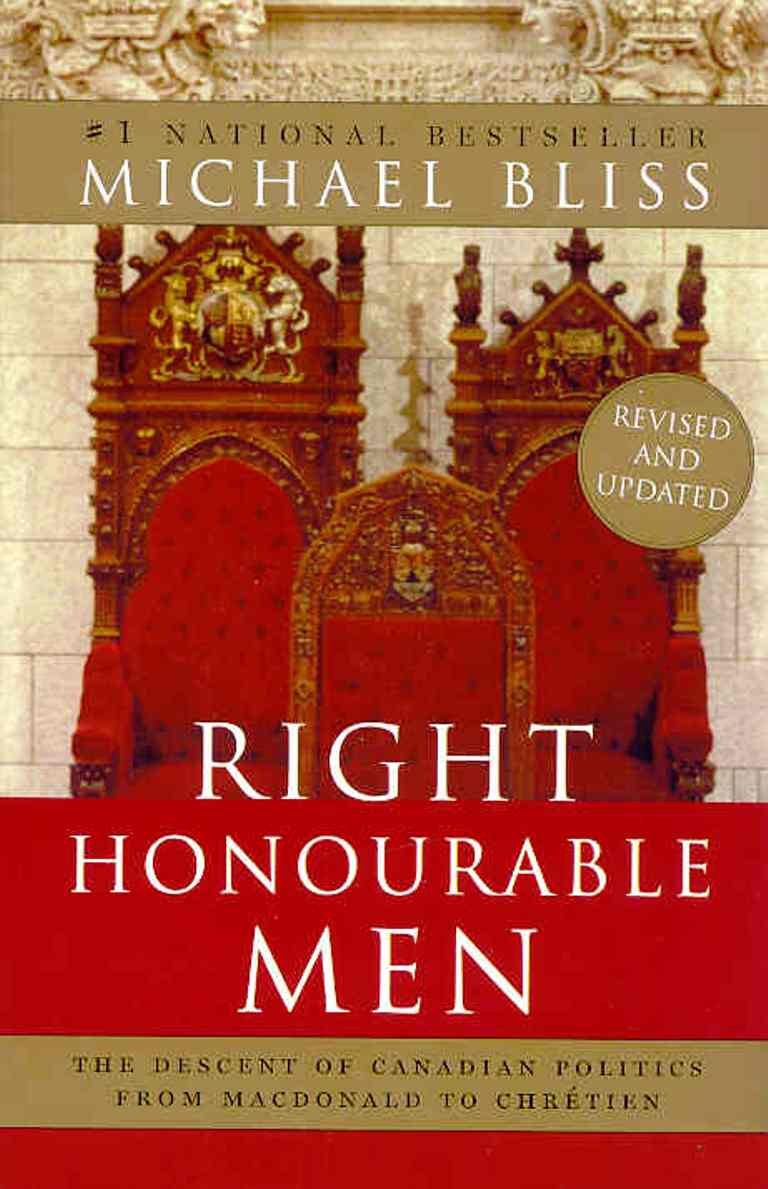
Michael Bliss, "Right Honourable Men" (1996, rev. 2004)

Subtitle: "The Descent of Canadian Politics from Macdonald to Chrétien".

Bliss presents a selective history of the men he regards as the most noteworthy Canadian Prime Ministers. His commentaries primarily reflect on these men's time as political leaders, exploring their campaigns, the decisions they made, and evaluating their successes and failures.

There are few surprises in the book, if you already have a decent grasp of Canada's political history. If not, Bliss writes an eminently readable book. It is more substantive than the average 'curiosity' reader probably wants, and perhaps a bit light for the academic reader. It would be ideal for a junior undergraduate course text.

Read a sample here.

You might also compare my comments on Bliss' book with those I've offered on Bruce Hutchison's Mr. Prime Minister: 1867-1964, a similar book written in 1965.

Thursday, 7 August 2014

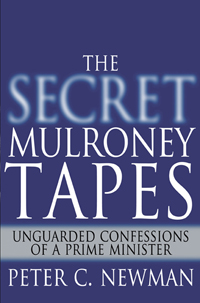
Peter Newman, "The Secret Mulroney Tapes" (2005)

Subtitle: "The Unguarded Confessions of a Prime Minister."

Newman, commentator emeritus on Canadian politics, published an unprecedented and very controversial view into a former Prime Minister's work, as culled from extensive interviews conducted with Brian Mulroney (Canadian Prime Minister from 1984 through 1993).

Newman claimed to have Mulroney's tacit agreement to publish a book of Mulroney's years of leadership, as long as the book did not come out until Mulroney left office. Later, Mulroney apparently rethought this plan, and decided to write his own book. Newman's response was to deliver transcripts of tapes he made in conversation with Mulroney, as well as with aides, along with his own analysis.

The book was primarily controversial because it's unvarnished foul language and Mulroney's clear vindictiveness made Mulroney appear bitter, venal, and uncouth. Mulroney's camp was also frustrated as Newman's book came out a year before Mulroney's autobiography.

Newman's original title for a book on Mulroney's leadership was "Burden of Power." The Secret Mulroney Tapes smacks of being written in a bit of a hurry. There are a few overlaps in the content, and Newman's hyperbole sometimes goes over the top. While he made an effort to treat Mulroney fairly, the clear sense emerges within the book that Newman finds Mulroney less than attractive. Some of his editorial choices may have been intended to reveal how the stress of leadership can take a toll on a good person. Alternatively, the book also could be seen as revealing what type of personality characteristics are required to become leaders.

Following the book's release, Mulroney sued Newman over ownership of the tapes as well as to how profits from the book would be distributed. By summer 2006, Mulroney had withdrawn his suit, but neither party has revealed the terms of settlement.

Allan Gregg interviews Peter Newman on the book.
Brian Mulroney's tongue-in-cheek response.

I've also discussed Newman's When the Gods Changed: The Death of Liberal Canada (2013) in this blog.

Monday, 17 March 2014

Nathan Tidridge, "Canada's Constitutional Monarchy" (2011)

An entertaining, informative, clearly-written assessment of Canada's relationship with the Monarchy.
Admirably thinking beyond the role the British Monarchy has played in Canada, Tidridge (a secondary school teacher no less) offers insights on the role played by French royal and vice-royal figures, as well as British. He indicates an encyclopedic knowledge of cultural and legal aspects of the Monarch, including Royal Tours, issues of protocol and patronage, as well as constitutional regulations. Generally, the book is better as a reference than as a cover-to-cover read, although for those seeking to better grasp the wide and important effects that the Monarchy has in Canada can certainly benefit from the entirety of this short book.

A sample chapter is available online from the publisher, Dundurn Books.

Friday, 9 April 2010

Pierre Vallieres, "Choose!" (1971, trans. 1972)

Having read Vallieres earlier Negres blanc…. I approached Choose! with some trepidation. The first half of Negres blanc… was highly entertaining, with a thought-provoking mix of autobiographical detail and Marxist theory. The second half, however, I recall as a bit overwhelming and indulgent.

Choose is very short… less than 200 pages. Essentially, Vallieres uses Choose! to suggest that the FLQ, which he valourizes in Negres blanc, has lost its ability to rescue the Quebecois, and may in fact serve to complicate, challenge, and dimish the Quebecois’ need for independence. Arranged into three chapters, Vallieres explains what he sees the political, economic, social and cultural situation being in Quebec, then explains why the FLQ cannot positively and meaningful contribute to the deliverance of the Quebecois from these problems. The third part explains how the Parti Quebecois is the only route through which the Quebecois, if they choose to unify behind and support it, holds the ability to meaningful contribute to the capacity of the Quebecois to build their own revolution through independence.

Perhaps even more than he did in Negres blanc…, Vallieres manages to explain the relationship between the Quebecois’ struggle for independence and Marxist theory in an eminently readable way. His thinking is clear, cogent, and convincing.