Showing posts with label European history. Show all posts

Tuesday, 8 December 2015

Oleg Khlevniuk, "Stalin" (2014)

Book finished. Comments not yet written.
Consider this a placeholder.

Sunday, 28 June 2015

Albert Jay Nock, "The Myth of a Guilty Nation" (1922)

Comments to follow soon.
Do note, in the interim, that Nock is writing about the First World War.

I used the digital edition produced and distributed by the (Ludwig von) Mises Institute of Alabama.


QUOTATIONS SELECTED, AND NOTES BY GREGORY KLAGES

Chapter I
"…the Governments of Europe are confronted with the inescapable…: they can either tear up the [Versailles] treaty and replace it by an understanding based on justice, or they can stick to the treaty and by so doing protract indefinitely the dismal succession of wars, revolutions, bankruptcies and commercial dislocations that the treaty inaugurated. That is the situation; and it is a situation in which the people of the United States have an interest to preserve—the primary interest of a creditor, and also the interest of a trader who needs a large and stable market. It is idle to suppose that American business can prosper so long as Europe remains in a condition of instability and insolvency."

Chapter II
"Germany, so the official story ran, not only plotted in secret, but she sprung her plot upon a Europe that was wholly unprepared and unsuspecting…"

Chapter III
"The fact is that Europe was as thoroughly organized for war as it could possibly be. The point to which that organization was carried by England, France and Russia, as compared with Germany and Austria, may to some extent be indicated by statistics. In 1913, Russia carried a military establishment (on a peace footing) of 1,284,000 men; France, by an addition of 183,000 men, proposed to raise her peace-establishment to a total of 741,572. Germany, by an addition of 174,373 men, proposed to raise her total to 821,964; and Austria, by additions of 58,505 already made, brought her total up to 473,643. These are the figures of the British War Office, as furnished to the House of Commons in 1913."

"England’s superiority in battleships alone was 112 per cent in 1901, and her superiority rose to nearly 200 per cent in 1904; in which year England spent £42,431,000 on her navy, and Germany £11,659,000. Taking the comparative statistics of naval expenditure from 1900, in which year England spent £32,055,000 on her navy, and Germany spent £7,472,000, down to 1914 it is absolutely impossible to make the figures show that Germany enforced upon the other nations of Europe an unwilling competition in naval armament."

"England’s army-expenditure for 1914 (pre-war figures) was £28 million; £4 million more than Austria’s. Nor was this a sudden emergency-outlay. Going back as far as 1905, we find that she laid out in that year the same amount, £28 million. In that year, Germany and Austria together spent £48 million on their armies; England, France and Russia together spent £94 million on theirs…"

Chapter IV
"France and Russia had been bound by a military convention ever since 17 August, 1892; England and France had been bound since January, 1906, by a similar pact; and this was subsequently extended to include Belgium."

Chapter VI
"Mr. Lloyd George, for example, is one of the cleverest of politicians. We have already considered his two statements; first, that of 4 August, 1917: What are we fighting for? To defeat the most dangerous conspiracy ever plotted against the liberty of nations; carefully, skilfully, insidiously, clandestinely planned in every detail with ruthless, cynical determination. —and then that of 3 March, 1921: For the Allies, German responsibility for the war is fundamental. It is the basis upon which the structure of the treaty of Versailles has been erected, and if that acknowledgment is repudiated or abandoned, the treaty is destroyed....German responsibility for the war must be treated by the Allies as a chose jugée. A little over two months before Mr. George made this latter utterance, on 23 December, 1920, he said this: The more one reads memoirs and books written in the various countries of what happened before the first of August, 1914, the more one realizes that no one at the head of affairs quite meant war at that stage. It was something into which they glided, or rather staggered and stumbled, perhaps through folly; and a discussion, I have no doubt, would have averted it."

"IF the theory upon which the treaty of Versailles is based, the theory of a single guilty nation, were true, there would be no trouble about saying what the war was fought for. The Allied belligerents would have a simple, straight story to tell; they could describe their aims and intentions clearly in a few words that any one could understand, and their story would be reasonably consistent and not vary greatly from year to year. It would be practically the same story in 1918 as in 1915 or at any time between. In America, indeed, the story did not greatly vary up to the spring of 1917, for the reason that this country was pretty much in the dark about European international relations."

"In Europe and in England, however, the case was different. International relations were better understood by those who were closer to them than we were; more questions were raised and more demands made."

"...the Allies, they were confronted with the politician’s traditional difficulty. They had to say something plausible and satisfactory, which yet must be something that effectively hid the truth of the situation."

"...the official and semi-official statements of the causes of the war and of the war-aims of the Allies are a most curious hotchpotch…"

Chapter VIII
"It was on the eastern frontier, we perceive, therefore—not on the western, where Belgium might have been invaded by France—that all the available Belgian military force was concentrated. Hence, to pretend any longer that the Belgian Government was surprised by the action of Germany, or unprepared to meet it; to picture Germany and Belgium as cat and mouse, to understand the position of Belgium otherwise than that she was one of four solid allies under definite agreement worked out in complete practical detail, is sheer absurdity."

Chapter XVII
"Lloyd George is right in saying that no one really wanted war. What every one wanted, and what every one was trying with might and main to do, was to cook the omelette of economic imperialism without breaking any eggs."

Chapter XVIII
"10 March of the following year [1914], Mr. Asquith, replying to a question in the Commons from Lord Hugh Cecil, denied that England was under an “obligation arising owing to an assurance given by the Ministry in the course of diplomatic negotiations, to send a very large armed force out of this country to operate in Europe.” On 24 March, he made similar denials in reply to questions from Sir W. Byles and Mr. King. On 14 April, Mr. Runciman, in a speech at Birkenhead, denied “in the most categorical way” the existence of a secret understanding with any foreign Power! On 3 May, the Secretary for the Colonies, Mr. Harcourt, declared publicly that he “could conceive no circumstances in which Continental operations would not be a crime against the people of this country.” On 28 June, the under-Secretary for Foreign Affairs, Mr. Acland, declared publicly that “in no European question were we concerned to interfere with a big army.” On 1 July, Lord Loreburn, Lord Chancellor from 1906 to 1912, said “that any British Government would be so guilty towards our country as to take up arms in a foreign quarrel is more than I can believe.” On 28 April, 1914, and again on 11 June, Sir E. Grey confirmed, in the House of Commons, Mr. Asquith's assertion, made 10 and 24 March, 1913, of British freedom from engagements with Continental Powers."

Sunday, 7 June 2015

Peter Longerich, "Goebbels: A Biography" (2015)

Just finished. Comments to follow soon.

Two useful reviews:
- Nigel Jones, "Ménage-à-trois with Hitler: the Goebbels’ marriage was a bit crowded," Spectator (UK), 9 May 2015.
- James J. Sheehan, New York Times, 13 May 2015.

Some noteworthy excerpts:
Prologue
In this historical biography, first and foremost concerned with the question of the part played by Goebbels in the leadership of the Third Reich, insights gained into the deficiencies of his personality can help to develop wider perspectives. A particular purpose of this biography is to open the way to an analysis of the construction and modus operandi of the Nazi propaganda apparatus.

The connections, often quite subtle, among his various responsibilities become apparent only through a description of his life.

“Faith Moves Mountains”: Political Beginnings in Berlin
He developed a friendship with the graphic artist Hans Herbert Schweitzer, who designed National Socialist posters under the pseudonym Mjölnir.

“Dare to Live Dangerously!”: Goebbels’s Radicalism and Hitler’s Policy of “Legality”
December 1930
After consulting “Hitler and a large number of experts,” Goebbels came up with a definition of socialism that immediately met with Hitler’s “enthusiastic” approval: “placing the concept of the people above that of the individual.”

CHAPTER 7:
A few weeks later it emerged, either as a result of police inquiries or of a leak by former Party employees, that the assassination attempt had clearly been faked by Goebbels himself—and quite crudely at that. The “explosives” consisted of some jumping jacks and a little gunpowder. That Goebbels wrote up the “assassination attempt” in his diary as a genuine threat shows his relationship to the truth: Having acted out a charade for public consumption, he then recorded it as a fact in his diary.

“Dare to Live Dangerously!”: Goebbels’s Radicalism and Hitler’s Policy of “Legality”
1931.
On March 13, he records in the diary, “someone tried to kill me with a bomb.”

“Dare to Live Dangerously!”: Goebbels’s Radicalism and Hitler’s Policy of “Legality”
In all these disputes it became clear how small Goebbels’s power base within the Party actually was during this phase of the NSDAP’s rapid expansion into a mass movement. In Berlin he had to appear as a radical hothead in order to keep the SA on board, but this in turn created tensions around his attitude to the “legal” course chosen by the Party leader, upon whose support he was so highly dependent.

CHAPTER 7:
Kurt Tucholsky poem of 1928: “Due to bad weather, the revolution will be held indoors.”

“We’re Here to Stay!”: Taking Power
...the head office of the fascist leisure organization Dopolavoro, which impressed Goebbels very much: “We must do something like that. The people at leisure. Sport…"

CHAPTER 13:
The great majority of the public had grown used to manifesting their support for the regime—as was expected of them—in their everyday behavior. This happened, for example, through the officially encouraged “Heil Hitler!” greeting; the wearing of uniforms by a large part of the population, or at least the wearing of insignia to signal their support for the regime; the public display of flags at home; attendance at Party events and mass rallies; donations to street collectors; listening en masse to broadcasts in public squares; the gradual exclusion of Jews, labeled enemies of the state, from normal daily life; and many other ways.

“Taking Firm Control of the Inner Discipline of a People”: Propaganda and Manipulation of the Public Sphere
...let journalists know what areas were out of bounds for critical, or even just independent, reporting. There should never, for example (stated Point 1 on the list of guidelines), be any broad-brush description of “official ceremonial occasions”: This took Goebbels back to one of his favorite themes, the avoidance of “pomp” in the Third Reich. Another rule was that any controversial discussion of proposed legislation was incompatible with the idea of a “Führer state.” Likewise, to discuss the form of government was “intolerable.” When reporting political trials it was undesirable to “discuss in detail false assertions that are the subject of the trial.” One of Goebbels’s guidelines stated succinctly: “Today, the church question has been settled.” With regard to ecclesiastical affairs, in order to avoid confusion as well as adverse reactions from foreign propaganda, only reports from the German News Service should be used. And as far as the much-lamented monotony of the German press was concerned, Goebbels forbade any discussion of press uniformity outright.

...he characterized the attitude now taken by German journalists toward the Nazi regime as “neue Sachlichkeit.”

Goebbels: "We have removed the journalist from his humiliating and demeaning dependence on parties and business interests, thereby placing him in a position of honorable and loyal dependence on the state. For we see the freedom of Germans not in the opportunity to do or not do what one wants, but in the opportunity to integrate freely and responsibly into the higher laws and higher moral commandments of a state.”

...in his cultural address the dictator not only condemned the “vandals” of modern art but also spoke out against “backward-looking people” and their “old-world Teutonic art”—those of Rosenberg’s persuasion, in other words.

These examples show that in 1934–35 Goebbels was by no means the unconstrained sole master and expert helmsman of Germany’s culture and media he liked to claim he was: He had to share control and management
with others.

Goebbels called on the Gestapo to send six members of the cabaret casts who in the meantime had been arrested to a concentration camp for an initial stint of six weeks.

...the trial of five of the performers from the two theaters ended in October 1936 with an acquittal in all cases.

...directive prohibiting all authorities, organizations, and associations from giving the press any instructions or orders. Likewise, no one was entitled to exercise criticism of the press.

The law also introduced the classification of films by the state board of censors: The board was authorized to categorize films as “of political value to the state,” “artistic,” “educational,” or “culturally valuable,” thus exempting the films in question from the entertainment tax. Additionally, the Cinema Law provided for a “Reich film dramaturge” who—independently of the board of censors—was entitled to oversee all film projects at the planning and screenplay stages.

December 15, 1935, Goebbels gave another set-piece lecture at the Kroll Opera to “film creators.” Here he accepted in principle the justification for “entertainment films” but was critical of their “stupidity” and the “assembly- line production of those who followed the same formula.” Almost three years after the “seizure of power,” this was a fairly damning indictment of his own impact on filmmaking,

Among the amenities enjoyed there was a television set, installed in February 1935; the propaganda minister loved watching it with his family, although broadcasting was limited to a few hours and was still at the test stage.

“Never Tire!”: Foreign Policy Successes and Anti-Jewish Policies
In his capacity as head of propaganda for the Reich, Goebbels ordered that “between about 19 and 21 hours today, Tuesday, January 15, the population will spontaneously [sic] attend mass rallies to celebrate victory in the Saar.”

In his speech, broadcast to the nation, he described Christmas as a Christian festival but at the same time claimed it for National Socialism, which in the form of the “national community” had given the command to love your neighbor a “new and unexpected content” in the form of the national community.

“The Tougher the Better!”: The Olympic Year, 1936
It was not until the next day that Hitler and Göring informed him of the decision made the previous night, to which Goebbels pointedly attributed only minor significance in his diary entry: “So we’re getting a bit involved in Spain. Planes etc. Not obvious. Who knows what the point is.”

...placed a wreath on Horst Wessel’s grave

“The Most Important Factors in Our Modern Cultural Life”: Consolidating Nazi Cultural Policies
...lack of support for his “völkisch-Germanic” ambitions, Rosenberg’s mission to “spiritually educate” the whole Nazi movement carried little weight.

...on Goebbels’s initiative artists shown in the Munich “Decadence Exhibition” were branded as “degenerate” even though they were teaching at state art schools or were members of the Prussian Academy of Fine Art.

...in 1937 the Reich Chamber of Fine Art still had 156 Jewish members, mostly art dealers and art publicists.

Even by May 1943, he found himself stating with consternation that “the Reich Culture Chamber is not yet as de-jewified as I intended”; “a whole lot of quarter-Jews, even a few half-Jews, and numbers of Jewish-related are hanging around there.”

Hitler was “extremely” pleased with some photos showing Helga on the Obersalzberg: “Says that if Helga was 20 years older and he was 20 years younger, she would be the wife for him.”

“Don’t Look Around, Keep Marching On!”: The Firebrand as Peacemaker
...the appearance of the three million — a majority of Berlin’s population — was not exactly a display of spontaneous popular enthusiasm. On September 26, for example, there was an article in the Völkischer Beobachter peremptorily commanding “the working Berlin population” to attend the rally en masse. The guarantee of “en masse” participation was achieved—to mention only one detail of the nearly perfect planning for this event—by the German Labor Front. After work ended early, they made the staff fall in and marched them en masse to their allocated sector of the approach roads. It was not easy to escape: If you felt ill, for example, you had to request special permission to leave from the works organizer.

Goebbels: "If I don’t do everything myself, I’m pleased when things go wrong.”

Hitler’s interest in this conversation was far-reaching, as he confided to Goebbels: “We need a prince of the church if we want to break away from Rome. And we must do so. There must be no authority outside Germany
able to give orders to Germans.”

Goebbels: "What I’m doing is trying to incite you. Against any kind of sentimentality. The watchword is not the law but harassment. The Jews have got to get out of Berlin.”

“Maturity Is Only Achieved Through Suffering!”: Preparations for War—from the Munich Agreement to the Attack on Poland
Goebbels arranged with the War Ministry in 1937 that, should war break out, units from his ministry would be put in uniform and “embedded” with the Wehrmacht.

“Our Banners Lead Us On to Victory!”: Between the War in the West and the War in the East
...the dictator made it quite clear to his propaganda minister: “No invasion planned,” although propaganda should encourage fears of invasion by dropping hints “in order to confuse the enemy.”

Goebbels, who after his conversations with Hitler always conscientiously recorded all the Führer’s comments about his foreign policy and military plans, does not report anything in his 1940 diaries about concrete plans for an attack on the Soviet Union. Rather, Goebbels’s entries in his diary for August 1940 show that Hitler intentionally left him in the dark about his war plans.

“Our Banners Lead Us On to Victory!”: Between the War in the West and the War in the East
Some prominent films produced under the Nazis - The Rothschilds, Jud Süss, The Eternal Jew, Bismarck, Ohm Krüger (on which Goebbels himself worked), and Carl Peters, Goodbye, Franziska and Request Concert, I Accuse, Stukas, U-Boat Going Westwards, and The Lützow Squadron

“A Great, a Wonderful Time, in Which a New Reich Will Be Born”: The Attack on the Soviet Union
On August 14 an inter-ministerial conference took place in the Propaganda Ministry at which, among other things, this plan to visibly identify the Jews was discussed.

CHAPTER 23:
Rühmann film The Gasman
Meine Frau Theresa

March 6 Goebbels read a “detailed memorandum prepared by the SD and the police about the final solution of the Jewish question.

Der große König

“We Can See in Our Mind’s Eye a Happy People”: Offensives and Setbacks
Goebbels: "I have no desire to have a 22-year-old eastern Jew—the saboteurs of the anti-Soviet exhibition included types like that—putting a bullet in my guts. I prefer ten Jews in a concentration camp or under the earth than having one in freedom.”

His continuing attempts to eliminate any remnant of the German people’s admiration and respect for Russia and Soviet communism can also be seen as an obsessive attempt to kill off the last germ of this dangerous sickness in himself.

CHAPTER 25:
Hitler’s increasing physical frailty was a growing problem in terms of the deployment of the Führer for propaganda purposes. Thus Goebbels was obliged to note that Hitler “is very unwilling to appear in the weekly newsreels” and kept removing clips in which he was shown

In December 1942 a growing number of reports about the mass murder of Jews in German-occupied Europe began to appear in the international media. On December 17 the Allies published a statement about the systematic murder of the Jews by the Nazi regime;

For the Führer state to be maintained in the absence of the Führer was going to require extraordinary efforts.

Hitler’s public silence had created a vacuum, which the propaganda minister was now entering with a vengeance.

During the evening many people were saying that this meeting represented a sort of quiet coup. [...] Total war is now no longer a matter for a few perceptive men; it’s now supported by the whole nation.

...both were agreed on “what would threaten us all if we became weak in this war”; they had committed themselves so far in the “Jewish question” that “there is no possible chance of escape. And that’s a good thing.” For “experience shows that a movement and a nation which has burned its bridges fights with far fewer reservations than one that still has the possibility of withdrawal.”

“The Masses Have Become Somewhat Skeptical or...Are in the Grip of a Permanent State of Hopelessness”: Crisis as a Permanent State
When they devised the plan for the total destruction of the German people, they were signing their own death warrant.

Horthy’s soft attitude had strengthened Hitler in his view that “the junk of small states which still exists in Europe must be liquidated as quickly as possible.”

The deep depression among the population that Goebbels detected at the end of May had to a significant extent been caused by the excessive use of anti-Semitism.

“I Have No Idea What the Führer’s Going to Do in the End”: The Search for a Way Out
During 1944, apart from his addresses on January 30 and after the July 20 assassination attempt, Hitler made no speeches that were broadcast and did not speak at any major events.

Goebbels’s summary of Hitler’s comments. “Anyone who says A must say B, and now that the Hungarians have begun implementing our Jewish policy they can no longer back out of it. After a certain point the Jewis

While hitherto German propaganda had put forward the thesis that “the Jews,” either as plutocrats or as communists, were the “glue” holding the enemy coalition together (an assertion that Goebbels frequently made both in public and in private), now, in view of the threat of military defeat, it was necessary to emphasize the contradictions within the enemy camp.

...actual instances of vigilantism committed against pilots, he hoped to make an impact in the enemy countries.

“Virtually a Wartime Dictatorship on the Home Front”: Between an Apocalyptic Mood and Total War
There were further trials in the People’s Court lasting until April 1945 with more than 150 people accused of participating in the conspiracy, of whom over a hundred were sentenced to death and hanged.

“But When Will There Be Some Action?”: Downfall
He was also unsuccessful in gaining acceptance for his idea of a Military Auxiliaries Law subjecting all women under thirty to military conscription and thereby recruiting two hundred thousand women as “military auxiliaries.” It was blocked by Bormann and Himmler.

Conclusion
...while the propaganda that was now preparing the German population for a confrontation with Poland justified the use of military means, it also led to this war, which allegedly had been forced on Germany, being seen as an exceptional situation. The result was that after its rapid conclusion the vast majority of the population wanted to return to peacetime conditions.

Friday, 15 May 2015

Bettina Stangneth, "Eichmann Before Jerusalem" (2014)

Subtitle: "The Unexamined Life of a Mass Murderer."

Stangneth offers a close, meticulous, and exhaustive analysis of texts produced by Adolf Eichmann between the end of World War II and the early 1960s, when he was captured in Argentina and taken to Israel to stand trial for war crimes. Her book is not for the casual reader. For those with some knowledge of the period, of World War II, of the Holocaust, or of the post-war hunt for Nazis, Stangneth has produced a wealth of knowledge.

Eichmann before Jerusalem holds several critical aspects. Firstly, Stangneth unearths the murky history of documents produced by Eichmann and some of his acquaintances in Argentina. Often referred to as the Sassen papers, these transcripts of audio recordings shed light on Eichmann's post-war thinking, his perceptions of the Nazi era, world politics during the 1950s, and his own culpability in what most would view as horrific crimes. In itself, her explorations of these texts and their history could serve as a single book.

The second value of this text is its exposure of how little Eichmann and other (former?) Nazis did to try to hide themselves. Given the gravity of their crimes, the thin veneer of changed identity these men engaged in, and that many of their friends and family were aware of, is shocking.

Finally, with the abundance of textual resources Stangneth has marshalled, she offers a fascinating psychological profile of Eichmann, revealing how his ideas change over time, how he represented them differently depending on his audience, and particularly how his testimony at his war crimes trial did not correspond with testimony he had recorded previously from in hiding.

I had produced digital extensive notes from the book, and tragically the file was lost. I may someday try to revisit the book and recreate some of these notes. Until then, I can say that this book is very fine history writing, although it is likely a bit of a laborious read for even those interested in the topic. The closest comparison I can make is Adam Tooze's Wages of Destruction, which I commented on in 2010.

The NY Times ran a fair review of the book, written by Steven Aschheim.

Monday, 27 April 2015

Ian Fleming, "Casino Royale" (1953)

On a lark, I acquired the entirety of Fleming's James Bond novels. I have never read any of these, and have watched only a few of the movies. Nonetheless, I really like the 2002-2003 Penguin release retro covers designed by Richie Fahey. Looking for something light and distracting for bedtime reading at the end of a busy term led me to Bond (James Bond).

This earliest Bond novel surprised me in several ways:
1) Fleming's regular references to Bond's service in the Second World War were a revelation to me. Perhaps it's the cinematic lens (har har) that I was viewing Bond through previously, but I associate him with a more recent type of Cold War modernity than a somewhat grim, post-war emerging hostility between Communism and the West. Casino Royale is definitely set in the latter.

2) I was taken aback by Bond's rather virulent misogyny. Casino Royale's Bond is not the Hefner-esque international playboy heartily enjoying the pleasures of the sexual revolution. He is a lonely, isolated, insecure, suspicious and bitter misogynist. The cinematic Bond is often a suave character who at his core seems generally likeable, if a bit of a hound.

The Bond of Casino Royale oscillates between calling his female counterpart (Vesper Lynd) a 'bitch', then wanting to ask her to marry, and then by the end of the book, returning to his original position even though she had confessed her love for him. Although he admitted a physical attraction to Lynd, he initiates a sexual relationship with her largely to test whether the torture he'd experienced had left him impotent.

3) While concerned with 'products' - quality and exceptional pleasure - the Bond of Casino Royale is not the brand-conscious clothes and technology advertisement of the film franchise. His consumption is more oriented towards 'types' than 'brands' - a particular mix of drink, a style of food, a sort of clothing… not a particular manufacturer or label.

4) I was somewhat shocked by how short the novel was. Perhaps I am unfairly comparing the book to the academic writing I normally read, but this book flashed by in about three nights' reading. It was nice, but left me feeling like there was a lot of depth missing from the story.

Quotations will be posted eventually.

Tuesday, 21 April 2015

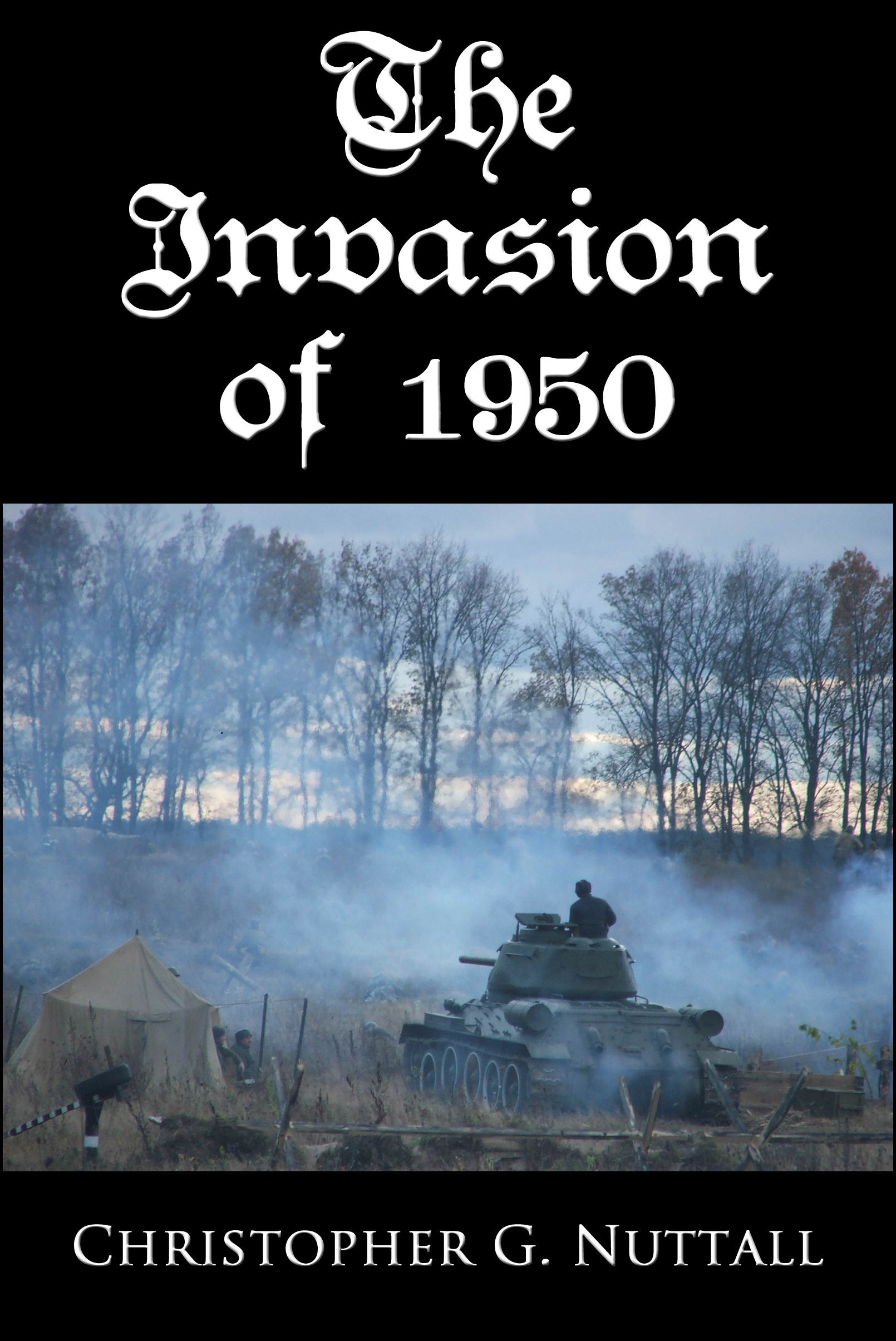
Christopher Nuttall, "The Invasion of 1950" (2013)

Just finished this self-published alt-history (allohistorical) work...

I heartily enjoyed it; worth the time, although it could use some editing. I did approach it, however, as pure escapist entertainment and not alternative history grounded in plausible variation of historical facts. More comments soon.

In the interim, travel over to the author's blog for more info.

Wednesday, 18 March 2015

Roy Porter, "Madness: A Brief History" (2002)

This short but pithy and informative book is an excellent read.

This similarly short and to-the-point review from Medical History will suffice to whet your appetite.

Comments and references that caught my attention:
- 32/33: “John Locke wrote to insist upon The Reasonableness of Christianity (1694): even religion now had to be rational. This pathologization of religious madness led Enlightenment free-thinkers to pathologize religiosity at large. In effect, this was also, much later, Freud’s position. God was an illusion, faith ‘wish-fulfilment’, and belief, though all too real, was a mental projection satisfying neurotic needs, to be explained in terms of the sublimation of suppressed sexuality or of the death wish. In reducing religion to psychopathology, Freud was echoing the more biting of the philosophes, like Voltaire and Diderot, who adjudged Christian beliefs the morbid secretion of sick brains. These days, while the Churches continue to accept, in principle, the reality of visions, spirit possession, and exorcism, they are profoundly suspicious of credulity and deception. The Roman Catholic or Anglican who claims to be assailed by the Devil has become an embarrassment. His priest may try to persuade him that such doctrines are merely metaphorical; and, if he persists, he may be urged to see a psychotherapist.”

- 89: “Foucault claimed that the great confinement essentially involved the sequestration of the mad poor by supporters of the bourgeois work ethic, and in his Madmen and the Bourgeoisie: A Social History of Insanity and Psychiatry (1981) Klaus Doerner followed suit. But there is little trace of organized labour in early asylums—indeed, critics accused them of being dens of idleness. And enterprising madhouse proprietors naturally sought rich and genteel patients, who would not be expected to work.”

- 93/94: “The decades around 1800 brought surging faith in the efficacy of personal treatment in sheltered asylum environments. In England, such doctors as Thomas Arnold, Joseph Mason Cox, and Francis Willis (called in to treat George III in 1788) followed Battie’s watchword that ‘management did more than medicine’ and pioneered a ‘moral management’ through which the experienced therapist would outwit the deluded psyche of his patient.”

- 94: “Shortly afterwards, the York Retreat developed ‘moral therapy’, with its emphasis upon community life in a domestic environment designed to recondition behaviour. The York Asylum, a charitable institution, had become bemired in scandal. By way of a counterinitiative, the local Quaker community, led by a tea merchant, William Tuke, established an alternative, the Retreat, opened in 1796. It was modelled on the ideal of bourgeois family life, and restraint was minimized. Patients and staff lived, worked, and dined together in an environment where recovery was encouraged through praise and blame, rewards and punishment, the goal being the restoration of self-control.”

- 98/99: “Criticism thus led not to the abolition of the madhouse, but to its rebirth, and institutionalization was transformed from a hand-to-mouth expedient into a positive ideal. In France the reforms of Pinel and the new legal requirements of the Napoleonic Code were further codified in the key statute of 1838. This formally required each departement either to establish public asylums, or to ensure the provision of adequate facilities. It guarded against improper confinement by establishing rules for the certification of lunatics by medical officers—though for paupers a prefect’s signature remained sufficient. Prefects were also given powers to inspect. Similar legislation was passed in Belgium twelve years later.
A comparable reform programme was put through in England, despite opposition from vested medical interests. Scandals revealing the improper confinement of the sane had already led to the Madhouses Act of 1774. Under its provisions, private madhouses had to be licensed annually by magistrates; a maximum size for each asylum was established; renewal of licences would depend upon satisfactory maintenance of admissions registers. Magistrates were empowered to carry out visitations (in London the inspecting body was a committee of the Royal College of Physicians). Most importantly, certification was instituted. Henceforth, although paupers could continue to be confined by magistrates, for all others a letter from a medical practitioner would be required to make confinement lawful. Further reforms followed. The 1774 legislation was strengthened in a series of Acts passed from 1828, above all establishing the Commissioners in Lunacy, first for the metropolis and then for the whole country. The Commissioners constituted a permanent body of inspectors (made up of doctors and lawyers) empowered to prosecute unlawful practices and to deny renewal of licences. They also took it upon themselves to improve and standardize care and treatment. The Commission ensured eradication of the worst abuses, for example, by requiring that all cases of the use of restraint should be documented. Safeguards against improper confinement were extended. Under an influential consolidating Act of 1890, two medical certificates were required for the detention of all patients.”

- 100: “Similar developments occurred in the United States, where the asylum arrived in the nineteenth century. The success of the York Retreat was the impulse behind the Frankford Asylum in Pennsylvania (1817), the Friends’ Asylum near Philadelphia (1817), the McClean Hospital in Boston (1818), the Bloomingdale Asylum in New York (1821), and the Hartford Retreat in Hartford, Connecticut, founded in 1824. Most early American asylums combined private (paying) and public (charity) patients. As in France, the early asylum era in America was spearheaded by physicians specializing in mental disorders, notably Samuel B. Woodward at the Worcester State Hospital and Pliny Earle of the Bloomingdale Asylum in New York, both of whom integrated medical and moral therapies in a climate of Pinelian therapeutic optimism. They were among the thirteen originators of the Association of Medical Superintendents of American Institutions for the Insane, established in 1844—it later became the American Psychiatric Association.”

- 101/102: “Throughout Europe, it was the nineteenth century which brought a skyrocketing in the number and scale of mental hospitals. In England, patient numbers climbed from perhaps 10,000 in 1800 to ten times that number in 1900. The jump in numbers was especially marked in new nation states. In Italy, no more than 8,000 had been confined as late as 1881; by 1907 that had soared to 40,000. Such increases are not hard to explain. Positivistic, bureaucratic, utilitarian, and professional mentalities vested great faith in institutional solutions in general— indeed quite literally in bricks and mortar. Schools, workhouses, prisons, hospitals, and asylums—would these not contain and solve the social problems spawned by demographic change, urbanization, and industrialization?”

- 103/104: “In England ‘non-restraint’ was introduced in the 1830s, by Robert Gardiner Hill at the Lincoln Asylum and independently John Conolly at the new Middlesex County Lunatic Asylum at Hanwell on London’s western outskirts. Taking moral therapy to its logical conclusion, Hill and Conolly renounced all forms of mechanical coercion whatsoever: not just irons and manacles but fabric cuffs and straitjackets too. These would be replaced by surveillance under ample trained attendants and a regime of labour, which would stimulate the mind and discipline the body.”

- 105: “…absolute non-restraint was seen by Continental reformers as a quixotically English idée fixe, a foible of doctrinaire liberalism, and it was little imitated. But French and German reformers made resourceful use of the asylum environment in their own ways. Work therapy was widely favoured. Planted in the countryside, the asylum typically became a self-sufficient colony, with its own farms, laundries, and workshops, partly for reasons of economy, partly to implement cures through labour. In France balneological treatments became a key feature of ‘asylum science’ (police intérieure). In Germany, C. F. W. Roller spelt out detailed directives for such matters as non-slip, smell-proof flooring, good drains, apparel, diet, and exercise at the influential Illenau asylum in Baden, where music and movement therapies were also pioneered. Everywhere, the care and cure of the mad became the subjects of the new ‘science’ of asylum management, spread by professional organs such as the significantly named Asylum Journal.”

- 139: “To some extent, psychiatrists were victims of their own propaganda. They had insisted that many of the aberrant and antisocial behaviours traditionally labelled vice, sin, and crime were actually mental disorders in need of the doctor and the asylum. As a result, magistrates deflected difficult cases from the workhouse or jail, but superintendents then discovered to their dismay and cost that rehabilitation posed more problems than anticipated. Furthermore, the senile and the demented, along with epileptics, paralytics, sufferers from tertiary syphilis (GPI), and other degenerative neurological disorders were increasingly shepherded through the asylum gates. For all such conditions, the prognosis was gloomy, and the asylum became a dustbin for hopeless cases.”

- 156: “Pinel’s favourite follower was Jean-Etienne Dominique Esquirol (1772-1840), whose Mental Maladies (1838) was the outstanding psychiatric text of his age. While asserting the ultimately organic nature of psychiatric disorders, Esquirol concentrated, like his mentor, on their psycho-social triggers. The diagnosis of ‘monomania’ was developed to describe a partial insanity identified with affective disorders, especially those involving paranoia, and he further delineated such conditions as kleptomania, nymphomania, and pyro-mania, detectable in advance only to the trained eye. A champion of the asylum as a therapeutic instrument, he became an authority on its design, and planned the National Asylum at Charenton, a suburb of Paris, of which he was appointed director. (It briefly housed the ageing Marquis de Sade.)”

- 156/7: “…the condition known as general paresis of the insane (one manifestation of tertiary syphilis) was elucidated in 1822 by Antoine Laurent Bayle. Although the micro-organism which causes syphilis had not yet been discovered—the bacteriological era lay ahead— the neurological and psychological features of GPI (notably euphoria and expansiveness), combined with the organic changes revealed by autopsy, supported Esquirol’s conviction that psychiatric disorders could be revealed using the techniques championed by such great French pathological anatomists as Laennec who had investigated tuberculosis and other internal conditions. Closely related to GPI, tabes dorsalis was another disorder, prevalent in the nineteenth century, which became the focus of neuro-pathological research. It was the subject of a masterly clinical study published in 1858 by Guillaume Duchenne, which established its syphilitic origin: so definitive was his account that it was soon named ‘Duchenne’s disease’. He was also at the forefront in describing many other neurological disorders involving personality degeneration, including progressive muscular atrophy and locomotor ataxia (lack of coordination in movement).”

- 177: “in the new world, where George M. Beard (1839-83) popularized the concept of ‘neurasthenia’, nervous breakdown produced by the frantic pressures of advanced civilization, which drained the individual’s reserves of ‘nerve force’. ‘American nervousness is the product of American civilization’ , he pronounced with mingled pride and regret. Neurasthenia’s prevalence in the modern era was no mystery, held Beard: the telegraph, railroad, press, and the market-driven rat race of Wall Street had rendered life insupportably hectic, intense, and stressful. Civilization made demands on nervous systems that nature had never anticipated. As with the eighteenth-century ‘English malady’, neurasthenia struck the elite and flagged up civilization and its discontents. Beard’s ideas were given a practical twist by Silas Weir Mitchell, who introduced the ‘Weir Mitchell treatment’—bed rest, strict isolation, fattening up with milk puddings, and passive massage—to counter such fatiguing tendencies amongst the neurasthenic.”

- 181: “The insanity plea became controversial in Britain when the trial in 1843 of Daniel M’Naghten for the murder of Prime Minister Sir Robert Peel’s private secretary was stopped on the grounds of insanity. The resulting furore led to new guidelines being drawn up, by the House of Lords, to clarify the legal basis for criminal insanity. The M’Naghten Rules (1844) grounded the insanity defence in the defendant’s inability to distinguish right from wrong. This pre-empted the claim advanced by post-Esquirolian psychiatrists that the grounds should be ‘irresistible impulse’, that is, disorders of emotion and volition, independently of delusions of the understanding. In France by contrast, ‘irresistible impulse’ and partial and temporary insanity figured large in the plea of insanity and crime passionelle. Disputes over the insanity defence (who was bad? who was mad?) highlighted conflicts between legal and psychiatric models of the person, and left the public standing of psychiatry dubious.”

- 182: “Mental illness, Hunter and Macalpine believed, was not psychogenic. Hence the utterances of the insane were but cries of distress—and not necessarily even good clues to its nature. You don’t crack mental illness by decoding what the mad say: for, they held, mental disease had a biological base. Powerful psychiatric currents have furthered such tendencies to silence the insane, especially in institutional environments.”

- 183: “…did not the methods of the natural sciences prescribe observation and objectivity, not interaction and interpretation? The noisiest patients were shunted off into the back wards, and all too often those who were shut up were, indeed, ‘shut up’—or at least nobody attended to what they were uttering, there being less communication than excommunication.”

- 215: “The course of psychiatric illness, he insisted, offered the best clue to its nature, rather than, as in common practice, the raft of symptoms the patient showed at a particular moment. On this basis, Kraepelin wrought a great innovation in disease concepts and classification. Amalgamating Morel’s demence precoce with the notion of hebephrenia (psychosis in the young, marked by regressive behaviour) developed by Karl Kahlbaum and his pupil Ewald Hecker, he launched the model of a degenerative condition which he named dementia praecox, to be decisively distinguished from manic-depressive psychoses (Falret’s ‘circular insanity’). The archetypal dementia praecox sufferer as pictured by Kraepelin on the basis of meticulous clinical experience might be astute and clever, but he seemed to have forsaken his humanity, abandoned all desire to participate in society, and withdrawn into a solipsistic world of his own, perhaps mute, violent, and paranoid. Kraepelin routinely used phrases like ‘atrophy of the emotions’ and ‘vitiation of the will’ to convey the sense that they were moral perverts, psychopaths, almost a species apart. As the precursor to schizophrenia, Kraepelin’s dementia praecox has left an indelible mark on modern psychiatry.”

- 242: “Invasive treatments equally reflect the powerlessness of patients in the face of arrogant and reckless doctors, and the ease with which they became experimental fodder. In a now notorious experiment, hundreds of black mental patients at the Tuskeegee Asylum in Alabama were guinea pigs without their knowledge or consent in an experiment to test longterm responses to syphilis, a minor echo of the atrocities committed by Nazi psychiatrists.”

- 272: “The growing centrality of women to psychiatry over the last couple of centuries is superbly handled in Elaine Showalter’s The Female Malady: Women, Madness, and English Culture, 1830-1980 (New York: Pantheon Press, 1986)…”

- 272: “Andrew Scull, Museums of Madness: The Social Organization of Insanity in Nineteenth-Century England (London: Allen Lane, 1979)—this has appeared in revised form as The Most Solitary of Afflictions: Madness and Society in Britain, 1700—1900 (New Haven and London: Yale University Press, 1993)”

- 276: “Leonard D. Smith, Cure, Comfort and Safe Custody: Public Lunatic Asylums in Early Nineteenth-Century England (London: Cassell, 1999)”

- 279: “Extracts from nineteenth-century English psychiatric texts may be found in Vieda Skultans, Madness and Morals: Ideas on Insanity in the Nineteenth Century (London and Boston: Routledge & Kegan Paul, 1975).”

- 279: “Autobiographical writings of ‘mad’ people have been anthologized and surveyed in Dale Peterson (ed.), A Mad People’s History of Madness (Pittsburgh: University of Pittsburgh Press, 1982); Michael Glenn (ed.), Voices from the Asylum (New York: Harper & Row, 1974); Allan Ingram, Voices of Madness: Four Pamphlets, 16831796 (Stroud: Sutton Publishing, 1997) and Roy Porter (ed.), The Faber Book of Madness (London: Faber, 1991; paperback 1993). Some attempt at reproducing their ‘view’ is offered in Roy Porter, A Social History of Madness: Stories of the Insane (London: Weidenfeld & Nicolson, 1987).”


Timur Vermes, "Look Who's Back" (2012)

This is likely one of the most clever, amusing, intriguing and generally enjoyable fiction books I have read in a long time.

Essentially, the premise is that Adolf Hitler awakens with a pounding headache in a Berlin vacant lot in 2011. He has no memory of what has transpired since April 1945, with his last memory of that time being the act of showing Eva Braun his antique pistol. The rest of the story is simply too good to spoil. Vermes combines a singular wit, trenchant political commentary, and thought-provoking representation of how Hitler might understand the contemporary political world (both within Germany, as well as beyond).

Some snippets that I found particularly enjoyable (pagination is from my digital version):
37: “…in the last sixty-six years the number of Soviet soldiers on the territory of the German Reich had fallen substantially, particularly in the Greater Berlin area. The current figure was between thirty and fifty men; in a flash I could see that this afforded the Wehrmacht a far better prospect of victory compared to the last estimate from my general staff of around 2.5 million enemy soldiers on the Eastern Front alone.”

41: “We all know, of course, what to make of our newspapers. The deaf man writes down what the blind man has told him, the village idiot edits it, and their colleagues in the other press houses copy it. Each story is doused afresh with the same stagnant infusion of lies, so that the “splendid” brew can then be served up to a clueless Volk. In this instance, however, I was prepared to be somewhat lenient. So rarely does Fate intervene this strikingly in its own workings that even the smartest minds must find it difficult to comprehend, let alone the mediocre intellects serving our so-called opinion sheets. My brain required the stomach of an ox to digest the other information I managed to unearth.”

48: “What irony: yesterday I was repositioning the 12th Army; today it was magazine racks.”

194: “the so-called reunification of Germany into his expansive lap. I have to concede that this supposed “reunification” was one of the few first-rate lies propagated by the republic. For how could they call it a proper reunification when essential components – such as the aforementioned Silesia granted to Poland, as well as Alsace-Lorraine or Austria – were missing?”

378: “That’s pure gold!” Madame Bellini said when, heavy-hearted, I showed her the report on the “National Democrats” alongside others we had filmed.”

540: “the telephone has to be a telephone, a calendar, a camera and everything else besides. This is dangerous nonsense, the only possible consequence of which is that thousands of our young people will be mown down on the roads because they cannot stop staring into their screens. One of my first undertakings will be to outlaw such telephone devices or allow them only for those inferior racial elements remaining in our society – for the latter I may even make them compulsory. Then they will litter the main thoroughfares of Berlin like squashed hedgehogs.”

541: “Christmas decorations have become more tasteful with the passing of the years. A most disagreeable industrialisation has taken hold. I am not concerned about whether something is kitsch or not, for every example of kitsch harbours a residue of the feelings of the simple man, and since that is the case there will always be the possibility of a development towards real art. No, what really bothers me is that the importance of Father Christmas has grown disproportionally, doubtlessly as a result of Anglo-American cultural infiltration.”

547: “He has also devised a new electoral slogan. It will be plastered at the bottom of all the placards, giving them a common thread. The slogan addresses old virtues, old doubts, and for good measure has a humorous, conciliatory element to win over those pirate voters and other young people. The slogan reads: “It wasn’t all bad.”


Thursday, 5 March 2015

Martin Luther, "Concerning Christian Liberty" (1520)


Page numbers are from my digital edition, and should not be regarded as authoritative:

Letter to Pope Leo X
- 2: "Your see, …which is called the Court of Rome, and which neither you nor any man can deny to be more corrupt than any Babylon or Sodom, and quite, as I believe, of a lost, desperate, and hopeless impiety, this I have verily abominated, and have felt indignant that the people of Christ should be cheated under your name and the pretext of the Church of Rome."

- 7: "I cannot bear with laws for the interpretation of the word of God, since the word of God, which teaches liberty in all other things, ought not to be bound."

- 7: "They are in error who raise you above councils and the universal Church; they are in error who attribute to you alone the right of interpreting Scripture."

- 7-8: "How much more rightly did the Apostles speak, who call themselves servants of a present Christ, not the vicars of an absent one!"

Concerning Christian Liberty
- 10: "…the things I have spoken of can be done by any impious person, and only hypocrites are produced by devotion to these things. On the other hand, it will not at all injure the soul that the body should be clothed in profane raiment, should dwell in profane places, should eat and drink in the ordinary fashion, should not pray aloud, and should leave undone all the things above mentioned, which may be done by hypocrites…"

- 10: "One thing, and one alone, is necessary for life, justification, and Christian liberty; and that is the most holy word of God, the Gospel of Christ."

- 11: "For the word of God cannot be received and honoured by any works, but by faith alone. Hence it is clear that as the soul needs the word alone for life and justification, so it is justified by faith alone, and not by any works. For if it could be justified by any other means, it would have no need of the word, nor consequently of faith."

- 11-12: "…it is solely by impiety and incredulity of heart that he becomes guilty and a slave of sin, deserving condemnation, not by any outward sin or work. Therefore the first care of every Christian ought to be to lay aside all reliance on works, and strengthen his faith alone more and more, and by it grow in the knowledge, not of works, but of Christ Jesus…"

- 12: "…the whole Scripture of God is divided into two parts: precepts and promises. The precepts certainly teach us what is good, but what they teach is not forthwith done. For they show us what we ought to do, but do not give us the power to do it. They were ordained, however, for the purpose of showing man to himself, that through them he may learn his own impotence for good and may despair of his own strength. For this reason they are called the Old Testament."

- 13: "…what is impossible for you by all the works of the law, which are many and yet useless, you shall fulfil in an easy and summary way through faith, because God the Father has made everything to depend on faith, so that whosoever has it has all things, and he who has it not has nothing."

- 14: "The highest worship of God is to ascribe to Him truth, righteousness, and whatever qualities we must ascribe to one in whom we believe. In doing this the soul shows itself prepared to do His whole will; in doing this it hallows His name, and gives itself up to be dealt with as it may please God."

- 14: "…what greater rebellion, impiety, or insult to God can there be, than not to believe His promises? What else is this, than either to make God a liar, or to doubt His truth—that is, to attribute truth to ourselves, but to God falsehood and levity?"

- 14: "For faith does truth and righteousness in rendering to God what is His… It is true and righteous that God is true and righteous; and to confess this and ascribe these attributes to Him, this it is to be true and righteous."

- 16: "It is not by working, but by believing, that we glorify God, and confess Him to be true."

- 18: "…there is nothing of which I have need—for faith alone suffices for my salvation—unless that in it faith may exercise the power and empire of its liberty."

- 19: "For though it is true that we are all equally priests, yet we cannot, nor, if we could, ought we all to, minister and teach publicly."

- 20: "There are now not a few persons who preach and read about Christ with the object of moving the human affections to sympathise with Christ, to indignation against the Jews, and other childish and womanish absurdities of that kind."

- 20: "Who can injure such a heart, or make it afraid? If the consciousness of sin or the horror of death rush in upon it, it is prepared to hope in the Lord, and is fearless of such evils, and undisturbed, until it shall look down upon its enemies. For it believes that the righteousness of Christ is its own."

- 21: "If faith does everything, and by itself suffices for justification, why then are good works commanded? Are we then to take our ease and do no works, content with faith?" Not so, impious men, I reply; not so. That would indeed really be the case, if we were thoroughly and completely inner and spiritual persons; but that will not happen until the last day, when the dead shall be raised. As long as we live in the flesh, we are but beginning and making advances in that which shall be completed in a future life."

- 21: "…he remains in this mortal life upon earth, in which it is necessary that he should rule his own body and have intercourse with men. Here then works begin; here he must not take his ease; here he must give heed to exercise his body by fastings, watchings, labour, and other regular discipline, so that it may be subdued to the spirit, and obey and conform itself to the inner man and faith, and not rebel against them nor hinder them, as is its nature to do if it is not kept under."

- 21: "…he comes into collision with that contrary will in his own flesh, which is striving to serve the world and to seek its own gratification."

- 22: "…from the requirements of his own body, a man cannot take his ease, but is compelled on its account to do many good works, that he may bring it into subjection. Yet these works are not the means of his justification before God; he does them out of disinterested love to the service of God; looking to no other end than to do what is well-pleasing to Him whom he desires to obey most dutifully in all things."

- 23: "Adam had been created by God just and righteous, so that he could not have needed to be justified and made righteous by keeping the garden and working in it; but, that he might not be unemployed, God gave him the business of keeping and cultivating paradise. These would have indeed been works of perfect freedom, being done for no object but that of pleasing God, and not in order to obtain justification, which he already had to the full, and which would have been innate in us all."

- 23: "Thus a Christian, being consecrated by his faith, does good works; but he is not by these works made a more sacred person, or more a Christian."

- 25: "For if works are brought forward as grounds of justification, and are done under the false persuasion that we can pretend to be justified by them, they lay on us the yoke of necessity, and extinguish liberty along with faith, and by this very addition to their use they become no longer good, but really worthy of condemnation. For such works are not free…"

- 25: "We do not then reject good works; nay, we embrace them and teach them in the highest degree. It is not on their own account that we condemn them, but on account of this impious addition to them and the perverse notion of seeking justification by them."

- 25: "The voice of the law should be brought forward, that men may be terrified and brought to a knowledge of their sins, and thence be converted to penitence and to a better manner of life. But we must not stop here; that would be to wound only and not to bind up, to strike and not to heal…"

- 25: "…the word of grace and of the promised remission of sin must also be preached, in order to teach and set up faith, since without that word contrition, penitence, and all other duties, are performed and taught in vain."

- 26: "…it is impossible that he should take his ease in this life, and not work for the good of his neighbours, since he must needs speak, act, and converse among men…"

- 26: "...but in all his works he ought to entertain this view and look only to this object—that he may serve and be useful to others in all that he does; having nothing before his eyes but the necessities and the advantage of his neighbour."

- 26: "It is the part of a Christian to take care of his own body for the very purpose that, by its soundness and well-being, he may be enabled to labour, and to acquire and preserve property, for the aid of those who are in want, that thus the stronger member may serve the weaker member, and we may be children of God."

- 27: "…the Apostle lays down this rule for a Christian life: that all our works should be directed to the advantage of others, since every Christian has such abundance through his faith that all his other works and his whole life remain over and above wherewith to serve and benefit his neighbour of spontaneous goodwill."

- 28: "Lo! my God, without merit on my part, of His pure and free mercy, has given to me, an unworthy, condemned, and contemptible creature all the riches of justification and salvation in Christ, so that I no longer am in want of anything, except of faith to believe that this is so. For such a Father, then, who has overwhelmed me with these inestimable riches of His, why should I not freely, cheerfully, and with my whole heart, and from voluntary zeal, do all that I know will be pleasing to Him and acceptable in His sight? I will therefore give myself as a sort of Christ, to my neighbour, as Christ has given Himself to me; and will do nothing in this life except what I see will be needful, advantageous, and wholesome for my neighbour, since by faith I abound in all good things in Christ."

- 29: "…we are quite ignorant about our own name, why we are and are called Christians. We are certainly called so from Christ, who is not absent, but dwells among us—provided, that is, that we believe in Him and are reciprocally and mutually one the Christ of the other, doing to our neighbour as Christ does to us."

- 31: "We give this rule: the good things which we have from God ought to flow from one to another and become common to all…"

- 34: "…we ought boldly to resist those teachers of tradition, and though the laws of the pontiffs, by which they make aggressions on the people of God, deserve sharp reproof, yet we must spare the timid crowd, who are held captive by the laws of those impious tyrants, till they are set free. Fight vigorously against the wolves, but on behalf of the sheep, not against the sheep."

- 34: "If you wish to use your liberty, do it secretly, as Paul says, "Hast thou faith? have it to thyself before God" (Rom. xiv. 22). … On the other hand, in the presence of tyrants and obstinate opposers, use your liberty in their despite, and with the utmost pertinacity, that they too may understand that they are tyrants, and their laws useless for justification, nay that they had no right to establish such laws."

Sunday, 30 November 2014

Witold Gombrowicz, "A Guide to Philosophy in Six Hours and Fifteen Minutes" (1967)

My dating of this work is representative of the date the material originated, not of its publication. The first French edition appeared in 1995, and the English translation followed about a decade later.

Gombrowicz is one of the luminaries of Eastern European (particularly Polish) literature. He authored titles such as Ferdydurke (likely his best-known work), and was nominated for a Nobel Prize in Literature during the late 1960s. Near the end of his life, as he was ailing in the south of France, a friend asked him to provide herself and Gombrowicz's Canadian wife with an overview of his ideas about philosophy. The book is the result of the notes from these talks.

As an introduction to philosophy, this book is not particularly useful. It is distinctly one man's interpretation of who and what ideas are important, and how thought evolved over time. The notes are sometimes incomplete, or cryptic in their meaning. Preserving these ideas strikes me as unnecessarily hagiographic. I'm not sure that Gombrowicz would ever be identified as being a leading historian of the European philosophic traditions. Nonetheless, for those interested in Gombrowicz's thinking, or the views circulating among the East European intellectual diaspora during the Cold War, the Guide offers unique insights.

You can download a PDF of the book here.

Some quotations that stood out:
First Lesson
Descartes:a single important idea: absolute doubt. Here rationalism begins: subject everything to absolute doubt, until the moment when reason forces us to accept an idea.

Answer: A priorisynthetic judgments are possible in general and therefore in transcendental aesthetics, because time and space are not a property of things but rather a property of the subject. In order for something to exist for us, we must inject it with time and space.

There are three reasons why space does not exist in the objective world outside us, but is an integral part of our consciousness.” First argument. Space does not come from an experience, but is the inevitable condition of all experience. Space is not an object but the condition of the existence of the object. Space does not derive from experience. Second argument. Space is not a concept obtained by deduction. We cannot understand it as concrete, because it is not an object. Space is pure intuition.

Analytical judgments are those which derive from analysis, dissecting a whole into its significant parts.

Synthetic judgments are a posteriori, in other words, based on experience.

For the first time consciousness asks the question: What are the limits of consciousness(of reason)?

Third argument(or rather, consequence). The intuition of space is the inevitable condition of our a priori synthetic judgments, conferring objective reality on things.

Second Lesson
Consciousness is the fundamental thing. Object-subject: nothing more. 1. consciousness cannot be a mechanism, nor broken up into parts, because it has no parts. It is a whole. 2. consciousness cannot be conditioned by science. It is what permits science, but science cannot explain something to us about consciousness. Consciousness is not the brain, nor the body, because I am conscious of my brain, but the brain cannot be conscious.

Time is not a thing that can be tested, but all things are in time.

A priori synthetic judgments are confirmed in experience because they are carried out in time. In the same way, all judgments related to mathematics are a priorisynthetic judgments, confirmed by experience.

Kant demonstrates that only the co-relativity of subject and object can form a reality. The object must be seized by consciousness in order to form reality in time and space.

There is an important boundary between science and philosophy. Science establishes its methods, its laws by experience. But it is valid only in the world of phenomena. Science can give us the connection between things, but not direct knowledge about the essence of things.

To tell the truth, in philosophy, one cannot say anything.

Kant
Our reason must be limited to the phenomenological world. The phenomenon is what I see according to my faculties, and my way of seeing things.

the soul is the synthesis of all impressions, because it is man’s self (the soul) which assimilates all impressions. The soul is that which receives the perceptions.

the critique of the idea of the soul consists in demonstrating that all our perceptions are

the concept of thing, in order to reach fullness, must inevitably insert time and space, since the Cosmos signifies absolutely everything that exists. We see a contradiction here, since the Cosmos must be unlimited in time and space in order to include absolutely everything.

Kant lists three theological arguments here to demonstrate the existence of God.

We have an idea of God as a perfect being. But a perfect being, to have perfection, must also have the quality of existing. This argument seems too sophisticated to me. Kant says that the category of existence is a perception. Yet God cannot be perceived.

The world must have a cause since, according to the category of causality, each thing must have a cause. If this is so, God must also have a cause.

Everything that is in the world must have a purpose, must be the work of God. But if God is teleological, then he himself should be created for an end.

we can never know what the noumenon, the absolute, is in itself, independent of our own perceptions.

Imperatives when the will is autonomous, conditioned by nothing. Example: “One must be moral” is categorical. It does not depend on any condition

Fourth Lesson
What is the will to live for Schopenhauer? He himself says that he uses these words because nothing better comes to mind. In truth, it is more the will to be, because for Schopenhauer, not only do man and animals want to live, but also the rock that resists and the light that persists.

if I myself am a thing, I must seek my absolute in my intuition, what I am in my essence. And, says Schopenhauer, “I know that the most elementary and fundamental thing in myself is the will to live.”

when this will to live passes to the phenomenological world, becoming a phenomenon limited by time and space, then it inevitably becomes divided. By the effect of a law that Schopenhauer called principium individuationis, it becomes individual, specific.

Man can never attain individual happiness. Our will to live forces us to consume others or to be consumed by them. As a result, Schopenhauer analyzes various noble feelings (example: the woman’s love for the child); he demonstrates that all that goes against individual happiness. After that, he likewise shows that what one calls happiness or pleasure is nothing more than the satisfying of a malaise. If you enjoy eating steak, it is because you felt hungry beforehand

Fifth Lesson
Schopenhauer recognizes two possibilities: 1. To affirm the will to live by fully participating in life with its cruelties and its injustices. 2. Not suicide, but meditation.

Art shows us nature’s game and its forces, namely the will to live.

Schopenhauer sees ART. It is meditation that he sets in opposition to life.

Schopenhauer makes a very good comparison in saying that a mediocre man’s intelligence resembles a flashlight, which shines only on what it is seeking, whereas a superior intelligence is like the sun, which illuminates everything. From there derives the objectivity of the art of the genius. It is disinterested.

Hegel
I was never born. I was never born in 1904. I only know that I have the idea of my birth in 1904 in my consciousness, and that I have the idea of 1904, that is to say, of all the past years. Everything changed in a diabolical way. That changes the universe. There is nothing more than a definitive center which is consciousness and that which passes into consciousness. Consciousness is evidently alon

existentialism cannot produce any philosophy. Me, I am alone, concrete, independent of any logic, of any concept

intuition is direct knowledge without reasoning. Thus existentialism is the profound and most definitive description of our facts concerning existence.

How can one define the characteristics of “the Being in itself,” that is, the being of objects? 1. We have to say that only phenomena exist (Husserl). Everything manifests itself as a phenomenon

The Being in itself is opaque. He is as he is, that is all one can say, he is immobile. He is not subject to creation and temporality, and cannot be inferred from something (like created by God).

Existential man is concrete, alone, made of nothingness, thus free. He is condemned to freedom and he can choosehimself. What happens if we choose, for example, frivolity and not authenticity, falseness and not truth? As there is no hell, there is no punishment. From the existential point of view, the only punishment is that this man has no true existence.

Here on the subject of freedom, Sartre is very categorical. He says that the choice depends only on us, there are no pre-established values, it is our choice which creates them. One could imagine that man, with all his freedom, is nevertheless condemned to satisfy the fundamental necessities of life, such as eating. But this also depends on me. If I choose suicide, food loses all value for me. And from this absolute responsibility of man to himself is born the characteristic anguish of existentialism, as much for Heidegger as for Kierkegaard and Sartre. This anguish is the anguish of nothingness

This phenomenological method is not concerned with God, etc., but only with what is in our consciousness, when it confronts our specific being, our existence. It is phenomenological ontology. Ontology means the science of Being (existence). Phenomenological means that there are only phenomena, and one must not look for something behind the phenomena. In this sense, this method is completely atheistic. Heidegger said that complex arguments are not needed as much as heroic naïveté.

What is existence, that is, man’s specific being? He says: It defines itself by what he calls “ Da-sein,” “to be there” (over there). To be man. To exist as a man. The “Seindes” is a way for things to exist, an absurd atemporal way (a chair, it is but does not know it). But man is also a “Seindes,” and he is conscious of that: being a thing. But he also transcends this (transcendent: that which within me navigates toward the exterior), since man is a thing but he is also something more. He extends beyond the thing. He is transcendent. The word “ Sein,” to be.

curiosity is the superficial connection of man. What are they talking about? In the more profound sense, it is an interpretation of man, of the world, of being, of scientific, philosophical, or religious problems. It is also a way to make existence commonplace, to flee from existence, a way of replacing the profound sense of life by a superficial and limited science. The dramatic thing about man (and here again, Sartre comes to mind) is that man gives a meaning to things by his existence. Now, in dealing with science, for example, he gives it an inauthentic meaning. He falsifies. Existentialism refrains from science.

For Heidegger, it is the Being which appears secondarily as a contradiction of nothingness. 1. nothingness 2. Being. This definition can seem rather unfounded, but actually it leads to an extremely curious and true experience: human existence is in constant opposition to nothingness. Man always threatened by death and annihilation persists like a flame which wants to be revived, fed.

a general characteristic of existence, according to Heidegger. 1. It is “Sorge,” concern. Human life is by no means assured, but endlessly wants conquests, life is to conquer what one does not have. 2. Human beings are limited and have an end precisely because they have nothingness within them. Authentic existence asserts man’s finiteness. It has moral constants. It does not permit having a clear conscience. Never are we what we want to be, but we still want to be. Man is essentially unhappy because he is limited

How does the world appear, according to Marx? The first aspect is its materialism. Marxism is the negation of religion. He considered religion as a product of men to run from danger. And this is an instrument of the higher class to dominate the lower class. Materialism constitutes the negation of idealism, of all metaphysics, of all recourse to ideas. For Marxism, there is only the brutal, concrete reality of life. Second aspect: Marxism defines itself by the well-known formula, consciousness depends on being.

consciousness is a function of our necessities, of our relationship with nature. But since man does not depend only on nature but also and above all on society, on historic conditions produced by that society, consciousness is formed by that society. Consciousness is therefore above all a function of human history. The third aspect: need creates value.

the growing consciousness of humanity lets him organize a society and a state which are above all a system for the production of goods. In this organization, one man must be subject to another, such that it is through the exploitation of one man by another that one arrives at the accumulation of goods. The man who forms a group is subject to the laws of the group, which wants to be strong, and this strength is the consequence of the exploitation of man by man. For example, the army which obeys a single man through generals, etc., or slaves or finally castes, different stages of the feudal systems, classes. It is man who obliges man to work.

Capitalists, that is to say, members of the upper class, buy labor as if it were merchandise, thus at the best possible price. This better price represents the bare minimum that the worker needs to eat and to father children. Surplus valueis formed this way because the worker produces much more than what he is paid; the rest goes to capitalism. The worker always produces more than what he is paid. Such is surplus value. The worker’s labor is subject, like all merchandise, to Adam Smith’s famous economic law, according to which if supply is greater than demand, the value of the merchandise decreases. It is this law which explains the process of devaluation. To curb devaluation, supply, that is, production, must be increased.

Alienated man, that is, he who cannot be himself, is obliged to serve as a machine instead of having his normal life. This theory is fine, but in my view, it does not apply to capitalism. Capital is used to create other wealth, but this exploitation of man by man is not done so much for the happiness of the individual. Capitalism is not exclusively beneficial to the capitalist, since if the capitalist is able to consume his money, he cannot buy more than one hundred hats or a yacht, etc., each year. Where does the rest of his money go? To other factories, other industries, etc., and this is the way that humanity’s technical power becomes greater each time. This exploitation of man by man is a fundamental necessity for human progress, which is extremely difficult for the individual.

Marxism is not an ideology or a truth, it is just simply the freedom from human needs as a source of values. The revolution, therefore, is going to free allmen from natural needs, and on the basis of this freedom, the values will be created by themselves. It must be clearly understood that Marxism is not a revolution of ideas but rather a revolution between concrete men. It is a liberation of man. The new ideas: future thought is unpredictable and will be created by itself in this new human order.

The human race is like all the others; it is improved by a struggle and a natural selection done by life itself. Here we see the most sensational and the most provocative aspect of this philosophy: it is the opposition to Christianity, which, according to Nietzsche, was a morality of the weak imposed on the strong, harmful to the human race and, therefore, immoral.

In Zarathustra (of which he sold only forty copies and gave seven of them as gifts): 1. God is dead. This means that humanity has reached its maturity. Faith in God is already anachronistic. Man ends up all alone in the cosmos. Nothing but life. 2. (Stupid idea.) The ideal of the superman. Man is a transient phenomenon that must be overtaken. Man is thus problematic. He is a bridge and not an end in himself.

Entropy. Loss of energy through radiation. Nietzsche starts from an original cause which produces all the other causes, cause-effects, etc. Automatic process from cause to effect, thanks to which we arrive at the present moment. This will be exceeded by other cause-effects and finally will vanish, and again the first cause will return, etc., and we shall arrive again at the same situation. As time is infinite, this will repeat itself eternally.

I return to this important point about existentialism: the philosopher is in life, one of the major currents of our thinking during the 19th century. The path of this Western thought could be defined by the great questions it asked. 1. The reduction of thought. Thought for Kant becomes conscious of its limits. It already knows that one cannot demonstrate, for example, the existence of God, but that it is just as impossible to demonstrate that God does not exist.

2. The other problem is more difficult, that of life, of becoming. Philosophy, before Hegel, claimed to describe a fixed world in a state of stability where the notion of movement, of becoming, surely was disturbing (already in Greek philosophy), but was not the fundamental problem. Now Hegel is the philosophy of becoming. It is the idea of an imperfection of reason which is in the process of moving ahead, of developing.

The world is a thing, it is understood to the extent that it is assimilated by reason, by a rational consciousness.

Each day, we understand the world better, we are better aware of the reason for every phenomenon. Thus each time the world exists a little more for us. There will come a moment, the final moment of our history and of the human race, where the world will be fully assimilated. On that day, time and space will disappear and the conjunction of subject and object will be transformed into an absolute. Beyond time and space.

Hegel’s philosophy is a philosophy of becoming, which is a great step ahead, since this process of becoming does not appear in earlier philosophies. It is not only a movement, but a progression, since this dialectical process always puts us on a higher rung, until the final outcome of reason,

For Hegel, nature is not creative. It does not advance. The sun, for example, always rises and sets the same way. But what is creative is human evolution, which expresses itself especially in history.

for earlier philosophy, man was subject to a moral law instituted by God or, as in Kant, subject to a moral imperative. In other words, man functions but the law already exists. But in Hegel, everything moves. In advancing, man crafts his own law, and there is no fixed law beyond that which is constituted by the dialectical process. In Hegel, not only man but laws are in progress because they are imperfect.

Existentialism is particularly meant to be a philosophy of the concrete. But this is a dream; in concrete reality, one cannot make arguments. Arguments always use concepts, etc.

reasoning can be done only through concepts and logic, and general laws cannot be formed without concepts and without logic. On the other hand, concepts do not exist in reality

Husserl says: because we can say nothing about the noumenon(thing in itself), we put the noumenonin parentheses; that is, that the only thing one can speak of are the phenomena.

existentialism moves into structuralism.

Curious thing: this rudimentary comparison that I have managed to do can seem naïve. Yet it leads to real concepts, for example, that the human being is empty because of the well-known intentionality of consciousness. If a chair is a chair, then consciousness is never identical to itself because one must always be conscious of something. One cannot imagine empty consciousness.

The Being in itself cannot disappear. It is independent of time and space. It is as it is, nothing more. While existence, the Being for itself, is a limited being, with an end, which dies. (This is at least how our existence appears to our consciousness. Existence must be sustained like a flame.

we are absolutely sure of being free. No one can take away from me the feeling that it is I myself who decides whether I have to move my hand or not. Indeed, when we contemplate other people, they appear to us as the consequence of a cause

freedom is a feature only of existence while causality is the feature of the Being in itself.

The existentialist is a subjective, freeman. He has what one calls free will, unlike a man viewed from the scientific outside, who is always subject to causality, like a mechanism.

to be man is to be subject. It is to have a consciousness which recognizes everything else as object. If I admitted that Witold too has a consciousness, then inevitably I myself am an object for Witold, who is the subject. It is impossible to be subject and object at the same time. Here Sartre was frightened. His highly developed ethics refuses to admit that there is no other man because there are no longer any moral obligations.

We must not forget that man by his body, by his mechanism, belongs to the world dictated by causality, since if we are stabbed, evidently we are going to bleed, like every other animal. Freedom manifests itself only in existence, in that specific being which is the Being for itself.

Man, says Heidegger, must create himself. As he is not a thing, well then! he must become “man.” Banal life simply means to flee from oneself. This is in order to forget and to lose oneself. To become man is only one possibility. One does not use the word “I,” but one uses “one.” “One” goes to the movies. “One” has political opinions. And man identifies himself with his social function. “One” is an engineer, etc. You understand in which direction Heidegger’s probing is going. Man must truly become man.

It is Heidegger who introduced the notion of “completed future.” Man’s time is always the future. He is never there where he is. He is always transcendent.

according to Sartre, a man needs water in the desert because he chooses life and not death. For Marxism, a living being is obliged to choose life and one cannot speak here of free choice.

The dominant class forms the superstructure which creates philosophy, religion, law, which in a word, organizes consciousness. All of this actually serves secretly to maintain the exploitation.

The profound and unique meaning of religion is quite simply to transfer justice to another world.

The big crisis in Marxism stems quite simply from the fact that—as shown by the situation in the East—one works badly and produces very little. And why? Life is hard; if you do not force men to work, naturally they will not work.

the only country in the world which has more or less liquidated the proletariat, except among the Blacks, is the glorious United States, that is, the capitalists. The Socialists, on the other hand, are going bankrupt everywhere for the simple reason that no one is interested either to produce, nor to force others to do so, because there is no interest at stake.

if you allow men to deploy all their energy and their intelligence, inevitably one will dominate the other, one will be superior to the other. But in this case, you obtain a huge amount of energy, whereas if you want equality between men, then naturally you must curb this possibility of superiority.

The big defect in the upper class is that it is essentially a class of consumption. Consequently, it is accustomed to conveniences, becomes lazy, delicate, and degenerate. But now the upper class is increasingly composed of engineers, producers, scientists, intellectuals, lastly, some working people.

Marx’s thesis is that Marxism is an absolute historical necessity which occurs due to inexorable economic laws, by the concentration of capital in a little group that will be annihilated by the huge mass of the destitute. Marxists want to introduce the dictatorship of the proletariat, not democracy but dictatorship

Nietzsche was not a philosopher in the strict sense: he wrote aphorisms, some notes.

Nietzsche considers pessimism to be a weakness, condemned by life and optimism, a superficial (Canadian!) thing

For Nietzsche, life is not good, but we are condemned to life. This leads to paradoxes, such as his admiration for cruelty, harshness (without mercy), and for the whip, weapons.

Tuesday, 28 October 2014

Deborah Lipstadt, "History on Trial: My Day in Court with a Holocaust Denier" (2005)

This book details Lipstadt's court battle to prove that her assertion that author David Irving had engaged in a long-standing effort to falsify history: selectively using and misrepresenting documents to cast Adolf Hitler in a favourable light, as well as denying the very existence of an intentional, widespread, systematic, and state-sanctioned effort to slaughter Europe's Jewish population.

The case stemmed from claims Lipstadt made in her 1993 book, Denying the Holocaust: The Growing Assault on Truth and Memory, wherein she discussed Irving's work as well as the efforts of other 'deniers'. (See my discussion of the book here). Three years later, Irving sued Lipstadt and her publisher, Penguin, for libel (stemming from the statements in her book). According to British law, the onus was placed on the defendants to prove that their assertions could be supported by evidence.

Working with an impressive team of scholars and legal minds, arrayed against Irving's rather lacklustre and self-managed representation, Lipstadt and Penguin without a doubt brought Irving low. He was publicly shown to work less as a historian than an ideologue, calling into question the integrity of the entirety of his oeuvre. The revelation of his sloppy, highly biased, and clearly flawed use of documentary sources and other archival materials effectively ended his career as a historian. Banned from entering multiple countries, considered persona non grata by respectable publishers, and saddled with a significant financial burden after losing the case, Irving is unlikely to ever widely enter public consciousness other than as a sad, deluded figure.

As a result of the trial, and her unwillingness to compromise or back down from defending her observations, Lipstadt has become a far more widely known scholar and commentator on 20th-century Jewish history, particularly as it relates to the Nazi regime.

Her book is more narrative of the experiences of the trial, and exploration of some of the choices made in her legal team's efforts. In this regard, it is compelling and informative reading. For readers seeking a closer analysis of Irving's work, however, better sources are available, such as the expert analysis of Irving's work carried out for the trial by Richard Evans, Hajo Funke, and Robert Jan van Pelt. (Electronic editions of these can all be found at the Holocaust Denial on Trial website). Trial transcripts can be found at the same site.

I discuss Lipstadt's 1993 book, Denying the Holocaust, here.
I also discuss her 2011 book, The Eichmann Trial, here.
I discuss Irving's 1996 biography of Josef Goebbels here.