Showing posts with label Toronto history. Show all posts

Wednesday, 1 July 2015

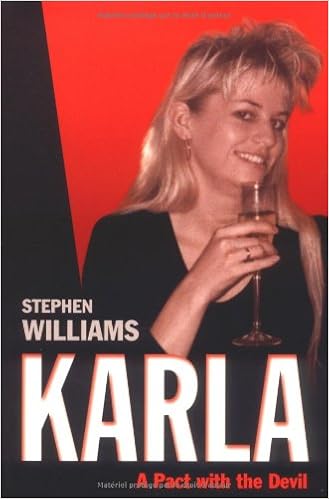
Stephen Williams, "Karla: A Pact with the Devil" (2003)

It's hard to offer any new insights on the sordid and tragic tale of sexual assaults and murders conducted by Paul Bernardo and Karla Homolka. In 2003, when this book was written, Williams was able to provide some new insights into the case, as well as Karla's state of mind in prison. Although he is evasive in the book, Williams apparently opened a mail conversation with her, while also seeking out interviews with a multitude of other people involved in the case.

The book plots out the legal prosecution of Karla Homolka, and explains the development of the plea bargain that would result in her serving much shorter jail time than she might otherwise face in exchange for testifying against her husband. Williams seems to want to tell the valid, but hard to integrate story of bureaucratic bungling in prosecuting Homolka (and Bernardo), along with a sympathetic telling of Homolka's suffering at the hands of a penal and justice system that approached her in a harsher fashion than other inmates guilty of similar crimes. In short, Williams seems to want to tell us that Karla is a criminal that deserved a worse sentence, but having reached a plea bargain, deserved to relish the terms she had been given by the state.

Williams lives in the region from which I grew up, and I wanted to enjoy this book, despite the story it tells. The tale he tells has all the hallmarks of a great work: internationally noteworthy crime, nationally much-discussed and controversial plea bargain, and suggestions of investigative and prosecutorial shortcomings. I found myself distracted by Williams rather awkward story-telling, and the poor editing of the book. Williams seems to fancy himself a cross between Truman Capote and Hunter S. Thomson. He blends comments on his own adventures, the food he's dining on and the company he keeps, with specious psychological analysis of the people he writes about. He makes an unfortunately showy love of vocabulary that I suspect serves to distance most readers, rather than impress them. I can only explain his strategy as a product of fearing his topic pandered to the stereotypical 'true crime' reader, and so sought to elevate his authorial persona with language he felt might better reflect his elevated intelligence. I found it more pompous and off-putting than appealing.


Quotations, and Gregory Klages' notes:

Chapter 7 - Cancer

"...post-traumatic stress disorder and its symptoms were fully extrapolated in a book by Arthur Kardiner, first published in 1941, called The Neuroses of War."

Chapter 9 - The Wedding Planner
"…[Karla] had seen a television program about how Italian men frequently live with their mothers until they are in their fifties. That might have explained it — Paul Bernardo was of Italian descent — but in the television program all the men really loved their mothers and Paul hated his and he wasn’t just saying it either and Karla could understand why."
NOTE: This sort of run-on sentence helps to establish a certain 'voice' for Karla. If it reflects her actual voice in the letters, wouldn't it have been more useful to actually use her words? I suppose this is part of the challenge of writing a textual conversation: if the author doesn't intervene, they become irrelevant. With too much intervention, the text becomes more about them than it does about the topic.

Chapter 22 - Deciphering Code
"Not to mention the anti-psychiatry, such as the idea that Karla was a malingering, histrionic hybristophiliac, developed for Bernardo’s defense team by Dr. Graham Clancy."
NOTE: If the average reader needs to check a dictionary more than once in a sentence, particularly when reading a pulp 'true crime' story, it should be a sign for concern.

Chapter 23 - The Man with Whom the Buck Stops
"And as Murray Segal said in this February 1995 letter to George Walker, they would continue to do exactly."
NOTE: End of sentence?… where are you?

Chapter 26 - A Propensity to Lie
"He was arraigned the next day, and held without bail for months even though Inspector Bevan’s charges on the murder charges had been thrown out."
NOTE: Editor? Did you disappear with the end of the sentence above?

Chapter 27 - The Fine Art of Adjudication
"What is now abundantly clear is that Michael Code’s ultimate decision not to charge Karla with respect to the repeated heinous attacks on Jane Doe, and the subsequent grant of blanket immunity, whereby, theoretically, he reinforced her “credibility” as an “accomplice witness,” has done nothing to maintain the public confidence in the administration of Justice — quite the opposite — but that consideration was clearly not the most important on Michael Code’s list. Although there are many facts and arguments to the contrary, which I tried to press on him time and again, he stubbornly asseverated that any prosecution of Karla Homolka would have put the successful prosecution of Paul Bernardo for first-degree murder at great risk. To him, Karla was by far the lesser of two evils, and was not then and is not now a danger to society."
NOTE: The quotation above is a fine example of all of the primary problems with this book.

"We did, however, agree on two other things. Karla should have been released on her statutory date, and that the prison officials far exceeded their mandate and their role when they detained her."

Chapter 30 - Macabre Cynicism
"On the surface, it seems lucid and logical but its observations and remarks are repetitive and pleonastic, as though they were uncomfortable with their subject matter, their decision and the basis on which it was made."

Chapter 31 - Back to the Future
"...doing time does something to one’s sense of time. You pass through it as though it is a vast mucilaginous bubble, emerging three months later none the wiser, feeling as though only three or four days have gone by."
NOTE: Hmmmm… is this Williams speculating, speaking from experience, or sharing Homolka's confidences? We'll never know.

"Understandably, this pecuniary redemption would ameliorate behavior and provide relief from stress and deliver some good old-fashioned middle-class stability."

Tuesday, 9 December 2014

Wayne Larsen, "Tom Thomson: Artist of the North" (2011)

Larsen's book is a brief, easy-to-read summary of many popular stories regarding the life of Canadian landscape painter Tom Thomson, who died in Ontario's Algonquin Park during the summer of 1917, under what has become described as 'mysterious circumstances'.

The book, as part of the Dundurn Press Quest Biography series, was conceived to appeal primarily to high school/junior undergraduate readers. This is important to note in evaluating Larsen's work. It is a basic form of biographical summary, written in clear and accessible language. He has not waded deeply into archival resources, and seems to have likely derived most - if not all - of the book from secondary sources.

The book is a fine introduction to Thomson's life, and certainly better than some biographies. That being said, it is not particularly demanding on the reader, and doesn't serve to challenge or question much of the hagiographic treatments of Thomson traditionally offered.

You can listen to a 2011 interview with Larsen here.

Wednesday, 1 October 2014

Robyn Doolittle, "Crazy Town: The Rob Ford Story" (2014)

Doolittle is a Toronto Star reporter who covers the City Hall beat.
While a flurry of books and investigative media pieces have told the Ford story, this is likely the best of the bunch. Doolittle not only coherently assesses the Ford rise to the mayoralty of Toronto, but places the Mayor within the context of his family history, changes within city politics, and as a player within a political 'machine'. Of course, she describes the chase for the now-infamous 'crack video(s)', but to her credit she also relates many of the details of how the Star's decision-making process worked with regard to not purchasing the video, and deciding to go to print with the information it had once the video's existence had been broken by other media.

You can read an excerpt from the book here.

You can read my discussion of a similar book, How Rob Ford Happened (from the National Post, a competitor to the newspaper Doolittle works for). In short, Doolittle does a better job of telling the story. The Post text seems pretty opportunistic.

Monday, 22 September 2014

Sam Sutherland, "Perfect Youth" (2012)

Subtitle: "The Birth of Canadian Punk."

Sutherland weaves a nice series of anecdotal tales culled from the memories of the Canadian punks who were "there" during the emergence of Canada's punk scene in the mid-to-late 1970s. His dogged determination in tracking down people who have left behind their punk roots (some to enter the sanctified realm of boardrooms, some to continue to struggle along in the music biz, and other who have simply moved to struggling...) is admirable and produces real insights into an era that is hard to source.

Sutherland's love of the subject, and of researching his subject, comes across in his writing. It is neither hagiography or shock journalism. It is simple and compassionate story-telling at its best. He conveys the spirit of the people, as well as of the music these people made, which is difficult to find. In this regard, Sutherland does a real service in providing something akin to a shopping list for those who want to find out more about Canadian punk, lends impetus to the effort to preserve these works and extend access to them, and increase awareness of the strong and important influence these bands had within their respective hometowns and (much to my surprise) internationally.

The book was received quite positively by critics, as can be seen in this National Post review, or one in Maclean's, this NOW magazine interview with Sutherland, or a similar author interview in Vice magazine.

Wednesday, 16 July 2014

"How Rob Ford Happened" (2013)

Subtitle: "A History of the Toronto Mayor From the Pages of the National Post."

For those not aware, Rob Ford is Toronto's mayor.

From the early 2000s, Ford represented one side in the polar divide of Toronto political life. Hailing from a somewhat dog-eared suburb, suffering from a distinct lack of social graces, and hailing himself as simultaneously "the peoples' mayor" and the "king of the regular people," Ford went from combative city counsellor with an eye on saving money and cutting government waste to the mayor known internationally for his corpulence, addictions, and his and his family's rather murky past with drug-related crimes.

This book smacks of opportunism. The content was all there in the National Post's files, and merely required some intern to cut-and-paste some articles referring to Ford into a chronological order. While some are quite interesting to read in retrospect, others - such as short debates between pundits - are of questionable value for gaining insight into Ford, or his history with Toronto. Particularly intriguing in this collection is the opportunity to read multiple articles by Christie Blatchford as her perspective on Ford evolves. Not being a fan of her writing, these articles served to affirm for me that her 'chippy', grouchy style of journalism doesn't really satisfy me.

Friday, 20 December 2013

Chester Brown, "Ed the Happy Clown: A Graphic Novel" (1980s)

I've reviewed several Chester Brown works on this blog. The early elements of the Ed story were contained in Brown's Yummy Fur mini-comics. An ex-girlfriend bought me a few in... 1986? I LOVED THEM. They mixed scatological humour ("The Man Who Couldn't Stop", about a man who could not stop defecating) with a rather straight take on the Gospel of Matthew. I was hooked, but could never find the rest. This anthology brings the run of Yummy Fur together, without the Gospel of Matthew material.

More later.

For my review of Brown's Paying for It, go here.

For my review of Brown's Louis Riel, go here.

Thursday, 4 July 2013

Geoffrey Reaume, Remembrance of Patients Past (2000, rep. 2009)

The sub-title for this book is: "Patient Life at the Toronto Hospital for the Insane, 1870-1940."

I've finished the book, but have yet to write a summary. Sorry!

York University (Toronto, ON) published an article discussing the book.

Wednesday, 28 March 2012

Lauren Kirshner, "Where We Have To Go" (2011)

Kirshner's book is one of the rare forays I've made into fiction in the last year. I must admit, at the outset, that I know Lauren, I know her partner, I've hung out in her apartment and played with her cats. So... I won't offer much of a critical assessment, in large part because I feel ill-equipped to comment on the quality of fiction writing outside of my own gut response to it.


Essentially, the book tells the story of a teenage girl, Lucy Bloom, who lives in Toronto with her fractious parents (for at least part of the story). I couldn't help but wonder, given the 'girl coming of age-type narrative, whether the protagonist's name was a nod to Judy Blume, author of 'preteen girl-books' such as Are You There God, It's Me, Margaret. I've never read Blume's books, so I could be far off the mark here.

As someone who grew up male, in a rural environment, it's intriguing to think about how the city where I live now might be seen by a teenage girl living twenty-five years ago. By that time I was coming here as a wide-eyed teenager, thrilled at the glass and steel, second-hand record stores, and roti shops.

The most troubling aspect of the book was the handling of time. The narrative seemed to move in fits and starts, leaping over periods with little warning, then dwelling for what seemed inordinate periods on stories that did not seem to be resolved. Perhaps this is part of the post-modern turn in fiction that I'm simply missing. As an infrequent fiction reader, I found it distracting.

The German edition cover is way cool.

Friday, 7 January 2011

Fred McClement, "The Strange Case of Ambrose Small" (1974)

Ambrose Small disappeared mysteriously from the streets of Toronto in 1919, the same day as he and his wife sold their chain of Canadian theatres for over $1.5 million. He handed over a cashier's cheque for $1 million dollars, transacted some other business around the city, and was never heard from again. His disappearance wasn't made public for over two weeks. His body was never found. His fate remains a mystery.

This book, written in the early 1970s, is clearly intended for a popular audience. It lacks footnotes, and makes little effort to indicate sources. That being said, there is almost no writing about the case, so most of the sources were likely newspapers of the time, covering the story or subsequent court cases. In 1960, the provincial police closed the case and tragically disposed of their files related to it.

Overall, this book provides an interesting, if brief glimpse into the rarified Toronto/Canadian upper society during the First World War era. It captures some of the sense of Catholic/Protestant clashes, and the moral ambiguity that revolved around popular entertainment. Unfortunately, the book leaves many questions unanswered, but given its size, the nature of the source material, and the intended audience, it offers an enjoyable, casual read.