Novel finished, comments not yet written.
Consider this a placeholder.
Follow this link for my comments on Ian Fleming's Casino Royale.
Reflections by Dr. Gregory Klages on non-fiction books dealing primarily with politics, history, and religion. Significant attention to Canadian content. Mail me/comment if you read anything. I love to hear feedback!
Showing posts with label Cold War history. Show all posts
Wednesday, 9 December 2015
Tuesday, 8 December 2015
Saturday, 18 July 2015
Kevin Lippert, "War Plan Red" (2015)
Subtitle: "The United States' Secret Plan to Invade Canada and Canada's Secret Plan to Invade the United States."
More notes to follow soon.
Lippert's book is disappointingly brief for such a provocative concern. Essentially, he provides a fairly basic outline of Canadian-American relations since the early 1800s, highlighting armed conflicts ranging from all-out wars (War of 1812), to silly skirmishes over concerns such as ownership of a pig.
Much of Lippert's focus is on a rather fanciful Canadian plan for how it might invade the United States if circumstances ever compelled it. This feint - which hardly lives up to the promise of the book's title - was primarily intended as a delaying tactic by which Canada might dampen US enthusiasm for invasion, and destabilize US plans to assault Canada if Canada was ever able to safely and reasonably conclude it was about to be invaded by the United States. That Canada would attempt a pre-emptive invasion of the United States is a stretch of imagination, which is likely one of the reasons Lippert's book takes a rather light-hearted approach to the idea of war between the two countries.
His assessment of US plans to invade Canada are unnecessarily similarly light. Given the traditional dynamics between the two countries, that the US had plans to occupy Canada - from Manifest Destiny onwards - and that it had the capacity to do so (as if physical invasion was even really necessary after NAFTA) would seem reason to approach the idea with more circumspection.
More notes to follow soon.
Lippert's book is disappointingly brief for such a provocative concern. Essentially, he provides a fairly basic outline of Canadian-American relations since the early 1800s, highlighting armed conflicts ranging from all-out wars (War of 1812), to silly skirmishes over concerns such as ownership of a pig.
Much of Lippert's focus is on a rather fanciful Canadian plan for how it might invade the United States if circumstances ever compelled it. This feint - which hardly lives up to the promise of the book's title - was primarily intended as a delaying tactic by which Canada might dampen US enthusiasm for invasion, and destabilize US plans to assault Canada if Canada was ever able to safely and reasonably conclude it was about to be invaded by the United States. That Canada would attempt a pre-emptive invasion of the United States is a stretch of imagination, which is likely one of the reasons Lippert's book takes a rather light-hearted approach to the idea of war between the two countries.
His assessment of US plans to invade Canada are unnecessarily similarly light. Given the traditional dynamics between the two countries, that the US had plans to occupy Canada - from Manifest Destiny onwards - and that it had the capacity to do so (as if physical invasion was even really necessary after NAFTA) would seem reason to approach the idea with more circumspection.
Friday, 15 May 2015
Bettina Stangneth, "Eichmann Before Jerusalem" (2014)
Subtitle: "The Unexamined Life of a Mass Murderer."
Stangneth offers a close, meticulous, and exhaustive analysis of texts produced by Adolf Eichmann between the end of World War II and the early 1960s, when he was captured in Argentina and taken to Israel to stand trial for war crimes. Her book is not for the casual reader. For those with some knowledge of the period, of World War II, of the Holocaust, or of the post-war hunt for Nazis, Stangneth has produced a wealth of knowledge.
Eichmann before Jerusalem holds several critical aspects. Firstly, Stangneth unearths the murky history of documents produced by Eichmann and some of his acquaintances in Argentina. Often referred to as the Sassen papers, these transcripts of audio recordings shed light on Eichmann's post-war thinking, his perceptions of the Nazi era, world politics during the 1950s, and his own culpability in what most would view as horrific crimes. In itself, her explorations of these texts and their history could serve as a single book.
The second value of this text is its exposure of how little Eichmann and other (former?) Nazis did to try to hide themselves. Given the gravity of their crimes, the thin veneer of changed identity these men engaged in, and that many of their friends and family were aware of, is shocking.
Finally, with the abundance of textual resources Stangneth has marshalled, she offers a fascinating psychological profile of Eichmann, revealing how his ideas change over time, how he represented them differently depending on his audience, and particularly how his testimony at his war crimes trial did not correspond with testimony he had recorded previously from in hiding.
I had produced digital extensive notes from the book, and tragically the file was lost. I may someday try to revisit the book and recreate some of these notes. Until then, I can say that this book is very fine history writing, although it is likely a bit of a laborious read for even those interested in the topic. The closest comparison I can make is Adam Tooze's Wages of Destruction, which I commented on in 2010.
The NY Times ran a fair review of the book, written by Steven Aschheim.
Stangneth offers a close, meticulous, and exhaustive analysis of texts produced by Adolf Eichmann between the end of World War II and the early 1960s, when he was captured in Argentina and taken to Israel to stand trial for war crimes. Her book is not for the casual reader. For those with some knowledge of the period, of World War II, of the Holocaust, or of the post-war hunt for Nazis, Stangneth has produced a wealth of knowledge.
Eichmann before Jerusalem holds several critical aspects. Firstly, Stangneth unearths the murky history of documents produced by Eichmann and some of his acquaintances in Argentina. Often referred to as the Sassen papers, these transcripts of audio recordings shed light on Eichmann's post-war thinking, his perceptions of the Nazi era, world politics during the 1950s, and his own culpability in what most would view as horrific crimes. In itself, her explorations of these texts and their history could serve as a single book.
The second value of this text is its exposure of how little Eichmann and other (former?) Nazis did to try to hide themselves. Given the gravity of their crimes, the thin veneer of changed identity these men engaged in, and that many of their friends and family were aware of, is shocking.
Finally, with the abundance of textual resources Stangneth has marshalled, she offers a fascinating psychological profile of Eichmann, revealing how his ideas change over time, how he represented them differently depending on his audience, and particularly how his testimony at his war crimes trial did not correspond with testimony he had recorded previously from in hiding.
I had produced digital extensive notes from the book, and tragically the file was lost. I may someday try to revisit the book and recreate some of these notes. Until then, I can say that this book is very fine history writing, although it is likely a bit of a laborious read for even those interested in the topic. The closest comparison I can make is Adam Tooze's Wages of Destruction, which I commented on in 2010.
The NY Times ran a fair review of the book, written by Steven Aschheim.
Monday, 27 April 2015
Ian Fleming, "Casino Royale" (1953)
On a lark, I acquired the entirety of Fleming's James Bond novels. I have never read any of these, and have watched only a few of the movies. Nonetheless, I really like the 2002-2003 Penguin release retro covers designed by Richie Fahey. Looking for something light and distracting for bedtime reading at the end of a busy term led me to Bond (James Bond).
This earliest Bond novel surprised me in several ways:
1) Fleming's regular references to Bond's service in the Second World War were a revelation to me. Perhaps it's the cinematic lens (har har) that I was viewing Bond through previously, but I associate him with a more recent type of Cold War modernity than a somewhat grim, post-war emerging hostility between Communism and the West. Casino Royale is definitely set in the latter.
2) I was taken aback by Bond's rather virulent misogyny. Casino Royale's Bond is not the Hefner-esque international playboy heartily enjoying the pleasures of the sexual revolution. He is a lonely, isolated, insecure, suspicious and bitter misogynist. The cinematic Bond is often a suave character who at his core seems generally likeable, if a bit of a hound.
The Bond of Casino Royale oscillates between calling his female counterpart (Vesper Lynd) a 'bitch', then wanting to ask her to marry, and then by the end of the book, returning to his original position even though she had confessed her love for him. Although he admitted a physical attraction to Lynd, he initiates a sexual relationship with her largely to test whether the torture he'd experienced had left him impotent.
3) While concerned with 'products' - quality and exceptional pleasure - the Bond of Casino Royale is not the brand-conscious clothes and technology advertisement of the film franchise. His consumption is more oriented towards 'types' than 'brands' - a particular mix of drink, a style of food, a sort of clothing… not a particular manufacturer or label.
4) I was somewhat shocked by how short the novel was. Perhaps I am unfairly comparing the book to the academic writing I normally read, but this book flashed by in about three nights' reading. It was nice, but left me feeling like there was a lot of depth missing from the story.
Quotations will be posted eventually.
This earliest Bond novel surprised me in several ways:
1) Fleming's regular references to Bond's service in the Second World War were a revelation to me. Perhaps it's the cinematic lens (har har) that I was viewing Bond through previously, but I associate him with a more recent type of Cold War modernity than a somewhat grim, post-war emerging hostility between Communism and the West. Casino Royale is definitely set in the latter.
2) I was taken aback by Bond's rather virulent misogyny. Casino Royale's Bond is not the Hefner-esque international playboy heartily enjoying the pleasures of the sexual revolution. He is a lonely, isolated, insecure, suspicious and bitter misogynist. The cinematic Bond is often a suave character who at his core seems generally likeable, if a bit of a hound.
The Bond of Casino Royale oscillates between calling his female counterpart (Vesper Lynd) a 'bitch', then wanting to ask her to marry, and then by the end of the book, returning to his original position even though she had confessed her love for him. Although he admitted a physical attraction to Lynd, he initiates a sexual relationship with her largely to test whether the torture he'd experienced had left him impotent.
3) While concerned with 'products' - quality and exceptional pleasure - the Bond of Casino Royale is not the brand-conscious clothes and technology advertisement of the film franchise. His consumption is more oriented towards 'types' than 'brands' - a particular mix of drink, a style of food, a sort of clothing… not a particular manufacturer or label.
4) I was somewhat shocked by how short the novel was. Perhaps I am unfairly comparing the book to the academic writing I normally read, but this book flashed by in about three nights' reading. It was nice, but left me feeling like there was a lot of depth missing from the story.
Quotations will be posted eventually.
Labels:
book reviews,
Cold War history,
European history,
fiction,
film history
Monday, 22 December 2014
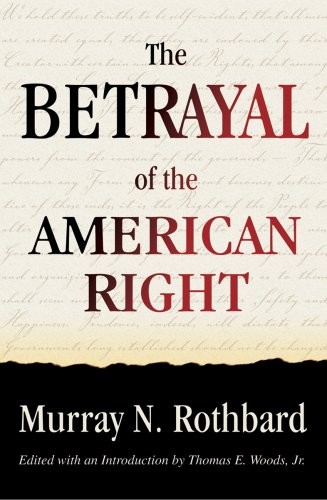
Murray Rothbard, "Betrayal of the American Right" (2007)
Rothbard is one of the pre-eminent American libertarian thinkers.
This title - written in the 1970s but not published until recently - offers Rothbard's assessment of the diversion of conservative thinking in the United States from libertarianism to statism from the late 19th- to the 1960s.
Rothbard offers a compelling, revisionist narrative history of the intellectual development of libertarian thinking in the United States. He particularly focuses on differences that emerged between libertarians and the Republican Party mainstream around the United States' participation in foreign wars.
Additional notes available soon.
The full text of the book is available at: http://mises.org/library/betrayal-american-right-0
This title - written in the 1970s but not published until recently - offers Rothbard's assessment of the diversion of conservative thinking in the United States from libertarianism to statism from the late 19th- to the 1960s.
Rothbard offers a compelling, revisionist narrative history of the intellectual development of libertarian thinking in the United States. He particularly focuses on differences that emerged between libertarians and the Republican Party mainstream around the United States' participation in foreign wars.
Additional notes available soon.
The full text of the book is available at: http://mises.org/library/betrayal-american-right-0
Friday, 7 November 2014
Norman Mailer, "Oswald's Tale: An American Mystery" (1995)
If you're not aware already, the Oswald in question here is Lee Harvey Oswald, assassin of US President Kennedy. Mailer is one of the US's best-known 'old white male' authors, primarily known for his fiction work.
Oswald's Tale is bit of a "dog's breakfast"; the first forty-percent of the book is a close consideration of Oswald's time living in the Soviet Union. Mailer and associates spent about six months locating and interviewing people who had contact with Oswald, ranging through love interests, co-workers, and KGB agents who spied on Oswald. Information gained from these interviews is supplemented with knowledge gained from documents produced during that time, primarily by Soviet state agencies. The second, sixty-percent of the book consists of Mailer's quoting at length from already-published works, interspersed with his own, rather unique speculations about Oswald's activities and motivations.
The first portion of the book is intriguing, and seems to bring some new insights to discussion of Oswald. The second is far more troubling, in that it offers little in the way of insights, and overwhelms with its dubious psychoanalysis and conjecture.
Mailer does try to use observations from the first section to ground some of his ideas developed in the second. For instance, based on some (rather dicey) proposals that Oswald may have been engaged in some kind of homosexual contact during his stint in the Marines, as well as later in Russia, Mailer later tries to propose that Oswald was perhaps receiving money from a male lover in Texas during the year preceding Kennedy's assassination. Mailer suggests also that Oswald's sapiosexuality might explain his sexual relationship with his wife, which apparently went through lengthy periods of non-interest.
Mailer's ideas are generally fairly loosely developed. While this can suggest openness, it can also lead him into excess. Evidence? Read the two following quotations.
I found Mailer's consideration of history writing, particular when trying to understand the motivations of historical characters, intriguing.
You can read the final two chapters of the book here, on the Frontline website.
A good review of the book by Thomas Powers can be found in the NY Times.
If you are interested in the Kennedy assassination, I have previously discussed the following:
- Vincent Bugliosi, Reclaiming History: The Assassination of President John F. Kennedy (2007)
- Jeff Greenfield, Then Everything Changed: Stunning Alternate Histories of American Politics: JFK, RFK, Carter, Ford, Reagan (2010)
- David Aaronovitch, Voodoo Histories: The Role of the Conspiracy Theory in Shaping Modern History (2009)
Oswald's Tale is bit of a "dog's breakfast"; the first forty-percent of the book is a close consideration of Oswald's time living in the Soviet Union. Mailer and associates spent about six months locating and interviewing people who had contact with Oswald, ranging through love interests, co-workers, and KGB agents who spied on Oswald. Information gained from these interviews is supplemented with knowledge gained from documents produced during that time, primarily by Soviet state agencies. The second, sixty-percent of the book consists of Mailer's quoting at length from already-published works, interspersed with his own, rather unique speculations about Oswald's activities and motivations.
The first portion of the book is intriguing, and seems to bring some new insights to discussion of Oswald. The second is far more troubling, in that it offers little in the way of insights, and overwhelms with its dubious psychoanalysis and conjecture.
Mailer does try to use observations from the first section to ground some of his ideas developed in the second. For instance, based on some (rather dicey) proposals that Oswald may have been engaged in some kind of homosexual contact during his stint in the Marines, as well as later in Russia, Mailer later tries to propose that Oswald was perhaps receiving money from a male lover in Texas during the year preceding Kennedy's assassination. Mailer suggests also that Oswald's sapiosexuality might explain his sexual relationship with his wife, which apparently went through lengthy periods of non-interest.
Mailer's ideas are generally fairly loosely developed. While this can suggest openness, it can also lead him into excess. Evidence? Read the two following quotations.
Pg. 491: “All through February and March he prepares himself to strike at Walker. The notion that the General was a Hitler in the making was key to choosing him for a target. The soft underbelly, however, of so lofty a notion – stop the second Hitler before he arises - comes in large degree because of Oswald’s concealed sense of himself – even from himself! – of also being a putative Hitler. A physical resemblance between the two men had to be, consciously or unconsciously, in Oswald’s mind. One need only pencil in a mustache on any photograph of Oswald in profile to feel the force of the resemblance. In his fantasies, would Oswald have refused a Faustian pact? Allow him to steal Hitler’s powers of ascendancy, and he could convert them to his own vastly more idealistic vision. But first he must kill a minor god.”
Pg. 551: “It was as if his murderous impulses could only be gathered if he was without sexual release. To continue his marriage was to condemn himself, therefore, to a life of mediocrity, yet – there is no other explanation for so many of his actions – a sizeable part of him adored Marina, and this quite apart from his full affection for June. For that matter, devotion to June was like an open display of his infatuation with himself. But Marina he loved as his woman, his difficult, caustic contrary, and often wholly attractice wife – even if he could hardly tolerate her for most of the month. Are half of the young husbands in existence all that much unlike him? Or young wives?”
I found Mailer's consideration of history writing, particular when trying to understand the motivations of historical characters, intriguing.
Pg. 605: “This book, however, was undertaken without a fixed conclusion in either direction; indeed, it began with a prejudice in favor of the conspiracy theorists. All the same, one’s plan for the work was to take Oswald on his own terms as long as that was possible – that is, to try and comprehend his deeds as arising from nothing more than himself until such a premise lost all headway. To study his life in this manner produced a hypothesis: Oswald was a protagonist, a prime mover, a man who made things happen… Indeed, this point of view has by now taken hold to a point where the writer would not like to relinquish it for too little. There is the danger! Hypotheses commence as our servant – they enable us to keep our facts in order while we attempt to learn more about a partially obscured subject. Once the profits of such a method accumulate, however, one is morally obliged… to be scrupulously on guard against one’s own corruption. Otherwise, the hitherto useful hypothesis will insist on prevailing over everything that comes in and so will take over the integrity of the project.”
You can read the final two chapters of the book here, on the Frontline website.
A good review of the book by Thomas Powers can be found in the NY Times.
If you are interested in the Kennedy assassination, I have previously discussed the following:
- Vincent Bugliosi, Reclaiming History: The Assassination of President John F. Kennedy (2007)
- Jeff Greenfield, Then Everything Changed: Stunning Alternate Histories of American Politics: JFK, RFK, Carter, Ford, Reagan (2010)
- David Aaronovitch, Voodoo Histories: The Role of the Conspiracy Theory in Shaping Modern History (2009)
Wednesday, 20 August 2014
Eric Schlosser, "Command and Control" (2013)
Subtitle: "Nuclear Weapons, the Damascus Accident and the Illusion of Safety."
In progress.
Tim Oliver of Johns Hopkins University (USA) published a good review of the book in International Affairs.
Schlosser commissioned a film related to the themes of Command and Control.
In progress.
Tim Oliver of Johns Hopkins University (USA) published a good review of the book in International Affairs.
Schlosser commissioned a film related to the themes of Command and Control.
Labels:
book reviews,
Cold War history,
military,
Soviet history,
U.S.A. history
Wednesday, 13 August 2014
John English, "Life of Lester Pearson, 1949-1972" (1992)
Full title: The worldly years : the life of Lester Pearson, 1949-1972.
In progress.
English is perhaps better known as the author of one of the finest, best-researched biographies of Prime Minister Pierre E. Trudeau (which I discussed earlier). His two-volume biography of Pearson is a much earlier work, also concerning one of the most respected contemporary Prime Ministers.
In progress.
English is perhaps better known as the author of one of the finest, best-researched biographies of Prime Minister Pierre E. Trudeau (which I discussed earlier). His two-volume biography of Pearson is a much earlier work, also concerning one of the most respected contemporary Prime Ministers.
Thursday, 26 June 2014
Duncan Anderson, "The Falklands War 1982" (2002)
A bit of a guilty indulgence. Osprey is known for publishing 'light' general descriptions of military history topics, including battles, technology and personalities.
This consideration of the Falklands War - a small battle though significant moment in late-20th century history - is not superficial, but provides rather closer attention to narrating the day-to-day combat than assessing the deeper geo-political and economic factors at play.
Essentially, an Argentinian military government decided that one way to distract public concern over domestic conditions while solving a long-standing desire to patriate/seize some strategically important territory would be to turf the British from several islands about 400 miles from the Argentinian coast. In May 1982, Argentine troops (disguised and in uniform) quickly overcame the very small British forces on the Falklands. In the ensuing conflict, Britain surprised the Argentines by throwing in a sizeable military response, and although taking losses, inflicting much heavier costs (particular in the air and at sea).
Losing the Falklands conflict reinforced Thatcher's reputation at home, and destroyed Galtieri's ability to govern Argentina.
This consideration of the Falklands War - a small battle though significant moment in late-20th century history - is not superficial, but provides rather closer attention to narrating the day-to-day combat than assessing the deeper geo-political and economic factors at play.
Essentially, an Argentinian military government decided that one way to distract public concern over domestic conditions while solving a long-standing desire to patriate/seize some strategically important territory would be to turf the British from several islands about 400 miles from the Argentinian coast. In May 1982, Argentine troops (disguised and in uniform) quickly overcame the very small British forces on the Falklands. In the ensuing conflict, Britain surprised the Argentines by throwing in a sizeable military response, and although taking losses, inflicting much heavier costs (particular in the air and at sea).
Losing the Falklands conflict reinforced Thatcher's reputation at home, and destroyed Galtieri's ability to govern Argentina.
Labels:
book reviews,
Cold War history,
European history,
military
Thursday, 19 June 2014
Francis Parker Yockey, "Proclamation of London..." (1949)
Yockey's pamphlet, a proclamation by the European Liberation Front, is an inflammatory anti-Semitic, anti-American screed that advocates for a Pan-European movement that will move away from materialism, capitalism, liberal democracy, communism, and feminism. He suggests instead that Europeans should 'return' to values of faith, authority, and power.
Having broken with the Union Movement, a political organization founded in 1948 by Sir Oswald Mosley, former head of the British Union of Fascists and recently freed British political internee, transplanted American Yockey founded the European Liberation Front.
Fuller comments will follow eventually.
The full text can be found in a multitude of online locations, such as archives.org.
If this text interests you, see also my comments on Ben Klassen's Letters (Vol. 1 & Vol. 2), and William Pierce's Turner Diaries and Hunter.
Having broken with the Union Movement, a political organization founded in 1948 by Sir Oswald Mosley, former head of the British Union of Fascists and recently freed British political internee, transplanted American Yockey founded the European Liberation Front.
Fuller comments will follow eventually.
The full text can be found in a multitude of online locations, such as archives.org.
If this text interests you, see also my comments on Ben Klassen's Letters (Vol. 1 & Vol. 2), and William Pierce's Turner Diaries and Hunter.
Labels:
book reviews,
Cold War history,
European history,
fascism,
racism
Tuesday, 20 May 2014
Anne Applebaum, "Iron Curtain" (2013)
The subtitle for this book is: "The Crushing of Eastern Europe, 1945-1956."
Applebaum is the author of the critically-acclaimed Gulag, and the spouse of Poland's Foreign Minister.
Applebaum's scholarship is impressive. She has mined a voluminous and multi-language body of archival material that has only become available in the last few decades. She has also, apparently, conducted interviews with an abundance of former Communist Party workers, members of the Communist youth associations, etc. She manages to tell a compelling story clearly, making the relationships between the Central/East European countries and their overseers in the Soviet Union clear.
Essentially, Applebaum divides the Soviet era into two periods, that running from 1944 through to 1949 (the consolidation of Soviet power), and the period of 1949 to 1956 (the period she describes as "High Stalinism", as well as the immediate aftermath of Stalin's reign).
Notes of relevance to possibly no one but me (page numbers correspond to my digital edition):
p. 193 – “In the eighteenth century, Edmund Burke wrote admiringly of the ‘little platoons,’ the small social organizations from which, he believed, public spirit arose (and which he thought were threatened by the French Revolution). In the nineteenth century, Alexander de Tocqueville wrote equally enthusiastically of the ‘associations’ that ‘Americans of all ages, all conditions, and all dispositions constantly form.’ He concluded that they helped ward off dictatorship: ‘If men are to be remain civilized or to become so, the art of associating together must grow and improve.’
p. 406 - Jakub Berman was both culture minister, as well as head of secret police. Noted from Toranska, Oni: Stalin’s Polish Puppets. 1988.
p. 516 – Noting that some Poles actually sought to bring their factories closer to Marxist-oriented worker-management, Applebaum quotes Hungarian intellectual Eörsi: “That is the common trap of all quasi-revolutionary systems: the people begin to take seriously the real message of the officially declared ideology and the nationalized heroes of the system.” (From: page 110. Hegedus, “The Petofi Circle…” Journal of Communist Studies and Transition Politics 113,2, pp. 108-122.
Applebaum is the author of the critically-acclaimed Gulag, and the spouse of Poland's Foreign Minister.
Applebaum's scholarship is impressive. She has mined a voluminous and multi-language body of archival material that has only become available in the last few decades. She has also, apparently, conducted interviews with an abundance of former Communist Party workers, members of the Communist youth associations, etc. She manages to tell a compelling story clearly, making the relationships between the Central/East European countries and their overseers in the Soviet Union clear.
Essentially, Applebaum divides the Soviet era into two periods, that running from 1944 through to 1949 (the consolidation of Soviet power), and the period of 1949 to 1956 (the period she describes as "High Stalinism", as well as the immediate aftermath of Stalin's reign).
Notes of relevance to possibly no one but me (page numbers correspond to my digital edition):
p. 193 – “In the eighteenth century, Edmund Burke wrote admiringly of the ‘little platoons,’ the small social organizations from which, he believed, public spirit arose (and which he thought were threatened by the French Revolution). In the nineteenth century, Alexander de Tocqueville wrote equally enthusiastically of the ‘associations’ that ‘Americans of all ages, all conditions, and all dispositions constantly form.’ He concluded that they helped ward off dictatorship: ‘If men are to be remain civilized or to become so, the art of associating together must grow and improve.’
p. 406 - Jakub Berman was both culture minister, as well as head of secret police. Noted from Toranska, Oni: Stalin’s Polish Puppets. 1988.
p. 516 – Noting that some Poles actually sought to bring their factories closer to Marxist-oriented worker-management, Applebaum quotes Hungarian intellectual Eörsi: “That is the common trap of all quasi-revolutionary systems: the people begin to take seriously the real message of the officially declared ideology and the nationalized heroes of the system.” (From: page 110. Hegedus, “The Petofi Circle…” Journal of Communist Studies and Transition Politics 113,2, pp. 108-122.
Tuesday, 6 May 2014
Max Boot, "Savage Wars of Peace" (2002)
Subtitled: "Small Wars and the Rise of American Power."
This book is eminently readable. Not only does Boot use a wide-ranging vocabulary, but his narrative style is light and fresh. He turns descriptions of relatively obscure 19th-century imperial battles between usually poorly balanced adversaries into informative, compelling tales.
As a scholar, I find his method of source citation frustrating. Instead of using footnotes or endnotes, he opts for that (weird) system - often employed in mass media books - that uses a set of brief quotations at the end of the book as a place to indicate what the sources were, as well as to add author marginalia. I despise having to flip back and forth to this information gulag speculatively, in the hopes that the author has provided some sources. I recognize that this is my pet peeve, however, and not really a weakness on Boot's part.
His personal politics are fairly obvious, thought not off-putting (at least to this reader). He is clearly an apologist for American imperial power, though certainly not blind to the risks and negative outcomes that application and extension of that power has produced in developing or non-developed societies.
Fuller comments will follow eventually.
This book is eminently readable. Not only does Boot use a wide-ranging vocabulary, but his narrative style is light and fresh. He turns descriptions of relatively obscure 19th-century imperial battles between usually poorly balanced adversaries into informative, compelling tales.
As a scholar, I find his method of source citation frustrating. Instead of using footnotes or endnotes, he opts for that (weird) system - often employed in mass media books - that uses a set of brief quotations at the end of the book as a place to indicate what the sources were, as well as to add author marginalia. I despise having to flip back and forth to this information gulag speculatively, in the hopes that the author has provided some sources. I recognize that this is my pet peeve, however, and not really a weakness on Boot's part.
His personal politics are fairly obvious, thought not off-putting (at least to this reader). He is clearly an apologist for American imperial power, though certainly not blind to the risks and negative outcomes that application and extension of that power has produced in developing or non-developed societies.
Fuller comments will follow eventually.
Labels:
book reviews,
Cold War history,
military,
U.S.A. history
Saturday, 19 April 2014
Jeff Greenfield, "Then Everything Changed" (2010)
Sub-titled: "Stunning Alternate Histories of American Politics: JFK, RFK, Carter, Ford, Reagan."
What distinguishes this book from many allohistorical texts - particularly those considered with political popular culture (that is a term I can apply to the Kennedy assassinations, no?) - is that the author is genuinely a political insider. He had familiarity with many of the people he writes about, including the Kennedys. He also brings years of experience as a political analyst and commentator. This knowledge has led him to write a book that is more daunting than the average 'science fiction'/casual reader might desire. It is, however, the key to Greenfield's approach.
Much of what Greenfield considers in weighing historical alternatives is based on tweaking a single event, and then looking at the weight of likely political response, particularly in how the negotiation of alliances, strategizing, and campaigning would play itself out in the new circumstances provided by the author's re-imagining. So, for instance, RFK's near-assassination is obviously important, but where the true 'grit' of Greenfield's imagination gains its importance is how he conceives of RFK's electoral chances given the likely messaging his team would have pursued, who the Republicans might have selected as their candidate in response to the changed circumstances, and how their competing messages might have played out in the various electoral colleges. Frankly, fascinating, daunting, exhausting reading that offers much for historians and political junkies alike.
I admit to knowing nothing about Greenfield before I read this book. I picked it up based on an interest in political allohistory.
What distinguishes this book from many allohistorical texts - particularly those considered with political popular culture (that is a term I can apply to the Kennedy assassinations, no?) - is that the author is genuinely a political insider. He had familiarity with many of the people he writes about, including the Kennedys. He also brings years of experience as a political analyst and commentator. This knowledge has led him to write a book that is more daunting than the average 'science fiction'/casual reader might desire. It is, however, the key to Greenfield's approach.
Much of what Greenfield considers in weighing historical alternatives is based on tweaking a single event, and then looking at the weight of likely political response, particularly in how the negotiation of alliances, strategizing, and campaigning would play itself out in the new circumstances provided by the author's re-imagining. So, for instance, RFK's near-assassination is obviously important, but where the true 'grit' of Greenfield's imagination gains its importance is how he conceives of RFK's electoral chances given the likely messaging his team would have pursued, who the Republicans might have selected as their candidate in response to the changed circumstances, and how their competing messages might have played out in the various electoral colleges. Frankly, fascinating, daunting, exhausting reading that offers much for historians and political junkies alike.
I admit to knowing nothing about Greenfield before I read this book. I picked it up based on an interest in political allohistory.
Wednesday, 2 April 2014
Francis Spufford, "Red Plenty" (2012)
You can read an extract from the book here.
Spufford has created a fairly fun website to support his book.
Tuesday, 18 March 2014
Deborah Lipstadt, "The Eichmann Trial" (2011)
In progress.
The New Republic offers an excellent assessment of the book.
You can also watch/listen to Lipstadt discuss the book, in a half-hour talk at University of South Florida, delivered in February 2012.
Additionally, see my discussion of Lipstadt's Denying the Holocaust: The Growing Assault on Truth and Memory (1993).
The New Republic offers an excellent assessment of the book.
You can also watch/listen to Lipstadt discuss the book, in a half-hour talk at University of South Florida, delivered in February 2012.
Additionally, see my discussion of Lipstadt's Denying the Holocaust: The Growing Assault on Truth and Memory (1993).
Monday, 3 March 2014
Patrick Coffey, "American Arsenal: A Century of Waging War" (2013)
The Los Angeles Review of Books offers an excellent review of Coffey's text.
Friday, 15 November 2013
John Clearwater, "Canada's Nuclear Weapons" (1998)
Subtitle: "The Untold Story of Canada's Cold War Weapons."
More to follow.
More to follow.
Wednesday, 18 September 2013
Monday, 6 May 2013
J.T. Patterson, "The Eve of Destruction" (2012)
The subtitle of this book is, " How 1965 Transformed America." 
I've finished the book, but have yet to write a summary. Sorry!
You can listen to/watch the author give a talk on the book at the University of Virginia's Miller Centre (Jan. 2013).
A discussion with the author is available via BookTV.
Some reviews of the book are linked here:
John Wilson, Books & Culture.

I've finished the book, but have yet to write a summary. Sorry!
You can listen to/watch the author give a talk on the book at the University of Virginia's Miller Centre (Jan. 2013).
A discussion with the author is available via BookTV.
Some reviews of the book are linked here:
John Wilson, Books & Culture.
Labels:
book reviews,
Cold War history,
racism,
social history,
U.S.A. history
Subscribe to:
Posts (Atom)


+06.43.36.png)