Reflections by Dr. Gregory Klages on non-fiction books dealing primarily with politics, history, and religion. Significant attention to Canadian content. Mail me/comment if you read anything. I love to hear feedback!
Thursday, 29 December 2011
Frances Widdowson & Albert Howard, "Disrobing the Aboriginal Industry" (2008)
The subtitle for this book is "The Deception Behind Indigenous Cultural Preservation."
This book is tough to read. Widdowson and Howard are not gentle in their criticism of aboriginal activists, government negotiators, academics, and the sundry hangers-on that speak in favour of a mythical 'golden' state of nature for aboriginals, and economic, social, and political solutions for contemporary Canadian problems based on that 'golden' myth.
More to follow.
Labels:
book reviews,
Canadian history,
Canadian politics,
racism
Thursday, 22 December 2011
Alexandra Highcrest, "At Home On The Stroll" (1997)
The subtitle of this book clarifies what it is really about: "My Twenty Years As A Prostitute In Canada."
In short, the story of a northern Ontario boy who moves to Toronto, begins working as a prostitute, finds the life not particularly objectionable (especially the money), makes some friends, conflicts with family, deals with some bad tricks, begins to experiment with living as a woman, leaves the trade, becomes an advocate. An intriguing story that doesn't wallow in polemicizing about the evils of prostitution, or preaching the virtues of liberal live-and-let-live economics. It is one person's story, one person's analysis, and a very humane one at that.
Belinda Beaton has written a very good review of this book in Books in Canada.
Labels:
book reviews,
Canadian politics,
prostitution
Vincent Bugliosi, "Reclaiming History: The Assassination of President John F. Kennedy" (2007)
I worked on Bugliosi's epic (more than 1,500 pages, as well as a full CD of notes and sources) on and off from 2008 through to the end of 2011 (more off than on, I'll admit). It is compelling, if at times annoying, reading. It is to be expected that anyone who treads into such a storied and controversial subject will anger many, and 'speak truth' to others. Bugliosi gives short shrift to the abundant conspiracy theorists. He denies, flat out and without any apology, the prospect of any conspiracy being involved in JFK's death. He attacks, sometimes in quite vitriolic terms, the arguments and even sometimes the reputations of many conspiracy theorists.
Bugliosi has an impressive history as an American prosecutor. He successfully tried, for instance, Charles Manson. In the 1980s, he was hired by a British media firm to engage in a mock trial of Lee Harvey Oswald. The budget for the project was fairly large, and resulted in something close to 15 hours of television. Bugliosi's preparation for the case likely forms the foundation for this book.
Part of what makes Reclaiming History so compelling is simply the weight... or should I say, the volume... of the text itself. It's hard to argue with a book that offers such a comprehensive, overwhelming amount of text, and that appears to be based on an exhaustive search of primary and secondary documents related to the case. Bugliosi also, like a good prosecutor would, not only provides an overview of what he understands the events related to the case to be, but devotes chapters to demolishing a multitude of positions related to conspiracy proposals, including questions regarding Oswald's ownership of the gun used for the assassination, sightings of other shooters, irregularities of the autopsy, etc. For this, the book's encyclopedic coverage is tremendously useful.
Bugliosi's writing style is - to be kind - indulgent. The text often wades into annoying rhetorical questions, petty name-calling, and unnecessary speculation about other authors' motivations. The worst chapter for such indulgence is the second-last, which explores Oliver Stone's film, JFK, in depth. With much of the rhetoric and excess excised (something a good editor could and should have done, if they could have gotten through the whole of the text in less than a year) the book would have run to perhaps a far more manageable 1,000 pages.
The length of the text is its central shortcoming for casual readers. The book is not for the faint of heart, nor for the weak of arm. For those with a deep interest in the Kennedy assassination, you will get what you most need in the first ten chapters or so. Some may also find it useful to read the chapter devoted to the film JFK.
Bryan Burrough wrote a very good review of Reclaiming History for the 20 May 2007 New York Times:
http://www.nytimes.com/2007/05/20/books/review/Burrough-t.html
You can watch or read the FORA.tv transcript of a 2007 talk by Bugliosi on the book:
http://fora.tv/2007/05/15/Vincent_Bugliosi_Reclaiming_History
Saturday, 3 December 2011
Joseph E. Stiglitz & Linda J. Bilmes, "The Three Trillion Dollar War" (2008)
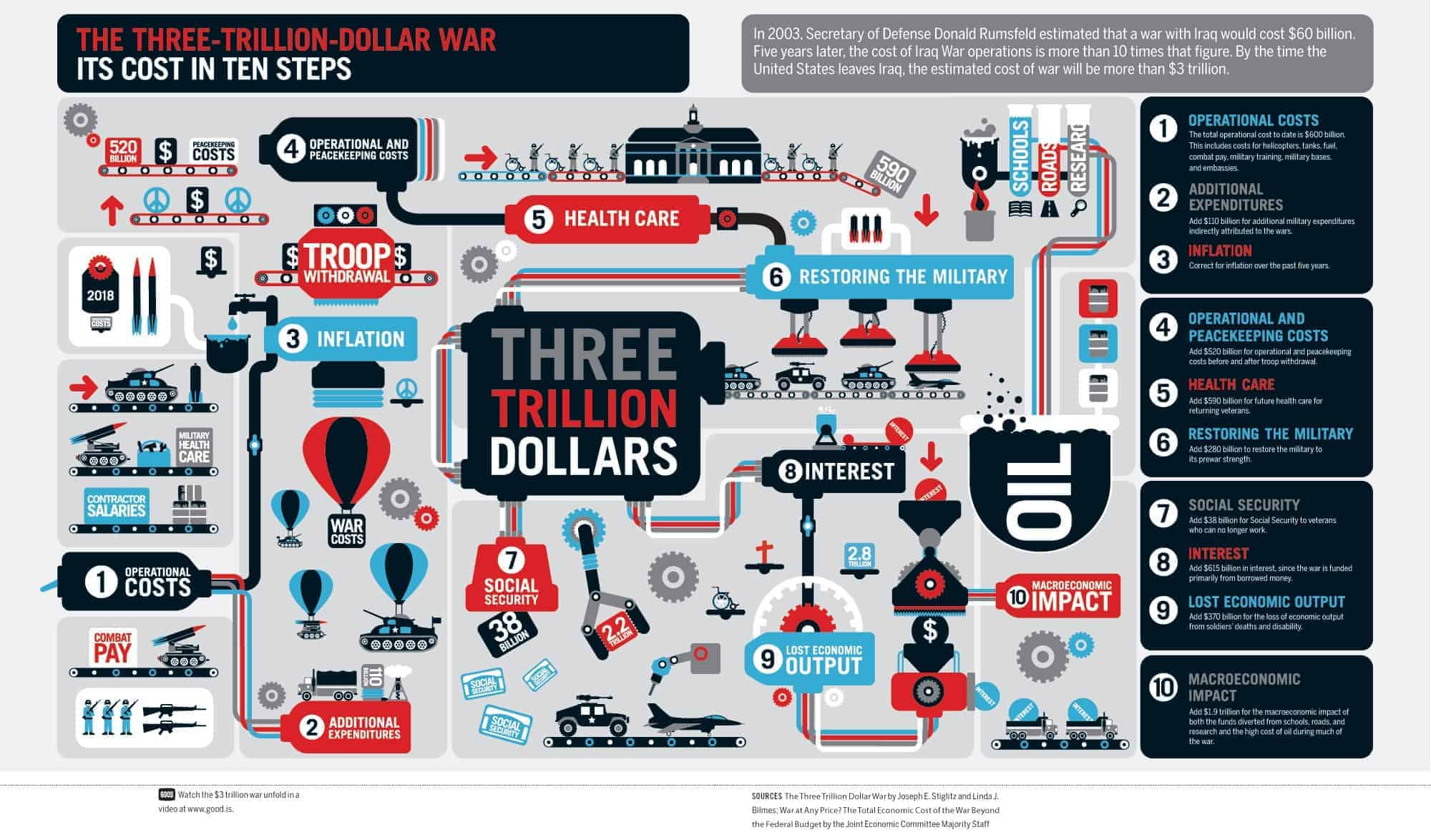
The full title of Stiglitz and Bilmes' much talked about book is The Three Trillion Dollar War: The True Cost of the Iraq Conflict. The central idea they propose in the book is that the way the costs of the war were discussed, by the great unwashed masses, the US government, and the US military, is wildly misleading, either by intention or error. They propose, through using a form of what I will call forensic auditing - for lack of a term I know that will be more correct - to identify heretofore hidden costs of the war, costs of the war that have not been discussed or built into short and long-term US national budgeting, and incidental or related costs of the war that do not go reported in calculations claiming to capture the cost of the war.
A decent, though cursory, outline of the types of costs the book analyses are laid out here:
http://dailyinfographic.com/wp-content/uploads/2011/01/threetrilliondollarwar.jpeg
Excerpts from the book can be read at:
National Public Radio, USA (NPR) - http://www.npr.org/templates/story/story.php?storyId=87855957
Vanity Fair, Apr. 2008 - http://www.vanityfair.com/politics/features/2008/04/stiglitz200804
Labels:
economics,
Middle East,
military,
U.S.A. history
Monday, 7 November 2011
Chalmers Johnson, "Nemesis: The Last Days of the American Republic" (2007)
Nemesis is the third in Johnson's 'American Empire Trilogy'. Dan Clendenin offers a succinct, accurate summary of the series at Journey with Jesus.
You can read significant portions of the text via Google Books.
All too often I write these summaries several weeks after having finished the text in question. This presents dangers and advantages. On one hand, the objectivity provided by some temporal distance from the reading experience helps to test the impressions made by the book. On the other, even the most thought-provoking ideas from the most well-written book – ideas that might benefit from prolonged consideration - can simply get lost in the challenges of managing daily life. To a certain degree, this is how I now experience Nemesis.
The book impressed me enough that I started to make notes. The notes were written on the back of a receipt, however, and do not go beyond cryptic comments such as, “pg. 73 – quote”.
Johnson’s American Empire Trilogy is an inspiring, chilling assessment of how the United States has developed as a global power since the Second World War, how that empire is likely to precipitously decline in the next few decades, and what the reasons for that decline currently appear to be. Nemesis explores the rise of a military state, where spending and policy prioritization is often driven by the needs of the military, the lobbyists hired by military contractors, and the elected officials and political constituencies who have come to depend on American domestic military spending. The need to pursue this sort of spending, and to control the domestic political process to allow the USA to carry out aggressive and often semi-secret military initiatives abroad also have led to a deteriorization in the practice of democracy in the country. The particular example explored in Nemesis is the growth of the Central Intelligence Agency, which can largely function (particularly in the waging of aggressive actions beyond the United States’ borders) without the consent of Congress, and is answerable only to the President, not Americans as a whole.
The increasing extension of the United States as a military empire – and by this I mean its creation of physical military facilities and properties explicitly intended to provide semi-permanent operating bases in foreign countries – holds significant risks for the country. While it calls for ongoing and significant spending, it also creates a certain tension between the countries who grow dependent – willingly or not – on that US military presence, while at the same time hating it and the cultural and political presumptions that they represent.
Johnson also explores, in a particularly scathing and informative chapter, the ridiculous record of US experimentation and investment in the militarization of space. He also wisely directs his readers’ attention to the very real problems – too rarely considered - that military conflict in space would pose. I was fascinated to read, for instance, the near instantaneous destruction that even a small explosion would likely cause for almost all satellites (aggressive or not, friendly or not). It is easy for us to forget how destructive something as minor as a screw flying through orbit at hundreds of kilometers an hour can be. Consider what fragments of an exploding satellite or ICBM would do the US military GPS satellite network.
A few last items purely of interest to me, I'm sure follow:
- pg. 73: Johnson quotes Michael Ignatieff, from the NY Times, 5 Jan. 2003: "Ever since George Washington warned his countrymen against foreign entanglements, empire abroad hasbeen seen as the republic's permanent temptation and its potential nemesis. Yet what word but 'empire' describes the awesome thing that America is becoming? It is the only nation that polices the world through five global military commands; maintains more than a million men and women at arms on four continents; deploys carrier battle groups on watch in every ocean; guarantees the survival of countries from Israel to South Korea; drives the wheels of global trade and commerce; and fills the hearts and minds of an entire planet with its dreams and desires."
- pg. 82: "the United States, protected from its inception to about 1940 by tariffs on manufactured importss that averaged 44 percent"
- pg. 89: "Imperialism and militarism will ultimately breach the separation of powers created to prevent tyranny and defend liberty. ...Rome and Britain are archetypes of the dilemma of combining democracy at home with an empire abroad. In the Roman case, they decided to hang on to the empire and lost their democracy. In the British case, they chose the opposite: in order to remain democratic they dumped their empire and military apparatus after World War II. For us [Americans], the choice is between the Roman and British precedents."
Here is a February 2007 Democracy Now! interview with Chalmers Johnson, regarding Nemesis.
Labels:
book reviews,
Cold War history,
Middle East,
military,
U.S.A. history
Tuesday, 4 October 2011
Gwynne Dyer, "The Mess They Made: The Middle East After Iraq" (2007)
Dyer has written a captivating, approachable, opinionated and authoritative discussion of how the war in Iraq came about, and how, built on a foundation of ill-thought out strategic choices, the long-term unintended and unforeseen consequences of that war might have devastating effects for US foreign policy goals.
One strength of Dyer’s approach is that he does not write in a way that depends on a deep familiarity with the historical, political, military or social conditions within which the war occurs. He certainly writes far above a “Middle Eastern conflict for Dummies” text; perhaps it might be called “Middle Eastern conflict for young diplomats”.
Key to Dyer’s analysis is consideration of three factors often touted as justifications for concern with Iraq, if not the second US war on the region. The first is the idea that Saddam Hussein was tantamount to a Middle Eastern Hitler, seeking lebensraum and riches from his immediate neightbours. Second, is the prospect of Hussein’s Iraq having capacity – if not using – weapons of mass destruction (WMDs). The third is the threat radical, militant Islam, particularly Shias, was believed to posed.
As Dyer clearly lays out, it is quite likely that the initial conflict that brought the US into direct conflict with Iraq, the invasion of Kuwait, represented a fundamental breakdown in communication between two cooperating, if not allied nations. The US had supported Iraq in its decade-long war with Iran, and the record suggests that Iraq believed – such as in its discussions with Madeleine Albright – that the US was not opposed to the invasion of Kuwait. Telescoping this problem into the future, illustrated by other examples, it is easy to see how US intervention in the region has often been intended to play forces off against each other, to limit the expansion of any particular force, and particularly during the presidency of G.W. Bush, to ensure that no meaningful counter-force to US dominance could arise in areas of US-concern, if not the globe. As the need to address US debt rises, as global powers rise to counter US hegemony, and as the nature of political power changes during the 21st century, however, the US may find itself facing a region with a deeply entrenched hostility to the US, and bent on avenging a previous generation’s humiliations.
The second concern presents an interesting dilemma. As most people know now, Iraq did not possess WMDs. It is even quite likely that the US knew this going into the second war. What is not often talked about is the widespread awareness that Iraq had already used chemical and biological weapons in its 1980s war with Iran, uses that were sanctioned, if not assisted by the US. Having armed an ally, much as was done in Afghanistan with the mujahideen, the US found itself within a decade, having to fight against a country armed largely with US weaponry. The argument that has been used to sabre-rattle against Iran is very similar to that which was used to justify attacking Iraq: Iran may have nuclear weapons, or be seeking the capacity to build them. Dyer observes that the economy of the country precludes its ability to generate a meaningful nuclear development program, let alone an arsenal that could provide any kind of sensible deterrent to Israel’s overwhelming nuclear armaments. For these reasons, the proposal that Iran might develop nuclear weapons should not be taken too seriously.
Finally, with regard to the rise of a militant stream of devout Shia Muslims, Dyer suggests that the cadre of radicals is not reflective of the larger Shia sensibilities. Additionally, if there is radicalization, it is as a result of US activities, not the other way around. In this respect, the rather unreasonable US response to 9/11, parsing the events as an act of war by a nation rather than as a terrible but singular terrorist attack, has hastened the downfall of the United States as it strives to fund multiple foreign wars, fight terrorism at home and abroad, and see its economy and politics succumb to a dangerous form of singularism of goal and absolutism of control.
Perhaps the most effective and thought-provoking chapter of The Mess They Made is the one Dyer devotes to exploring the role of Israel in the Middle East. From his perspective, political division within Israel, and the competing desires to achieve peace while not yielding any territory acquired through military conquest has served to exacerbate tensions surrounding Israel’s future. Noting its substantial military buildup (Israel has more nuclear missiles than Britain, for instance, and has not been shy in suggesting that it would use them if necessary, and not just on Arab neighbours), Dyer suggests that if it seeks lasting peace, or at least hopes to indicate a willingness to bargain in good faith with its neighbours, it will need to at some point accept a two-state solution with Palestine. When considered with respect to waning US power, and growing enmity towards the US in the Middle East, and the important role the US has played in supporting Israel internationally for the last fifty years, the implications are substantial. The next generation could see growing pressure on Israel to come to the table regarding Palestine, and a growing militarism from within Israel as a response to the perceived threat of growing demands from its neighbours. This militarism might serve to be particularly dangerous in light of the significantly diminished military, particularly offensive, capacity of the country’s neighbours.
Labels:
book reviews,
Middle East,
military,
U.S.A. history
Monday, 3 October 2011
Chester Brown, "Louis Riel: A Comic Strip Biography" (2004)
I had high hopes for this graphic novel. Not too long ago I reviewed Chester Brown's Paying For It on this blog. I had seen his Louis Riel book many times in book stores, and been intrigued. I had browsed through it briefly. I know someone who assigned it as a text for the students taking a history course concentrating on Canadian history since 1867. It seemed to be right up my alley. I was suspicious that a graphic novel could not do Riel and the Metis conflicts with Canada justice, however. My suspicions were right.
Maybe I'm a politics and history geek. Maybe I demand too much of a graphic novel. As a particular kind of tool, for a particular kind of audience, this work may be a great 'teaser' work. The very format of the graphic novel - or perhaps this particular graphic novel - simply did not allow the ambiguity and complexity of the situation to be well communicated. Instead, it offered the kind of guilty Canadian anti-nationalism that Jack Granatstein so lamented a few years ago in Who Killed Canadian History?
Yes, this is a quick read. Yes, it's about the kind of topic that I'd be glad to see high school students reading about. Yes, it's by Chester Brown, whose Yummy Fur series I loved. No, it's not that great a book if you're interested in Canadian history and capable of reading straight prose for more than ten minutes.
Subscribe to:
Posts (Atom)