Friday, 5 August 2011

Marci Mcdonald, "The Armageddon Factor: The Rise of Christian Nationalism in Canada" (2011)


Mcdonald kicked open wide a hornet's nest of controversy with this book. I admit that even jaded old me avoided reading it thinking it would just a sad, rambling case of conspiracy theory. It was actually pretty interesting, compelling reading.

Essentially, she explores two questions:
1) What is the relationship between the Harper government and 'Christian Nationalists' in Canada?; and
2) What is the motivation for Christian Nationalists to involve themselves in Canadian politics when traditionally they have opted to steer clear of political involvement?

Her answer to these questions is that there is a distinct community of Canadian Christian Nationalists (those who believe not only that Canada should be governed according to strict evangelical Christian principles, but that the Bible indicates Canada will play a special role in the anticipated 'end days'). These CCNs, and their like-minded community of evangelicals (who may not share the idea regarding Canada's pre-ordained end days role), have become significantly more politicized in the last few decades, and attempted to not only influence politics indirectly (e.g., through encouraging congregants to vote for particular candidates, or raising issues for public debate), but also directly (e.g., through financial support for candidates, providing campaign volunteers, etc.). Additionally, the CCNs and their peers have begun to create parallel streams of political education that operate alongside the traditional party apparatus, and that are created with the explicit intention of creating devout, politically astute, evangelical Christians who have as their career goal the aim of civil service and government work. Given their commitment to the idea of Canada's special role in the end times, and the idea that the political system might be 'permeable' enough to be influenced by an organized, like-minded community, the motivation for evangelical Christians to seek to exercise political influence is high.

Here's an excerpt from the book:
http://www.randomhouse.ca/catalog/display.pperl?isbn=9780307356475&view=excerpt

Mcdonald started a blog, but appears to have abandoned it.
http://www.thearmageddonfactorblog.com/

Friday, 8 July 2011

Tim Cook, "At the Sharp End: Canadians Fighting the Great War 1914-1916" (2007)


Volume 1 of an awarding-winning two-volume series.

As Cook mentions near the beginning of this opus, he is striving to tell the story of the war as experienced at "the sharp end"; by the Canadian soldiers at the front lines, in the trenches. His narrative closely and effectively weaves excerpts from soldiers' letters and diaries into well-researched information about Canadian troop movements, and technical aspects of the war (ranging from the mechanical - such as how an artillery gun worked, or the evolution of the grenade - to the mundane - such as how the latrines worked (or didn't, as the case may be)). The concentration on the details of daily life, such as why so many soldiers took to smoking, is what makes this book really fascinating. For those who don't have the time or desire to read the whole volume, Chapters 18 through 20 are the best in the book, and the ones that most effectively cover the mechanical and mundane technical details that I find so interesting.

The National Post has published excerpts from the first chapters of the book.

Wednesday, 29 June 2011

Deborah Dwork & Robert Jan Van Pelt, "Auschwitz" (1996)


This book is well-written, meticulously researched, chock full of singular illustrations (rare photos of the town of Oswiecim, maps, and design drafts of camp buildings) often drawn from the authors' personal collections, and takes a surprising breadth of approach (considering the development of the Auschwitz-Birkenau concentration camp complex within the 1,000-year history of German colonizing drives towards the East as well as anti-Semitism). In short, this is a really excellent book.

The BBC produced a great documentary, Auschwitz: Inside the Nazi State based on some of the research for this book. The PBS-linked site contains much of the same maps, blueprints, and other materials contained in the book.

Saturday, 25 June 2011

1947 Farmall BN & Alan Klages


This is a restored 1947 Farmall BN, with Alan Klages at the wheel. If you know Alan (he lived in Cremona, Alberta during the 1980s & 1990s), he can be contacted through the author of this blog.

IH produced the Farmall BN from 1940 to 1947, and there were about 1500 of them produced. The Farmall BN is the same tractor as the Farmall B, except for a few rear wheel changes. It provides a narrower rear wheel tread , varying in 4 inch increments. It would allow the rear wheel to be placed from 56 to 84 inches apart, while the B only allowed the wheels to stretch from 64 to 92 inches. The BN was designed to work row crops, such as beets and potatoes.
Here are some specifications of the B range of tractors.

This one is in a lot rougher shape than Alan's, but for those of you seeking some close-ups, these will be helpful.

http://photos.cubfest.com/albums/userpics/10146/normal_HendersonLoader2.jpg
http://img1.classistatic.com/cps/kj/110425/692r3/6214a28_19.jpeg
http://photos.cubfest.com/thumbnails.php?album=184
http://www.yesterdaystractors.com/cgi-bin/clasquery.cgi

Monday, 20 June 2011

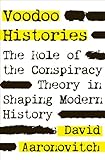
David Aaronovitch, "Voodoo Histories: The Role of the Conspiracy Theory in Shaping Modern History" (2009)


Christopher Hart nicely summarizes the message of the book in the 3 May 2009, (London, U.K.) Sunday Times.

"Voodoo Histories is... much more than a prolonged sneer at human folly, ignoble fun though that always is. It is also a serious inquiry into why conspiracy theories appeal, and Aaronovitch’s theories are consistently reasonable, persuasive and humane. The complexity of our society is clearly a factor, and the frigid non-humanity of so many of our transactions. Real connections are few and far between, so some people start to invent their own."

The text explores a number of popular 20th-century conspiracy theories, as well as some that are more obscure (or at least obscure outside of the UK). No surprises that significant chapters or portions of chapters are devoted to: the Protocols of the Elders of Zion, Pearl Harbour, the Kennedy assassinations, the death of Marilyn Monroe, speculations around the book Holy Blood, Holy Grail, and 9/11. I was a bit surprised to discover that there was not a chapter dealing with speculations surrounding the first moon landing (or all of them?) being faked.

I would have preferred that Aaronovitch spent a bit more time trying to understand in some more objective sense the reasons for conspiracy theory creation, and the popularity of the practice in 20th-century societies. He does tackle this, but usually as a bit of an aside alongside his explorations of particular conspiracy speculations. My desire for such a chapter, however, may stem more from wanting this book to read like an academic text, rather than a book for a popular audience.


Aaronovitch closes the book with a few key claims regarding conspiracy theories:
1) "[c]onspiracy theories originate and are largely circulated among the educated and middle class" (338)

2) "overarching theories are formulated by the politically defeated and taken up by the socially defeated, deriving 'from the concrete experience of modernity by losers who will not go softly into the night but instead rage against it.' ...If it can be proved that there has been a conspiracy... then their defeat is not the product of their own inherent weakness or unpopularity, let alone their mistakes; it is due to the almost demonic ruthlessness of their enemy." (340)

3) "the possibility that conspiracy theories are history as written by the losers confers a kind of underdog's truth upon them." (342)

4) Conspiracist fantasies are "much more problematic when the theorist is someone who is seen as being repulsive or dangerous and/or whose targets are people like yourself." (346)

5) "That conspiracism is, at bottom, a symptom of paranoia subsequently became an anti-conspiracist cliche, and it's easy to see why. In modern society, paranoia seems omnipresent. (351) ... this impulse to grasp half-baked and damaging but attractive notions of why the world is as it is could be replaced through emotional literacy." (352)

6) Humans are intolerant of ignoring important causes. We invent stories to explain important events, even when they cannot be tested against - or test poorly against - reality. (354)

Thursday, 16 June 2011

Midland & Penetanguishene, 15 June 2011


Looking northeast out into the bay, Mundy's Harbour, Midland.


Looking across the water in Midland, from the east side of Mundy's Harbour. Almost the same position as above.


The marina at the main dock in Penetanguishene.


Looking towards the King's Wharf Theatre and Discovery Harbour, Penetanguishene.


Sunset at the north end of Penetanguishene, with Magazine Island at the bottom right horizon. From the same position as above.

Wednesday, 8 June 2011

Cooking with goat's milk and goat's cheese

My big brother very generously supplied me with a cache of goat's milk and goat's cheese (he works at Mornington Heritage Dairy - see more info below). I thought I would post my observations and comments here.

Firstly, in the past I have had problems with cow's milk. I'm not lactose-intolerant, but have experienced some GI tract discomfort, and so had switched to soy products. I have experienced no problems with goat's milk, and was even surprised to discover that it had no unusual tastes. I thought it might have a bit of a "gamey", "musky" taste like lamb meat. None. I must admit to having the great pleasure of returning to late night visits to the fridge to chug cold milk out of the carton.

Secondly, the cheese has a delicious bite that is not overpowering, or in any way "gamey" (as some people claim they find goat's cheese), but far more enjoyable than the rather bland standard cheddars most people tend to buy. My wife LOVES the cheese in salads, and we both have fallen prey to keeping an eye on how much cheese is left and measuring each other's consumption so that it is fairly shared. ;)

Thirdly, having a new cheese to experiment with has led me to try some new recipes, all of which worked well with a slightly stronger flavoured cheese. I have included below pictures of two. The first is scalloped potatos, carrots, and onions, with goat's milk and goat's cheese. The second is layered, baked polenta and goat's cheese, with a tomato relish topping. Both were delish.

Finally, for those of you who appreciate food that's grown with a traditional approach to human and animal health, and that contributes to maintaining the viability of locally-rooted, family-owned farming in rural Ontario, and businesses that operate on democratic principles, the products of Mornington Heritage Dairy (operated as part of the Ontario Dairy Goat Cooperative) are ideal.

- Feb. 2011: "Dairy Goat Co-op Take Over Mornington," Better Farming

Others apparently feel the way I do. In Westboro, Ontario, "The Piggy Market" offers the following comments regarding Mornington's goat butter: "While searching for Ontario cheese producers, we came across Mornington goat dairy, and found butter! Goat butter is, if you can believe it, even more creamy and decadent than regular butter."


Scalloped potatos, carrots, and onions with goat's milk and goat's cheese


Baked polenta layered with goat's cheese