The full title of this influential but controversial book is Eichmann in Jerusalem: A Report on the Banality of Evil. It had sat for many years on my 'to read' list. In short, it is a record of the 1960 trial and hanging of Adolf Eichmann, a fairly high-ranking bureaucrat within the political apparatus created in Nazi Germany to manage, and subsequently dispose of, Jews, Gypsies, and other 'undesireables'.
I must admit that for much of the book I could recognize why it was regarded as such an important philosophical and historical reference point. As an early, well-informed and thoughtful assessment of an upper-middle bureaucrat's responsibility within the Nazi extermination apparatus, it is certainly interesting. Of course, in the intervening fifty years or so since the work was published, there have been voluminous materials produced, drawing on more archival materials and interviews, and that give a much more detailed and comprehensive understanding of the historical and political dimensions of the Nazi Germany's racial and politically-motivated concentration, expulsion, and extermination policies.
Where Arendt's text remains particularly impressive and thought-provoking (if only, perhaps, for this author), is in the final chapter discussing the rendering of the court's decision regarding Eichmann's fate, his appeal, and the carrying out of his death sentence. Even more impressive is the 'Epilogue', which considers the legal precedents and ramifications for Israel's kidnapping of Eichmann from Argentina, and Arendt's summary and assessment of the legal arguments of the prosecution and defence. Once again, although many other texts have now been written about both aspects of this case, as an early, concise, and influential document, casual readers who have a good knowledge of Holocaust history could skip forward to these two chapters to gain a good sense of what Arendt was attempting to do.
As I read these final two chapters, I couldn't help but consider the United States' assassination of Osama bin Laden within the context of Arendt's discussion of the criminality of organized mass slaughter and the illegal kidnapping of someone to force them to face trial for their involvement of this crime.
Essentially (spoiler alert!), Arendt's argument might be summed up as resting on two pillars. Firstly, she suggests that Israel should have either had Eichman tried by an international court, or after trying him in their own court, turned him over for carrying out of the sentence to an international body. Secondly, she suggests that what is essential to keep in mind - and that Eichmann's case provides an ideal example of - is that in the case of crimes against humanity we are far more likely to have to deal with 'banal evil'; rather ordinary people who do terrible things based on some flawed but functional rationalizations, than truly sick, cognizant, anti-social and "evil" people. In the case of Germany, the execution apparatus was populated by many, many people, sometimes even including those who were targeted by that machinery. Many of these people 'went along' with the criminal activities simply because the flow of history and morality seemed to be moving in that direction, and so they acquiesced, or believed what they were told was right. As the court commented regarding Eichmann, it was quite likely that in different circumstances he might not have ever been motivated to do what he had done.
In this regard, as Arendt decries Israel's kidnapping of Eichmann from Argentina, as well as their decision to single-handedly try and kill Eichmann, I find myself comparing these conclusions to the treatment of Osama bin Laden by the US. Of course, there are some critical differences: bin Laden did not represent or act in the name of a state, and bin Laden's acts were not therefore not the carrying out of a state's policies. Nonetheless, why the United States did not seek Pakistan's permission to seize bin Laden, and why they unilaterally decided to assassinate someone within another country's sovereign territory without respecting that country's sovereignty over their own space, and without the individual in question having recourse to trial, remains a deeply problematic and vexing aspect of this case. In the case of bin Laden it seems to me, in some respects similar to the case of Eichmann, the country's acting in the name of justice and vengeance (two very different to reconcile motivations) undermined the very foundation of the beliefs that they seemed to be so offended someone else did not respect.
Reflections by Dr. Gregory Klages on non-fiction books dealing primarily with politics, history, and religion. Significant attention to Canadian content. Mail me/comment if you read anything. I love to hear feedback!
Saturday, 21 April 2012
Saturday, 7 April 2012
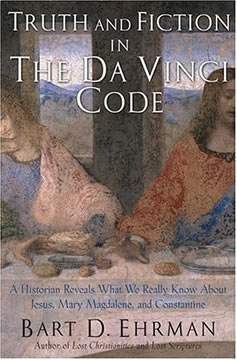
Bart Ehrman, "Truth and Fiction in the Da Vinci Code" (2004)
The subtitle of this book is: "a historian reveals what we really know about Jesus, Mary Magdalene, and Constantine."
I've reviewed two other Ehrman books on this blog: Forged (2011) and Jesus Interrupted (2009), and read yet more before this blog was started (such as Lost Christianities (2003), Misquoting Jesus (2005), and his commentaries on the Gospel of Judas [2006]).
Truth and Fiction... is, as the title communicates, is an attempt to clarify and challenge claims about Jesus and early Christianity offered in Dan Brown's popular fiction book The Da Vinci Code. Brown's prefatory statement that much of what he discusses in his book is factual deserves challenge by a historian. Ehrman is the historian to do it. His books are readable, straight-forward, sensible, and rarely make radical claims that haven't been already made in peer-review academic literature. With the benefit of the books Ehrman has written since Truth and Fiction... , this one doesn't really offer any new material.
For those who have not read anything by Ehrman, or who would like an introduction to critical Biblical history, this is a short, easy-to-read option. I would more highly recommend some of the Ehrman's other books, such as Misquoting Jesus or Lost Christianities, however.
I've reviewed two other Ehrman books on this blog: Forged (2011) and Jesus Interrupted (2009), and read yet more before this blog was started (such as Lost Christianities (2003), Misquoting Jesus (2005), and his commentaries on the Gospel of Judas [2006]).
Truth and Fiction... is, as the title communicates, is an attempt to clarify and challenge claims about Jesus and early Christianity offered in Dan Brown's popular fiction book The Da Vinci Code. Brown's prefatory statement that much of what he discusses in his book is factual deserves challenge by a historian. Ehrman is the historian to do it. His books are readable, straight-forward, sensible, and rarely make radical claims that haven't been already made in peer-review academic literature. With the benefit of the books Ehrman has written since Truth and Fiction... , this one doesn't really offer any new material.
For those who have not read anything by Ehrman, or who would like an introduction to critical Biblical history, this is a short, easy-to-read option. I would more highly recommend some of the Ehrman's other books, such as Misquoting Jesus or Lost Christianities, however.
Wednesday, 28 March 2012
Christopher Hibbert, "Benito Mussolini" (1962, rev. 1972)
The sub-title for this classic is "The Rise and Fall of Il Duce."
Hibbert's book appears to be one of those great British cheap paperback reprints about facets of the Second World War that seem to have been produced in great scads during the 1970s.
I don't know nearly enough about Mussolini, other than that he is presented as the somewhat buffoonish Italian parallel to Hitler. Of course, he came to power before Hitler, and was really the leading Fascist politician (hence the name for the ideology that derives from an classic Roman reference) before Hitler began to pursue his search for German lebensraum.
I was somewhat surprised to learn of his early socialist ideological roots, ideas that to some degree stayed with him even to his death. Much like Hitler, however, the allure of power spoke loudly to Mussolini, leading him to increasingly radical solutions where political success to priority over other values. Upon rising to power, Mussolini's desire for grandeur and power led him into a series of ill-advised foreign military adventures: against Egypt, Albania, France, and Greece. The unequivocal disasters that these invasions were compelled Mussolini to repeatedly seek out the assistance of Nazi Germany, diminishing Mussolini's capacity to debate, question, or redirect Hitler's political visions for Europe and the Mediterranean.
Hibbert's book, particularly in its last third, looks at Mussolini from a far more personal perspective than political. This makes sense given that he fell from grace - was rescued by the Nazis and returned to power as the head of the puppet Salo Italian government - and then captured again, and killed with his mistress.
Labels:
biography,
book reviews,
European history,
fascism,
World War I,
World War II
Lauren Kirshner, "Where We Have To Go" (2011)
Kirshner's book is one of the rare forays I've made into fiction in the last year. I must admit, at the outset, that I know Lauren, I know her partner, I've hung out in her apartment and played with her cats. So... I won't offer much of a critical assessment, in large part because I feel ill-equipped to comment on the quality of fiction writing outside of my own gut response to it.
Essentially, the book tells the story of a teenage girl, Lucy Bloom, who lives in Toronto with her fractious parents (for at least part of the story). I couldn't help but wonder, given the 'girl coming of age-type narrative, whether the protagonist's name was a nod to Judy Blume, author of 'preteen girl-books' such as Are You There God, It's Me, Margaret. I've never read Blume's books, so I could be far off the mark here.
As someone who grew up male, in a rural environment, it's intriguing to think about how the city where I live now might be seen by a teenage girl living twenty-five years ago. By that time I was coming here as a wide-eyed teenager, thrilled at the glass and steel, second-hand record stores, and roti shops.
The most troubling aspect of the book was the handling of time. The narrative seemed to move in fits and starts, leaping over periods with little warning, then dwelling for what seemed inordinate periods on stories that did not seem to be resolved. Perhaps this is part of the post-modern turn in fiction that I'm simply missing. As an infrequent fiction reader, I found it distracting.
The German edition cover is way cool.
Essentially, the book tells the story of a teenage girl, Lucy Bloom, who lives in Toronto with her fractious parents (for at least part of the story). I couldn't help but wonder, given the 'girl coming of age-type narrative, whether the protagonist's name was a nod to Judy Blume, author of 'preteen girl-books' such as Are You There God, It's Me, Margaret. I've never read Blume's books, so I could be far off the mark here.
As someone who grew up male, in a rural environment, it's intriguing to think about how the city where I live now might be seen by a teenage girl living twenty-five years ago. By that time I was coming here as a wide-eyed teenager, thrilled at the glass and steel, second-hand record stores, and roti shops.
The most troubling aspect of the book was the handling of time. The narrative seemed to move in fits and starts, leaping over periods with little warning, then dwelling for what seemed inordinate periods on stories that did not seem to be resolved. Perhaps this is part of the post-modern turn in fiction that I'm simply missing. As an infrequent fiction reader, I found it distracting.
The German edition cover is way cool.
Saturday, 17 March 2012
Philip Roth, "Our Gang" (1971)
Roth has written very, very thinly veiled political satire. His novel focuses on US President Tricky Dixon, who has been preceded by Lyin' B. Johnson, and John F. Charisma. The first few chapters outline 'laugh-out-loud' policy discussions regarding the need for, and benefits of, extending voting rights to yet-to-be born children. An unforeseen consequence of the President's policy decision is a violent riot by Boy Scouts who have taken offence at Dixon's advocacy of sex (how else could babies be conceived?). Faced with a difficult decision, Tricky's advisors debate the best solution for the riot, and decide upon sending in the military, and shipping off the Scouts to a camp in Arizona. In the end, Tricky is assassinated, but bounces back to campaign in hell for the position of Devil.
The book started off with such promise, but forty years after the fact, with Nixon dead, and with moral and ethical errors by politicians seeming to be the norm rather than the exception, the joke got stale before it hardly began.
This 1971 review captures the book well, although it is a bit more effusive than I would have been:
http://www.nytimes.com/books/98/10/11/specials/roth-gang.html
This review will give you a fairly good plot summary, in case you don't want to read the book yourself:
http://www.smirkingchimp.com/thread/11846
The book started off with such promise, but forty years after the fact, with Nixon dead, and with moral and ethical errors by politicians seeming to be the norm rather than the exception, the joke got stale before it hardly began.
This 1971 review captures the book well, although it is a bit more effusive than I would have been:
http://www.nytimes.com/books/98/10/11/specials/roth-gang.html
This review will give you a fairly good plot summary, in case you don't want to read the book yourself:
http://www.smirkingchimp.com/thread/11846
Monday, 13 February 2012
Max and Monique Nemni, "Trudeau Transformed: The Shaping of a Statesman 1944-1965" (2011)
The second-volume of this Trudeau biography series came as a bit of a surprise to me. I read the first volume (Young Trudeau, 1919-1944: Son of Quebec, Father of Canada (2006) - sheesh, what a title!), but frankly, have forgotten it almost completely. The approach in this second volume, however, strikes me as a departure from the previous one. It is, in many respects, an intellectual history; a record of the development of Trudeau's philosophy, arrived at through close analysis of his published, and some unpublished, writing. The Nemni's make a good attempt to place the material within the context of the political events within (and beyond) Quebec, as well as showing how Trudeau's ideas fit within or contrasted with philosophic trends, once again, particularly within Quebec.
The first few chapters are rather surprising. They offer a very close analysis of Trudeau's notes and letters from the late 1940s, when he was studying at Harvard, Paris' "Sciences Po", and the London School of Economics. What might be quite boring offers intriguing insights into the evolution of Trudeau's thinking has he is exposed to a variety of challenging thinkers and texts. The Nemnis suggest that popular characterizations of Trudeau's influences during this period (such as Keynes and Schumpeter) are inaccurate. While their explanations of each thinkers' ideas is a little off-putting, it is more or less required to help tie the concepts advanced by the thinkers to Trudeau's responses to them.
The most significant weakness of the book is that in an attempt to trace the development of Trudeau's changing (or consistent) position on issues such as Quebec nationalism, justice, and democracy, the authors have opted (and in a sense are required) to jump from period to period, from event to event, from article to article, and then, to jump back and forth again to trace development of some other idea. In a following chapter, they'll return to an event discussed previously, to touch on another aspect of Trudeau's thinking, or refer back to it to clarify how it relates to some other event from the period that they didn't discuss. This form of historical hopscotch is a little frustrating.
Additionally, the authors will engage in a few unnecessary asides that seem more suitable to an undergraduate essay rather than an opus on one of our most contentious Prime Ministers. These quips are not particularly stinging, however, and rare enough that they can be forgiven.
In conclusion, this volume is a particularly useful record of the development of Trudeau's thoughts. It places many of the essays in long-available compilation volumes such as Federalism and the French Canadians (1968) in their philosophic and political context, and is an enjoyable read. While the structure is awkward, this is an admirable effort.
Labels:
biography,
book reviews,
Canadian history,
Canadian politics,
philosophy
Monday, 6 February 2012
Andrew Hussey, "The game of war: the life and death of Guy Debord" (2001)
I'm torn about this book. While reading it I was distracted by Hussey's interjection of personal anecdotes regarding his drinking interviews with Debord associates. These smacked of insecurity, as if Hussey was desperate to assure us that he was 'cool' enough to wander Paris' Left Bank, to share cognac with Alice Becker-Ho, and to mix comfortably and confidently with these notoriously catty theoreticians and revolutionaries.
On the other hand, his explication of Debord's theories at times was rather simplistic. For the common reader, this would be helpful, though I can't help but wonder how many 'common' readers were likely to pick such a book up?
In short, Game of War was akin to an extended Rolling Stone biography. Pithy, loaded with personal insights, and light on philosophical and political insights. I can say, however, that I had never known that Debord once opened a bar in Paris, and designed advertising for the bar before he became involved as a co-manager.
As an addendum, particularly given the title of this book I was disappointed to find that Hussey did not offer a translation (or really even a mention) of Debord's 1987 text that outlined the rules for the kriegspiel he invented (the only version of the text that I have found was the translation in Len Bracken's Guy Debord: Revolutionary, and frankly, the editing quality of that volume was so bad that I can't help but regard anything in the book as being a bit dodgy). As Hussey discusses Debord and Becker-Ho wiling away many days playing this game, and suggests the game was a metaphor in some ways for Debord's later thinking about politics and revolution, this oversight feels significant.
Labels:
art history,
biography,
book reviews,
European history,
French history,
philosophy
Subscribe to:
Posts (Atom)