Saturday, 19 April 2014

Jeff Greenfield, "Then Everything Changed" (2010)

Sub-titled: "Stunning Alternate Histories of American Politics: JFK, RFK, Carter, Ford, Reagan."

What distinguishes this book from many allohistorical texts - particularly those considered with political popular culture (that is a term I can apply to the Kennedy assassinations, no?) - is that the author is genuinely a political insider. He had familiarity with many of the people he writes about, including the Kennedys. He also brings years of experience as a political analyst and commentator. This knowledge has led him to write a book that is more daunting than the average 'science fiction'/casual reader might desire. It is, however, the key to Greenfield's approach.

Much of what Greenfield considers in weighing historical alternatives is based on tweaking a single event, and then looking at the weight of likely political response, particularly in how the negotiation of alliances, strategizing, and campaigning would play itself out in the new circumstances provided by the author's re-imagining. So, for instance, RFK's near-assassination is obviously important, but where the true 'grit' of Greenfield's imagination gains its importance is how he conceives of RFK's electoral chances given the likely messaging his team would have pursued, who the Republicans might have selected as their candidate in response to the changed circumstances, and how their competing messages might have played out in the various electoral colleges. Frankly, fascinating, daunting, exhausting reading that offers much for historians and political junkies alike.

I admit to knowing nothing about Greenfield before I read this book. I picked it up based on an interest in political allohistory.

Monday, 7 April 2014

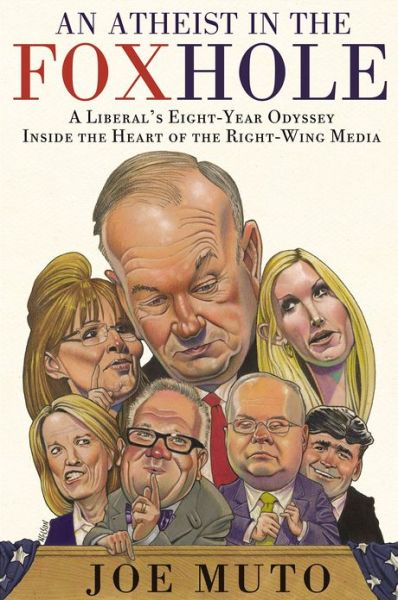
Joe Muto, "An Atheist in the Foxhole" (2013)

Muto seems to have started off as a pretty run-of-the-mill American mid-west liberal arts university undergraduate without much focus or desire. Not long after graduating, he ends up, as much by luck as by planning, working in New York City for the Fox media empire. Muto makes much of the fact that Fox is viewed as part of the 'enemy' by American Democrats and liberals genuinely. It's frequent and well-known commentators include figures such as Bill O'Reilly, Sean Hannity, Greta Van Susteren, Geraldo Rivera, and Ann Coulter. While not particularly politically-minded, Muto is aware that Fox's positioning may indicate that his politics will clash with his new employer's. After years of employment, during which he bears what he characterizes as petty, although seemingly mostly harmless demands from the likes of O'Reilly, Muto finally opts to leak his 'insider' knowledge to a political blog. He is quickly found out and dismissed.

In short, the greatest value of this book is its intriguing insight into how a contemporary television news-type corporation works, from the perspective of the coffee-fetchers and wrench-turners. For this, Muto has provided an eminently worthy book for university students hoping to break into big media work.


Wednesday, 2 April 2014

Charlie Duff, "Detroit: An American Autopsy" (2013)

A beautiful book. Duff spares no one in his commentary from inside the belly of the corpse that is contemporary Detroit. From the trials faced by emergency responders, police, newspaper folk, regular citizens, the under- and unemployed, the homeless, city politicians, business owners, criminals... they all play a role in the decrepit stage Duff narrates his story upon.

His story is not merciless; he clearly loves the city he grew up in, and returned to. He has family there, who much like the city itself, struggle with decay, loss of dignity, and poor coping mechanisms. They figure in his story as well.

Elegiac in tone, unsparing in its assessment, frightening in its observations, Duff has indeed offered an autopsy for a patient who has died. The city he describes is a new thing, a shell of the destroyed American dream.

Francis Spufford, "Red Plenty" (2012)

You can read an extract from the book here.

Spufford has created a fairly fun website to support his book.

Tuesday, 18 March 2014

Deborah Lipstadt, "The Eichmann Trial" (2011)

In progress.

The New Republic offers an excellent assessment of the book.

You can also watch/listen to Lipstadt discuss the book, in a half-hour talk at University of South Florida, delivered in February 2012.

Additionally, see my discussion of Lipstadt's Denying the Holocaust: The Growing Assault on Truth and Memory (1993).

Monday, 17 March 2014

Nathan Tidridge, "Canada's Constitutional Monarchy" (2011)

An entertaining, informative, clearly-written assessment of Canada's relationship with the Monarchy.
Admirably thinking beyond the role the British Monarchy has played in Canada, Tidridge (a secondary school teacher no less) offers insights on the role played by French royal and vice-royal figures, as well as British. He indicates an encyclopedic knowledge of cultural and legal aspects of the Monarch, including Royal Tours, issues of protocol and patronage, as well as constitutional regulations. Generally, the book is better as a reference than as a cover-to-cover read, although for those seeking to better grasp the wide and important effects that the Monarchy has in Canada can certainly benefit from the entirety of this short book.

A sample chapter is available online from the publisher, Dundurn Books.

Wednesday, 12 March 2014

Stephen McGinty, "Camp Z: The Secret Life of Rudolf Hess" (2011)

McGinty's record of Hess' time imprisoned in the United Kingdom, primarily at Mychett House outside London, records a sometimes tragic, sometimes farcical dance between a mysterious Nazi leader and his British guards, doctors, and interrogators.

More to come...


The Daily Mail provided a pretty solid summary, without much critical commentary.